

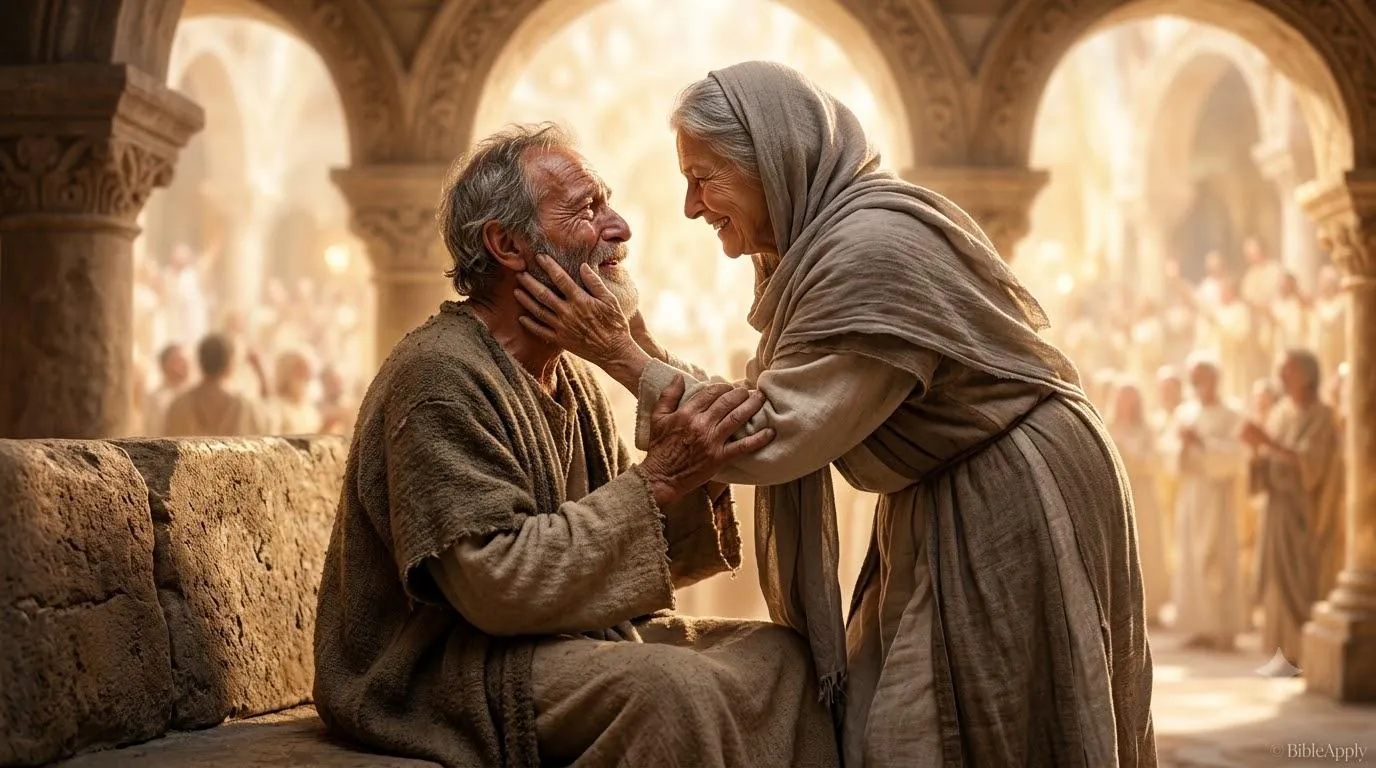
Quick Answer: Yes. The Bible heavily implies that our personal identities, memories, and relationships carry over into eternity and are glorified, not erased.
Few questions touch the deepest parts of the human soul like this one. When we stand beside the grave of a spouse of fifty years, or endure the agony of losing a child, the promise of eternal life can feel abstract. We don’t just want a golden city. We ache for a familiar embrace.
We long to look into the eyes of those we love and know those bonds haven’t been severed by death. Culturally, humanity has always wrestled with the afterlife. Eastern philosophies often lean toward a loss of individual identity, likening the soul to a drop of water returning to a cosmic ocean. Secular materialism offers the grim finality of the grave.
But the Christian hope is radically different, profoundly personal, and fiercely bodily. It does not promise the annihilation of the self. Believers ask if they will recognize loved ones because they want to know if heaven is a place of relational continuity.
The resounding answer of Scripture is yes. We will absolutely know each other in heaven. Our knowledge of one another will actually be vastly superior, untainted by hidden motives, insecurities, or sin. We will finally become our truest selves.
A Pastoral Note: Grieving people always ask me: “Will I see them again?” When you’re staring at a casket, theological abstractions offer zero comfort—you just want the person you love. The beautiful truth of Scripture is that eternity doesn’t erase our identities or scrub away our deeply forged relationships. God honors those bonds and glorifies them. Our future reunions will be more real and vibrant than anything we’ve experienced here on earth.
The Biblical Foundation for Heavenly Recognition
The Bible doesn’t provide a single proof text that explicitly says, “You will recognize your family members in heaven.” Instead, it provides a pervasive, undeniable pattern of relational continuity. This weaves through the pages of both the Old and New Testaments.
“Gathered to His People”
In the Old Testament, a recurring phrase is used to describe the death of the patriarchs. When Abraham died, the text says he “breathed his last and died in a good old age… and was gathered to his people” (Genesis 25:8). This exact phrasing is used for Isaac, Jacob, Aaron, and Moses.
This gathering isn’t just about burial in a family tomb. The Hebrew verb used here means to gather, assemble, or bring together. Abraham was buried in Canaan, while his ancestors were buried hundreds of miles away. Moses was buried by God in an unmarked grave in Moab, yet he too was “gathered to his people.” This ancient phrase points to a conscious reunion in the afterlife.
Perhaps the most poignant example is King David’s response to the death of his infant son. While the child was sick, David fasted and wept. But when the child died, David washed himself, worshiped, and ate.
When his bewildered servants asked why, David uttered a statement of deep hope: “But now he is dead. Why should I fast? Can I bring him back again? I shall go to him, but he will not return to me” (2 Samuel 12:23, ESV). David’s comfort was rooted in the expectation of reunion. He believed he would see and know his child again.
Jesus’ Teachings and Interactions
The New Testament brings the afterlife into brilliant focus. The teachings of Jesus are saturated with the promise of relational recognition.
Consider the Mount of Transfiguration (Matthew 17:1-8). When Jesus was glorified before Peter, James, and John, Moses and Elijah appeared. Moses had been dead for roughly 1,400 years, and Elijah had been caught up to heaven 900 years prior. Yet, they retained their distinct, recognizable identities.
Peter didn’t see two generic glowing spirits; he saw Moses and Elijah. Even without formal introductions, the disciples recognized them. If saints retain their distinct identities across millennia, we will certainly recognize those we knew intimately on earth.
Jesus also used the imagery of a great banquet to describe the kingdom of heaven: “I tell you, many will come from east and west and recline at table with Abraham, Isaac, and Jacob in the kingdom of heaven” (Matthew 8:11, ESV).
A banquet implies rich conversation, recognition, and joy. Jesus states we will recognize Abraham, Isaac, and Jacob. If we can recognize ancient patriarchs we’ve never met, we will recognize the friends and family we’ve known our whole lives.
In the parable of the Rich Man and Lazarus (Luke 16:19-31), identity is perfectly preserved. The rich man recognizes both Abraham and Lazarus. Memory is intact, as the rich man remembers his five brothers on earth. Identity, memory, and recognition successfully cross the threshold of death.
Comfort for the Grieving
When the young church in Thessalonica was gripped with grief over believers who had died, the Apostle Paul wrote to comfort them. His words are rendered meaningless if we won’t know each other in heaven.
“But we do not want you to be uninformed, brothers, about those who are asleep, that you may not grieve as others do who have no hope. For since we believe that Jesus died and rose again, even so, through Jesus, God will bring with him those who have fallen asleep” (1 Thessalonians 4:13-14, ESV).
Paul uses a word for “asleep” that serves as a Christian metaphor for physical death, implying that waking up is guaranteed. His comfort to the grieving is precisely the promise of reunion. If our loved ones lost their identities, Paul’s words would offer hollow consolation. Our hope is a bodily resurrection and a joyous reunion.
Paul also writes to the Thessalonians about his own joy at the Second Coming: “For what is our hope or joy or crown of boasting before our Lord Jesus at his coming? Is it not you? For you are our glory and joy” (1 Thessalonians 2:19-20, ESV). Paul fully expects to look at the Thessalonian believers in heaven and rejoice over them.
Resurrection Bodies
We do not spend eternity as floating, ethereal ghosts. Believers are given resurrected, glorified physical bodies.
Continuity of Identity
When Jesus rose from the dead, He possessed a glorified body. It was adapted for eternity, yet it was undeniably Him. He told His terrified disciples, “See my hands and my feet, that it is I myself” (Luke 24:39, ESV).
His disciples recognized Him by His physical appearance and His unique mannerisms. They knew Him by the way He broke bread and the way He spoke Mary’s name.
Paul tells us in Philippians 3:21 that Jesus “will transform our lowly body to be like his glorious body.” If Christ’s resurrection body retained its distinct identity and physical markers, our resurrection bodies will similarly possess a continuity of identity. You will be uniquely you. The old self is raised, healed, and glorified.
Perfected, Not Erased
In 1 Corinthians 13:12, Paul writes: “For now we see in a mirror dimly, but then face to face. Now I know in part; then I shall know fully, even as I have been fully known.”
The Greek word Paul uses for “know fully” means precise, complete, and absolute knowledge. In heaven, our capacity for relationship will not be diminished. It will be exponentially expanded to perfection.
On earth, relationships are hindered by limited understanding, selfishness, and our inability to truly see one another’s hearts. In heaven, the veil is lifted. We will know each other better and more deeply than we ever did on earth. Your personality will not be erased; it will be cleansed of sin and brought to its highest potential.

Common Objections and Misconceptions
Despite the biblical evidence, several sincere questions often arise regarding heavenly relationships.
“Won’t we just be focused on God?”
This objection suggests a false dichotomy between loving God and loving others. On earth, Jesus taught that the two greatest commandments are inextricably linked. First John 4:20 bluntly states that you cannot love God if you do not love your brother.
In heaven, our love for God will be perfected, which means our love for one another will also be perfected. We won’t be locked in a solitary trance staring at the throne. We will worship God together as a unified multitude (Revelation 7:9).
“What if my loved one isn’t there?”
This is perhaps the most agonizing question believers face. If we perfectly remember our earthly lives, and we realize a beloved family member is not in heaven, how can it be paradise?
The Bible is unmistakably clear that there will be no sorrow in heaven. Revelation 21:4 promises that God “will wipe away every tear from their eyes.”
How God accomplishes this comfort is a mystery, but theologians generally point to two realities. First, our perspective on justice and holiness will be perfectly aligned with His. Second, the overwhelming joy of the presence of Christ will satisfy every longing of our hearts. God will heal the wounds of earthly grief entirely.
“Will I still be married in heaven?”
When the Sadducees tried to trap Jesus with a hypothetical scenario about a widow, Jesus replied: “For in the resurrection they neither marry nor are given in marriage, but are like angels in heaven” (Matthew 22:30, ESV).
This verse can cause anxiety for married couples. Jesus is not saying we will lose our deep love for our spouses. Rather, He is teaching that the institution of earthly marriage will have fulfilled its divine purpose.
In heaven, the shadow gives way to reality. The exclusivity of marriage is replaced by a profound, perfect love for all believers. You will still have a deep, continuous relationship with the person you were married to on earth. That relationship will be elevated, untainted by sin, and integrated into the perfect fellowship of the family of God.
Practical Applications
Understanding that we will know each other in heaven has immediate implications for how we live today.
-
Grieve with anchored hope. When death separates you from a fellow believer, your grief is real and necessary. But as a Christian, your grief is not final. You are saying “see you later,” not “goodbye forever.” Let the promise of a joyous reunion anchor your soul.
-
Invest in eternal relationships. If relationships are one of the few things we take with us into eternity, they should be our highest priority now. Forgive quickly and love deeply. Invest your time into sharing the gospel and building friendships that will literally last forever.
-
Endure present suffering with an eternal perspective. Earthly life is brief and broken. But the doctrine of heavenly recognition reminds us that this life is just the prologue. Let the certainty of a perfectly restored community in the presence of Christ sustain you through difficult seasons.