

Quick Answer: Explore 1 Corinthians 15 and the promise of resurrected bodies. Discover what the Bible teaches about our eternal physical form in the new creation.
When facing the fragility of human existence or the reality of aging, we instinctively ask what comes next. For generations, popular culture has offered a weak vision of the afterlife. We’re handed images of disembodied spirits floating on clouds in a formless existence. This cultural osmosis leaves many Christians with a quiet dread about eternity.
If we are merely floating consciousnesses in a white abyss, stripped of our physical senses, is Heaven something to look forward to? Taste, touch, sight, and sound make human life vibrant.
Our bodies are inextricably linked to our identities. The thought of losing our physical form forever feels not like salvation, but like an amputation of our very humanity. For someone who has spent a lifetime mastering a physical craft, an eternity devoid of physical reality seems like a tragic loss.
For those who suffer chronic pain, physical disability, or bodily trauma, the promise of the afterlife must address their suffering. If salvation does not include the physical body, God’s victory over the Fall remains incomplete.
The biblical witness gives a definitive yes. We will have physical bodies in Heaven—or more precisely, on the New Earth. God’s redemptive plan is not the evacuation of the soul from the physical world. It is the restoration and resurrection of the physical body.
To grasp this, we have to look past ancient philosophical errors and examine the resurrection of Jesus Christ as our prototype.
A Pastoral Note: I recently sat with a church member whose body is failing him day by day. We didn’t talk about mansions or streets of gold, because right now, what he wants most is a body that actually works. The gospel guarantees that Jesus didn’t just come to save our souls; He came to reclaim our flesh and bone. There is a gritty, unspeakable hope in knowing that one day, those who suffer most will stand up straight, take a deep breath, and walk into the kingdom without a trace of pain.
Platonism vs. Biblical Theology
To see why people think we’ll be disembodied spirits in Heaven, we have to look at ancient Greek philosophy. Plato taught a strict divide between the spiritual and the physical. He believed the material world was flawed and corrupt, while the spiritual realm was pure and perfect. According to Platonic thought, the goal of human existence was for the immortal soul to escape the prison of the physical body.
As Christianity expanded, this dualism bled into Christian thinking. It shaped Gnostic heresies, which argued that matter was evil. They claimed Jesus couldn’t have had a real physical body, and that salvation was entirely spiritual.
The Bible completely rejects this. In Genesis 1, God creates dirt, water, animals, and human bodies, calling them “very good.” God is not anti-matter; He invented it.
The Fall corrupted both the spiritual and physical realms. God’s plan of redemption covers the restoration of both. The idea of spending eternity as floating ghosts is a Greek philosophical concept, not a biblical one. God intends to redeem His physical creation, not abandon it.
A Theology of Resurrection
If we want to know our future state, we don’t have to guess. We just need to look at Jesus Christ. The New Testament ties our future directly to His historical, bodily resurrection.
Christ’s Resurrection Body
Paul calls Jesus the “firstfruits” of those who have died:
“But in fact Christ has been raised from the dead, the firstfruits of those who have fallen asleep. For as by a man came death, by a man has come also the resurrection of the dead. For as in Adam all die, so also in Christ shall all be made alive. But each in his own order: Christ the firstfruits, then at his coming those who belong to Christ.” (1 Corinthians 15:20-23)
In ancient agriculture, the “firstfruits” were the initial portion of the harvest. They weren’t a different kind of crop; they were the exact preview of what was coming. Because Jesus is the firstfruits, His resurrection body is the blueprint for ours.
When Jesus rose from the dead, He didn’t rise as a phantom. He actively proved His physical form to His followers. In Luke’s Gospel, the disciples are terrified, thinking they are seeing a spirit. Jesus tells them:
“See my hands and my feet, that it is I myself. Touch me, and see. For a spirit does not have flesh and bones as you see that I have.” (Luke 24:39)
He then asked for something to eat and consumed a piece of broiled fish right in front of them (Luke 24:41-43). The resurrected Jesus had flesh, bones, and a digestive system. He could be touched. If Jesus possesses a physical, tangible body, we will too.
Redeeming Our Bodies and the Cosmos
Paul states that our hope is not the escape of our souls, but the resurrection of our bodies.
“And not only the creation, but we ourselves, who have the firstfruits of the Spirit, groan inwardly as we wait eagerly for adoption as sons, the redemption of our bodies.” (Romans 8:23)
The Greek phrasing means the full liberation of our physical bodies. The Bible’s vision of Heaven is not a distant, non-spatial realm, but a renewed, physical universe.
In Revelation 21:1-3, John sees “a new heaven and a new earth.” The New Jerusalem comes down from God to earth, and His dwelling place is with humanity. A physical, redeemed earth requires physical, redeemed humans to inhabit it.
What Will Our Resurrection Bodies Be Like?
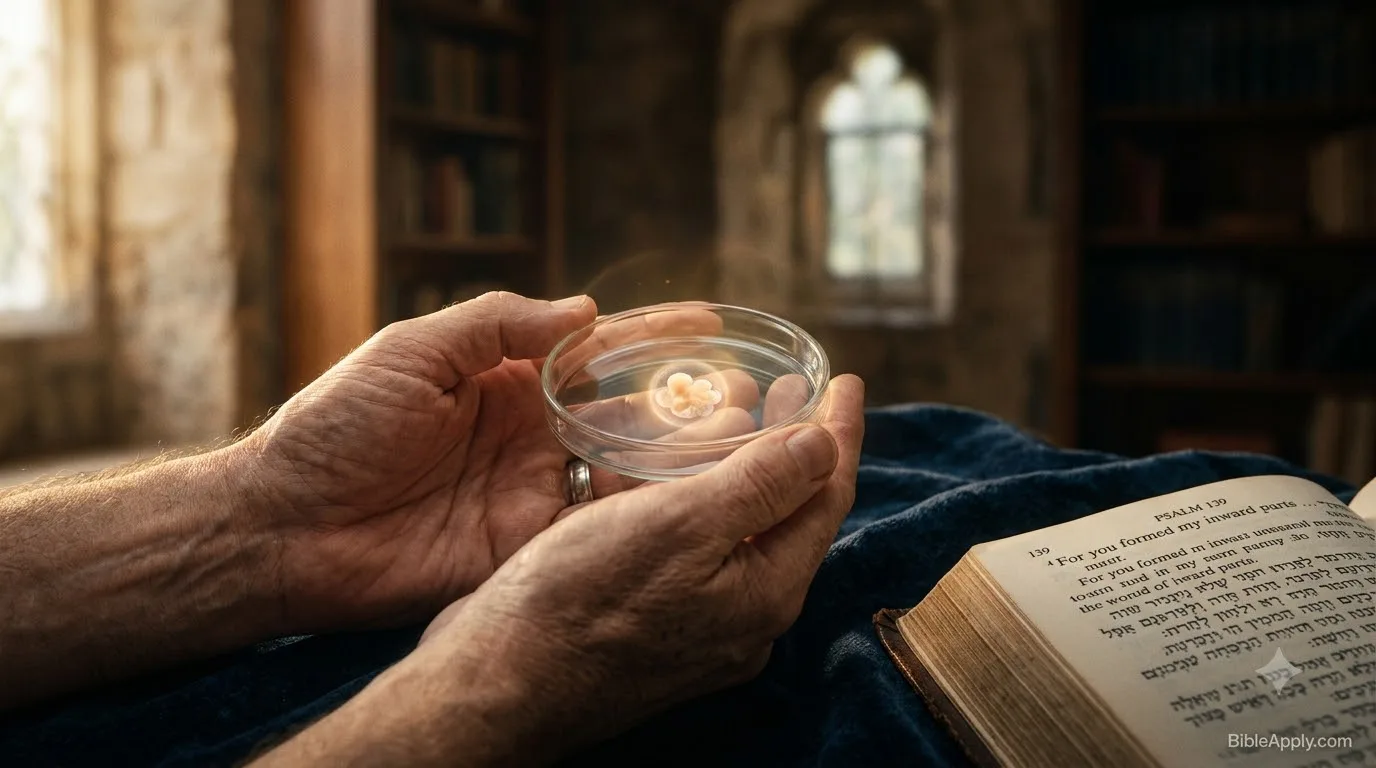
If we will have physical bodies, what exactly will they be like? Paul tackles this in 1 Corinthians 15. He compares our current mortal bodies to a seed, and our future bodies to the full-grown plant.
Physical, but Incorruptible
Paul writes:
“So is it with the resurrection of the dead. What is sown is perishable; what is raised is imperishable. It is sown in dishonor; it is raised in glory. It is sown in weakness; it is raised in power. It is sown a natural body; it is raised a spiritual body. If there is a natural body, there is also a spiritual body.” (1 Corinthians 15:42-44)
Many stumble over the phrase “spiritual body,” assuming it means a body made of spirit. But in Greek grammar, this phrasing describes what empowers the noun, not what it is made of. Paul is contrasting a “natural body”—animated by the fallen human life force—with a “spiritual body”—a physical body empowered by the Holy Spirit.
Think of a steam engine versus an electric engine. An electric engine isn’t made of electricity; it’s made of metal and powered by electricity. Our future bodies will be made of real physical matter, but powered by the Spirit of God. They will no longer be subject to sickness, decay, fatigue, or death.
Personal Identity
Will we recognize each other? Yes. The resurrection is about the restoration of you, not a generic replacement. When Jesus rose from the dead, He still bore the scars of His crucifixion. He was distinctly Jesus of Nazareth.
Throughout Scripture, personal identity carries over into the afterlife. When Moses and Elijah appeared at the Mount of Transfiguration, they were still Moses and Elijah. We will retain our memories and our unique personalities, cleansed from sin. We will know our loved ones, and our relationships will continue.
Capable of Physical Action
Since we will live on a physical New Earth, we will engage in physical activities. The prophet Isaiah describes this reality:
“They shall build houses and inhabit them; they shall plant vineyards and eat their fruit. They shall not build and another inhabit; they shall not plant and another eat; for like the days of a tree shall the days of my people be, and my chosen shall long enjoy the work of their hands.” (Isaiah 65:21-22)
We will eat, drink, work, create, and rest. The original mandate given to Adam and Eve—to cultivate the earth—will finally be fulfilled by resurrected humans on a restored earth.
Common Objections
Despite the biblical evidence, several objections frequently come up regarding physical bodies in Heaven.
“Flesh and blood cannot inherit the kingdom of God”
This objection stems from 1 Corinthians 15:50:
“I tell you this, brothers: flesh and blood cannot inherit the kingdom of God, nor does the perishable inherit the imperishable.”
If read alone, this seems to contradict physical resurrection. But “flesh and blood” was a Jewish idiom for mortal, frail humanity. It wasn’t a reference to physical matter itself.
Paul immediately clarifies: “nor does the perishable inherit the imperishable.” He isn’t saying we won’t have physical bodies. He is saying our current, corruptible physical state cannot survive in God’s eternal kingdom. Our bodies must be transformed from perishable to imperishable.
“What about the Intermediate State?”
When a believer dies today, their body goes into the grave, and their spirit goes to be with the Lord. Paul notes that to be “away from the body” is to be “at home with the Lord” (2 Corinthians 5:8). Jesus told the thief on the cross, “Today you will be with me in paradise” (Luke 23:43).
This temporary period is often called the “Intermediate Heaven.” During this time, believers live as conscious spirits in God’s presence. But this is not our final destination.
Paul states in 2 Corinthians 5:2-4 that we groan in our present bodies, not because we want to be “unclothed” as disembodied spirits, but because we want to be “further clothed” with resurrected bodies. The intermediate state is with Christ, but it remains incomplete until the bodily resurrection.
“What about cremated or destroyed bodies?”
Throughout history, Christians have been martyred, burned at the stake, or lost in the ocean. How can God resurrect a body that has decomposed into dust?
The answer lies in the omnipotence of the Creator. The God who spoke the universe into existence out of nothing does not need intact DNA to reconstruct a human being. God knows the location of every atom in the universe. He is perfectly capable of gathering the necessary material and reconstituting our physical form.
The resurrection is an act of divine re-creation. Just as a seed completely dissolves in the ground to produce a plant, the destruction of our earthly body poses no obstacle to God’s resurrecting power.
Practical Applications
The doctrine of the bodily resurrection is practical and life-altering. Here are three ways this truth impacts our daily lives:
1. Honoring the Physical Body
If God intends to resurrect our physical bodies, then the body is intrinsically valuable. This combats the modern extremes of either worshipping the body or despising it.
We shouldn’t abuse our bodies, because they are “temples of the Holy Spirit” destined for eternity (1 Corinthians 6:19-20). This truth also brings healing to those dealing with body hatred, eating disorders, or self-harm. Your body is not a cosmic mistake or a prison. It is a piece of God’s creation that He plans to redeem and perfect.
2. Hope in the Face of Suffering and Aging
For those living with chronic illness, physical disabilities, or the decay of old age, the promise of a resurrected body provides real hope.
Author Joni Eareckson Tada, who lived as a quadriplegic for over fifty years, often spoke of the joy she found in the promise of a future physical body. She knew her paralysis was temporary.
Every wheelchair, prosthetic limb, hospital bed, and hearing aid is a temporary accommodation. In the resurrection, the blind will see, the deaf will hear, and the lame will leap like deer (Isaiah 35:5-6). We look forward to the day when bodily brokenness is permanently reversed.
3. Transforming Our Vision of Eternal Life
Knowing that we will have physical bodies on a New Earth transforms our view of Heaven. Eternity will not be an endless, monotonous church service in the clouds.
We will eat feasts with believers from every era of history (Matthew 8:11). We will explore an uncorrupted universe. We will engage in meaningful work, create art, and deepen our relationships without the weight of sin or fatigue. It is the fulfillment of our God-given physical desires, lived directly in the presence of our Creator.