

Quick Answer: Discover how the biblical canon was formed, who actually decided which books were included, and why the process is reliable.
The question of how the Bible was put together strikes at the heart of our trust in Scripture. We constantly see documentaries and viral videos suggesting the Bible is a product of shadowy political maneuvering. Stories like The Da Vinci Code claim fourth-century emperors ruthlessly suppressed “alternative” gospels to consolidate power.
If you have ever felt a lingering doubt about whether the Bible is truly the word of God, you are not alone. Many wonder if it is just a curated anthology of human religious propaganda.
This skepticism is entirely understandable. The Bible is not a single book that dropped fully formed from heaven. It is a vast library of sixty-six distinct books.
These books were written over a span of roughly 1,500 years, on three different continents, in three different languages. More than forty authors contributed, coming from walks of life like kings, peasants, fishermen, and scholars. The sheer logistical complexity of such an ancient project naturally invites scrutiny. How did this diverse collection of writings coalesce into a single, unified volume?
To trace the origins of the Bible, we must look at the historical and theological processes that shaped it. We have to engage with history to see how a sovereign God not only inspired His Word but faithfully preserved it. He did this through the very messy, complicated corridors of human history.
A Pastoral Note: A college student came to my office last year, dead set on proving the Bible was a political tool. He dropped a stack of printouts about ‘lost gospels’ on my desk and challenged me to explain why they were hidden. We spent hours sifting through the gritty history of the early church. When he finally saw that the canon wasn’t forced by emperors, but recognized by communities willing to die for these texts, his hostility turned into honest curiosity.
The Concept of Canon: A Measuring Rod
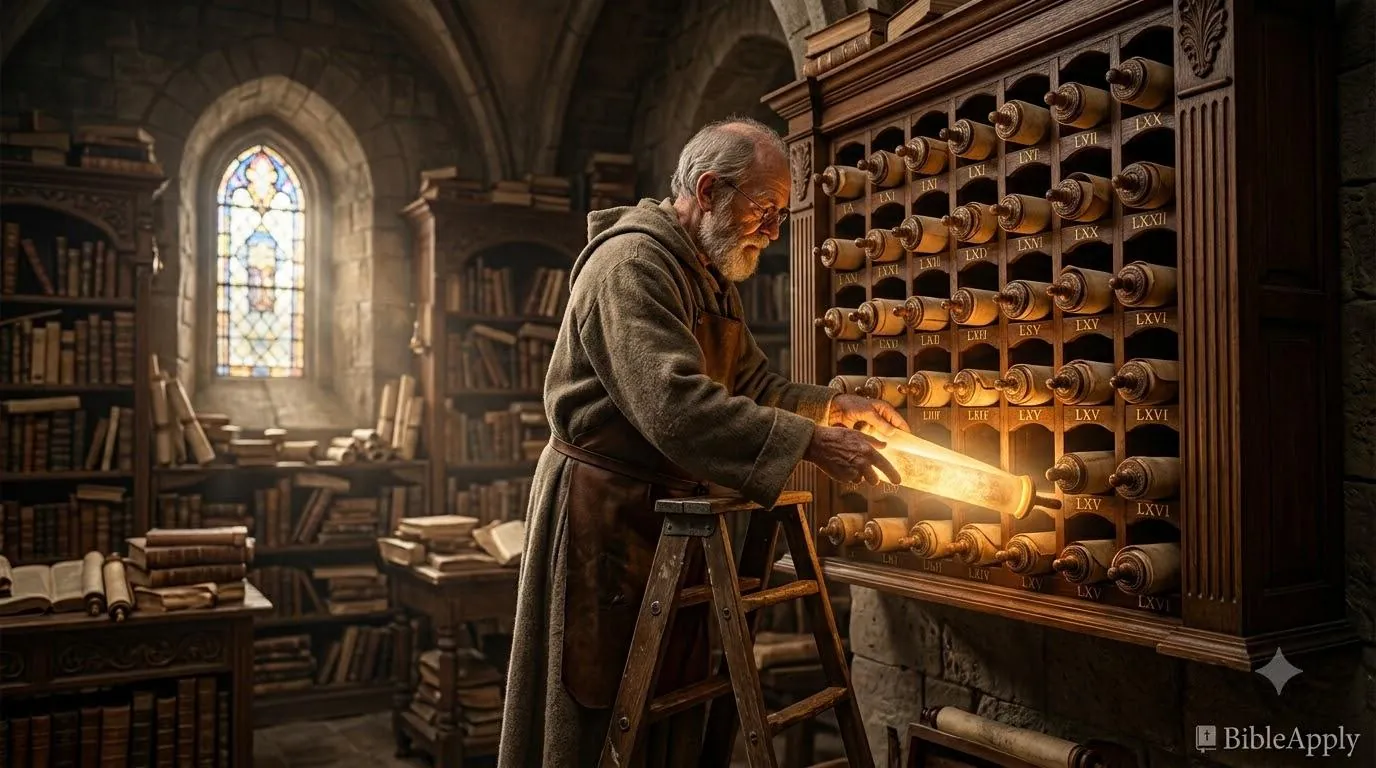
When theologians discuss how the Bible was put together, they use the word canon. The term comes from the Greek word kanōn, which originally referred to a reed used as a measuring rod. Over time, it came to mean a standard or rule. In biblical terms, the canon refers to the authoritative collection of sacred writings that form the rule of faith for God’s people.
A crucial distinction shatters the most common misconception about the Bible’s formation: The church did not create the canon; the church recognized the canon.
Theologian J.I. Packer stated that the church no more gave us the New Testament canon than Sir Isaac Newton gave us the law of gravity. God gave the law of gravity, and Newton recognized it. Similarly, a book is not the Word of God because it was accepted by councils. It was accepted because it was already the inherent, inspired Word of God.
The Formation of the Old Testament
The Old Testament contains thirty-nine books written primarily in Hebrew. For the Jewish people, this collection is known as the Tanakh. This is an acronym derived from its three traditional divisions: the Torah (Law), the Nevi’im (Prophets), and the Ketuvim (Writings).
The Gradual Gathering
Gathering the Old Testament was organically tied to the history of Israel. It began with Moses, who wrote the foundational Torah and commanded that it be placed beside the Ark of the Covenant:
“Take this Book of the Law and put it by the side of the ark of the covenant of the LORD your God, that it may be there for a witness against you.” (Deuteronomy 31:26)
As God raised up prophets, their writings were recognized as having divine authority and added to the sacred collection. The prophets operated with recognizable divine authority, often validated by fulfilled prophecies. Their writings were immediately accepted as Scripture by the faithful.
By the time of Ezra and Nehemiah around 400 BC, Jewish tradition holds that the Old Testament canon was practically closed. The prophetic voice ceased, and a period known as the “400 silent years” began as the people awaited the Messiah.
The Validation of Jesus
The strongest validation of the Old Testament comes from Jesus Christ Himself. In the first century, the thirty-nine books we have today were universally accepted by the Jewish community. Jesus frequently quoted from them as His final authority.
After His resurrection, Jesus appeared to His disciples and validated the traditional divisions of the Hebrew Bible:
“Then he said to them, ‘These are my words that I spoke to you while I was still with you, that everything written about me in the Law of Moses and the Prophets and the Psalms must be fulfilled.’” (Luke 24:44)
Jesus and the apostles never debated the Jewish leadership over which books belonged in the Bible. The Old Testament canon was already a settled fact.
The Formation of the New Testament: Apostolic Authority
The New Testament was written in Koine Greek during the first century AD. Forming the New Testament canon was a rigorous process. It was driven by the need to protect the young church from heresy and to clarify which texts should be read in worship.
The Divine Breath
To understand why certain books were accepted, we look at the doctrine of inspiration. The Apostle Paul writes:
“All Scripture is breathed out by God and profitable for teaching, for reproof, for correction, and for training in righteousness.” (2 Timothy 3:16)
The Greek word for “breathed out by God” is theopneustos. This means the words on the page originate from God. Peter explains the mechanism of dual authorship:
“For no prophecy was ever produced by the will of man, but men spoke from God as they were carried along by the Holy Spirit.” (2 Peter 1:21)
The human authors used their own vocabularies and historical contexts. Yet, the Holy Spirit directed them so precisely that their writing was exactly what God intended.
The Three Tests of Canonicity
When the early church examined writings, they applied three criteria:
- Apostolicity (The Test of Origin): Was the book written by an apostle or someone closely associated with one? Matthew and John were apostles. Mark wrote under the authority of Peter, and Luke traveled with Paul.
- Orthodoxy (The Test of Content): Did the book’s teachings align with the rule of faith? The theology had to match the recognized Old Testament and the teachings of Jesus. Documents with theological contradictions were rejected.
- Catholicity (The Test of Universal Acceptance): Was the book widely circulated and accepted by the majority of early churches? A genuine apostolic letter would naturally be treasured, copied, and shared widely.
The Historical Timeline
The books of the New Testament were written between AD 45 and AD 95. They quickly circulated as authoritative Scripture. Peter even refers to Paul’s letters as “Scripture” alongside the Old Testament (2 Peter 3:15-16).
By AD 170, the Muratorian Fragment listed the vast majority of the New Testament books. In AD 367, Athanasius listed exactly the twenty-seven books we use today. Shortly after, the Councils of Hippo and Carthage formally ratified this list. These councils did not invent the list; they simply recognized the consensus the church had already reached.
Addressing Common Objections
When discussing the formation of the Bible, several objections often arise.
Didn’t Constantine Choose the Books?
Many believe that the Roman Emperor Constantine gathered bishops at the Council of Nicaea in AD 325 to decide which books would go into the Bible. The story goes that they burned the texts they didn’t like to consolidate power.
This is historically false. The Council of Nicaea had nothing to do with the biblical canon. Its focus was affirming the full deity of Jesus Christ against the Arian controversy. The canon of Scripture was not on the agenda because it was already largely settled within the churches long before Constantine.
What About the Gnostic Gospels?
Were books like the Gospel of Thomas, the Gospel of Judas, or the Gospel of Mary suppressed?
These texts, often called Gnostic gospels, were neither “lost” nor arbitrarily excluded. They were rejected because they were late forgeries written long after the apostles died. Their theology was wildly heretical, teaching a dualistic worldview that contradicted the goodness of creation and the physical resurrection of Jesus.
For example, the Gospel of Thomas ends with a bizarre claim that Mary must make herself male to enter heaven. Early Christians easily recognized these texts as philosophical counterfeits trying to hijack the Christian narrative.
What About the Apocrypha?
Catholic and Eastern Orthodox Bibles include additional Old Testament books known as the Apocrypha. Why aren’t they in Protestant Bibles?
These books provide valuable historical context, but they were never considered inspired Scripture by the Jewish people. They were not part of the Hebrew Tanakh, and Jesus and the apostles never quoted them as Scripture. Early church fathers like Jerome recognized a distinction between the inspired Hebrew canon and the Apocrypha. The Protestant Reformers returned to the original Hebrew canon, maintaining that the Apocrypha did not bear the stamp of divine inspiration.
The Providence of Preservation
The story of how the Bible was put together is fundamentally a story of God’s providence. God is actively involved in His creation. The Bible’s own survival—outlasting empires and centuries of persecution—points to a living, sovereign Author. If God is powerful enough to speak the universe into existence, He is capable of preserving His written revelation.
Isaiah 40:8 declares:
“The grass withers, the flower fades, but the word of our God will stand forever.”
The Bible we hold today is not an accident of history. It survived manuscript burnings, the complexities of translation, and the intense scrutiny of Enlightenment skeptics. The sixty-six books form a perfectly integrated narrative, telling the unified story of creation, fall, redemption, and restoration.
3 Practical Applications
Understanding how the Bible was put together is not just historical trivia. Here are three practical takeaways:
1. Read with Confidence
When you open your Bible, you do not need to harbor doubts about whether you are reading the right books. You can read and study with absolute confidence that it is the very breath of God. Because it is providentially preserved, it is completely trustworthy in everything it teaches.
2. Answer Objections with Clarity
Our culture is quick to dismiss the Bible based on historical inaccuracies. By understanding the rigorous process of canonization, you can dismantle these myths. When a friend mentions the Council of Nicaea or the Gnostic gospels, you can graciously provide historical facts that point them to the reliability of Scripture.
3. Let the Word Measure Your Life
The original meaning of the word canon is a measuring rod. The tragedy of modern Christianity is not that we doubt the canon, but that we fail to submit to it. We must allow the Bible to measure our thoughts, behaviors, and relationships. We do not stand in judgment over the Word of God; it stands in judgment over us.