

Quick Answer: Uncover the historical and cultural context behind violence in the Old Testament. Learn the facts about ancient warfare, divine judgment, and biblical justice.
For many modern readers of the Bible, few obstacles are as jarring or emotionally distressing as the pervasive violence in the Old Testament. We read of devastating plagues, sweeping floods, and divine commands to utterly destroy entire cities, including women and children. In a post-Enlightenment world that highly values human rights, tolerance, and peaceful resolution, these ancient texts can feel not just archaic, but deeply offensive. It is entirely understandable why a thoughtful seeker—or even a lifelong believer—might pause in the middle of the book of Joshua and ask, “How can a loving God command or condone such bloodshed?”
This visceral reaction is not a sign of weak faith; rather, it often stems from a genuine desire to reconcile the compassionate Jesus we meet in the Gospels with the seemingly wrathful deity of the ancient Israelites. For centuries, critics have weaponized these texts to argue that religion is inherently violent, or that the Bible is merely a collection of primitive, bloodthirsty myths. Even early in church history, figures like Marcion attempted to solve this tension by cutting the Old Testament out of the Bible entirely, claiming its God was a lesser, hostile being.
Orthodox Christianity has consistently rejected such easy off-ramps. We are called to grapple with the whole counsel of Scripture, trusting that it is the inspired Word of God.
Understanding the violence in the Old Testament requires us to step out of our modern, Western paradigms and immerse ourselves in the historical context of the Ancient Near East. It demands a rigorous look at the nature of God’s justice, the horrific reality of human sin, and the overarching storyline of redemption that culminates in the cross of Christ.
A Pastoral Note: A combat veteran in my church once sat in my office, visibly shaken by the conquest narratives in Joshua. He had seen the raw ugliness of war and couldn’t stomach the idea of God ordering that kind of slaughter. We didn’t try to sanitize the blood or offer cheap apologetics. Instead, we sat with the brutal reality of human corruption and God’s severe justice. Realizing these texts aren’t a moral blueprint, but a desperate cry for a Savior, didn’t erase his questions—but it gave him room to trust a God big enough to handle them.
The Context of the Ancient Near East (ANE)
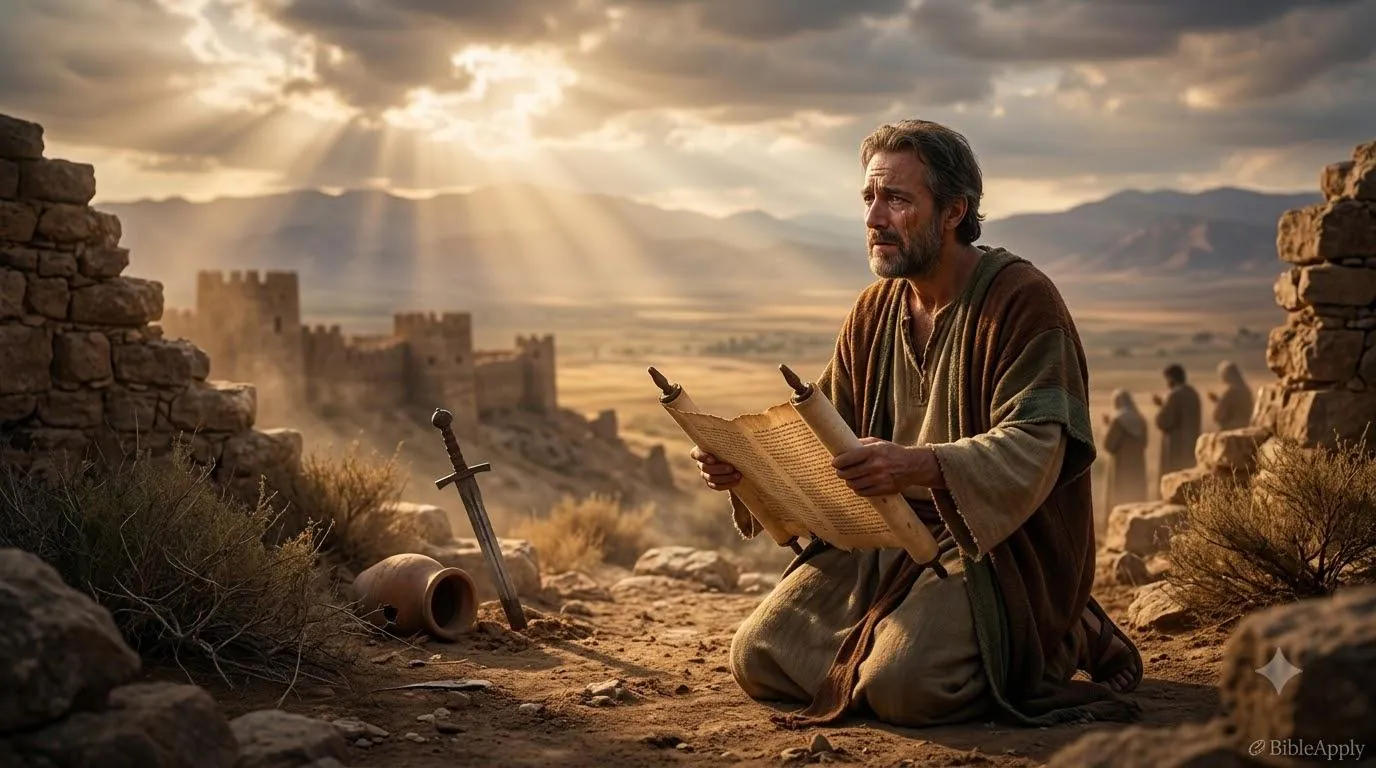
To read the Old Testament as if it were written in the twenty-first century is to invite massive misunderstanding. God accommodated His revelation to the people of the Ancient Near East, speaking to them in language, categories, and cultural frameworks they would understand.
Hyperbolic Language in Ancient Warfare
A critical piece of the puzzle lies in understanding the genre and rhetoric of ancient military accounts. When reading the conquest narratives in Joshua, we frequently encounter the Hebrew term kherem, often translated as “devoted to destruction” or “the ban.” The root of kherem means to separate or consecrate something entirely to God, completely removing it from human use. Commands are given to “save alive nothing that breathes” (Deuteronomy 20:16).
Ancient historians and archaeologists have demonstrated that such sweeping language was standard military hyperbole. Just as a modern sports fan might say, “We completely slaughtered them on the field,” ancient kings routinely boasted of totally annihilating their enemies, even when the historical reality was far more limited.
“And Joshua took Makkedah on that day and struck it, and its king, with the edge of the sword; he devoted to destruction every person in it; he left none remaining.” (Joshua 10:28, ESV)
If we read further into the biblical text itself, we find that the Canaanites were not completely wiped out. Just a few chapters after claiming the land was entirely conquered and all inhabitants destroyed, the text explicitly states that many Canaanites still lived among the Israelites (Joshua 15:63, 17:12-13).
The primary targets of these campaigns were often military outposts and strongholds (like Jericho and Ai), rather than large civilian population centers. The rhetoric of “total destruction” was the culturally understood way of claiming a decisive, definitive victory, not necessarily a literal, exhaustive genocide.
A Corrupt and Cruel Culture
We must also reckon with the moral reality of Canaanite culture. The violence commanded by God was not arbitrary, nor was it based on ethnic superiority. It was an act of divine justice against a culture that had reached unimaginable levels of depravity.
The Canaanites practiced ritual prostitution, bestiality, and most horrifyingly, systemic child sacrifice. They worshipped gods like Molech by burning their own infants alive in the fire as religious offerings. God had delayed His judgment for over four hundred years, telling Abraham in Genesis 15:16 that the Israelites could not yet take the land because “the iniquity of the Amorites is not yet complete.” God gave the Canaanite culture centuries to repent, but their corruption only deepened.
The destruction of the Canaanite religious and political systems was essentially a moral surgery. Just as a surgeon must radically remove a cancerous tumor to save the body, God used Israel to remove a deeply infectious moral cancer that threatened to corrupt both Israel and the lineage through which the Savior of the world would come.
The Weight of Divine Justice
Modern Western culture tends to emphasize God’s love at the expense of His holiness, creating a lopsided theology where God is viewed more as a cosmic therapist than a sovereign King. To understand the Old Testament, we must recover the biblical doctrine of divine justice.
God as the Righteous Judge
God, as the Creator and Sustainer of all life, possesses the sovereign right to give life and to take it away. When humans extinguish a life, it is murder, because we are usurping an authority that belongs to God alone. When God decrees the end of a life, it is a matter of perfect justice.
“Far be it from you to do such a thing, to put the righteous to death with the wicked, so that the righteous fare as the wicked! Far be that from you! Shall not the Judge of all the earth do what is just?” (Genesis 18:25, ESV)
Abraham’s rhetorical question points to a fundamental truth: God’s actions, even when they involve destruction, are always perfectly just. The violence in the Old Testament is often a manifestation of God’s settled, righteous wrath against unrepentant evil. It is a reminder that God is not indifferent to the suffering, oppression, and wickedness in the world. A God who does not judge evil is not a good God.
The Gravity of Sin
Part of our struggle with Old Testament violence is that we dramatically underestimate the gravity of sin. Because we are so deeply infected by it ourselves, we rarely see sin as the cosmic treason it truly is. In the biblical worldview, rebellion against God is lethal to the source of all life and goodness.
The harsh judgments in the Old Testament—such as the Flood, Sodom and Gomorrah, or the opening up of the earth to swallow Korah’s rebellion (Numbers 16)—serve as visceral, historical illustrations of the destructive nature of sin. They are merciful warnings to all subsequent generations that rebellion against a holy God leads to death. As the Apostle Paul writes, “For the wages of sin is death” (Romans 6:23). The Old Testament provides a graphic, tangible demonstration of this spiritual reality.

From Sinai to Golgotha: The Trajectory of Redemption
The Bible is not a flat, static book; it is a progressive revelation. God reveals Himself and His redemptive plan gradually over time, culminating in the person and work of Jesus Christ. We cannot interpret Old Testament violence without reading it through the lens of the New Testament.
A Temporary and Specific Mandate
It is crucial to recognize that the commands for holy war in the Old Testament were highly specific, restricted to a particular time, place, and people. God gave Israel a unique, unrepeatable mandate to conquer the land of Canaan as part of establishing a theocratic nation that would bear His name and eventually produce the Messiah.
This was not a general mandate for religious warfare. The Old Testament never commands Israel to conquer neighboring nations to force conversions or expand an empire. It was an intrusion of final, eschatological judgment into history.
Once the promised land was secured, this mandate ceased. This is why the Christian church, as the new covenant people of God, is explicitly forbidden from taking up the sword to advance the kingdom of God (Matthew 26:52, Ephesians 6:12).
Jesus, the Ultimate Resolution
The definitive answer to the violence in the Old Testament is found at the cross. If the Old Testament reveals the terrifying reality of God’s wrath against sin, the cross reveals the staggering depths of His love.
At Calvary, Jesus Christ, the perfectly innocent Son of God, willingly subjected Himself to the ultimate violence. He absorbed the kherem—the curse and the ban of destruction—upon Himself. He drank the cup of God’s righteous wrath down to the dregs so that we would not have to.
No moment in the Old Testament foreshadows this more powerfully than the account of God providing a ram instead of Isaac on Mount Moriah. This scene always pointed forward to the Son whom the Father would not spare, but give up for us all (Romans 8:32).
“Christ redeemed us from the curse of the law by becoming a curse for us—for it is written, ‘Cursed is everyone who is hanged on a tree.’” (Galatians 3:13, ESV)
The cross does not contradict the justice of the Old Testament; it fulfills it. It shows that God takes sin so seriously that it requires a death penalty, and He loves us so deeply that He pays that penalty Himself. The violence of the Old Testament points forward to the violent, bloody sacrifice of the Lamb of God, who takes away the sin of the world.
Engaging with Common Misconceptions
When discussing this topic, several recurring objections must be addressed to bring clarity to the biblical witness.
“The God of the Old Testament is Different from the God of the New Testament”
This ancient heresy (Marcionism) assumes the Old Testament God is a wrathful, capricious monster, while the New Testament God is a purely loving, forgiving Father. This is a severe misreading of both testaments that cherry-picks verses to fit a preconceived narrative.
The Old Testament is saturated with God’s mercy, patience, and love. He consistently commands the Israelites to care for the vulnerable: the poor, the widow, the orphan, and the immigrant. When the notoriously wicked, violent Assyrian city of Nineveh repents, God eagerly relents from destroying them, much to the prophet Jonah’s chagrin (Jonah 4:2).
In Exodus 34:6-7, God reveals His core character to Moses: “The Lord, the Lord, a God merciful and gracious, slow to anger, and abounding in steadfast love and faithfulness…”
By contrast, the New Testament contains terrifying depictions of divine judgment. Jesus speaks more about the reality of hell than any other figure in the Bible. In the book of Acts, Ananias and Sapphira are struck dead for lying to the Holy Spirit. The book of Revelation portrays Jesus returning as a warrior-king to execute devastating judgment on the wicked. God is perfectly just and perfectly loving in both testaments.
“The Text Promotes Genocide”
Modern readers often label the Canaanite conquest as “genocide” or “ethnic cleansing.” This terminology is anachronistic and inaccurate. Genocide is the systematic destruction of a people group based on their race or ethnicity. The biblical conquest was not based on race, but on religion and morality.
We see this clearly in the narrative itself. Rahab, a Canaanite prostitute, demonstrates faith in Yahweh and is not only spared but is grafted into the lineage of Jesus Christ (Joshua 6, Matthew 1:5).
Yet when Achan, a pure-blooded Israelite, disobeyed God’s command regarding the devoted things, he suffered the exact same judgment intended for the Canaanites (Joshua 7). The judgment was based entirely on allegiance and moral behavior, not ethnicity. Anyone who repented and turned to Yahweh could be saved.
3 Practical Applications
Wrestling with the difficult passages of Scripture should profoundly shape our faith and our daily lives.
1. Trust in God’s Perfect Justice
When we look at the world today, we see systemic injustice, horrific abuses of power, and unpunished evil. The violence of the Old Testament reminds us that God is a righteous Judge who will ultimately right every wrong. We can relinquish our desire for personal vengeance and trust that God will settle all accounts with perfect justice, either at the cross or on the day of final judgment.
2. Cultivate a Biblical Hatred for Sin
The severity of God’s judgment in the Old Testament should shatter our casual, comfortable attitude toward our own sin. If sin is destructive enough to warrant the flood or the conquest of Canaan, it is destructive enough to ruin our lives, our families, and our churches today. These texts call us to aggressive repentance, putting to death the sin in our own hearts by the power of the Holy Spirit.
3. Rejoice in the Cross as the End of the “Holy War”
Because Christ has absorbed the wrath of God, the era of physical holy war is over. The Christian’s battle is no longer against flesh and blood, but against spiritual forces of evil (Ephesians 6). We are called to love our enemies, pray for those who persecute us, and wield the sword of the Spirit, which is the Word of God. The Old Testament violence should drive us to our knees in profound gratitude that through Jesus, we have been saved from the wrath to come and enlisted in a kingdom of eternal peace.