

Quick Answer: Discover what the Bible actually reveals about Christ’s time in the grave. Unpack 1 Peter 3, the Apostles’ Creed, and the historical reality of the harrowing of hell.
The phrase “He descended into hell” is a familiar one to millions of Christians around the world, recited weekly as part of the Apostles’ Creed. Yet, for many believers and inquisitive seekers alike, this ancient line sparks a profound sense of confusion, unease, or outright bewilderment. When trying to understand did Jesus descend into hell, many wonder why the sinless Son of God—who definitively triumphed over death—would need to enter the realm of the damned. Does this mean He suffered in the eternal fires of Gehenna alongside unrepentant sinners? In a modern culture that often caricatures hell as a subterranean torture chamber ruled by a pitchfork-wielding devil, the idea of the Savior descending into such a place feels inherently contradictory to His victorious, dying cry on the cross: “It is finished!”
This question is not just a theological puzzle for academics; it touches the very heart of the Christian understanding of salvation, the nature of death, and the true extent of Christ’s redemptive victory. When people ask if Jesus descended into hell, they are often wrestling with much deeper existential anxieties: What exactly happens between the moment of physical death and the final, bodily resurrection? Did Jesus truly experience the absolute depths of human suffering and separation from God, or did His divine nature somehow insulate Him from the darkest realities of the human condition? For those grieving the profound loss of loved ones, or for those facing their own impending mortality, understanding where Jesus went after He died offers an anchor of profound comfort.
To uncover the truth behind this perplexing question, we must look beyond medieval, Dante-inspired imagery and later religious traditions. We must return instead to the rich, nuanced, and structurally distinct worldview of the biblical authors, which is the same thoughtful approach required when exploring why is God so violent in the Old Testament. By examining the Scriptures, understanding the ancient concepts of the afterlife, and unpacking the theological implications of Christ’s bodily death and glorious resurrection, we can discover a deeply hopeful reality—one that unambiguously proclaims Christ’s absolute lordship over every realm of existence, including the grave itself.
A Pastoral Note: A few Easters ago, a curious member of our choir asked me why we recite ‘He descended into hell’ in the Apostles’ Creed, wondering if Jesus was actively tortured by demons after the cross. It’s a confusing phrase that has caused unnecessary distress for many believers. I explained that Jesus’ cry of ‘It is finished’ meant His suffering was completely over, and His descent refers either to the realm of the dead or a proclamation of His triumph. As a pastor, I love clarifying this because it highlights that Christ’s victory on Good Friday was absolute, leaving no unfinished business for our salvation.
The Biblical Worldview: Sheol, Hades, and Gehenna
Before we can accurately determine where Jesus went between Good Friday and Easter Sunday, we must clarify what the Bible actually means by the word “hell.” In modern English, “hell” is often used broadly as a catch-all term for the place of final, eternal punishment. However, the original biblical languages (Hebrew and Greek) employ several distinct terms that were unfortunately conflated in early English translations like the King James Version. Understanding these crucial distinctions is the master key to unlocking the mystery of Christ’s descent.
Sheol: The Old Testament Realm of the Dead
In the Hebrew Old Testament, the word most frequently associated with the afterlife is Sheol (שְׁאוֹל). Sheol is not a place of fiery torment reserved exclusively for the wicked; rather, it is the general “abode of the dead” or the “grave.” It is the shadowy, silent destination for all human beings upon death, regardless of their moral standing before God, impacting everyone created in the likeness of God. Both the righteous (like the patriarchs Jacob and David) and the wicked expected to go to Sheol when they drew their final breath.
“For my soul is full of troubles, and my life draws near to Sheol.” (Psalm 88:3)
In Sheol, life is fundamentally diminished—a state of severe separation from the vibrant land of the living and, seemingly, from the joyous, embodied worship of God on earth. Over time, particularly during the intertestamental period (the years between the Old and New Testaments), the Jewish theological understanding of Sheol evolved to include separate compartments or differing experiences for the righteous (a place of comfort often called “Abraham’s Bosom”) and the wicked (a place of conscious suffering and regret).
Hades: The New Testament Equivalent
When the Hebrew Old Testament was translated into Greek (in a version known as the Septuagint), the translators used the word Hades (ᾅδης) to represent Sheol. In the New Testament, Hades carries this exact same fundamental meaning: the temporary, intermediate state of the dead who are awaiting the final resurrection and the ultimate judgment of God.
“And the sea gave up the dead who were in it, Death and Hades gave up the dead who were in them, and they were judged, each one of them, according to what they had done.” (Revelation 20:13)
It is absolutely crucial to recognize that Hades is not the final destination for the unredeemed. In fact, the Book of Revelation explicitly tells us that Hades itself will eventually be thrown into the lake of fire (Revelation 20:14). Hades is merely the temporary holding place, the realm of the disembodied dead.
Gehenna: The Place of Final Judgment
When Jesus speaks of the terrifying, fiery hell of final judgment—the place of eternal conscious punishment for the devil and the wicked—He uses an entirely different word: Gehenna (γέεννα). Gehenna derives its name from the “Valley of Hinnom” located just outside the walls of Jerusalem. This valley had a dark, tragic history of idolatrous child sacrifice and, in later years, served as a smoldering, perpetually burning garbage dump for the city.
“And do not fear those who kill the body but cannot kill the soul. Rather fear him who can destroy both soul and body in hell [Gehenna].” (Matthew 10:28)
Gehenna is the true lake of fire, the second death. When people today ask, “Did Jesus descend into hell—, they are almost always picturing Gehenna. However, the early church leaders, when formulating the Apostles’ Creed, used the Latin word inferna (meaning the lower regions, or the underworld), which corresponds directly and exclusively to the concepts of Sheol and Hades, not to the eternal fires of Gehenna.
Did Jesus Go to Gehenna (The Place of Torment)?
The short, biblically faithful, and emphatically orthodox answer is: No. Jesus did not descend into Gehenna, the lake of fire, to suffer alongside the damned or to continue paying for our sins after His physical death on the cross.
When Jesus hung on the cross, just moments before voluntarily giving up His spirit, He cried out, “It is finished!” (John 19:30). The original Greek word used here is tetelestai, an ancient accounting term meaning “paid in full.” The cosmic atonement for human sin was entirely, perfectly completed on the wood of the cross. Christ bore the full, unmitigated wrath of God against sin in His physical and spiritual suffering before He took His final breath. There was absolutely no need for Him to suffer further in the afterlife to complete the work of redemption. The debt was canceled.
Furthermore, Jesus’ own poignant words to the repentant thief crucified beside Him explicitly contradict the idea that He went to a place of torment:
“And he said to him, ‘Truly, I say to you, today you will be with me in paradise.’” (Luke 23:43)
If Jesus was heading straight to the fiery torment of Gehenna for three days, His promise to the dying thief would be completely meaningless, if not cruel. Upon His physical death, Jesus’ human soul went to the presence of the Father in “paradise,” which is synonymous with the blessed compartment of the afterlife, or the heavenly realm. In His dying breath, Jesus entrusted His spirit not to the jeering demons of hell, but directly into the loving arms of God the Father: “Father, into your hands I commit my spirit!” (Luke 23:46).

Did Jesus Descend to Hades (The Realm of the Dead)?
If Jesus did not go to Gehenna, did He go anywhere? The answer to whether He descended to Hades (the realm of the dead) is a resounding: Yes. Because Jesus died a true, authentic human death, His lifeless body went into the tomb of Joseph of Arimathea, and His human soul departed to the realm of the dead—Sheol or Hades.
This is the primary, historical meaning of the phrase “He descended into hell” in the ancient Christian creeds. It is an unapologetic affirmation of the stark reality of His death. He did not merely swoon, pass out, or fall into a spiritual coma; He genuinely died and experienced the state of death just as any human being would. Yet, crucially, He experienced it without suffering corruption, because He was the holy, sinless Son of God.
The Apostle Peter makes this explicitly clear in his monumental Pentecost sermon, quoting the prophetic words of King David in Psalm 16:
“For you will not abandon my soul to Hades, or let your Holy One see corruption… [David] foresaw and spoke about the resurrection of the Christ, that he was not abandoned to Hades, nor did his flesh see corruption.” (Acts 2:27, 31)
Peter’s powerful theological argument hinges entirely on the undeniable fact that Jesus was in Hades. His soul entered the realm of the dead, but unlike every other human who had gone there before Him, He was not abandoned there. The descent into Hades was not a crushing defeat; it was the strategically necessary prelude to His victorious resurrection. He entered the dark belly of the grave in order to conquer it from the inside out.
The Proclamation of Victory: 1 Peter 3:18-20
One of the most enigmatic and intensely debated passages concerning Christ’s activities between His death and resurrection is found in the Apostle Peter’s first epistle:
Many believers wrestle with questions like does the bible mention ghosts or the Bible and evolution — and Scripture has profound answers.
“For Christ also suffered once for sins, the righteous for the unrighteous, that he might bring us to God, being put to death in the flesh but made alive in the spirit, in which he went and proclaimed to the spirits in prison, because they formerly did not obey, when God’s patience waited in the days of Noah, while the ark was being prepared, in which a few, that is, eight persons, were brought safely through water.” (1 Peter 3:18-20)
What does it mean that the disembodied Christ “proclaimed to the spirits in prison”? Scholars and theologians have proposed numerous interpretations over the centuries, but the most robust theological and contextual understanding is that Jesus, upon His death, made a triumphant proclamation of His absolute victory over sin, death, and the demonic realm.
Who exactly are these “spirits in prison”? The term “spirits” (Greek: pneumasin) in the New Testament, when used without a qualifying modifier, almost universally refers to angelic or demonic beings, not to deceased human souls. This is highly likely a direct reference to the fallen angels-in-the-bible/) who egregiously rebelled during the time of Noah (echoing the mysterious events of Genesis 6 and ancient traditions found in extra-biblical Jewish literature like 1 Enoch, which was widely known to Peter’s first-century audience).
Therefore, Jesus did not go to Hades to offer a second chance at salvation to deceased, unrepentant humans (a doctrine entirely contrary to Hebrews 9:27, which states, “it is appointed for man to die once, and after that comes judgment”). Instead, His descent was a royal, victorious declaration. He appeared to the imprisoned demonic forces to proclaim (the Greek word is ekeruxen, which means to herald as a sovereign king) that their doom was permanently sealed. The cross, which the demonic powers foolishly believed was their greatest victory, was actually the very instrument of their ultimate, humiliating defeat.
The Apostle Paul beautifully echoes this cosmic triumph in his letter to the Colossians:
For a deeper study, see our guide on Psalm 91 Meaning: He Who Dwells in the Shelter which many readers have found helpful.
“He disarmed the rulers and authorities and put them to open shame, by triumphing over them in him.” (Colossians 2:15)
By entering Hades, Jesus bound the “strong man” (Satan) and took authoritative possession of the keys of death and Hades (Revelation 1:18). His descent into the underworld was not a journey of agonizing suffering, but a parade of absolute, undisputed conquest.
Addressing Common Misconceptions
As we delve into this profound doctrine, it is essential to clear away several persistent misconceptions that often muddy the theological waters and cause unnecessary fear and confusion among believers today.
Misconception 1: Jesus Wrestled with Satan in Hell
Popularized by certain fringe strands of modern teaching (sometimes referred to as the “Spiritual Death of Jesus” doctrine), some believe that Jesus died spiritually, literally took on the sinful nature of Satan, and had to brutally battle demons in hell for three days to finally win our salvation. This is a severe theological heresy. Christ’s spirit never died; it was safely and securely commended to the Father. He never lost His divine nature, and the atonement was perfectly, completely finished on the cross, not in a subterranean wrestling match. Furthermore, Satan is not the ruler or king of hell—he is a defeated foe who will eventually be hell’s ultimate, most tormented prisoner.
Misconception 2: Purgatory and Second Chances
Some religious traditions historically use the doctrine of Christ’s descent into Hades to argue for the existence of purgatory or the possibility of post-mortem salvation (the idea of getting a second chance to believe after dying). The Bible simply does not support this view. The division between the righteous and the wicked is irrevocably fixed at the moment of death, as vividly illustrated in Jesus’ own parable of the Rich Man and Lazarus (Luke 16). Christ’s proclamation to the spirits was a bold declaration of final victory over evil, not an evangelistic altar call for those who had already perished in rebellion.
Misconception 3: The Harrowing of Hell
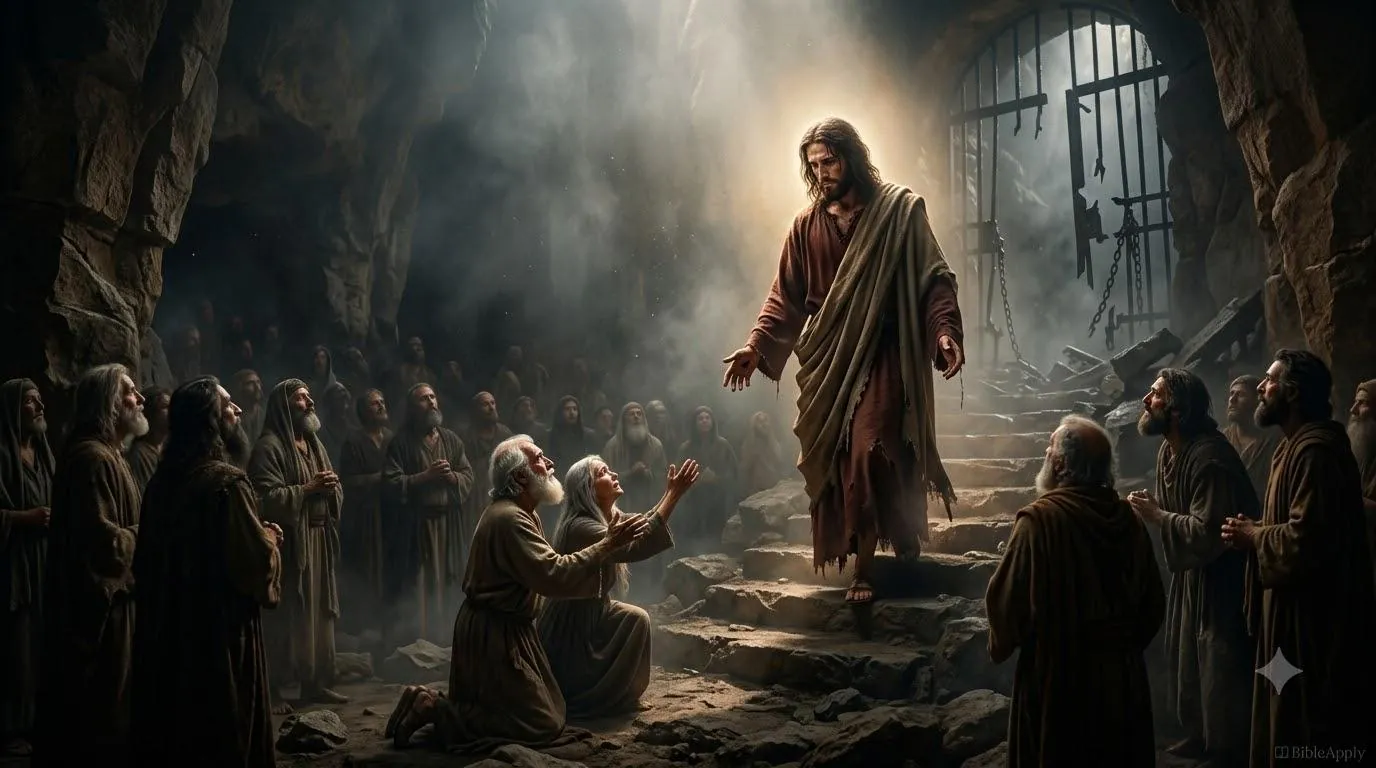
Medieval tradition developed a highly imaginative and vivid narrative called the “Harrowing of Hell,” based largely on the apocryphal Gospel of Nicodemus. It artistically depicted Jesus literally breaking down the physical brass gates and iron bars of hell to rescue Old Testament saints like Adam, Eve, David, and the prophets, triumphantly leading them in a massive procession up to heaven. While it is absolutely true that Christ’s death objectively secured the eternal salvation of Old Testament believers, the canonical Bible does not explicitly describe a dramatic, physical prison break from Hades in this manner. The righteous dead were already in a place of blessedness and comfort (Paradise or Abraham’s Bosom), resting peacefully and eagerly waiting for the final consummation of Christ’s redemptive work.
3 Practical Applications
Understanding that Jesus descended into Hades—experiencing the stark reality of death without suffering the torments of Gehenna—is not merely academic trivia reserved for theologians in ivory towers. It holds profound, practical, and life-altering implications for how we live out our faith, how we grieve our losses, and how we worship our Savior.
-
You do not need to fear the grave. Because Jesus entered the realm of the dead and emerged entirely victorious, death is no longer a dark, terrifying, unmapped unknown for the believer. Christ has already scouted the territory. He currently holds the keys to death and Hades in His resurrected hands (Revelation 1:18). When a Christian dies today, they do not descend into a shadowy, uncertain underworld; their soul goes immediately and directly into the glorious, conscious presence of the Lord—a truth that directly addresses what happens immediately after death according to the Bible and leaves no room for an intermediate state of purification. As the Apostle Paul wrote, to be absent from the body is to be present with the Lord (2 Corinthians 5:8). For the believer, the grave is merely a temporary resting place for our physical bodies until the glorious day of bodily resurrection, when we will finally understand what are the crowns in heaven and receive our eternal inheritance. It has been completely stripped of its ultimate power to hold us captive.
-
Christ’s victory is absolute and cosmic. The doctrine of the descent reminds us forcefully that Jesus’ triumph on the cross was not just a localized, historical event; it was a massive, cosmic victory that echoed simultaneously through the heavens, the earth, and the deepest underworld. He definitively disarmed every demonic power, principality, and spiritual force of darkness. When you face intense spiritual warfare, mental oppression, or overwhelming darkness in your daily life, you stand securely in the unshakeable victory of a Savior who marched into the very stronghold of death and declared it utterly defeated. No realm of existence, visible or invisible, is outside His sovereign, loving lordship.
-
God’s empathy reaches our absolute lowest points. The astounding fact that the Son of God voluntarily experienced the severe separation of soul and body—the most unnatural, traumatic, and grievous aspect of the human experience—demonstrates the breathtaking extent of His solidarity with broken humanity. He didn’t just save us from a safe, comfortable distance; He plunged headfirst into the darkest depths of our fragile reality. Whatever profound grief, deep isolation, crippling depression, or “living hell” you may be experiencing right now, Jesus has been to the deepest pit. He understands your sorrow completely and intimately. And because He rose from it in triumphant victory, He promises to walk with you through the valley of the shadow of death and bring you safely into His marvelous, eternal light.