

Quick Answer: The Imago Dei reveals that humans reflect God’s rationality, relational nature, and authority to steward creation as seen in Genesis 1:27.
In an era of rapid technological change and shifting identity, the question of what it means to be human is critical. We look at the stars and feel small. We look at artificial intelligence and wonder what makes our minds unique. People are asking if their lives have inherent meaning or if we are just products of biology.
The Christian tradition offers a clear answer: the Imago Dei. This doctrine teaches that human beings are created in the image and likeness of God. Our culture often assigns value based on productivity, appearance, or wealth. But the Bible claims every human life holds unchangeable worth simply by existing.
This universal longing for dignity serves as strong evidence for God. It points to a Creator who gives life purpose. It tells the exhausted worker and the questioning student that their value is bestowed, not earned.
Knowing that we are made in God’s image immediately raises the question of how. What does this ancient phrase mean? Do we look like God? Do we act like Him? To answer this, we must examine the biblical text, original languages, and the life of Jesus Christ.
A Pastoral Note: I spend a lot of time visiting memory care wings, sitting with men and women who can’t speak or remember their own kids. By the world’s metric of utility, their lives might seem empty or finished. But when you understand the image of God, you realize you’re sitting in the presence of sacred royalty. Their dignity isn’t tied to their memory or mobility; it’s anchored in the God who made them. That truth changes everything about how we care for the vulnerable.
The Biblical Foundation: Imago Dei in Scripture
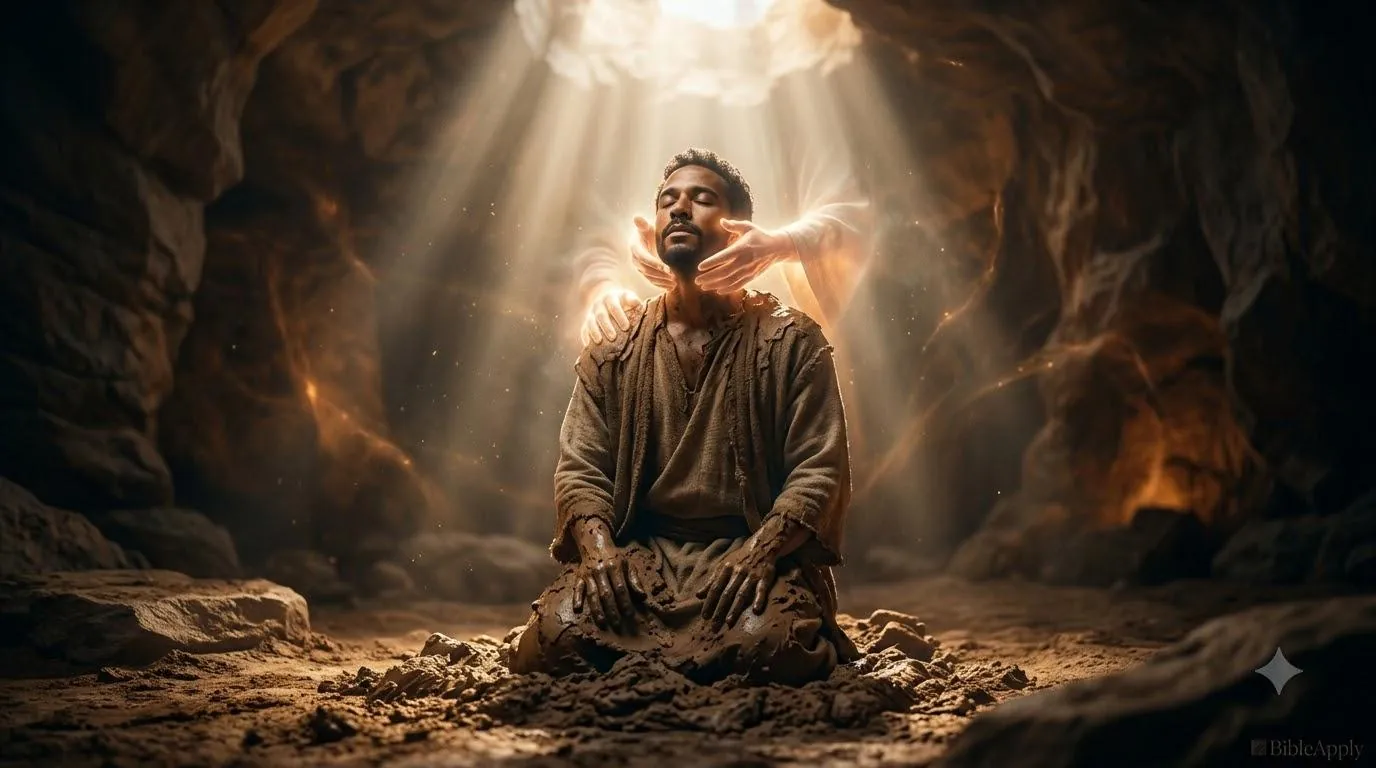
The concept of the Imago Dei (Latin for “Image of God”) arrives in the opening chapter of the Bible. It is the climax of the creation narrative. After speaking the cosmos and animals into existence, God pauses.
The rhythm of creation shifts to a divine council:
“Then God said, ‘Let us make mankind in our image, in our likeness, so that they may rule over the fish in the sea and the birds in the sky, over the livestock and all the wild animals, and over all the creatures that move along the ground.’ So God created mankind in his own image, in the image of God he created them; male and female he created them.” (Genesis 1:26-27, NIV)
This text establishes that humanity is distinct from the rest of creation. We are uniquely crafted representatives of the Creator.
The Hebrew Words: Tselem and Demuth
To grasp this passage, we must look at the Hebrew words used by the author: tselem (image) and demuth (likeness).
- Tselem (צֶלֶם): In the ancient Near East, a tselem was a physical statue representing a deity or a monument set up by a king to signify his rule. God subverts this cultural norm. Pagan religions believed statues housed the presence of the gods. The God of Israel declares that living, breathing human beings are His true representatives. We are the living statues of the invisible God, placed in creation to reflect His authority.
- Demuth (דְּמוּת): Translated as “likeness,” this word softens and clarifies tselem. It prevents the misunderstanding that humans are exact physical replicas of God. Demuth implies an analogy or a pattern. We are a reflection—like a mirror capturing the sun—sharing in certain qualities without sharing His uncreated divine essence.
Together, these terms show that the image of God defines the core of human existence.
What Does It Mean to Bear God’s Image?
Theologians have long debated the precise nature of the Imago Dei. Most modern biblical scholars agree it is best understood through three views: substantive, relational, and functional.
The Substantive View: Attributes and Characteristics
For much of history, theologians like Augustine argued the image of God resides in human nature. This substantive view highlights the internal attributes that distinguish humans from animals.
These attributes include:
- Rationality: The ability to think logically and possess self-awareness.
- Morality: A conscience and the capacity to distinguish right from wrong.
- Spirituality: The possession of a soul and the capacity to commune with God.
- Creativity: The desire to create art, music, and culture, mirroring the Creator.
Defining the image of God solely by these capacities can be problematic. If rationality is the image of God, what does that mean for an infant or someone with dementia? To protect the dignity of all human life, the substantive view must be paired with other perspectives.
The Relational View: Designed for Connection
In the mid-20th century, theologians emphasized the relational aspect of the Imago Dei. Genesis 1:27 connects the image of God with gender and relationship: “in the image of God he created them; male and female he created them.”
God Himself exists in eternal relationship as the Trinity: Father, Son, and Holy Spirit. To be made in His image is to be created for relationship. We are fundamentally designed for community.
We reflect God’s image when we engage in deep, sacrificial relationships with one another. The image of God is found in the “we” just as much as in the “I.”
The Functional View: Vice-Regents of Creation
Old Testament scholars have also highlighted the functional aspect of the image. In Genesis 1:26, immediately after God speaks of making humanity in His image, He assigns a task: “so that they may rule…”
In the ancient world, only kings and pharaohs were considered the “image of God.” Genesis democratizes this concept. The Bible declares that every human being is appointed as a vice-regent or steward of creation.
The image of God is not just something we are; it is something we do. We are called to represent God’s loving, just dominion over the earth. We are meant to cultivate the world and act as God’s hands and feet. This gives meaning to human vocation, science, and environmental stewardship.

The Impact of the Fall on the Image of God
If humans are made in the image of a loving God, why is human history marked by violence and selfishness? The biblical narrative explains this through the Fall in Genesis 3.
When humanity rebelled against God, the Imago Dei was damaged. Like a mirror shattered into pieces, we still reflect the light, but the image is distorted.
- Substantively: Our reasoning became flawed and our moral compass skewed. Our creativity is often used for destruction.
- Relationally: The perfect harmony between humans and God, and between male and female, was broken. It was replaced by shame, blame, and conflict.
- Functionally: Our stewardship of creation often turns into exploitation. We rule with selfishness rather than sacrificial love.
Despite this brokenness, the image of God remains intact in every person. In Genesis 9:6, God institutes a severe penalty for murder precisely because “in the image of God has God made mankind.” The shattered mirror still holds immense, sacred value.
Christ: The Perfect Image of the Invisible God
Because the image in us is broken, we cannot look at ourselves to see exactly what God is like. To understand what a true, unblemished human being looks like, we must look to Jesus Christ.
The New Testament identifies Jesus as the perfect realization of the Imago Dei.
“The Son is the image of the invisible God, the firstborn over all creation.” (Colossians 1:15, NIV)
Jesus is the exact imprint of God’s nature (Hebrews 1:3). In His earthly ministry, we see perfect relational love as He embraces the outcast. We see perfect functional stewardship as He brings healing and feeds the hungry. We see perfect substantive morality as He lives a sinless life and sacrifices Himself.
The goal of the Christian life is a process of restoration. Through the Holy Spirit, believers are “being transformed into his image” (2 Corinthians 3:18, NIV). Salvation is about recovering our humanity and being remade into the likeness of Christ.
Common Objections and Misconceptions
Several misconceptions about the image of God often arise.
Misconception 1: The Image is Physical
Because the Bible uses anthropomorphic language, some assume the image of God is physical. However, God is Spirit (John 4:24) and does not have a physical body in His divine essence. The image of God is not about having two arms and two legs. It is about our nature, relationships, and calling.
Misconception 2: We Lose the Image Through Sin
Some fear that if a person commits a terrible crime, they forfeit the image of God. This is biblically false. The image is marred by sin, but it is intrinsic to our state of being. No amount of sin or degradation can erase the image of God in a human being. This truth forms the absolute bedrock of human rights.
Misconception 3: Animals Bear the Image
Animals are beautiful creations of God that deserve respect. However, they are not created in the Imago Dei. Genesis strictly separates the creation of the animal kingdom from humanity. Only humans are appointed as God’s representatives and equipped for moral reasoning and spiritual communion.
3 Practical Applications
The doctrine of the Imago Dei alters how we view others and ourselves.
1. Inherent Dignity and Worth
Because every human being is made in the image of God, every person possesses inalienable dignity. This demands that we fight against racism, sexism, ageism, and any system that devalues human life.
It means the unborn child, the elderly patient, the refugee, and even our enemies have immense worth. You cannot simultaneously love God and despise the image He placed in your neighbor.
2. Purposeful Vocation and Stewardship
The functional view of the image reminds us that our daily work matters. We are called to be vice-regents and stewards of creation.
Whether you are a CEO, an artist, a stay-at-home parent, or a software engineer, your work is a holy calling when it promotes human flourishing. Caring for the earth is the original human mandate. We are responsible for protecting the creation God entrusted to us.
3. Relational Flourishing
If God is a relational being, and we are made in His image, we will never find fulfillment in isolation. We are wired for connection.
This means we must prioritize healthy, self-giving relationships. We must cultivate empathy, practice forgiveness, and invest deeply in our communities. Our ultimate relational need is communion with God Himself.
The image of God answers the human search for identity. It tells us that we are not accidents, but intentional creations. We are broken, yet loved. Through Jesus Christ, we are invited to recover our humanity and reflect the grace of the God who made us.