

Quick Answer: The Bible teaches that after death, believers are immediately present with the Lord (2 Corinthians 5:8, Philippians 1:23, Luke 23:43). Unbelievers enter a state of conscious separation from God (Luke 16:22-23). The final judgment and eternal destiny (heaven or hell) are confirmed at Christ’s return (Revelation 20:11-15).
Death is the great equalizer. It is the one universal human experience that no living person has fully comprehended. Every culture and civilization grapples with the mystery of what lies beyond the final breath. Modern perspectives range from the materialistic view of a sudden fade to black, to generalized realms of light and peace.
When we stand at the graveside of a loved one or face our own mortality, abstract philosophies fail to comfort. The human heart instinctively cries out for assurance. We want to know where our departed loved ones have gone and what awaits us.
We want to know if consciousness continues and if relationships are remembered. Most importantly, we want to know if we will be with God. The sorrow of losing someone is compounded by the silence that follows their passing. We are left looking at a motionless body, knowing intuitively that the essence of the person is no longer there.
The Bible does not leave us in the dark regarding the immediate afterlife. Scripture provides a clear, comforting, and sobering framework for understanding the transition from this life to the next. The Christian hope is not a vague leap into the unknown. It is a confident rest in the promises of a God who has conquered death through the resurrection of Jesus Christ.
A Pastoral Note: I’ve stood in quiet hospital rooms and watched believers take their final breath. The grief is always sharp, but there’s a distinct peace that settles over the space when a Christian goes home. Scripture promises that leaving this body means being immediately present with the Lord. There are no waiting rooms or layovers in the afterlife. The moment your eyes close here, they open to the face of the Savior.
The Intermediate State
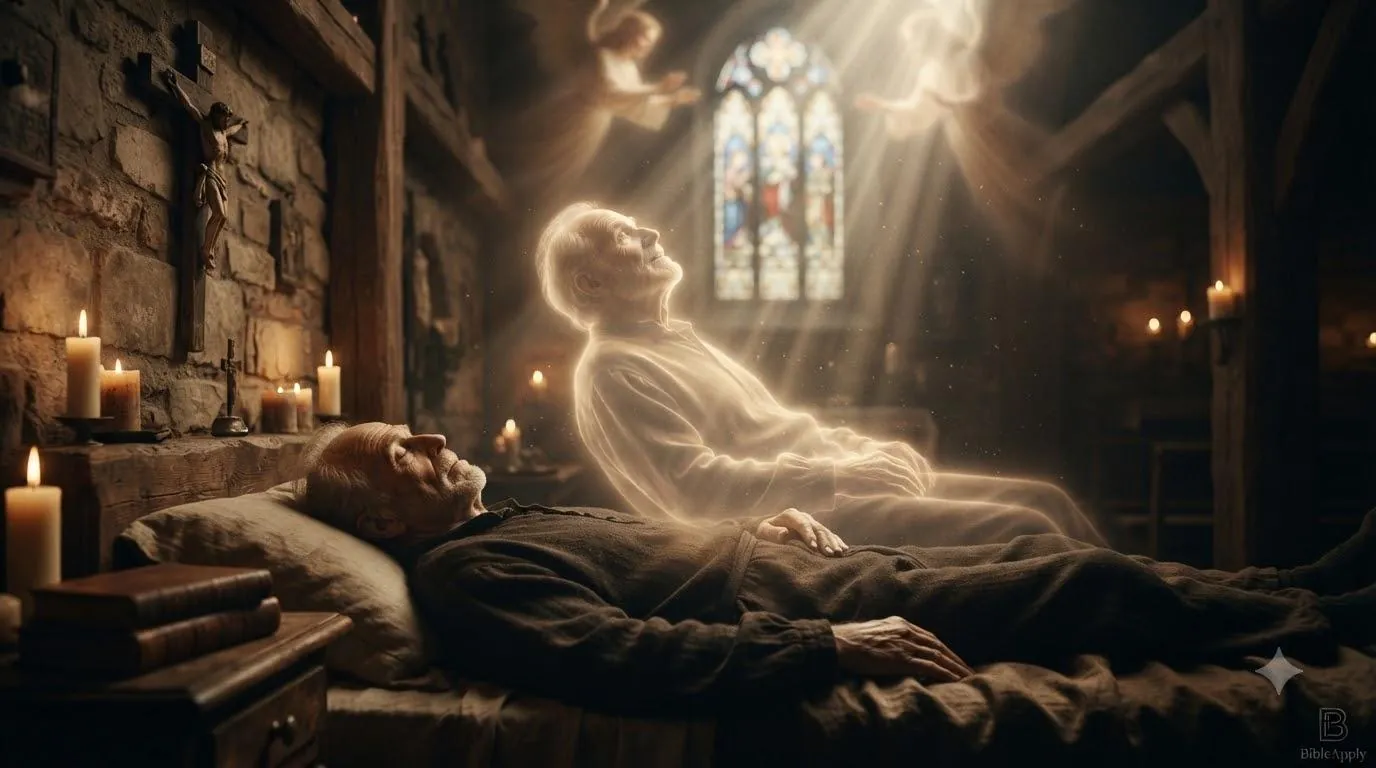
The biblical framework for the afterlife begins with the “intermediate state.” In Christian theology, this refers to the condition of human beings between their physical death and the final bodily resurrection at the return of Christ.
When a person dies, there is a temporary separation of the material and immaterial parts of human nature. The physical body ceases to function and returns to dust (Genesis 3:19). However, the immaterial part—the soul or spirit—continues to exist consciously.
This conscious existence is immediate. There is no gap in time, no period of suspended animation, and no wandering of the soul. The destination of the soul depends entirely on the individual’s relationship with Jesus Christ during their earthly life.
The Destiny of the Believer: Present with the Lord
For the Christian, the transition of death is characterized by immediate, conscious fellowship with God. This applies to anyone who has repented of their sins and placed their faith in Jesus Christ.
At Home with the Lord
The Apostle Paul provides some of the most definitive teachings on this subject. In his second letter to the Corinthians, he expresses a confident hope regarding death:
“So we are always of good courage. We know that while we are at home in the body we are away from the Lord, for we walk by faith, not by sight. Yes, we are of good courage, and we would rather be away from the body and at home with the Lord.” (2 Corinthians 5:6-8, ESV)
Paul sets up a sharp dichotomy. We are either “at home in the body” (alive on earth) or “away from the body and at home with the Lord” (deceased). There is no purgatorial waiting room or state of unconsciousness. To leave the physical body is to be instantly in the presence of Jesus Christ.
He reiterates this same truth in his letter to the Philippians, written while he was facing possible execution:
“For to me to live is Christ, and to die is gain. If I am to live in the flesh, that means fruitful labor for me. Yet which I shall choose I cannot tell. I am hard pressed between the two. My desire is to depart and be with Christ, for that is far better.” (Philippians 1:21-23, ESV)
Notice Paul’s language: to die is “gain” and to depart is to be “with Christ.” If death meant a cessation of consciousness or a long sleep, Paul could hardly call it “gain” over serving God on earth. The “gain” is the unmediated, immediate presence of the Savior.
The Promise to the Thief on the Cross
A clear illustration of a believer’s destination after death is found in the crucifixion narrative. As Jesus hung on the cross, one of the criminals crucified beside Him expressed sudden, repentant faith. He said, “Jesus, remember me when you come into your kingdom” (Luke 23:42).
Jesus’ response is crucial for our understanding of the immediate afterlife:
“And he said to him, ‘Truly, I say to you, today you will be with me in paradise.’” (Luke 23:43, ESV)
The Greek word used here for paradise is paradeisos, meaning a walled garden or a royal park. Jesus promises the repentant thief that they would be together in paradise that very day. This underscores the immediacy of the transition and the conscious joy of the destination.
What is Heaven Like in the Intermediate State?
When believers die, their souls go to heaven. This present heaven is distinct from the future, eternal state (the New Heavens and New Earth described in Revelation 21-22).
In the intermediate heaven, believers are:
- Conscious and aware: They are not asleep. Revelation 6:9-11 depicts the souls of martyrs under the heavenly altar, crying out to God and receiving white robes. They are aware of their surroundings and the passage of time on earth.
- Resting from labor: Revelation 14:13 declares, “Blessed are the dead who die in the Lord from now on… that they may rest from their labors.” It is a place of profound peace and rest from the suffering of the fallen world.
- Incomplete: While they are perfectly joyful and sinless, their state is technically incomplete because they do not yet have their resurrected bodies. They are awaiting the final resurrection when Christ returns (1 Thessalonians 4:13-18).
The Destiny of the Unbeliever: Conscious Separation
The biblical testimony regarding those who die without saving faith is clear and sobering. Just as the believer immediately enters the presence of the Lord, the unbeliever immediately enters a state of conscious separation from God.
The Reality of Hades
In the New Testament, the Greek word Hades (translating the Hebrew Sheol) is used to describe the temporary abode of the unrighteous dead prior to the final judgment. It is distinct from Gehenna, the final lake of fire.
The most vivid description of this state is found in Jesus’ teaching of the Rich Man and Lazarus. The theological realities it conveys about the afterlife are consistent with the rest of Scripture.
“The poor man died and was carried by the angels to Abraham’s side. The rich man also died and was buried, and in Hades, being in torment, he lifted up his eyes and saw Abraham far off and Lazarus at his side. And he called out, ‘Father Abraham, have mercy on me, and send Lazarus to dip the end of his finger in water and cool my tongue, for I am in anguish in this flame.’” (Luke 16:22-24, ESV)
From this passage, several terrifying realities emerge regarding the immediate afterlife for those outside of Christ:
- Consciousness: The rich man is fully conscious. He has memory, he can speak, and he can reason.
- Torment: He is immediately in a state of “anguish” and “torment.” There is no period of unconsciousness or a “second chance” probationary period.
- Finality: Abraham tells the rich man that a great chasm has been fixed, preventing anyone from crossing over (Luke 16:26). The state is fixed immediately upon death. No post-mortem salvation is possible.
Like the intermediate heaven, Hades is not the final state. At the Great White Throne Judgment, Hades will give up its dead. The unrighteous will be resurrected to face final judgment before being cast into the lake of fire (Revelation 20:11-15).
Addressing Common Misconceptions
Several pervasive misconceptions about the afterlife have crept into popular theology and cultural consciousness.
Soul Sleep
Some Christian groups teach that upon death, the soul enters a state of unconsciousness, or “sleep,” until the final resurrection. They often cite Old Testament verses that refer to death as “sleeping” (e.g., Daniel 12:2) or state that the dead know nothing (Ecclesiastes 9:5).
When the Bible uses “sleep” as a metaphor for death, it is a euphemism referring to the physical body. It looks like it is sleeping, and the state is temporary since they will “wake up” in the resurrection. The New Testament overwhelmingly teaches that the immaterial soul is fully conscious immediately following physical death.
Purgatory
Roman Catholic theology teaches that many believers must undergo a period of purification (Purgatory) before entering the joy of heaven. This applies to those who die in a state of grace but still bear the temporal punishment for venial sins.
The concept of Purgatory is at odds with the biblical doctrine of justification by faith alone. Hebrews 1:3 declares that Christ “made purification for sins” once and for all. On the cross, Jesus cried, “It is finished” (John 19:30). To suggest that a believer must suffer to purify themselves is to suggest that Christ’s blood was insufficient.
Reincarnation and Angels
Popular culture often embraces the idea of reincarnation or the sentimental notion that dead humans “gain their wings” and become angels.
Hebrews 9:27 decisively refutes reincarnation: “And just as it is appointed for man to die once, and after that comes judgment.” Human beings and angels are distinct orders of creation. Humans do not become angels upon death. In fact, the Apostle Paul states that believers will one day judge angels (1 Corinthians 6:3).
3 Practical Applications
1. Let Immediacy Drive Your Evangelism
Every person immediately enters a conscious state of either eternal joy or eternal torment upon death. This should radically transform our sense of urgency in sharing the Gospel. There is no second chance after death. Let this sobering reality motivate us to pray fervently for the lost and to boldly proclaim the saving message of Jesus Christ.
2. Grieve with Unshakeable Hope
When a fellow believer dies, the pain of separation is deep. The Bible does not tell us not to grieve, but Paul commands us “that you may not grieve as others do who have no hope” (1 Thessalonians 4:13). Our believing loved ones are immediately in the presence of Christ. Our sorrow is tempered by profound joy for their current state, fully confident in a future reunion.
3. Live with Eternal Courage
Knowing what awaits us immediately after death frees us from the paralyzing fear of mortality. If to be away from the body is to be at home with the Lord, then death only succeeds in sending believers into the immediate presence of Jesus. This eternal perspective allows Christians to take risks for the Kingdom and endure illness with grace. Our present sufferings are light and momentary compared to the eternal weight of glory (2 Corinthians 4:17).
Related
- What Happens When the Euphrates River Dries Up?
- What Happens to Souls Who Commit Suicide?
- What Happens to People Who Never Heard of Jesus?