

Quick Answer: The biblical vision of heaven isn’t a place of disembodied spirits on clouds. It is a restored, physical New Earth defined by the eternal joy of God’s presence.
Perhaps no question captures the human imagination quite like the mystery of what happens immediately after we die. For millennia, humanity has stared into the great unknown, longing for a place where suffering ceases, where justice prevails, and where broken things are made whole.
In our modern era, the yearning for heaven isn’t merely escapism. It is a primal ache for the restoration of a world that feels fundamentally out of joint. When people ask about heaven, they are rarely looking for sterile theological data. They are asking deeply personal questions: “Will my pain end?”, “Will I see my spouse again?”, and “Is this fragile life all there is?”
Culturally, our visions of the afterlife are shaped more by folklore and media than by the biblical text. We frequently picture disembodied spirits floating on fluffy clouds, playing harps in a glowing white ether. Honestly, that sounds boring. It’s no wonder many struggle to muster genuine excitement for eternity.
Yet, when we dive into the Scriptures, the picture that emerges is vibrant and incredibly alive. The biblical vision of heaven is a robust, redeemed physical reality. To understand it, we must trace the biblical narrative from God’s present spiritual dwelling to the promise of a resurrected earth.
A Pastoral Note: I stood by a hospital bed last week watching a young father lose his battle with cancer. His wife wasn’t asking for theological abstractions; she needed to know if the man she loved was actually going somewhere real. When death tears our world apart, fluffy clouds and harps offer zero comfort. We need the gritty, physical hope of the resurrected earth. Heaven is a real place where broken bodies are made whole and the crushing weight of grief is finally lifted.
The Two Heavens: Present and Future
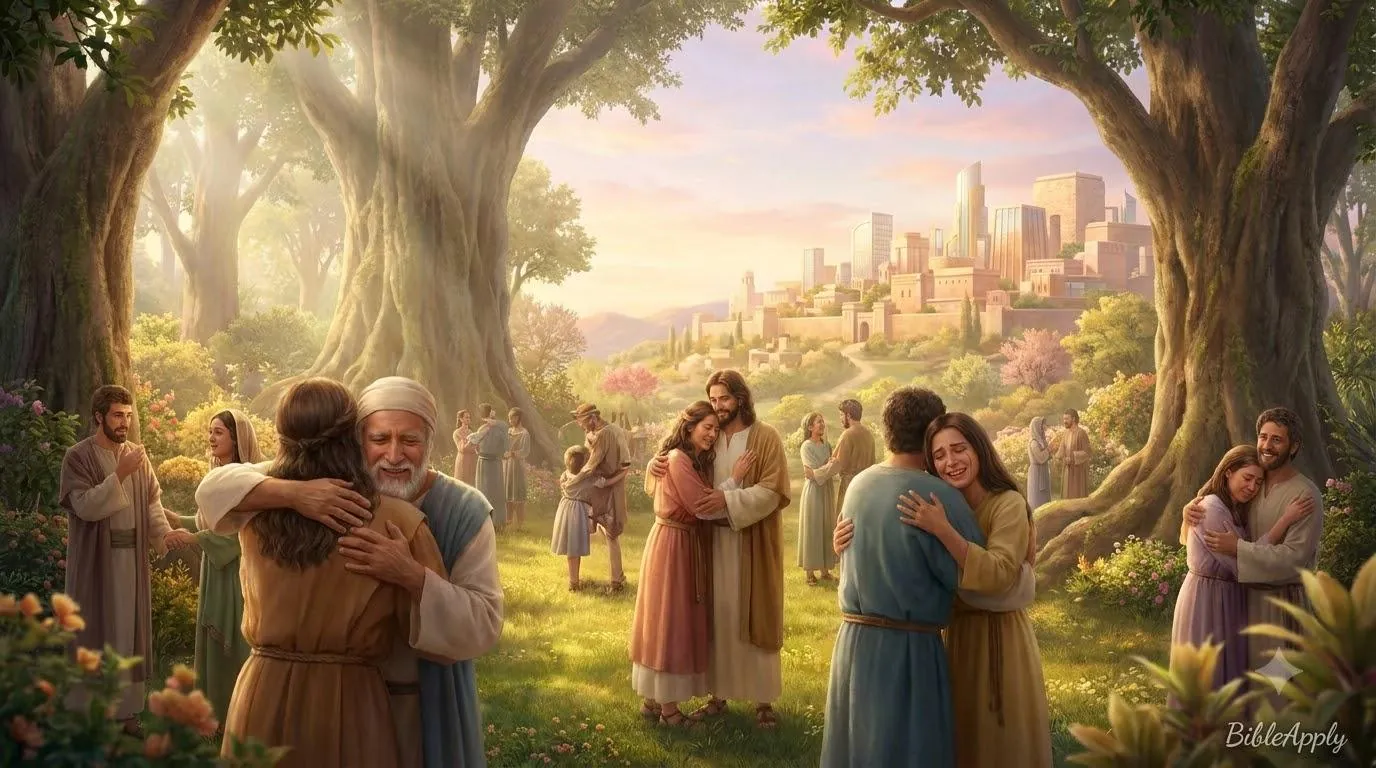
We must first distinguish between the present heaven and the future heaven. When a believer dies today, they enter the present, or “intermediate,” heaven. This is not the end of the story. It is a temporary resting place awaiting the climax of redemptive history.
The Present Heaven
In the Old Testament, the Hebrew word for heaven is shamayim, which can refer to the visible sky, the starry universe, or the unseen dwelling place of God. The New Testament Greek equivalent is ouranos. When Jesus tells the repentant thief on the cross, “Truly, I say to you, today you will be with me in paradise” (Luke 23:43), He is referring to the present heaven.
The present heaven is a place of conscious, joyful existence in the immediate presence of Christ. The apostle Paul describes the state of believers after death as being “away from the body and at home with the Lord” (2 Corinthians 5:8).
In Revelation, we see martyrs in this present heaven, conscious, resting, wearing white robes, and communicating with God (Revelation 6:9-11). It is a wonderful place, far better than our earthly existence. Paul admits that his desire is “to depart and be with Christ, for that is far better” (Philippians 1:23).
Yet, the present heaven is incomplete. The saints there are in a disembodied state. They do not yet have their resurrected bodies, and the physical universe has not yet been renewed. They are joyful, but they are waiting for the return of the King.
The Future Heaven: The New Earth
The crowning hope of the Christian faith is not a permanent, disembodied existence. It is the resurrection of the dead and the total renewal of all creation. As theologian N.T. Wright emphasizes, heaven is not merely a place we go to escape the earth. Heaven is a reality that is coming here to transform the earth.
“Then I saw a new heaven and a new earth, for the first heaven and the first earth had passed away, and the sea was no more. And I saw the holy city, new Jerusalem, coming down out of heaven from God, prepared as a bride adorned for her husband.” (Revelation 21:1-2, ESV)
The concept of the “new heaven and new earth” represents the final merging of God’s dwelling place and humanity’s dwelling place. The Greek word used here for “new” is kainos, which means renewed, refreshed, and transformed in quality.
God is not throwing the original earth in the cosmic trash can. He is refining it, purging it of sin, and redeeming it. The future heaven is, quite literally, heaven on earth.
The Nature of the New Creation
If our final destination is a redeemed physical universe, what will life actually look like? The Scriptures point to a reality of stunning beauty, vitality, and perfect shalom (universal flourishing and wholeness).
Radical Physicality
The bodily resurrection of Jesus provides the template for our eternal existence. After His resurrection, Jesus was not a ghost or an apparition. He went out of His way to prove His physicality. He said, “See my hands and my feet, that it is I myself. Touch me, and see” (Luke 24:39).
He ate broiled fish with His disciples. He walked on dirt roads, spoke with friends, and bore the glorified scars of His crucifixion. In the exact same way, we will receive glorified, physical bodies (Philippians 3:21; 1 Corinthians 15).
A physical body requires a physical world. The New Earth will likely feature mountains, rivers, trees, animals, and cities. The prophet Isaiah speaks of a time when God’s people will build houses, plant vineyards, and enjoy the fruit of their labor (Isaiah 65:21-22).
The continuity between this world and the next is vast. The things we love most about God’s creation now—the taste of a great meal, the majesty of mountains, the warmth of an embrace—will be elevated and purified. Creation itself is eagerly longing for this day. Paul writes that creation waits “to be set free from its bondage to corruption” (Romans 8:20-21). The New Earth is creation set free.
The Eradication of the Curse
While there is glorious continuity, there is also a sharp break from our current reality. The most defining characteristic of the New Earth is the permanent absence of the Fall and its consequences.
“He will wipe away every tear from their eyes, and death shall be no more, neither shall there be mourning, nor crying, nor pain anymore, for the former things have passed away.” (Revelation 21:4, ESV)
Every effect of sin—cancer, dementia, depression, natural disasters, abuse, and death itself—will be permanently banished. The entropy that plagues our universe will be completely reversed.
We will never again experience the grief of a funeral, the sting of betrayal, or the decline of aging. The old order of things will be closed forever.
Life and Activity in Eternity
A common fear regarding heaven is that it will be a stagnant eternity of endless choir practice on a cloud. However, the biblical picture of eternal life is dynamic, active, and culturally rich.
Purposeful Work and Creativity
Work was not introduced as a punishment. It was given to humanity in the perfection of Eden before the Fall (Genesis 2:15). God is a worker, and we are designed to work. The curse merely made work frustrating and painful (Genesis 3:17-19).
In heaven, work will be fully redeemed. We will engage in meaningful, creative, and fulfilling endeavors. Revelation 22:3 states, “His servants will worship him” (the Greek word latreuo implies active service). We will govern, build, create, and explore the New Creation without a hint of exhaustion or anxiety.
Deep, Flawless Community
We are created for relationship. Eternity will be the ultimate realization of perfect community. We will not lose our identities or personalities. Instead, cleansed of sin, we will be our truest, most authentic selves.
We will absolutely recognize and reunite with loved ones who are in Christ (1 Thessalonians 4:13-18). We will fellowship with saints across all of history—from Abraham to believers from every tribe, language, people, and nation (Revelation 7:9).
The eternal state is described as the New Jerusalem, a bustling, vibrant city (Revelation 21). This implies complex social interaction, redeemed culture, music, and art, entirely free from selfishness or conflict.
Continual Learning and Discovery
God is infinite in His wisdom, beauty, grace, and power. Because we are finite creatures, we will never exhaust our knowledge of Him. We will not suddenly become omniscient.
Ephesians 2:7 says that in the coming ages, God will “show the immeasurable riches of his grace.” Eternity will be an unending journey of discovering more of who God is. We will never be bored because we will be constantly exploring the infinite depths of the Creator.
The Supreme Joy: The Beatific Vision
The physical wonders and purposeful work of the New Earth are breathtaking, but they are not the main attraction. The greatest feature of heaven is the unmediated, unveiled presence of God Himself.
“And I heard a loud voice from the throne saying, ‘Behold, the dwelling place of God is with man. He will dwell with them, and they will be his people, and God himself will be with them as their God.’” (Revelation 21:3, ESV)
For centuries, theologians have spoken of the Beatific Vision—the direct apprehension of God’s glory. Revelation 22:4 makes an incredible promise: “They will see his face.” Currently, we see God’s glory “through a glass, dimly” (1 Corinthians 13:12). God told Moses that no man could see His face and live (Exodus 33:20).
But in heaven, resurrected and purified, the veil will be completely lifted. We will look upon the face of the Lord of the universe and experience a pure, overwhelming joy. It will instantly eclipse every sorrow we ever endured on earth.
Every joy we experience now is merely a tiny stream leading back to the infinite ocean of God Himself. Christ is the very light of the city (Revelation 21:23). His radiant presence will perfectly satisfy every corner of our being forever.
Addressing Common Misconceptions
To fully grasp the biblical vision of heaven, we must discard several pieces of cultural baggage.
Misconception 1: Heaven is exclusively “up” in the clouds. Our final destiny is not floating endlessly in an ethereal sky, but living on a physical, renewed Earth. We do not merely go up to heaven; heaven comes down to us (Revelation 21:2).
Misconception 2: We become angels when we die. Humans and angels are distinct orders of creation. Humans are uniquely created in the image of God (Genesis 1:27); angels are ministering spirits (Hebrews 1:14). When a human dies, they do not sprout wings. We are resurrected as glorified humans. In the age to come, glorified humanity will even govern angels (1 Corinthians 6:3).
Misconception 3: Eternity will eventually become boring. Boredom is a byproduct of our fallen world. It results from the monotony of sin and the futility of our labors. In a flawless universe, with an infinite God to discover and limitless avenues for creativity, boredom is impossible. Eternity will be an endlessly unfolding adventure.
Misconception 4: I will lose my personality or forget my earthly life. Some fear that perfection means losing what makes them unique. Yet, Jesus retained His scars after the resurrection. The Bible suggests our works follow us (Revelation 14:13). God will wipe away every tear, implying we carry memories of our past, completely stripped of pain. You will be more you in heaven than ever before.
3 Practical Applications
The biblical reality of heaven is meant to transform how we live and suffer today.
-
Grieve with Deep, Resilient Hope: The reality of bodily resurrection fundamentally changes how we experience loss. We mourn the bitter sting of death, but we do not grieve “as others do who have no hope” (1 Thessalonians 4:13). Because the New Earth involves physical resurrection, we trust that every goodbye in Christ is temporary. We can face the darkest tragedies knowing that God will one day make all things right.
-
Invest Courageously in Eternal Treasures: Jesus commanded us to lay up treasures in heaven rather than on earth (Matthew 6:19-20). Knowing the New Earth is our true home frees us from the exhausting pursuit of material wealth and status. We can leverage our resources and time to bless others and seek justice. Acts of love, generosity, and faithfulness will echo into eternity and be rewarded by our King.
-
Cultivate an Intense Longing for God’s Presence: Our anticipation of heaven should primarily be an anticipation of Christ Himself. We must honestly ask if we want heaven simply for the reunion with loved ones, or if we truly desire God. We can practice for heaven right now by cultivating a life of joyful worship and finding our deepest satisfaction in Him. Let the beauty of the present world stir your affections as an appetizer for the eternal feast.