Ruth Chapter Summaries
A complete, chapter-by-chapter guide to the Book of Ruth. Read deep dives into the meaning, historical context, and modern application of every chapter.
Welcome to our complete guide to the Book of Ruth. Below you will find a chapter-by-chapter summary that flows through the entire narrative, helping you understand the context, meaning, and application of this profound book.
Chapter 1: Tragedy and Loyalty
Introduction: The Dark Backdrop of the Judges
The Book of Ruth opens with an ominous historical marker: “Now it came to pass in the days when the judges ruled…” (Ruth 1:1, KJV). To the original Hebrew audience, this introductory phrase immediately set a grim and turbulent tone. The era of the Judges, spanning roughly 300 years between the conquest of Canaan and the monarchy of Israel, was characterized by a recurring, heartbreaking cycle of national apostasy, divine discipline, reluctant repentance, and temporary deliverance. It was an age marked by moral relativism and spiritual anarchy, summarized perfectly in the haunting refrain that concludes the Book of Judges: “In those days there was no king in Israel: every man did that which was right in his own eyes” (Judges 21:25).
Amidst this macro-level national darkness, the Book of Ruth zooms in on the micro-level—the personal, devastating tragedy of a single family from Bethlehem. While Judges focuses on mighty military leaders, tribal warfare, and massive national sin, Ruth provides a stark, refreshing contrast. It is a quiet, beautiful story of ordinary people navigating immense suffering, radical loyalty, and the subtle, unseen divine providence of Yahweh.
Chapter 1 serves as the crucial foundation for this redemptive narrative, taking the reader on a geographic and spiritual journey from Bethlehem to the pagan land of Moab, and finally back again. It is fundamentally a story about emptiness. It begins with an empty stomach (a devastating famine), leads to an empty family (the premature death of a husband and two sons), and concludes with an empty soul (Naomi’s bitter, agonizing confession). Yet, hovering above the tragedy of human failure and immense suffering is the unseen hand of a sovereign God, meticulously setting the stage for the redemption not only of this destitute family but, ultimately, of the entire world through the royal line of David and Jesus Christ.
The Flight from the House of Bread (Ruth 1:1-5)
“Now it came to pass in the days when the judges ruled, that there was a famine in the land. And a certain man of Bethlehemjudah went to sojourn in the country of Moab, he, and his wife, and his two sons.” (Ruth 1:1, KJV)
Many believers wrestle with questions like jeremiah 29 11 — and Scripture has profound answers.
The narrative begins with a stark, painful irony: a famine strikes Bethlehem. In biblical Hebrew, Bethlehem translates literally to “House of Bread” (Beth = house; Lehem = bread). The House of Bread is completely empty. In the covenant framework of the Old Testament, famine was rarely a mere meteorological coincidence; it was frequently a sign of divine discipline for national covenant unfaithfulness (as warned in Deuteronomy 28). Rather than repenting, seeking the face of the Lord, and trusting Yahweh to provide in the Promised Land, a man named Elimelech chooses to relocate his family to Moab.
The Theological Weight of the Names
The Hebrew names in this opening prologue carry immense theological weight and prophetic irony:
- Elimelech: Means “My God is King.” Yet, Elimelech’s actions contradict his name. Rather than trusting his Divine King to sustain him in the land of promise, he acts out of human pragmatism and fear, fleeing to a pagan nation for security.
- Naomi: Means “Pleasant” or “Sweet.” Her life, however, will soon turn completely sour and agonizing.
- Mahlon and Chilion: The names of their two sons translate roughly to “Sickly” and “Failing” (or “Pining”). Their very names seem to foreshadow their tragic and premature deaths in a foreign land.
The Tragedy in Moab
Moab was not just a friendly neighboring country; it was a nation born out of incest (the union of Lot and his eldest daughter) and a historic, bitter enemy of Israel. The Moabites worshipped the false, bloodthirsty god Chemosh, a deity often appeased through abhorrent practices like child sacrifice. For an Israelite family to seek refuge and sustenance in Moab was a profound compromise of faith, essentially abandoning the covenant community for the illusion of pagan security.
This topic connects with Jeremiah 29:11 Meaning: For I Know the Plans I Have for You, one of the most-searched biblical questions today.
“And Elimelech Naomi’s husband died; and she was left, and her two sons. And they took them wives of the women of Moab; the name of the one was Orpah, and the name of the other Ruth: and they dwelled there about ten years. And Mahlon and Chilion died also both of them; and the woman was left of her two sons and her husband.” (Ruth 1:3-5, KJV)
The family’s attempt to preserve their lives in Moab ultimately results in the loss of absolutely everything. The sons marry Moabite women, violating the spirit—if not the direct letter—of the Mosaic law regarding intermarriage with pagan nations that could lead Israelite hearts astray. Over the course of ten long years, Elimelech, Mahlon, and Chilion all perish. Naomi is left utterly destitute—a widow in a patriarchal ancient Near Eastern society, living in a hostile foreign land, with no male protector, no source of income, and no heirs to carry on the family name. She is reduced to a state of complete vulnerability and societal invisibility.
The Call to Return and the Test of Loyalty (Ruth 1:6-14)
“Then she arose with her daughters in law, that she might return from the country of Moab: for she had heard in the country of Moab how that the LORD had visited his people in giving them bread.” (Ruth 1:6, KJV)
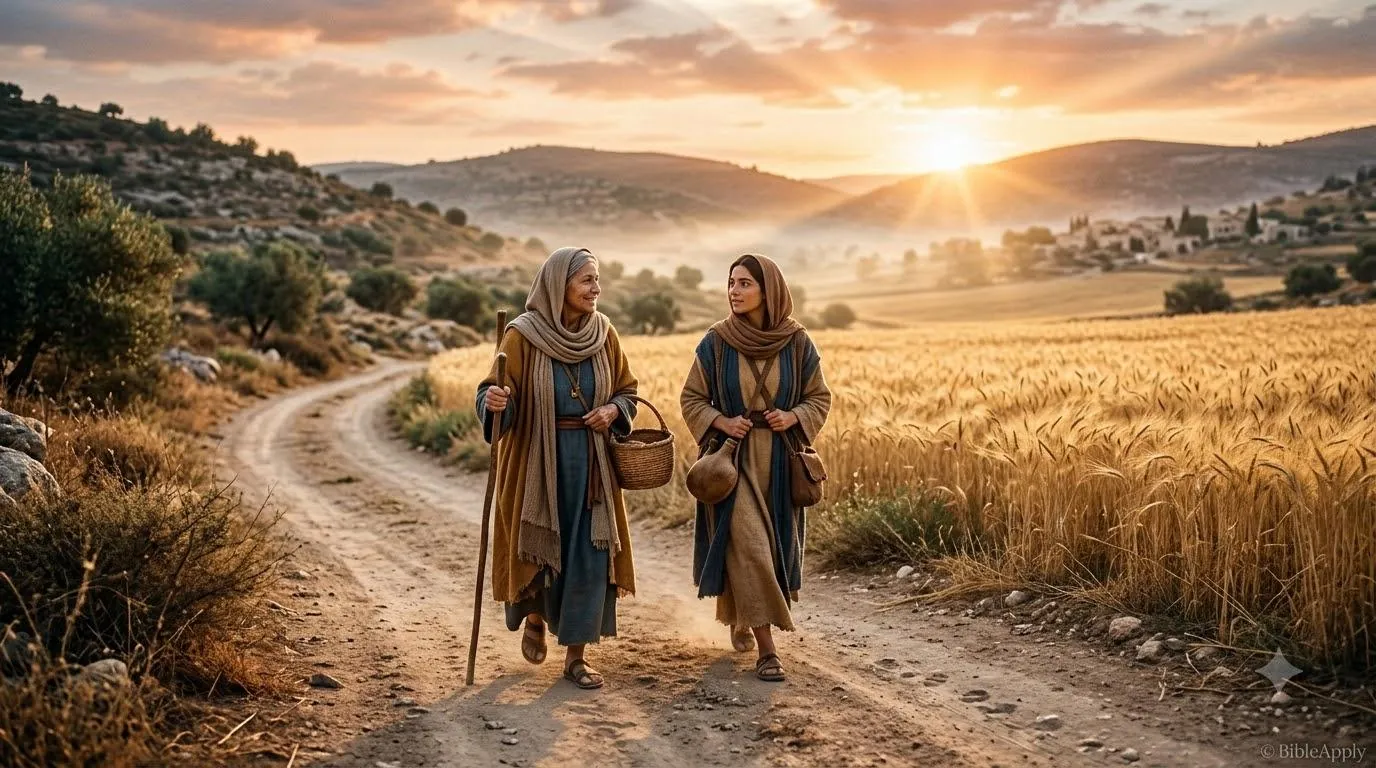
The turning point of the chapter occurs when a spark of hope reaches Moab: Naomi hears that Yahweh has “visited” His people by restoring the harvest in Bethlehem. This is a subtle but profound theological statement. God has not abandoned His covenant people; His discipline is purposeful, and grace is once again flowing back to the House of Bread. Naomi decides to return, and her two Moabite daughters-in-law, Orpah and Ruth, begin the long, arduous journey with her.
However, as they travel, Naomi attempts to dissuade them. She argues with brutal, calculated logic: she has no more sons in her womb for them to marry. This is a reference to the levirate marriage custom (Deuteronomy 25:5-10), where a brother would marry his deceased brother’s widow to continue the family line and keep the ancestral property intact. Naomi believes the punishing hand of the Lord has gone out against her, and she urges the young women to return to their mothers’ houses and find new husbands among their own people.
The Introduction of Hesed
“And Naomi said unto her two daughters in law, Go, return each to her mother’s house: the LORD deal kindly with you, as ye have dealt with the dead, and with me.” (Ruth 1:8, KJV)
Here, we encounter for the first time one of the most important and beautiful words in the Hebrew Bible: hesed (translated here as “deal kindly”). Hesed is a robust, multi-layered, untranslatable term that encompasses lovingkindness, fierce covenant loyalty, unfailing mercy, and steadfast love. It is the defining characteristic of Yahweh’s love for Israel. Naomi prays that God will show hesed to Orpah and Ruth because they showed hesed to her deceased sons. Little does she know that she is about to become the recipient of unimaginable hesed through the actions of the Moabite woman standing in front of her.
The Contrast: Orpah’s Departure and Ruth’s Clinging
Both young women weep bitterly at the prospect of parting. Orpah ultimately bows to common sense and societal expectation; she kisses her mother-in-law goodbye and returns to Moab and her gods (Chemosh). There is no biblical condemnation of Orpah in the text—she makes the logical, rational choice for a young widow seeking security in the ancient world.
But Ruth’s response defies all earthly logic. The text says that Orpah kissed her mother-in-law, “but Ruth clave unto her” (Ruth 1:14). The Hebrew word used for “clave” or “clung” is dabaq. This is the exact same, powerful word used in Genesis 2:24 to describe the unbreakable, covenantal bond of marriage: “Therefore shall a man leave his father and his mother, and shall cleave [dabaq] unto his wife.” Ruth is binding herself to Naomi with a fierce, covenantal ferocity that surpasses human understanding.
Also Read:
Ruth’s Radical Confession of Faith (Ruth 1:15-18)
Naomi pushes Ruth one final time to leave, pointing out that Orpah has logically returned to her people and to her gods. This provocation sets the stage for one of the most breathtaking confessions of faith in all of Scripture.
“And Ruth said, Intreat me not to leave thee, or to return from following after thee: for whither thou goest, I will go; and where thou lodgest, I will lodge: thy lift people shall be my people, and thy God my God: Where thou diest, will I die, and there will I be buried: the LORD do so to me, and more also, if ought but death part thee and me.” (Ruth 1:16-17, KJV)
This is not merely a statement of deep familial affection; it is a profound religious conversion and an ironclad covenant vow.
- A Geographic Renunciation: “Whither thou goest, I will go.” Ruth completely abandons her homeland, her culture, and her familiar surroundings for an unknown future in a land where Moabites were traditionally despised and excluded.
- A Societal Renunciation: “Thy people shall be my people.” She leaves her ethnic identity behind to graft herself completely into the people of Israel, accepting whatever marginalization might come with it.
- A Theological Conversion: “Thy God my God.” This is the absolute pinnacle of her confession. Ruth definitively renounces the pagan idols of Moab and places her faith entirely in Yahweh, the God of Israel. She trusts the God of a woman whose life is currently in ruins.
- A Vow unto Death: She seals her promise with an oath invoking the sacred covenant name of God (Yahweh/LORD), swearing a curse upon herself if anything other than death separates them.
Gospel Connection: The Grafting of the Gentiles
Unfathomable theological depth explodes from these verses when we view them through the lens of the Gospel of Jesus Christ. Ruth, a Moabitess—a foreigner, an outsider, and legally excluded from the assembly of the Lord to the tenth generation (Deuteronomy 23:3)—is demonstrating a level of saving faith and covenant loyalty (hesed) that completely outshines the native-born Israelites of the chaotic Judges era.
God’s redemptive plan has always been to bless all the nations of the earth (Genesis 12:3). Ruth serves as a brilliant, beautiful Old Testament picture of what the Apostle Paul later describes in Ephesians 2: Gentiles, who were once “aliens from the commonwealth of Israel, and strangers from the covenants of promise, having no hope, and without God in the world,” are brought near by the blood and grace of Christ. Ruth’s incredible, self-sacrificing faith positions her to become not just a citizen of Israel, but the great-grandmother of King David, and a direct, celebrated ancestor of Jesus Christ (Matthew 1:5). Grace obliterates her outsider status.
The Arrival in Bethlehem: A Bitter Homecoming (Ruth 1:19-22)
“So they two went until they came to Bethlehem. And it came to pass, when they were come to Bethlehem, that all the city was moved about them, and they said, Is this Naomi? And she said unto them, Call me not Naomi, call me Mara: for the Almighty hath dealt very bitterly with me.” (Ruth 1:19-20, KJV)
When the two widows finally limp into Bethlehem, the town is thrown into an uproar. Ten hard years have passed, and the women of the city barely recognize Naomi. The physical, emotional, and spiritual toll of grief, famine, and harsh desert travel has undoubtedly altered her appearance and her demeanor.
Naomi’s response to the townspeople is dripping with raw, unfiltered anguish. She explicitly rejects her given name, Naomi (“Pleasant”), and demands to be called Mara, which means “Bitter.” (This is the very same root word used in Exodus 15 when the parched Israelites encountered the bitter, undrinkable waters of Marah).
Related to this, you may want to read Psalm 91 Meaning: He Who Dwells in the Shelter for additional biblical perspective.
“I went out full, and the LORD hath brought me home again empty: why then call ye me Naomi, seeing the LORD hath testified against me, and the Almighty hath afflicted me— (Ruth 1:21, KJV)
The Theology of Lament and God’s Sovereignty
Naomi’s theology is deeply profound, even in the darkest valley of her pain. She recognizes the absolute, overarching sovereignty of God, referring to Him as El Shaddai (the Almighty). She attributes her suffering directly to His hand, rather than to random chance or pagan deities. She does not try to sugarcoat her pain or offer shallow religious platitudes to make others comfortable; she brings her lament directly to the throne of God.
While her perspective is understandably skewed by her paralyzing grief—she dramatically claims she came back “empty,” completely ignoring the fiercely loyal, faithful daughter-in-law standing right next to her—her willingness to wrestle with God in her sorrow is a hallmark of biblical lament. God does not strike her down for her honesty.
The chapter concludes with a powerful, quiet hint of divine providence that shines a ray of light into Naomi’s darkness:
“So Naomi returned, and Ruth the Moabitess, her daughter in law, with her, which returned out of the country of Moab: and they came to Bethlehem in the beginning of barley harvest.” (Ruth 1:22, KJV)
They arrive precisely at the beginning of the barley harvest. God, the unseen Master Orchestrator, has brought them back to the House of Bread just as the bread is miraculously returning. What looks to Naomi like mere coincidence or a bitter footnote is actually the quiet, relentless providence of God meticulously setting the stage for a glorious redemption.
3 Practical Applications from Ruth 1
1. Do Not Flee the “House of Bread” During Seasons of Trial
Elimelech’s grave, generational mistake was running from Bethlehem to Moab the moment life grew difficult. When we face spiritual dryness, financial hardship, intense suffering, or relational friction within the church, our human pragmatism often tempts us to compromise. We look to “Moab”—the systems, comforts, philosophies, and compromises of the secular world—for sustenance. The theological lesson is crystal clear: it is far better to endure a season of famine while remaining in the will and presence of God than to find temporary, fatal relief in a place of spiritual compromise. Stay in the House of Bread, remain faithful to the covenant community, and trust Yahweh to provide in His perfect timing.
Many believers wrestle with the question of psalm 23 kjv — and Scripture has profound, life-changing answers.
Many believers wrestle with questions like romans 8 28 — and Scripture has profound answers.
2. Practice Unshakeable Hesed (Covenant Loyalty)
Ruth’s devotion to Naomi stands as one of the most breathtaking examples of love in human history. She had absolutely nothing to gain materially, socially, or financially by clinging to a bitter, impoverished widow. Yet, she bound herself to Naomi with steadfast, sacrificial love. As Christians, we are called to exhibit this exact type of hesed in our marriages, our friendships, and our local churches. True biblical love does not abandon the relationship when the other person is grieving, difficult, depressed, or has nothing left to offer. It says, “Where you go, I will go.” It is a love that mirrors Christ’s unfailing love for His bride, the Church.
3. Trust the Unseen Providence of God in Your Bitterness
Naomi felt entirely abandoned and targeted by God. She genuinely believed her life was completely ruined and that the Almighty was her active adversary. Yet, even as she loudly declared herself “empty,” God had already provided the incredible gift of Ruth, and they were walking into Bethlehem at the exact, orchestrated moment the barley harvest was beginning. When you are walking through seasons of profound grief, catastrophic loss, and bitterness, remember that your current human perspective is severely limited. God is often quietly, relentlessly working behind the scenes of your deepest tragedies, weaving a story of redemption, provision, and grace that you cannot yet see. Bring your lament to Him honestly, but trust that the harvest is coming.
Also Read
- Micah 1 Summary & Meaning: The Roar of the Lord’s Judgment
- 2 Timothy 1 Summary & Meaning: Fanning the Flame of Faith in a Dark World
- 2 Corinthians 1 Summary & Meaning: The God of All Comfort and the ‘Yes’ in Christ
Read Ruth 1
Dive into the full scripture text for deeper study.
Chapter 2: Grace in the Fields
He goes beyond the legal requirements of charity, offering Ruth protection, providing her with roasted grain at mealtime, and secretly instructing his workers to leave extra bundles of barley for her to gather. By the end of the day, Ruth brings an astonishingly large harvest and leftover food back to Naomi. When Naomi hears that Ruth gleaned in Boaz's field, her hope is unexpectedly rekindled. She praises God for His lingering kindness and reveals to Ruth that Boaz is a 'kinsman-redeemer'—a close relative who has the cultural and legal obligation to rescue and provide for their vulnerable family.
Chapter 3: The Threshing Floor
Startled awake in the middle of the night, Boaz discovers Ruth at his feet. She plainly asks him to spread the corner of his garment over her, appealing for him to fulfill his duty as her kinsman-redeemer. Deeply moved by her noble character and her willingness to seek him rather than a younger man, Boaz blesses her and promises to do all she asks. However, he reveals a crucial complication: there is another relative closer in line than he is. Boaz sends her back to Naomi at dawn with a generous gift of six measures of barley, promising to settle the matter that very day.
Chapter 4: Redemption and Legacy
With the path clear, Boaz officially acts as the kinsman-redeemer, purchasing the family property and taking Ruth as his wife to the joyous blessing of the town elders. The Lord blesses their union with a son named Obed, bringing overwhelming joy and restoration to Naomi, who nurses the child as her own. The women of Bethlehem celebrate Naomi's renewed life, declaring that her devoted daughter-in-law is better to her than seven sons. The book concludes with a genealogy, revealing that this beautiful story of redemption paved the way for King David, seamlessly connecting this quiet romance to God's grand redemptive history.
Conclusion
We hope this chapter-by-chapter summary of Ruth has helped you better understand God's Word. To continue your study, explore our other Bible Chapter Summaries or read our detailed Verse Meanings.