

Quick Answer: The Bible teaches that all humans share one bloodline and bear God’s image. Racism is a sin of partiality, while the gospel breaks down ethnic barriers to unite us in Christ.
The question of what the Bible says about racism isn’t just an abstract theological debate. It’s personal. For many, it comes from deep wounds caused by discrimination and prejudice.
Others are simply trying to navigate modern conversations about race and justice through a biblical lens. When we look at the headlines and see the pain of our neighbors, it’s natural to ask where God is in all of this. What does His Word actually demand of us?
We also have to acknowledge the church’s complex history with race. Tragically, people have weaponized Scripture to justify slavery, segregation, and white supremacy. They twisted verses to subjugate fellow image-bearers of God.
At the same time, the truth of God’s Word fueled abolitionists and civil rights leaders. When read rightly, the Bible actively dismantles racism. It shows us that prejudice stems from a fundamental pride, much like the root of lucifer’s rebellion.
You won’t find the exact word “racism” in a biblical concordance. The modern biological construct of race didn’t exist in the ancient world. Instead, Scripture addresses ethnicity, partiality, justice, and human dignity.
From Genesis to Revelation, the narrative is uncompromising. Racism is a sin that attacks the image of God. In contrast, the gospel of Jesus actively tears down ethnic hostility to build a unified, diverse family.
A Pastoral Note: Early in my ministry, I had a terrible habit of throwing theology at people’s pain. When friends of color shared their exhaustion over racial prejudice, I’d quickly pivot to a Bible verse about unity rather than just validating their hurt. I had to learn the hard way that you can’t heal what you refuse to hear. True Christian community means getting uncomfortable, closing our mouths, and grieving alongside one another without getting defensive.
The Imago Dei: The Foundation of Human Dignity
To understand the Bible’s condemnation of racism, we have to start at the beginning. The doctrine of the Imago Dei—the image of God—is the foundation of human dignity.
Created in God’s Image
In the opening chapter of Genesis, God makes a definitive statement about humanity:
“So God created mankind in his own image, in the image of God he created them; male and female he created them.” (Genesis 1:27, NIV)
Every single human being is an image-bearer of the Creator. This means every person possesses inherent worth. Racism directly violates this truth.
When someone harbors racial prejudice, they aren’t just wronging another person. They are looking at God’s masterpiece and calling it defective. It’s an arrogant attempt to assign varying degrees of worth to God’s creation based on superficial traits.
One Human Race from One Source
The Bible further dismantles racism by affirming our shared ancestry. In his address to the elites in Athens, the Apostle Paul declared:
“From one man he made all the nations, that they should inhabit the whole earth; and he marked out their appointed times in history and the boundaries of their lands.” (Acts 17:26, NIV)
The Greek word for “nations” here is ethnos, the root of our word ethnicity. Paul establishes that despite ethnic diversity, humanity is one family with a shared origin.
The modern construct of distinct, unequal biological races is a human invention meant to justify exploitation. Scripture insists there is only one human race.
The Origin of Racism and the Sin of Partiality
If God created a unified human family, where did racism come from? The biblical answer is rooted in the Fall.
The Fall and the Fracturing of Humanity
When sin entered the world in Genesis 3, it shattered human relationships. We see this quickly in Cain’s murder of Abel, followed by widespread violence and tribalism. Even as society expanded—leading some to wonder where Cain found his wife—humanity grew increasingly fractured.
The Tower of Babel in Genesis 11 shows how human rebellion led to the scattering of peoples. What should have been a harmonious tapestry became tangled with suspicion and hostility. Racism is simply a fruit of this depravity—a desire to exalt oneself by pushing down someone else.
The Sin of Partiality (Prosōpolēmpsia)
While the specific word “racism” isn’t in Scripture, the concept is frequently condemned as “partiality” or “favoritism.” James explicitly warns the early church against this:
“My brothers and sisters, believers in our glorious Lord Jesus Christ must not show favoritism… But if you show favoritism, you sin and are convicted by the law as lawbreakers.” (James 2:1, 9, NIV)
The Greek word for favoritism is prosōpolēmpsia, which literally means “to receive a face” or judge by the face. It refers to judging a person’s worth based on surface-level factors.
God operates completely contrary to this. As 1 Samuel 16:7 reminds us, “The Lord looks at the heart.” Judging someone’s value by their physical appearance or ethnic heritage is an ungodly partiality that violates God’s law of love.

God’s Heart for the Nations
God’s redemptive plan was never restricted to one ethnic group. It has always been a global rescue mission.
The Abrahamic Covenant
When God called Abraham, He stated His ultimate purpose clearly:
“I will bless those who bless you, and whoever curses you I will curse; and all peoples on earth will be blessed through you.” (Genesis 12:3, NIV)
God chose the nation of Israel to be a conduit of blessing to “all peoples on earth.” The goal was always to reach every family and clan on the ground.
The Ministry of Jesus
Jesus lived out this cross-cultural mission by shattering the ethnic boundaries of His day. In first-century Judea, the hostility between Jews and Samaritans was intense. Yet Jesus went out of His way to engage a Samaritan woman at a well, offering her the living water of salvation.
Later, when asked “Who is my neighbor?”, Jesus told the Parable of the Good Samaritan. To a Jewish audience, a “good Samaritan” was an oxymoron. By making the despised ethnic “other” the hero, Jesus dismantled their prejudice and showed that neighbor-love knows no borders.
Tearing Down the Dividing Wall
The cross accomplished more than individual forgiveness. It achieved cosmic reconciliation, bridging the gap between divided ethnic groups. Paul writes:
“For he himself is our peace, who has made the two groups one and has destroyed the barrier, the dividing wall of hostility… His purpose was to create in himself one new humanity.” (Ephesians 2:14-15, NIV)
The Jerusalem temple had a physical wall keeping Gentiles out of the inner courts. Christ demolished that wall. To harbor racism as a Christian is to try and rebuild the very hostility that Jesus bled to tear down.
When Peter later struggled with his own prejudice, God gave him a vision in Acts 10. Peter finally realized, “God does not show favoritism but accepts from every nation the one who fears him and does what is right” (Acts 10:34-35).
The Vision of Heaven: Every Nation, Tribe, and Tongue
To understand God’s final answer to racism, we look to the end of the story. The book of Revelation shows us the culmination of God’s work.
“After this I looked, and there before me was a great multitude that no one could count, from every nation, tribe, people and language, standing before the throne and before the Lamb.” (Revelation 7:9, NIV)
This scene is critical for how we view race today. The multitude in heaven is not a colorblind, assimilated blob. The distinctions of nation, tribe, people, and language remain recognizable in God’s presence.
This tells us that God doesn’t erase ethnic diversity in eternity. He redeems and celebrates it. Racism tries to suppress diversity, while secular colorblindness tries to ignore it.
The biblical vision teaches us to value ethnicity as a reflection of God’s creative genius. If heaven will be multi-ethnic, our local churches should strive to be a preview of that reality.
Common Objections and Misconceptions
When discussing the Bible and race, a few misconceptions frequently come up.
“Doesn’t the Old Testament endorse ethnic separation?”
Critics often point to the conquest of Canaan or commands against intermarriage as evidence of biblical xenophobia. But a careful reading shows these commands were theological, not ethnic.
The Canaanites were judged for extreme wickedness like child sacrifice, not their race (Deuteronomy 9:4-5). Non-Israelites who embraced Yahweh were welcomed into the community. Rahab and Ruth are prime examples, and both ended up in the lineage of Jesus. The separation God demanded was purely to protect Israel from idolatry.
“Is the Bible colorblind?”
As we saw in Revelation 7, the Bible is not colorblind. Claiming to be colorblind often dismisses the unique cultural heritage and struggles of people of color.
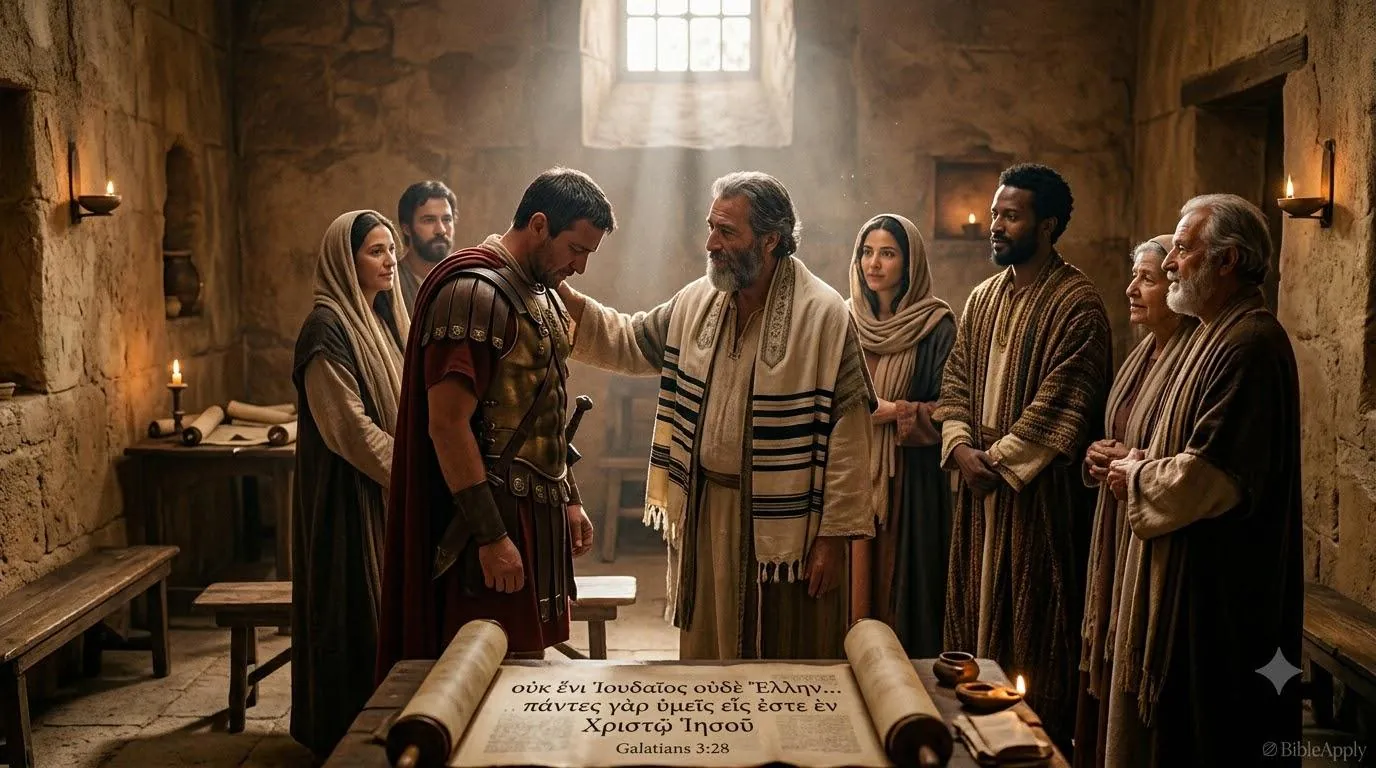
Scripture acknowledges ethnic differences but insists they don’t determine a person’s value. Galatians 3:28 says, “There is neither Jew nor Gentile, neither slave nor free, nor is there male and female, for you are all one in Christ Jesus.” This doesn’t erase our identities; it just means those identities can no longer be used for division.
“The Curse of Ham”
Historically, one of the worst abuses of Scripture was weaponizing the “Curse of Ham” (Genesis 9:20-27) to justify enslaving African people. In the text, Noah curses his grandson Canaan. Proponents of slavery falsely argued that Ham’s descendants became the African nations and were destined for servitude.
This was a gross distortion. The curse was directed at Canaan, whose descendants lived in the Middle East. The Bible never associates skin color with this curse. It was a fabricated theology built to protect a wicked economic system.
3 Practical Applications
Good theology should always lead to tangible action. Here is how Christians can respond.
1. Repent of Prejudice and Challenge Injustice
The fight against racism begins in the human heart. We have to ask the Holy Spirit to search us for unconscious biases and repent of any prejudice.
But repentance can’t stop at the individual level. Sin infects both hearts and the systems human hearts build. Following the command of Micah 6:8 to “act justly,” believers should advocate for equitable policies and stand up for those marginalized by systemic disparities.
2. Cultivate Real Cross-Cultural Relationships
It’s easy to harbor prejudice against a group of people from a distance. It’s much harder when you’re sharing a meal at a table.
We have to intentionally step out of our cultural echo chambers. This means practicing James 1:19—being “quick to listen, slow to speak”—when people of color share their experiences. Bearing one another’s burdens requires genuine friendship, proximity, and empathy.
3. Champion Unity in the Local Church
The church is meant to be a living example to a divided world. We should actively work toward multi-ethnic communities where dividing walls are actually torn down.
If our churches remain starkly segregated, we need to ask why. Pursuing unity doesn’t mean forcing everyone to assimilate to a dominant culture. It means sharing power, honoring different worship styles, and elevating diverse leadership. A unified, diverse church points the world straight to the gospel.