

Quick Answer: Lucifer, originally a glorious cherub, fell due to his own pride. Isaiah 14 and Ezekiel 28 describe his desire to usurp God’s throne, which led to his expulsion from heaven and his role as humanity’s spiritual adversary.
When we look at the brokenness in our world—suffering, malice, sickness, and injustice—it’s natural to ask where it all began. The opening pages of the Bible present a pristine world spoken into existence by a loving Creator. Yet almost immediately, a malevolent force enters the narrative, successfully tempting humanity into rebellion.
This abrupt shift leads many believers to study when Satan fell, and whether his rebellion occurred before or after Adam and Eve were created. Understanding the timeline of Satan’s rebellion provides vital context for the world’s brokenness. It helps us reconcile the absolute goodness of God’s original design with the reality of a spiritual adversary.
We often inherit cartoonish depictions of Satan—a red figure with a pitchfork, ruling hell from the beginning of time. The biblical portrait is far more tragic. Satan was originally a glorious angelic being, created perfect, who chose the path of pride and rebellion.
A Pastoral Note: In ministry, I see so many believers living in low-grade terror of the devil, attributing every flat tire and bad mood to demonic attack. They give Satan way too much credit. When you realize the enemy fell because he was obsessed with his own reflection—and that his defeat is already sealed—it changes everything. We don’t need to be arrogant, but we do need to stop cowering. The cross was a decisive victory; walk in it.
The Identity of the Fallen One: Who Was Lucifer?
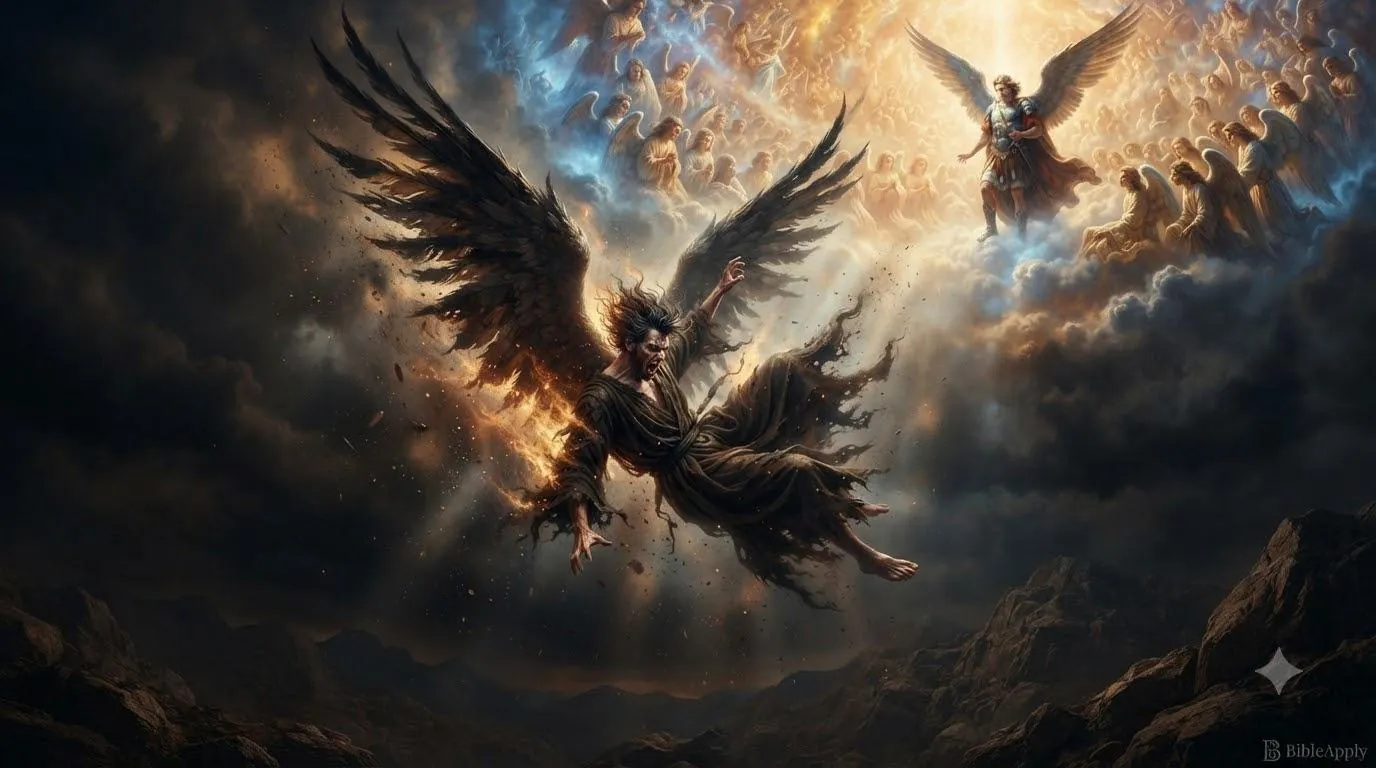
To understand how Lucifer fell, we must first understand who he was. The biblical text presents a picture of a creature of staggering beauty, power, and privilege. The name “Lucifer” itself is derived from the Latin Vulgate translation of Isaiah 14:12, where the Hebrew word helel (הֵילֵל) is used.
The Meaning of Helel
The word helel literally translates to “shining one,” “light-bearer,” or “morning star.” In the ancient Near East, the morning star (the planet Venus) was the brightest celestial body in the sky just before dawn. Before his rebellion, this being was a creature of unparalleled radiance. He reflected the glory of God more brightly than perhaps any other created being.
The prophet Ezekiel provides a parallel passage that most scholars view as a dual prophecy. While addressing the human King of Tyre, the language transcends human limitations to describe the spiritual power behind the earthly king.
“You were the signet of perfection, full of wisdom and perfect in beauty. You were in Eden, the garden of God… You were an anointed guardian cherub. I placed you; you were on the holy mountain of God; in the midst of the stones of fire you walked.” (Ezekiel 28:12-14, ESV)
An Anointed Guardian Cherub
The text identifies him as an “anointed guardian cherub.” Cherubim are the highest class of angelic beings, associated with guarding the holiness and immediate presence of God. The Ark of the Covenant was topped by the Mercy Seat flanked by two golden cherubim.
Lucifer held an exalted position of immense privilege. He was perfectly created, endowed with extraordinary wisdom, and entrusted with significant authority in the heavenly realm. His fall was not the stumble of a lowly creature, but the calculated rebellion of God’s most magnificent creation.
The Anatomy of the Fall: The Sin of Pride
The Bible is unequivocal in identifying the root cause of Lucifer’s fall: pride. It was not a weakness of the flesh, nor was it a deception by a higher power. It was an internal, self-generated corruption of his own will.
The Five “I Wills” of Isaiah 14
Isaiah poetically captures the inner monologue of this majestic being, detailing the progression of his pride through five boastful declarations.
“You said in your heart, ‘I will ascend to heaven; above the stars of God I will set my throne on high; I will sit on the mount of assembly in the far reaches of the north; I will ascend above the heights of the clouds; I will make myself like the Most High.’” (Isaiah 14:13-14, ESV)
Let’s break down the anatomy of this rebellion:
- “I will ascend to heaven”: A desire to occupy the supreme dwelling place of God, rejecting his assigned station.
- “I will set my throne on high”: An ambition for absolute dominion, seeking to rule over the “stars of God” (other angelic beings).
- “I will sit on the mount of assembly”: A demand for supreme authority and the right to preside over the divine council.
- “I will ascend above the heights of the clouds”: The clouds are frequently associated in Scripture with the glory and presence of God. He coveted the visible glory that belonged only to Yahweh.
- “I will make myself like the Most High”: The final usurpation. Lucifer wanted God’s position, authority, autonomy, and worship.
The Corruption of Beauty and Wisdom
Ezekiel 28 further clarifies exactly how this pride festered within him.
“Your heart was proud because of your beauty; you corrupted your wisdom for the sake of your splendor.” (Ezekiel 28:17, ESV)
Lucifer became enamored with his own reflection. Instead of recognizing his beauty and wisdom as gracious gifts from the Creator, he viewed them as inherent attributes justifying his self-exaltation. This is the essence of sin: turning away from the Creator to worship the self.

The Timeline of Creation and the Fall
To determine exactly when Satan fell, we have to look closely at the book of Genesis, which provides the foundational timeline for the creation of the cosmos, angels, and humanity.
One of the most important anchor points in this discussion is the conclusion of the six days of creation.
“God saw all that he had made, and it was very good. And there was evening, and there was morning—the sixth day.” (Genesis 1:31, NIV)
At the end of the sixth day, the entire created order was flawlessly aligned with God’s perfect will. If Satan had already fallen prior to the end of the sixth day, the universe would contain a source of catastrophic evil. This makes the divine declaration that all God had made was “very good” difficult to reconcile.
The biblical text strongly implies that at the close of day six, the angelic realm was still in a state of holy obedience.
The Intrusion of the Serpent
The narrative shifts dramatically in Genesis 3.
“Now the serpent was more crafty than any of the wild animals the Lord God had made. He said to the woman, ‘Did God really say, “You must not eat from any tree in the garden”?’” (Genesis 3:1, NIV)
Between the conclusion of the creation week (Genesis 2) and the temptation of Eve (Genesis 3), an unspecified amount of time passes. By Genesis 3, a malevolent being is actively seeking to destroy God’s crown jewel of creation.
This gives us a definitive chronological boundary: Satan’s fall must have occurred after the declaration of “very good” on the sixth day, but before the temptation in Eden.
The Cosmic Conflict and the Expulsion
Lucifer’s internal, silent rebellion inevitably led to a massive external conflict. Sin inherently seeks to expand its influence and recruit others to its cause.
The Rebellion of the Angels
The book of Revelation provides a dramatic vision of this cosmic struggle. While the precise chronological timing of Revelation 12 is debated, it vividly depicts the scale of the conflict.
“Now war arose in heaven, Michael and his angels fighting against the dragon. And the dragon and his angels fought back, but he was defeated, and there was no longer any place for them in heaven. And the great dragon was thrown down… and his angels were thrown down with him.” (Revelation 12:7-9, ESV)
Using his corrupted wisdom, Lucifer managed to deceive and lead a massive faction of angels in his rebellion against the throne of God. Revelation 12:4 symbolically suggests that his tail swept down a “third of the stars of heaven,” representing a third of the angelic host. These fallen angels became the demonic entities that now serve his destructive purposes.
The Judgment
The result of this celestial coup was swift, decisive judgment. God’s holiness cannot tolerate the presence of sin. As Ezekiel declares:
“I cast you as a profane thing from the mountain of God, and I destroyed you, O guardian cherub, from the midst of the stones of fire.” (Ezekiel 28:16, ESV)
Jesus Christ Himself testified to witnessing this momentous event, declaring in Luke 10:18, “I saw Satan fall like lightning from heaven.” The expulsion was absolute. While Satan still operates with limited access to the heavenly realms to accuse believers, his final doom was sealed the moment he rebelled.
Addressing Common Objections
When discussing the fall of Lucifer, several important theological questions frequently arise.
Did God create evil?
If God created everything, and God created Lucifer, did God create evil? The biblical answer is no. God created Lucifer as a perfect, morally free being.
True love and true worship require free will. Free will inherently necessitates the possibility of choosing contrary to God’s will. Evil is not a created substance; it is a privation or lack of goodness, much like darkness is merely the absence of light. God is the author of free will; Lucifer is the author of sin.
The Misunderstanding of Dualism
We often view the universe as a battleground between two equal and opposite forces: God and Satan. This concept, known as dualism, is entirely unbiblical.
Satan is not God’s equal. He is not omniscient, omnipresent, or omnipotent. He is a created, finite being completely under the sovereign permission and boundaries set by God. His rebellion does not threaten God’s throne.
Why didn’t God stop him immediately?
If God knew Lucifer would fall, why create him? And once he fell, why allow him to continue causing havoc? This touches on the deepest mysteries of God’s sovereignty.
Scripture suggests that God allows the rebellion to play out for a season to demonstrate the full spectrum of His attributes—His justice, His wrath against sin, and His unfathomable grace. The existence of a real adversary provides the necessary context for genuine love, tested faith, and the astonishing redemption accomplished through Jesus Christ.
Practical Applications
The theological truths surrounding the fall of Lucifer carry urgent implications for our daily lives.
Guard Against the Poison of Pride
The primary lesson of Lucifer’s fall is the utterly destructive nature of pride. Pride was the first sin in the universe, and it remains the root of almost all human sin.
We must ruthlessly examine our own hearts for the desire for autonomy, the craving for applause, and the belief that we know better than God. We must cultivate a posture of radical, daily humility. When we promote ourselves, we echo the ancient rebellion of the fallen cherub.
Recognize the Reality of Spiritual Warfare
Lucifer’s rebellion inaugurated a cosmic conflict that continues to rage today. As Christians, we are not living on a playground; we are born onto a battlefield.
Understanding the origin and malevolent nature of our enemy reminds us that we cannot fight this battle in our own strength. We must consistently put on the full armor of God, relying entirely on the finished work of Christ and the truth of Scripture.
Rest in God’s Final Victory
While the enemy is formidable and deceptive, his doom is already written in stone. The cross of Jesus Christ was the fatal, crushing blow to Satan’s kingdom.
Through His death and resurrection, Jesus “disarmed the rulers and authorities and put them to open shame” (Colossians 2:15). We do not fight for victory; as believers, we fight from a position of victory. The “morning star” that fell in pride has been decisively conquered by Jesus Christ, who reigns supreme forever.