

Quick Answer: The Angel of the Lord is a distinct divine messenger in the Old Testament. Many theologians interpret this figure as a pre-incarnate appearance of Jesus Christ.
Many readers of the Old Testament stumble upon mysterious encounters where an otherworldly figure appears to biblical heroes. Hagar in the wilderness, Moses at the burning bush, and Gideon in the winepress all meet this being. In these narratives, the text often transitions between calling this figure “the Angel of the Lord” and identifying Him directly as God.
This blurred line sparks curiosity. Is this a high-ranking angelic messenger like Gabriel or Michael? Or is it a tangible manifestation of Yahweh Himself? Understanding this unique biblical figure forces us to grapple with how the divine intersects with humanity.
For readers from monotheistic backgrounds, the idea of God taking on a localized form before the New Testament era can be jarring. We are accustomed to clear categories: there is the Creator, and there is creation. Yet, “the Angel of the Lord” defies these boundaries. He speaks with unmediated authority while being presented as one sent by God.
The search for the identity of this angel is deeply personal. Studying the angel of the lord shifts how we read the Old Testament. It shows us that God has never been a distant deity. He willingly steps into human history to comfort the marginalized and rescue the broken.
A Pastoral Note: I was doing premarital counseling a few years ago with a couple going through a really dark season. We read the story of Hagar, and the bride broke down in tears when she realized the Angel of the Lord actually chased Hagar into the desert. I told them this was likely Jesus showing up long before Bethlehem. That changes everything. It means our God doesn’t wait for us to clean ourselves up; He comes after us when we’re running away and completely broken.
The Linguistic Foundation: Malakh Yahweh
To understand this figure, we must look at the original language. In Hebrew, the phrase translated as “the Angel of the Lord” is Malakh Yahweh (מַלְאַךְ יְהוָה). The word malakh simply means “messenger” or “one who is sent.” It describes ordinary human messengers as well as spiritual beings. When combined with the divine name Yahweh, it means “the Messenger of Yahweh.”
In the ancient Near East, a messenger acted with the authority of the sender. The principle of “agency” meant the messenger’s words were received as the king’s own words. However, the Malakh Yahweh behaves unlike any other malakh in Scripture.
Regular angels vigorously refuse worship and distinguish themselves from the Creator (Revelation 22:8-9). In contrast, the Malakh Yahweh speaks in the first person as God. He claims divine prerogatives, performs divine actions, and accepts human worship without hesitation.
Key Old Testament Encounters
The best way to determine the identity of the Angel of the Lord is to examine how He operates within the narrative. In several pivotal moments in Israel’s history, this figure steps onto the stage. The text weaves His identity together with Yahweh’s.
Hagar in the Wilderness (Genesis 16)
The first appearance of the Angel of the Lord is moving. He does not appear to a king or patriarch, but to an Egyptian slave named Hagar. She is pregnant, abused, and fleeing into the desert. The Angel finds her by a spring and makes promises that only God can fulfill.
“Then the Angel of the Lord said to her, ‘I will multiply your descendants exceedingly, so that they shall not be counted for multitude.’ … Then she called the name of the Lord who spoke to her, You-Are-the-God-Who-Sees; for she said, ‘Have I also here seen Him who sees me?’” (Genesis 16:10, 13)
Hagar recognizes that the one who spoke to her was not a subordinate spirit. She names Him El-Roi, “The God Who Sees.” She realizes she has had a face-to-face encounter with the living God.
Abraham and Isaac on Mount Moriah (Genesis 22)
In one of the most tense scenes in the Bible, Abraham is about to sacrifice his son, Isaac. At the last second, a voice calls out from heaven to stop him. The language used by the Angel is intensely personal.
“But the Angel of the Lord called to him from heaven and said, ‘Abraham, Abraham!’ … ‘Do not lay your hand on the lad, or do anything to him; for now I know that you fear God, since you have not withheld your son, your only son, from Me.’” (Genesis 22:11-12)
The Angel explicitly says, “from Me.” This directly equates Him with the God who commanded the sacrifice. He speaks in the first person as the offended and honored party.
Moses and the Burning Bush (Exodus 3)
The most famous encounter features the Angel of the Lord appearing in a blazing bush that is not consumed.
“And the Angel of the Lord appeared to him in a flame of fire from the midst of a bush. So he looked, and behold, the bush was burning with fire, but the bush was not consumed. … So when the Lord saw that he turned aside to look, God called to him from the midst of the bush…” (Exodus 3:2, 4)
In this passage, “the Angel of the Lord,” “the Lord” (Yahweh), and “God” (Elohim) are used interchangeably. The figure in the bush identifies Himself as the God of Abraham, Isaac, and Jacob. He commands Moses to remove his sandals because the ground is holy. An ordinary created angel does not make the dirt holy.
Gideon and Samson’s Parents (Judges 6 and 13)
During the days of the Judges, the Angel of the Lord appears to Gideon and says, “The Lord is with you, you mighty man of valor!” (Judges 6:12). Two verses later, the text shifts: “Then the Lord turned to him and said…” (Judges 6:14).
When the Angel appears to Samson’s parents, Manoah asks for His name. The Angel replies, “Why do you ask my name, seeing it is wonderful?” (Judges 13:18). The Hebrew word for “wonderful” denotes incomprehensible majesty. Manoah later realizes the terrifying truth: “We shall surely die, because we have seen God!” (Judges 13:22).
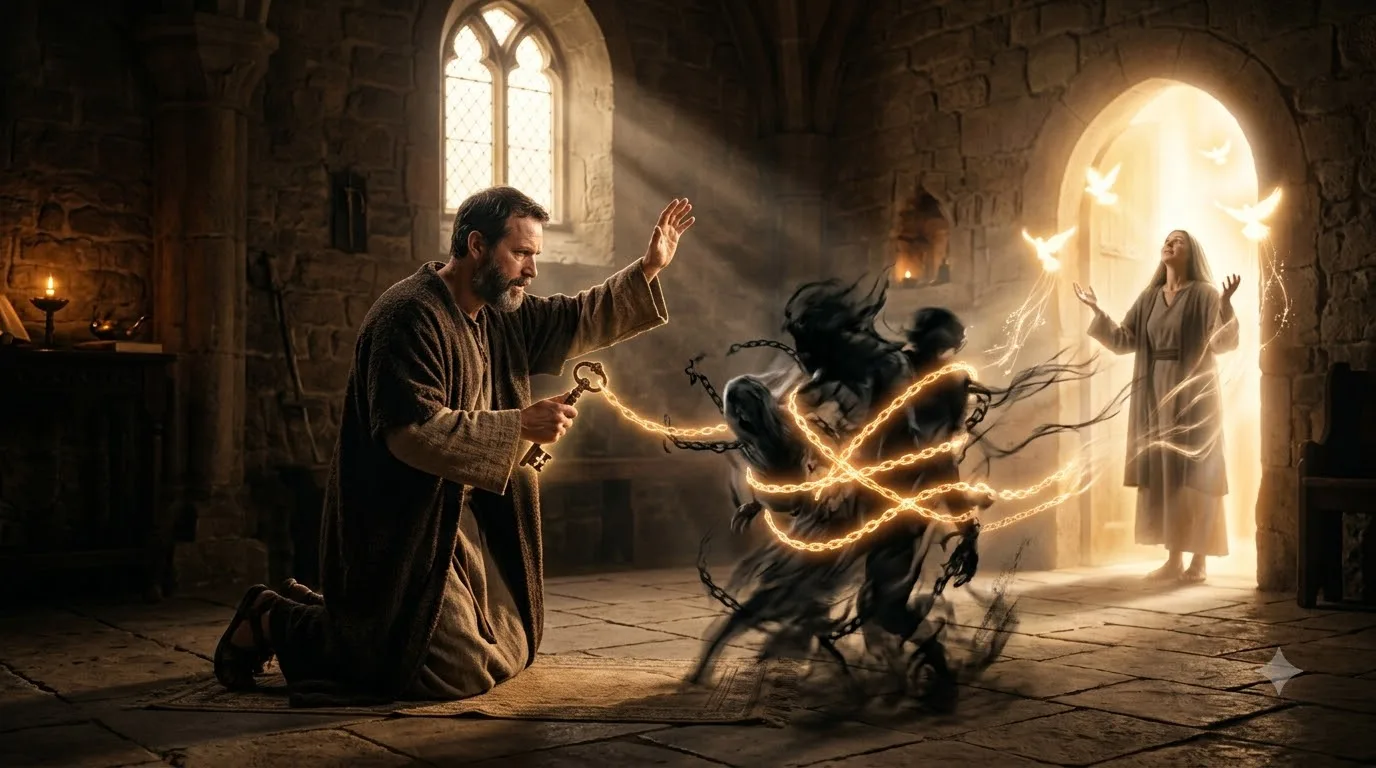
The Theological Conclusion: A Christophany
When we compile these attributes, we face a fascinating reality. This figure speaks as God, acts as God, and accepts worship as God. How can someone be God and the Messenger of God at the same time?
The early church fathers and many conservative theologians conclude that the Angel of the Lord is a Christophany. This is a pre-incarnate appearance of Jesus Christ, the Second Person of the Trinity.
In the New Testament, Jesus is presented as the visible image of the invisible God (Colossians 1:15). It makes sense that the Son actively revealed Himself in visible forms during the Old Testament era to guide His people. Once the incarnation occurs, the distinct title “the Angel of the Lord” disappears from the New Testament narrative. The Word became flesh, replacing temporary manifestations.
Addressing Common Objections
Objection 1: Doesn’t the Bible say no one has seen God?
“No one has seen God at any time. The only begotten Son, who is in the bosom of the Father, He has declared Him.” (John 1:18)
Some argue that because Scripture plainly states no one can see God and live (Exodus 33:20), the Angel of the Lord must be merely a created angelic being.
The Response: The New Testament clarifies that no one has seen God the Father in His unmediated glory. However, God the Son has always been the agent of divine revelation. When Old Testament saints saw the Angel of the Lord, they were seeing the pre-incarnate Son. He accommodated His glory into a form they could perceive without being destroyed.
Objection 2: Calling Jesus an “Angel” diminishes His deity.
Cults like the Jehovah’s Witnesses teach that Jesus is Michael the Archangel, a created being. They point to the word “angel” to argue against Christ’s eternal deity.
The Response: The Hebrew word malakh simply means “messenger.” Calling the pre-incarnate Christ the “Messenger of Yahweh” describes His role in that specific encounter, not His essence. Being the Divine Messenger highlights His willing submission to the Father’s redemptive plan without compromising His divine identity.
Objection 3: Is every mention of “an angel” a Christophany?
It is crucial to distinguish between “the Angel of the Lord” and “an angel of the Lord.” The latter usually refers to a created celestial being carrying out God’s orders.
Context is key. The appearances to Hagar, Abraham, Moses, and Gideon possess the unique hallmarks of divine identity. Other references to angels in prophetic literature might refer to ordinary angels. A Christophany is determined by whether the entity exhibits divine prerogatives and speaks interchangeably as Yahweh.
3 Practical Applications
1. God Sees You in Your Wilderness
The first time the pre-incarnate Christ appears in Scripture, He goes to an abused runaway slave weeping in the desert. This reveals the immense, pursuing compassion of God. If you feel unseen, marginalized, or trapped, know that El-Roi—the God Who Sees—will pursue you into your wilderness. He meets you exactly where you are with grace.
2. Jesus Has Always Been the Rescuer
Jesus wasn’t just waiting in heaven until it was time to be born in Bethlehem. He was actively involved in redemption from the beginning. This sets the stage for how Jesus fulfilled the Old Testament. The same Jesus who fought for His people back then is the Jesus who fights for you today.
3. Cultivate Reverence for the Holiness of God
Whenever people encountered the Angel of the Lord, their response was never casual. Moses took off his sandals. Manoah fell on his face in mortal terror. We must not lose the awe of His holiness. Encountering the living God should lead us to deep humility and a worshipful recognition of His majesty.