

Quick Answer: Discover biblical guidance on choosing a lifelong partner. Explore essential principles of spiritual compatibility, shared mission, and wisdom beyond a simple profession of faith.
In modern Christian culture, navigating the dating world often feels like wandering through an unpredictable maze. Many single Christians are handed a simple, albeit reductive, rule when they begin their search for a spouse: “Just make sure they are a Christian.” This well-meaning advice stems directly from the biblical mandate to marry “in the Lord.” However, it can inadvertently reduce the sacred search for a partner to a theological checkbox.
Once that box is checked, singles often wonder, does God care who I marry? Rather than a relational free-for-all as long as your potential spouse shares your core faith, the Bible provides deep wisdom for making this choice.
The anxiety surrounding this question is palpable. On one side is the creeping fear of settling for someone who merely passes the theological minimum. They might be a poor match in personality, life calling, emotional maturity, or conflict resolution. On the other side is the paralyzing fear of “missing God’s will.” This stems from a hyper-spiritualized view of matchmaking that suggests God has precisely one soulmate for every person on earth.
When the only explicit, unbreakable biblical boundary seems to be a shared faith in Christ, how do we discern God’s guidance? How do we know what matters to Him beyond the baseline of salvation?
To answer whether God cares who you marry beyond their basic Christian confession, we must look past cultural truisms. We need to explore the biblical theology of marriage spanning from Genesis to Revelation. God cares immensely. He cares in a way that emphasizes our spiritual transformation, alignment with His Kingdom mission, and pursuit of godly wisdom.
A Pastoral Note: I sit across from too many engaged couples who look perfect on paper but are completely mismatched in practice. They both go to church and believe the right things, but their daily lives are heading in opposite directions. If one of you is running hard after Jesus and the other is just casually strolling along, you’re going to spend your whole marriage chafing against each other. Being equally yoked isn’t a theological checkbox—it’s a shared trajectory.
The Baseline: Marrying “In the Lord”
Before exploring nuances of compatibility and character, we must establish the non-negotiable biblical foundation. The idea that a Christian should only marry a Christian is not a suggestion for a smoother life. It is a clear command rooted in the spiritual reality of who we are in Christ.
The Unequally Yoked Principle
“Do not be unequally yoked with unbelievers. For what partnership has righteousness with lawlessness? Or what fellowship has light with darkness? What accord has Christ with Belial? Or what portion does a believer share with an unbeliever?” (2 Corinthians 6:14-15, ESV)
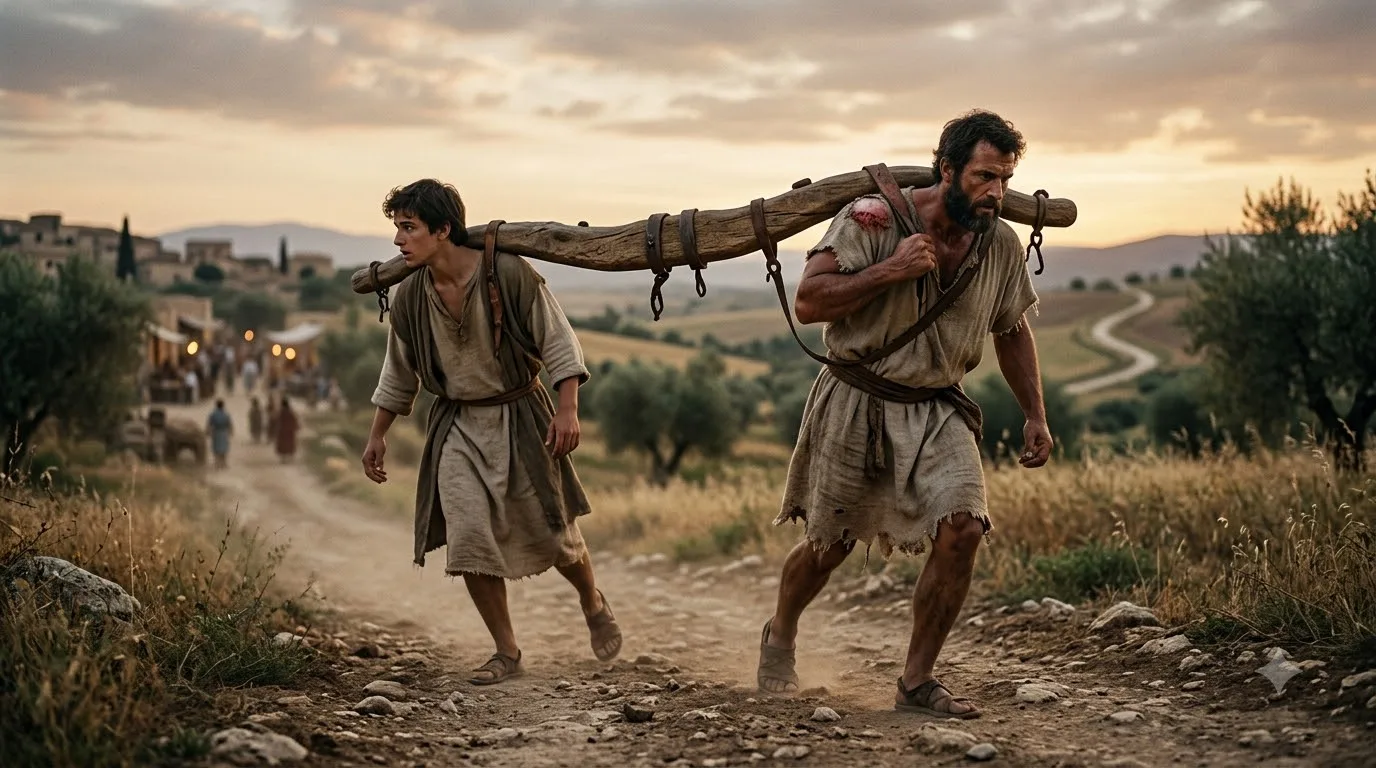
The concept of being “unequally yoked” comes from the Greek verb heterozygeō, translating to “mismatched.” This agricultural metaphor draws from Old Testament law (Deuteronomy 22:10) forbidding plowing with an ox and a donkey together. Their different sizes, gaits, and instincts would chafe their necks and make plowing a straight line impossible.
While Paul writes generally about partnerships with the pagan world, the application to marriage is clear. Marriage is the tightest, most intimate yoke two human beings can share on earth.
If one spouse pulls toward the Kingdom of God and the other pulls toward the world, the yoke will snap under the tension. God’s command here is protective, not restrictive. Tying your soul to someone who does not acknowledge your Lord often leads to spiritual heartbreak.
Only in the Lord
“A wife is bound to her husband as long as he lives. But if her husband dies, she is free to be married to whom she wishes, only in the Lord.” (1 Corinthians 7:39, ESV)
Here, the Apostle Paul explicitly states the boundary for a Christian seeking marriage. He addresses widows but establishes a universal principle: they are free to choose their partner, but the choice must be “in the Lord” (en Kyriō).
This establishes the absolute baseline. However, assuming this is the only thing God cares about drastically misunderstands the purpose of marriage and God’s fatherly care.
Beyond the Checkbox: The Purpose of Christian Marriage
If God’s only requirement was shared faith, any two random Christians could theoretically build a thriving marriage. We know from human experience and Scripture that this is not true. Two genuine believers can still have a dysfunctional marriage. God cares about who you marry because He cares about what marriage is designed to do.
Sanctification: The Crucible of Holiness
Marriage is designed by God as a primary vehicle for our sanctification. The Greek word for sanctification, hagiasmos, refers to the ongoing process of being made holy and set apart.
“Husbands, love your wives, as Christ loved the church and gave himself up for her, that he might sanctify her, having cleansed her by the washing of water with the word…” (Ephesians 5:25-26, ESV)
Who you choose to marry will determine the specific shape of your sanctification. A spouse’s particular weaknesses will grate against your sins. Their unique strengths will challenge your complacency.
A spouse who is nominally Christian but deeply selfish or spiritually apathetic will hinder your spiritual growth and drain your joy. Conversely, a spouse who actively pursues Christ will spur you on toward love and good deeds (Hebrews 10:24).
The ‘Ezer Kenegdo: Shared Mission and Calling
In the Genesis creation account, God looks at Adam and declares, “It is not good that the man should be alone; I will make him a helper fit for him” (Genesis 2:18). The English word “helper” is a weak translation of the Hebrew phrase ‘ezer kenegdo.
The word ‘ezer is not a term of subordination; it is a term of vital strength. In the Old Testament, it frequently describes God Himself as a rescuer and strength-provider (e.g., Psalm 121:1-2). Kenegdo means “corresponding to” or “face-to-face.” Together, it denotes a counterpart in a shared mission.
God gives believers different spiritual gifts and specific callings. If you are called to a life of frugal ministry, and your partner is pursuing a luxury-driven corporate career, you are mismatched in mission. You cannot be a proper ‘ezer kenegdo to one another if you run in opposite directions. Alignment in purpose matters just as much as shared belief.
The “One Soulmate” Myth vs. The Theology of Wisdom
A major source of anxiety for Christian singles is the cultural concept of “The One.” This romanticized idea suggests God has predestined exactly one specific person for you to marry, and missing them ruins your life.
Deconstructing the Soulmate Myth
The idea of a single “soulmate” who completes you is actually rooted in ancient Greek mythology. Plato’s Symposium tells a fable of humans originally having four arms, four legs, and two faces before being split by Zeus. This concept is fundamentally pagan, not biblical.
The biblical theology of marriage implies that God’s will is not a tightrope we might accidentally fall off. Instead, Scripture presents God’s will as a sunlit playing field with clear boundaries. Inside those boundaries, God grants us the freedom to use wisdom to make choices. Once you marry someone, through the act of covenant, they become your “one.”
The Vital Role of Biblical Wisdom
Instead of waiting for a mystical sign, the Bible commands us to pursue wisdom. The Hebrew concept of wisdom, hokhmah, is the applied, practical skill of living well in God’s ordered world.
“Get wisdom; get insight; do not forget, and do not turn away from the words of my mouth. Do not forsake her, and she will keep you; love her, and she will guard you.” (Proverbs 4:5-6, ESV)
When choosing a spouse, applying hokhmah means rigorously evaluating character, assessing practical compatibility, and seeking communal input.
- Character Assessment: Are the fruits of the Spirit (Galatians 5:22-23) consistently evident in their life? Do they exhibit humility to repent when they sin?
- Practical Compatibility: Do you actually enjoy being around each other? Can you communicate effectively without manipulation? Do you agree on finances, gender roles, and raising children?
- Communal Confirmation: What do the wise, objective people in your life think of the relationship? Proverbs 11:14 reminds us, “in an abundance of counselors there is safety.”
Addressing Common Objections and Misconceptions
When discussing the necessity of looking beyond mere Christian profession, several common objections arise.
“But nobody is perfect, and we are all sinners. Shouldn’t I just extend grace?”
Grace is the oxygen of any Christian marriage. Because both you and your future spouse are fallen human beings, you will undoubtedly sin against each other.
However, extending grace within a marriage covenant is different from intentionally entering into a covenant with someone who displays toxic patterns of behavior. God’s grace does not obligate you to deliberately step into a deeply unwise situation.
The book of Proverbs warns about avoiding the “fool”—someone who despises wisdom, mocks instruction, and lacks self-control. A person can profess Christ and still act foolishly.
“What if I feel a deep ‘peace’ about marrying them, even if there are red flags?”
In modern Christian parlance, claiming to have “peace” is often subjective code for emotional infatuation. The prophet Jeremiah offers a sobering warning: “The heart is deceitful above all things, and desperately sick; who can understand it?” (Jeremiah 17:9, ESV).
Our emotions are incredibly unreliable guides when disconnected from truth. True, biblical peace (shalom) perfectly aligns with the objective truth of Scripture. If there are glaring character deficiencies, an emotional feeling of “peace” must not override objective biblical wisdom.
“Didn’t God literally command the prophet Hosea to marry a prostitute?”
Yes, God commanded the prophet Hosea to marry Gomer, a woman who would be habitually unfaithful (Hosea 1:2). This is often brought up to justify marrying someone with severe red flags.
However, this was a specific, unique prophetic act. God used Hosea’s tragic marriage as a living sermon to illustrate His own relentless love for an idolatrous nation.
This text is descriptive history of a specific prophetic calling, not a prescriptive template for modern Christian dating. We are nowhere commanded to intentionally marry someone who will betray us.
3 Practical Applications
If God cares about who we marry beyond a basic profession of faith, how do we actively apply this theology? Here are three concrete takeaways.
-
Prioritize Proven Character Over Spiritual Credentials. Do not settle for a “nominal” Christian who simply warms a pew. Look critically at their character over time. How do they treat service workers or their own family members? When they sin, are they quick to justify it, or quick to repent? The transformative presence of the Holy Spirit should be tangibly evident in their Monday-through-Saturday life.
-
Fiercely Align Your Missions Before Aligning Your Lives. Before you buy a ring, have explicit conversations about your life goals and deep theological convictions. You must be pulling the yoke in the same general direction. Discuss how you view debt, your philosophy of raising children, and what role the local church will play in your family. If your overarching life missions are incompatible, the most loving thing you can do is to walk away.
-
Invite Your Spiritual Community into the Messiness. Dating in a silo is dangerous. Infatuation blinds us to glaring flaws that are painfully obvious to objective onlookers. Invite godly mentors and wise, trusted friends into your relationship. Most importantly, give them explicit permission to speak hard truth to you. If wise counselors express serious reservations, you must not ignore them.
God does not micromanage your decision by hiding a singular “soulmate” in a haystack. But He also does not abandon you to figure it out alone. He provides the clear boundary of shared faith, the compass of biblical wisdom, and the safety net of Christian community.
Marriage is designed to be a living picture of Jesus Christ and His relentless love for the Church (Ephesians 5:32). Choose wisely, choose prayerfully, and choose joyfully. Rest in the knowledge that within the bounds of His wisdom, you are free to build a Kingdom-honoring life together.