Judges Chapter Summaries
A complete, chapter-by-chapter guide to the Book of Judges. Read deep dives into the meaning, historical context, and modern application of every chapter.
Welcome to our complete guide to the Book of Judges. Below you will find a chapter-by-chapter summary that flows through the entire narrative, helping you understand the context, meaning, and application of this profound book.
Chapter 1: Incomplete Conquest
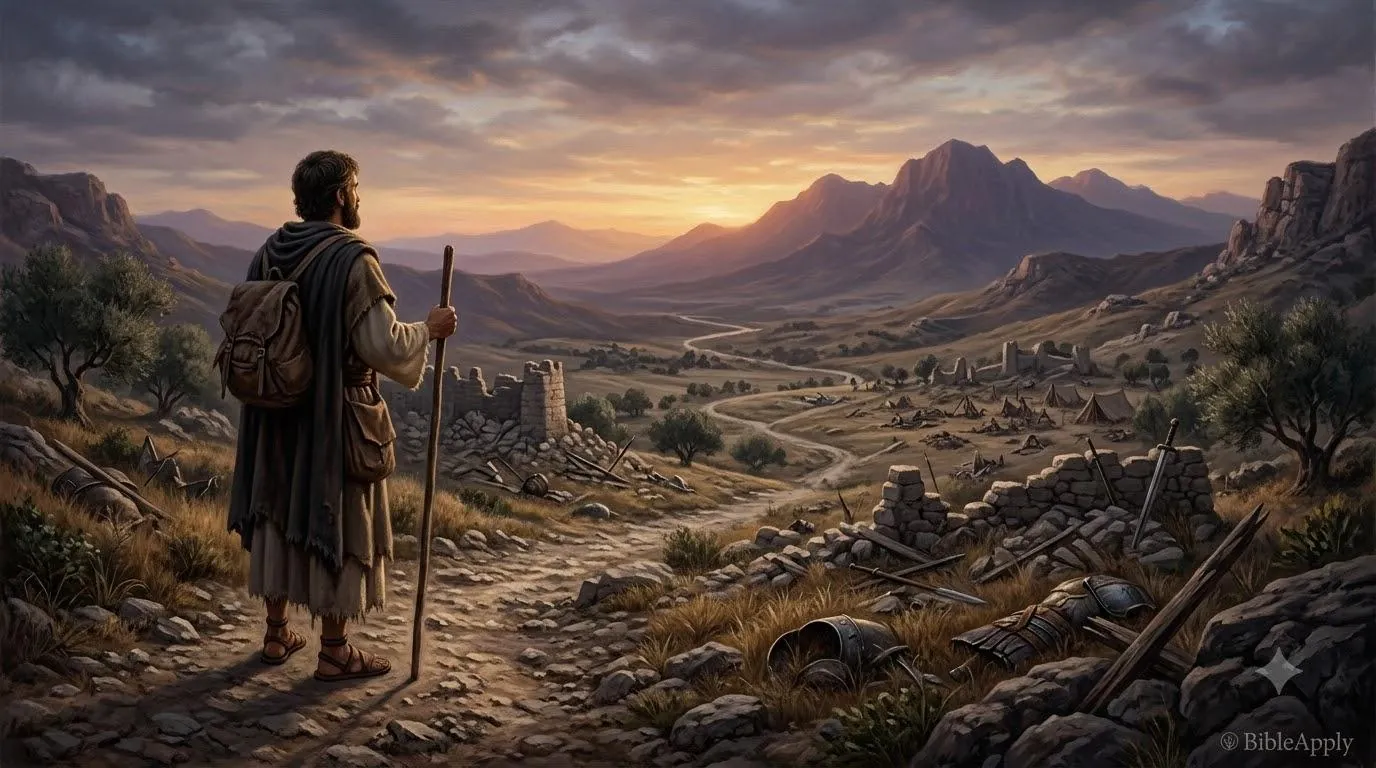
The book of Judges opens in the shadow of a monumental loss: the death of Joshua. Under Joshua’s fierce and faithful leadership, the nation of Israel had experienced miraculous victories. They had crossed the Jordan River on dry ground, seen the walls of Jericho collapse, and witnessed the beginning of the fulfillment of God’s ancient promise to Abraham to give his descendants the land of Canaan. Yet, as Judges 1 begins, the conquest is far from complete. The Israelites are living in a fractured, transitional era. They are no longer a unified army marching under a single visionary commander; instead, they are a loose confederation of independent tribes tasked with clearing out the remaining Canaanite strongholds in their respective, allotted territories.
To understand Judges, we must grasp its overarching narrative structure: spiritual entropy. The book documents a tragic, downward spiral of moral decay, marked by a brutal and repeating cycle. The Israelites rebel against God, God hands them over to oppressive foreign powers, the people cry out in distress, and God mercifully raises up a “judge” (a military and spiritual deliverer) to rescue them. However, with each passing generation, the cycles grow darker, and the judges themselves become increasingly flawed. Chapter 1 serves as the crucial theological prologue to this centuries-long disaster. It essentially answers the burning question: How did God’s chosen people fall so far, so fast?
The answer, we find in this opening chapter, is not an overnight, spectacular apostasy but a series of slow, rationalized, and seemingly pragmatic compromises. Judges 1 reads like a military report card, beginning with promising victories but descending into a depressing refrain of what the tribes “did not” do. It sets a theological precedent that echoes throughout the entirety of Scripture: incomplete obedience is, ultimately, disobedience. When we tolerate sin rather than driving it out, it eventually becomes our master.
The Southern Campaign: Successes and Failures (Verses 1-20)
The Consultation and Judah’s Promising Start (Verses 1-7)
“Now after the death of Joshua it came to pass, that the children of Israel asked the LORD, saying, Who shall go up for us against the Canaanites first, to fight against them? And the LORD said, Judah shall go up: behold, I have delivered the land into his hand.” (Judges 1:1-2)
The chapter begins on a notably hopeful and faithful note. The Israelites do the exact right thing—they seek the Lord’s guidance before acting. The Hebrew phrase for “asked the LORD” typically implies the use of the Urim and Thummim by the High Priest to divine God’s will. God appoints the tribe of Judah to lead the charge. This prophetic elevation of Judah points forward to the future Davidic dynasty and, ultimately, to the Messiah.
Judah partners with the tribe of Simeon—whose territory was situated entirely within Judah’s borders—and they achieve early, stunning military successes. They specifically engage the Canaanites and Perizzites at Bezek, striking down ten thousand men.
Here, they capture the local king, Adoni-Bezek (whose name literally translates to “Lord of Bezek”). In a brutal reflection of ancient Near Eastern warfare, they cut off his thumbs and great toes. While this sounds barbaric to modern ears, Adoni-Bezek himself recognizes the divine, poetic justice in this mutilation, noting that he had done the exact same thing to seventy other kings who subsequently scrounged for scraps under his table. This moment reflects the theological principle of lex talionis (the law of retaliation, or “an eye for an eye”), a legal concept prevalent in the Torah designed to ensure punishments fit the crime. It demonstrates that God’s justice was finally catching up with the deep-seated, systemic wickedness of Canaanite culture.
The Contrast of Wholehearted Faith: Caleb and Achsah (Verses 8-15)
As the narrative shifts to specific conquests in the southern region of the Promised Land, we are reintroduced to Caleb, one of the two faithful spies from Numbers 13 (the other being Joshua). Caleb is an older man now, yet his zeal for Yahweh remains undiminished. He offers his daughter Achsah in marriage to whoever captures the fortified city of Debir (also known as Kiriath-sepher). Othniel, Caleb’s younger relative, captures it and wins the prize. Later, Othniel will become the very first judge of Israel (Judges 3), proving his spiritual pedigree.
Believers seeking more clarity will appreciate our full study on Jeremiah 29:11 Meaning: For I Know the Plans I Have for You.
“And she said unto him, Give me a blessing: for thou hast given me a south land; give me also springs of water. And Caleb gave her the upper springs and the nether springs.” (Judges 1:15)
This seemingly minor, domestic family detail is packed with profound theological significance. Caleb and his family represent the ideal of wholehearted devotion to God. The name Caleb itself is associated with the Hebrew root for “dog” (kelev), which in antiquity could signify fierce, unwavering loyalty to a master. Achsah boldly asks her father for springs of water to sustain her newly acquired dry land in the Negeb, and Caleb generously provides both the upper and lower springs.
This stands in stark, brilliant contrast to the rest of the Israelites in this chapter, who settle for less than what God intended. Caleb’s family aggressively pursues God’s inheritance fully, asking for and receiving the life-giving water necessary to thrive. They are not content with a barren inheritance. Meanwhile, the rest of the nation begins to compromise, settling for half-measures and forfeiting the abundant life God promised.
The Iron Chariots: Where Faith Faltered (Verses 16-20)
“And the LORD was with Judah; and he drave out the inhabitants of the mountain; but could not drive out the inhabitants of the valley, because they had chariots of iron.” (Judges 1:19)
Verse 19 is the pivot point of the chapter and one of the most chilling, tragic verses in the entire Old Testament. The text explicitly states that Yahweh was with Judah. Empowered by the Creator of the universe, they successfully conquered the difficult, mountainous regions. But when they reached the flat plains and valleys, they encountered Canaanite forces equipped with “chariots of iron”—the cutting-edge military technology of the late Bronze / early Iron Age, serving as the ancient equivalent of tanks.
The text says Judah “could not” drive them out. We must pause here and ask a critical theological question: Was God’s sovereign power somehow limited by human metallurgy? Was Yahweh intimidated by iron? Absolutely not. Earlier, God had explicitly promised Joshua that Israel would drive out the Canaanites “though they have iron chariots, and though they be strong” (Joshua 17:18). Furthermore, God had previously destroyed the far superior chariot forces of Pharaoh in the Red Sea.
The failure here was not military or technological; it was entirely theological. It was a failure of faith.
Judah looked at the terrifying, clanking machinery of the Canaanites and allowed natural fear to eclipse the supernatural promises of God. They reasoned that the valley was simply too difficult to conquer and chose to retreat to the safety of the mountains. This sets an incredibly dangerous precedent for the nation: adapting God’s absolute commands to fit human limitations and fears. Judah’s failure teaches us that unbelief will always find a plausible, pragmatic excuse to disobey.
Also Read:
The Northern Campaign: The Domino Effect of Compromise (Verses 21-36)
Once Judah, the lead and most powerful tribe, compromises, the spiritual dam breaks. The rest of the nation follows suit. The remainder of Judges 1 transitions from a narrative of conquest into a repetitive, tragic litany of failure. The Hebrew verb yarash (to drive out, dispossess, or inherit) appears repeatedly, but now in the negative form.
If you want to explore this further, our in-depth study on jeremiah 29 11 breaks this down verse by verse.
“And the children of Benjamin did not drive out the Jebusites that inhabited Jerusalem…” (v. 21) “Neither did Manasseh drive out the inhabitants of Bethshean and her towns…” (v. 27) “Neither did Ephraim drive out the Canaanites that dwelt in Gezer…” (v. 29) “Neither did Zebulun drive out the inhabitants of Kitron…” (v. 30)
As the depressing list continues, a troubling and darker pattern emerges. Initially, it seemed the Israelites couldn’t drive out the Canaanites due to a lack of faith and military fear (as seen with Judah and the chariots). But soon, the text reveals the true, insidious nature of their compromise:
“And it came to pass, when Israel was strong, that they put the Canaanites to tribute, and did not utterly drive them out.” (Judges 1:28)
Notice the profound shift. When Israel gained the upper hand and became “strong,” they possessed the military capability to finish the job. Yet, instead of obeying God’s direct command to completely purge the land of its wicked, hyper-sexualized, and child-sacrificing idolatrous culture, they chose to enslave the Canaanites for economic gain. They preferred forced labor and taxation over divine obedience.
They thought they were being smart and pragmatic. They believed they could domesticate the sin of the Canaanites and use it to their own financial advantage.
This pragmatic compromise sowed the seeds for Israel’s total destruction in the centuries to come. By allowing the Canaanites to remain, Israel essentially invited Canaanite idolatry, immorality, and false gods (like Baal, the storm god, and Asherah, the fertility goddess) directly into their backyards. The very people they thought they had subjugated economically would soon subjugate them spiritually. As Psalm 106:34-36 summarizes this era: “They did not destroy the peoples as the LORD had commanded them, but they mixed with the nations and learned to do as they did. They served their idols, which became a snare to them.”
This topic connects with Psalm 91 Meaning: He Who Dwells in the Shelter, one of the most-searched biblical questions today.
Gospel Connection: The Need for a True, Uncompromising Deliverer
Judges 1 is not just ancient history; it is a profound mirror reflecting the fatal flaw of the human heart. It reveals the deep inadequacy of human leadership and the persistent pull of sin. Joshua was dead, and without a strong, singular leader to hold them accountable, the people naturally drifted into compromise and self-interest. Even the best of Israel—the royal tribe of Judah—faltered when faced with the intimidation of iron chariots. The tribes preferred the immediate comfort of compromise over the difficult, costly work of total obedience.
This chapter screams for the need of a better Leader, a perfect King who will not compromise with evil, who will not negotiate with sin, and who possesses the power to truly conquer the darkest valleys. It points us directly to Jesus Christ, the ultimate “Lion of the tribe of Judah” (Revelation 5:5).
Unlike the ancient Israelites who left their conquest unfinished, seeking comfort and wealth over holiness, Jesus came to do the perfect and complete will of the Father. On the cross, He did not declare a truce with the enemy. He declared, “It is finished” (John 19:30). Christ did not compromise with the “iron chariots” of sin, death, and the devil; He utterly disarmed and defeated them (Colossians 2:15). Where Israel failed to drive out the enemy and secure the land, Jesus perfectly conquered sin and secured the eternal inheritance for His people. Through Christ, believers are empowered not by their own strength, but by the Holy Spirit, to wage war against sin without compromise.
3 Practical Applications from Judges 1
-
Beware of the Trap of Partial Obedience: Judges 1 vividly illustrates that partial obedience in God’s eyes is actually full disobedience. When we justify keeping “small” sins in our lives because they seem manageable, harmless, or even beneficial (just as Israel rationalized taxing the Canaanites for economic gain), we invite spiritual disaster. Sin cannot be domesticated; it must be eradicated. God calls for complete surrender, not negotiated terms. Ask yourself: What area of your life are you currently trying to “tax” or manage, rather than completely “drive out” in repentance?
-
Do Not Let “Iron Chariots” Dictate Your Faith: We all face our own “iron chariots”—obstacles, deeply rooted addictions, relational crises, or intense cultural pressures that seem utterly insurmountable to our human logic. When we look at these massive problems, we often say, “I cannot overcome this. It’s just who I am” or “The culture is too strong.” But God’s promises and power are not limited by human logic or earthly strength. When we allow our fear of circumstances to override our faith in God’s Word, we lose the spiritual battle. We must trust in God’s supernatural strength, remembering that “He who is in you is greater than he who is in the world” (1 John 4:4).
-
The Deadly Danger of Cultural Assimilation: Israel’s ultimate failure was driven by a desire to comfortably coexist with the surrounding pagan culture rather than endure the hardship of standing apart as God’s distinct, holy people. Today, the church faces the exact same temptation. There is immense pressure to compromise our biblical ethics, to water down the truth of Scripture, and to fit in with the modern Canaanites of our secular age. We must be vigilant not to absorb the values, ethics, and idols of the culture around us. We are called to be salt and light, which requires living as distinct, uncompromising representatives of Jesus Christ in a world that desperately needs the uncompromising truth of the Gospel.
Also Read
- 2 Kings 1 Summary & Meaning: The God Who Answers by Fire
- Lamentations 1 Summary & Meaning: The Weeping of a Desolate City
- Song of Solomon 1 Summary & Meaning: The Dawning of Desire
Read Judges 1
Dive into the full scripture text for deeper study.
Chapter 2: The Cycle of Rebellion
They quickly abandon God to serve Baal and the Ashtaroth, provoking God's anger. He hands them over to raiders and oppressors, yet in His mercy, God raises up 'judges' to deliver them. Tragically, as soon as each judge dies, the Israelites plunge even deeper into corruption, establishing a tragic, repetitive cycle of sin, suffering, supplication, and salvation.
Chapter 3: The First Deliverers
Upon relapsing into sin, Israel is oppressed by King Eglon of Moab for eighteen years. God then raises Ehud, a left-handed Benjamite, who executes a daring and gruesome assassination of the fat king in his private chamber. Ehud escapes, rallies the Israelites, and defeats the Moabites, ushering in eighty years of rest. Briefly mentioned is Shamgar, who saves Israel by striking down six hundred Philistines with an oxgoad.
Chapter 4: Deborah and Barak
The Lord completely routs Sisera's formidable chariot army before Barak. Fleeing on foot, Sisera seeks refuge in the tent of Jael, the wife of Heber the Kenite. As the exhausted commander sleeps, Jael drives a tent peg through his temple, decisively fulfilling Deborah's prophecy and delivering Israel.
Chapter 5: The Song of Victory
The poetic narrative vividly describes the cosmic scale of the conflict, where even the stars fought from heaven and the river Kishon swept away the enemy. It dramatically retells Jael's courageous assassination of Sisera and poetically imagines Sisera’s mother anxiously and vainly waiting for her son's return. The song concludes with a powerful prayer for God's enemies to perish and His lovers to shine like the sun.
Chapter 6: The Call of Gideon
Despite Gideon's profound feelings of inadequacy, God assures him of His presence. Gideon begins his mission by courageously, though secretly by night, tearing down his father’s altar to Baal. To confirm his daunting calling, Gideon places a fleece on the threshing floor, asking God for two specific signs with the morning dew, which the Lord graciously provides.
Chapter 7: Gideon's Three Hundred
That night, God encourages a still-hesitant Gideon by allowing him to overhear a Midianite soldier recounting a dream of their impending defeat. Emboldened, Gideon equips his small band with trumpets, empty pitchers, and torches. They surround the vast enemy camp in the dead of night, smashing the pitchers and blowing their trumpets while shouting for the Lord and Gideon. The panicked Midianites turn their swords on one another and flee into the darkness.
Chapter 8: Victory and Compromise
After executing the kings in retaliation for his brothers' deaths, the Israelites urge Gideon to rule over them as king. He rightly refuses, declaring that the Lord is their ruler. However, Gideon immediately requests their gold plunder to craft an ephod—a priestly garment. This well-intentioned artifact quickly becomes an idol, ensnaring Gideon’s family and all of Israel in spiritual compromise, casting a dark shadow over his remaining years.
Chapter 9: The Usurpation of Abimelech
After three years of oppressive rule, God sends an evil spirit to sow hostility between Abimelech and the leaders of Shechem. A bitter and bloody conflict ensues, culminating in Abimelech destroying the city and slaughtering its inhabitants. While attempting to burn down a tower in the nearby town of Thebez, a woman drops an upper millstone on Abimelech's head. To avoid the shame of being killed by a woman, he orders his armor-bearer to run him through, fulfilling Jotham's curse.
Chapter 10: Oppression and Repentance
Crushed by their suffering, the Israelites cry out in repentance. The Lord initially refuses to save them, sarcastically telling them to cry out to the false gods they chose to serve. Yet, as the Israelites put away their foreign gods and earnestly serve the Lord, His heart is moved by their misery. As the Ammonite army gathers for war in Gilead, the leaderless Israelites desperately seek a commander.
Chapter 11: Jephthah's Tragic Vow
Filled with the Spirit of the Lord, Jephthah advances to battle. However, he makes a rash and tragic vow: if God grants him victory, he will sacrifice whatever comes out of his house to greet him upon his return. After a crushing defeat of the Ammonites, Jephthah returns home in triumph, only to be met by his only daughter dancing with tambourines. Devastated, he grants her two months to weep for her youth before agonizingly fulfilling his foolish vow.
Chapter 12: Civil Conflict and Succession
Jephthah judges Israel for only six years before his death. The narrative then briefly records the tenures of three minor judges: Ibzan of Bethlehem, Elon the Zebulunite, and Abdon of Pirathon. These men bring a period of peace and are characterized by their numerous offspring and signs of wealth, maintaining stability in the land before the next cycle of rebellion.
Chapter 13: The Birth of Samson
Manoah prays for the man of God to return to teach them how to raise the boy. The Angel reappears, reiterating the instructions. When Manoah prepares a young goat as an offering, the Angel famously ascends in the flames of the altar, revealing His divine nature. Awe-struck and fearful, Manoah and his wife are comforted by her realization that God would not have accepted their sacrifice if He intended to kill them. Soon after, Samson is born.
Chapter 14: The Riddle at the Feast
During his seven-day wedding feast, Samson wagers thirty linen garments with thirty Philistine companions that they cannot solve a riddle based on his lion encounter. Unable to figure it out, the furious guests threaten his new bride, forcing her to coax the answer from Samson. Betrayed, a spirit-empowered Samson travels to Ashkelon, kills thirty Philistines to pay his debt, and storms back to his father's house in anger, leaving his bride to be given to his companion.
Chapter 15: Vengeance with a Jawbone
Seeking refuge in a cave at Etam, Samson is confronted by three thousand men of Judah, who fear Philistine reprisal. He agrees to be bound and handed over. However, as the Philistines approach with shouts of triumph, the Spirit of the Lord breaks the ropes on Samson's arms like charred flax. Finding a fresh jawbone of a donkey, he single-handedly strikes down a thousand Philistine warriors, solidifying his role as a formidable judge.
Chapter 16: Samson and Delilah
While he sleeps, his hair is shaved, and the Lord departs from him. Captured, blinded, and reduced to a grinding slave, Samson becomes an object of mockery at a grand festival honoring the Philistine god Dagon. As thousands gather in the temple, Samson prays for one last surge of strength. Grasping the central pillars, he brings the entire temple down, killing more Philistines in his sacrificial death than he did throughout his turbulent life.
Chapter 17: Micah's Idolatry
Micah establishes his own personal religious center, complete with an ephod and teraphim, and initially consecrates one of his own sons as a priest. Later, a wandering Levite from Bethlehem arrives in the area. Recognizing an opportunity to legitimize his idolatrous operation, Micah hires the Levite to be his personal priest, foolishly believing that this unauthorized arrangement will guarantee the Lord’s favor and prosperity.
Chapter 18: The Migration of Dan
Six hundred armed Danite warriors march toward Laish. En route, they blatantly rob Micah of his carved image, ephod, and household gods, and persuade his opportunistic Levite priest to join them rather than serve a single household. When Micah attempts to reclaim his idols, he is threatened with violence and forced to retreat. The Danites massacre the unsuspecting people of Laish, rebuild the city as Dan, and institutionalize Micah's idolatry for generations.
Chapter 19: The Outrage at Gibeah
In a horrifying act of cowardice reminiscent of Sodom and Gomorrah, the Levite thrusts his concubine outside to the mob. She is brutally abused throughout the night and is found dead on the doorstep in the morning. The callous Levite loads her body onto his donkey, returns home, and coldly cuts her corpse into twelve pieces, sending them throughout the tribes of Israel to demand a unified, violent retribution.
Chapter 20: Civil War in Israel
The conflict is initially disastrous for Israel; despite seeking God's counsel, they suffer devastating defeats on the first two days, losing forty thousand men. Broken and weeping, they fast and offer sacrifices before the Lord. On the third day, using an ambush tactic similar to Joshua's at Ai, Israel finally crushes the Benjamite forces. The slaughter is absolute, destroying cities and livestock, leaving only six hundred Benjamite men alive, hiding in the wilderness at the rock of Rimmon.
Chapter 21: A Desperate Resolution
Still needing two hundred more wives, the elders devise a morally compromised scheme. They instruct the remaining Benjamite men to hide in the vineyards during an annual festival at Shiloh and forcefully kidnap the young women as they come out to dance. The kidnapping secures the survival of the tribe, but the book closes on a dark and chaotic note, reiterating that 'in those days there was no king in Israel. Everyone did what was right in his own eyes.'
Conclusion
We hope this chapter-by-chapter summary of Judges has helped you better understand God's Word. To continue your study, explore our other Bible Chapter Summaries or read our detailed Verse Meanings.