Haggai Chapter Summaries
A complete, chapter-by-chapter guide to the Book of Haggai. Read deep dives into the meaning, historical context, and modern application of every chapter.
Welcome to our complete guide to the Book of Haggai. Below you will find a chapter-by-chapter summary that flows through the entire narrative, helping you understand the context, meaning, and application of this profound book.
Chapter 1: Consider Your Ways
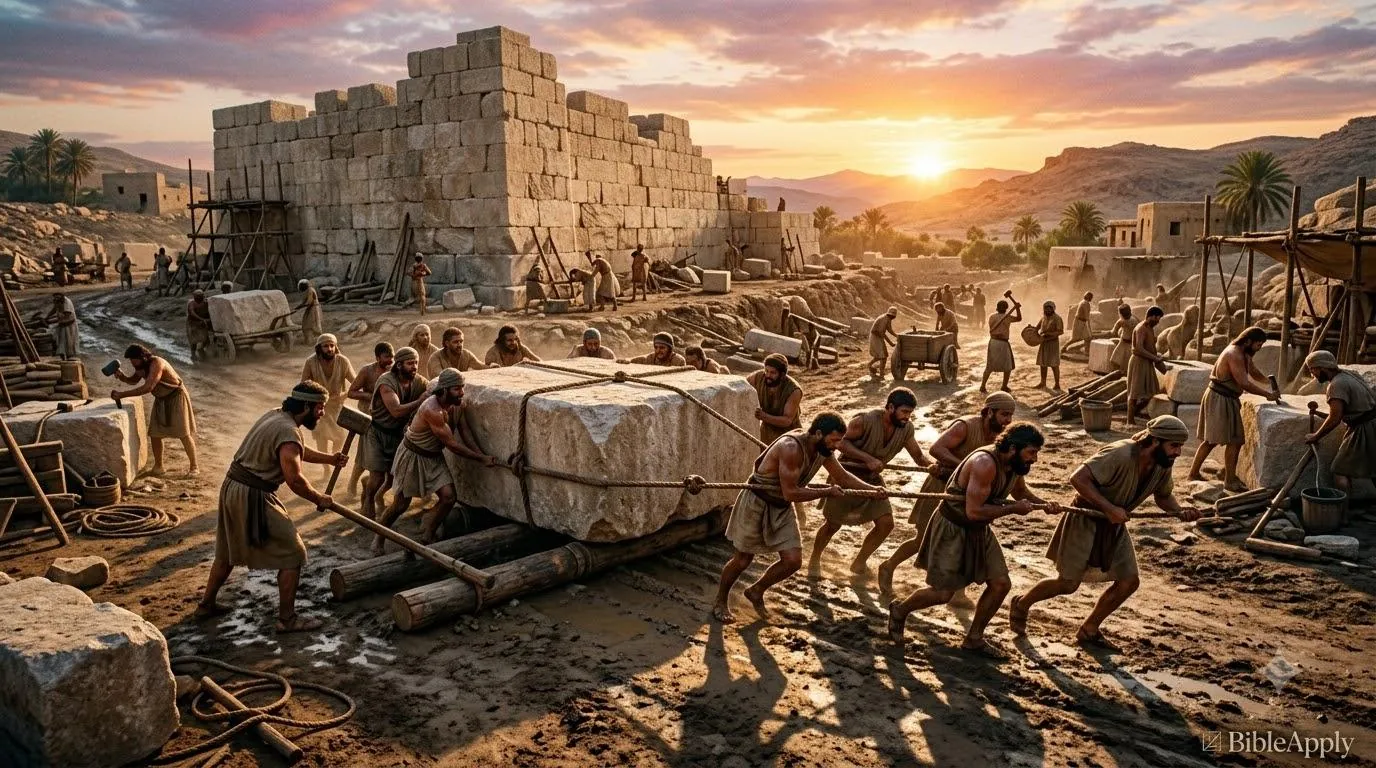
Haggai is one of the shortest books in the Old Testament, yet it packs an immense theological punch. Historically, the book is situated in the post-exilic period. In 538 B.C., King Cyrus of Persia issued a decree allowing the Jewish exiles to return to Jerusalem and rebuild the temple that Babylonian forces had tragically destroyed in 586 B.C. A remnant returned under the leadership of Zerubbabel (the governor) and Joshua (the high priest). They quickly laid the foundation of the temple amid a profound mixture of great rejoicing and bitter weeping (Ezra 3). However, intense opposition arose from neighboring Samaritans, and a subsequent decree from the Persian court forced the work to halt. For sixteen long years, the temple site lay in ruins. During this time, the people shifted their attention away from the things of God to their own lives, becoming increasingly preoccupied with personal comfort, agricultural success, and economic stability.
Chapter 1 of Haggai bursts onto this scene of spiritual apathy in 520 B.C. with a prophetic wake-up call. God raises up Haggai to confront the lethargy and misplaced priorities of the returned exiles. This opening chapter sets the stage for the entire book by addressing the fundamental issue of the human heart: who or what occupies the center? It masterfully juxtaposes the unfinished house of God with the lavishly paneled houses of the people, highlighting the devastating spiritual and physical consequences of elevating personal ambition above divine worship.
This chapter is not merely a historical account of an ancient building project; it is a profound theological diagnosis of the human condition. It reveals how easily we can become desensitized to spiritual ruin when our physical comforts are prioritized. Furthermore, Haggai 1 powerfully illustrates the restorative power of God’s Word—how it confronts our flimsy excuses, awakens our dormant spirits, and realigns our priorities with the kingdom of God. As we dive into this chapter section by section, we discover that the divine command to “consider your ways” is as urgent and life-giving for the modern believer as it was for the ancient Israelite.
The Excuse of a Complacent People (Haggai 1:1-4)
The Timing and the Rationalization
The chapter opens with a precise timestamp: “In the second year of Darius the king, in the sixth month, in the first day of the month” (Haggai 1:1, KJV). God speaks on a very specific day, signaling that He is sovereign over history and acutely aware of how much time has passed. Sixteen years of inaction is enough. Through Haggai, God addresses the leadership—Zerubbabel and Joshua—but His message targets the collective attitude of the entire nation.
“Thus speaketh the LORD of hosts, saying, This people say, The time is not come, the time that the LORD’s house should be built.” (Haggai 1:2, KJV)
Notice the chilling exactness of their excuse. The people did not say, “We will never build the temple,” or “We reject God.” Instead, they said, “The time is not come.” The greatest enemy of spiritual obedience is rarely outright, fist-shaking rebellion; it is often rationalized procrastination. They likely looked at the economic difficulties, the political opposition, and the sheer magnitude of the task, and concluded it simply wasn’t the right season. It was a subtle form of self-deception. They confused their own lack of zeal with divine providence.
The Contrast of Paneled Houses
God immediately pierces through their rationalization with a striking rhetorical question:
“Is it time for you, O ye, to dwell in your cieled houses, and this house lie waste— (Haggai 1:4, KJV)
The word translated as “cieled” or “paneled” is the Hebrew word saphun (סָפוּן). It refers to being covered or paneled, usually with expensive cedar wood. In the ancient world, paneled houses were a mark of royalty and luxury (Solomon used cedar to panel the first temple and his own palace, as seen in 1 Kings 7:7).
The theological indictment here is profound. The exiles had taken the very resources, time, and energy meant for the glory of God and redirected them toward their own extravagant comfort. While the place of God’s presence—the physical representation of the covenant—lay in disgraceful ruins, the people were living in luxury. God highlights the hypocrisy: they claimed it wasn’t the right time for His house, yet they found ample time and resources for their own.
This topic connects with Jeremiah 29:11 Meaning: For I Know the Plans I Have for You, one of the most-searched biblical questions today.
The Futility of Misplaced Priorities (Haggai 1:5-6)
A Call to Introspection
Having exposed their hypocrisy, the Lord of Hosts issues a defining command that echoes throughout the book:
“Now therefore thus saith the LORD of hosts; Consider your ways.” (Haggai 1:5, KJV)
The Hebrew phrase translated “consider your ways” is simu levabkhem ‘al darkekhem (שִׂימוּ לְבַבְכֶם עַל־דַּרְכֵיכֶם), which literally translates to “set your heart upon your roads.” It is a demand for deep, honest introspection. God is asking them to evaluate the trajectory of their lives, to look at the path they are walking, and to assess where it is actually leading them.
The Theology of Frustration
God then forces them to look at the undeniable results of their self-centered living:
“Ye have sown much, and bring in little; ye eat, but ye have not enough; ye drink, but ye are not filled with drink; ye clothe you, but there is none warm; and he that earneth wages earneth wages to put it into a bag with holes.” (Haggai 1:6, KJV)
This vivid description outlines the theology of frustration. The exiles were working harder than ever, yet experiencing diminishing returns. This is not arbitrary punishment; it is the enactment of the covenant curses outlined in Deuteronomy 28. When Israel put God first, the land would yield its blessing. When they turned to idolatry—and in this case, the idolatry of self and comfort—the universe would refuse to cooperate.
There is a profound theological truth here: whenever we seek ultimate satisfaction in anything other than God, we will inevitably be left empty. It is the curse of the “bag with holes.” You can pour all your money, energy, and ambition into worldly pursuits, but without God at the center, the soul remains starved. Like the book of Ecclesiastes famously declares, life under the sun without reference to the Creator is hebel—a vapor, vanity, and a chasing after the wind.
The Divine Remedy: Rebuild for God’s Glory (Haggai 1:7-11)
The Call to Action
The Lord repeats His call to “Consider your ways” (verse 7) and then provides the practical remedy for their spiritual sickness:
“Go up to the mountain, and bring wood, and build the house; and I will take pleasure in it, and I will be glorified, saith the LORD.” (Haggai 1:8, KJV)
The command is straightforward: Go, bring, build. Repentance in Haggai is not merely a feeling of remorse; it involves tangible obedience. But the motivation is what matters most. They are not building just to have a nice structure in the city; they are building so that God may “take pleasure in it” and be “glorified.” The Hebrew word for glory is kabad (כָּבַד), which implies weightiness, significance, and honor. By rebuilding the temple, the people would be visibly declaring that God is the heaviest, most significant reality in their community.
Also Read:
The Severe Mercy of the Drought
God then makes a startling claim regarding the economic hardship the people had been facing:
“Ye looked for much, and, lo, it came to little; and when ye brought it home, I did blow upon it. Why? saith the LORD of hosts. Because of mine house that is waste, and ye run every man unto his own house. Therefore the heaven over you is stayed from dew, and the earth is stayed from her fruit. And I called for a drought upon the land…” (Haggai 1:9-11, KJV)
God takes direct responsibility for their failed crops and economic struggles. He says, “I did blow upon it” and “I called for a drought.” In the Hebrew text, there is a brilliant, though tragic, play on words. God says that because His house lies in “ruins” (hareb, חָרֵב), He has called for a “drought” (horeb, חֹרֶב) upon the land.
This is a demonstration of God’s severe mercy. He orchestrated their circumstances and frustrated their self-centered pursuits to wake them up. If they had been prosperous while the temple lay in ruins, they would have happily continued in their spiritual slumber, drifting further from the covenant. God loved them too much to let them succeed in their sin.
The Response: Repentance and the Empowering Presence (Haggai 1:12-15)
The Fear of the Lord
The preaching of Haggai yielded immediate and spectacular results. Unlike many of the pre-exilic prophets (like Jeremiah or Isaiah) whose messages were largely rejected, Haggai’s audience listened.
If you want to explore this further, our in-depth guide on isaiah 41 10 breaks this down verse by verse.
“Then Zerubbabel… and Joshua… with all the remnant of the people, obeyed the voice of the LORD their God, and the words of Haggai the prophet… and the people did fear before the LORD.” (Haggai 1:12, KJV)
True revival always begins with a restoration of the fear of the Lord. It is a holy reverence that recognizes God’s absolute authority and supremacy. They stopped making excuses and submitted to the divine word.
The Gospel Connection: The Promise of Immanuel
In response to their obedience and reverence, God immediately issues one of the most comforting phrases in all of Scripture:
This topic connects with Psalm 91 Meaning: He Who Dwells in the Shelter, one of the most-searched biblical questions today.
“Then spake Haggai the LORD’s messenger in the LORD’s message unto the people, saying, I am with you, saith the LORD.” (Haggai 1:13, KJV)
This is the theological climax of the chapter and a powerful connection to the Gospel. For sixteen years, they had insulted God through their neglect. Yet, the very moment they turn their hearts back to Him in repentance, God doesn’t say, “I will be with you once you finish the roof,” or “I will dwell with you once you prove you are committed.” He simply says, “I am with you,” right there in the rubble and the ruin.
This points gloriously forward to Jesus Christ. In Matthew 1:23, Jesus is called Immanuel, which means “God with us.” Christ did not wait for humanity to clean up its act and build a perfect world before He arrived. He descended into the ruin of our sin-cursed world. Jesus Himself is the ultimate Temple (John 2:19-21), the true and final meeting place between God and humanity. The promise of God’s presence is not the reward for a finished building; it is the grace provided to empower the work itself.
The Awakened Spirit
The chapter concludes by showing how this divine presence practically functions in the lives of believers:
“And the LORD stirred up the spirit of Zerubbabel… and the spirit of Joshua… and the spirit of all the remnant of the people; and they came and did work in the house of the LORD of hosts, their God.” (Haggai 1:14, KJV)
The phrase “stirred up” translates the Hebrew word ‘ur (עוּר), which means to awaken, rouse, or excite to action. The people obeyed, but it was God who provided the spiritual energy to do so. We cannot accomplish kingdom work in the flesh. As the Apostle Paul would later articulate, “For it is God which worketh in you both to will and to do of his good pleasure” (Philippians 2:13, KJV). True obedience is always a synergistic dance between human submission and divine awakening.
3 Practical Applications from Haggai 1
1. Audit Your Priorities in Light of Eternity
Haggai commands us to “set our hearts upon our roads.” We must regularly evaluate where our time, money, and energy are going. Look closely at your bank statement and your calendar—they are the most accurate theological documents of your life, revealing what you truly worship. Are you pouring your best resources into building your own “paneled house” (your career, your comfort, your status), while neglecting the kingdom of God? We must purposefully arrange our lives so that the glory of God remains at the absolute center.
2. Beware the Subtlety of the “Not Yet” Excuse
The exiles didn’t refuse to build the temple; they just claimed it wasn’t the right time. We do the exact same thing. We tell ourselves, “I’ll start serving at church when work slows down,” or “I’ll give generously once I reach a certain income,” or “I’ll deal with my habitual sin in the next season of life.” Procrastination in the things of God is a subtle, dangerous form of idolatry because it assumes we have sovereignty over our time. If God is calling you to obedience today, do not delay it until tomorrow.
3. Rest in the Promise of God’s Presence for God’s Work
Whenever God calls us to a daunting task—whether it’s rebuilding a broken marriage, stepping into a new ministry, breaking an addiction, or sharing the gospel with a neighbor—we are never expected to do it in our own strength. The promise of Haggai 1:13, “I am with you,” is the fuel for all Christian obedience. When you feel inadequate or overwhelmed by the spiritual ruins around you, remember that the Holy Spirit is present to “stir up your spirit.” We labor with courage because Immanuel, God with us, has already secured the victory.
Also Read
- 1 Timothy 1 Summary & Meaning: Guarding the Gospel and the Grace of God
- 2 Timothy 1 Summary & Meaning: Fanning the Flame of Faith in a Dark World
- Genesis 1 Summary & Meaning: In the Beginning
Read Haggai 1
Dive into the full scripture text for deeper study.
Chapter 2: The Coming Glory
Months later, Haggai delivered another message regarding defilement and blessing. He reminded them that their previous disobedience had tainted their offerings and brought economic hardship. However, God declared a turning point: 'From this day on, I will bless you.' The book concludes with a powerful, personal promise to Zerubbabel. Amidst the future shaking of kingdoms and the overthrow of earthly powers, God chose Zerubbabel to be His 'signet ring,' a symbol of divine authority and a messianic guarantee that the Davidic line would continue, culminating ultimately in Jesus Christ.
Conclusion
We hope this chapter-by-chapter summary of Haggai has helped you better understand God's Word. To continue your study, explore our other Bible Chapter Summaries or read our detailed Verse Meanings.