Deuteronomy Chapter Summaries
A complete, chapter-by-chapter guide to the Book of Deuteronomy. Read deep dives into the meaning, historical context, and modern application of every chapter.
Jump to Chapter
Welcome to our complete guide to the Book of Deuteronomy. Below you will find a chapter-by-chapter summary that flows through the entire narrative, helping you understand the context, meaning, and application of this profound book.
Chapter 1: The Journey Reviewed: Failure at Kadesh
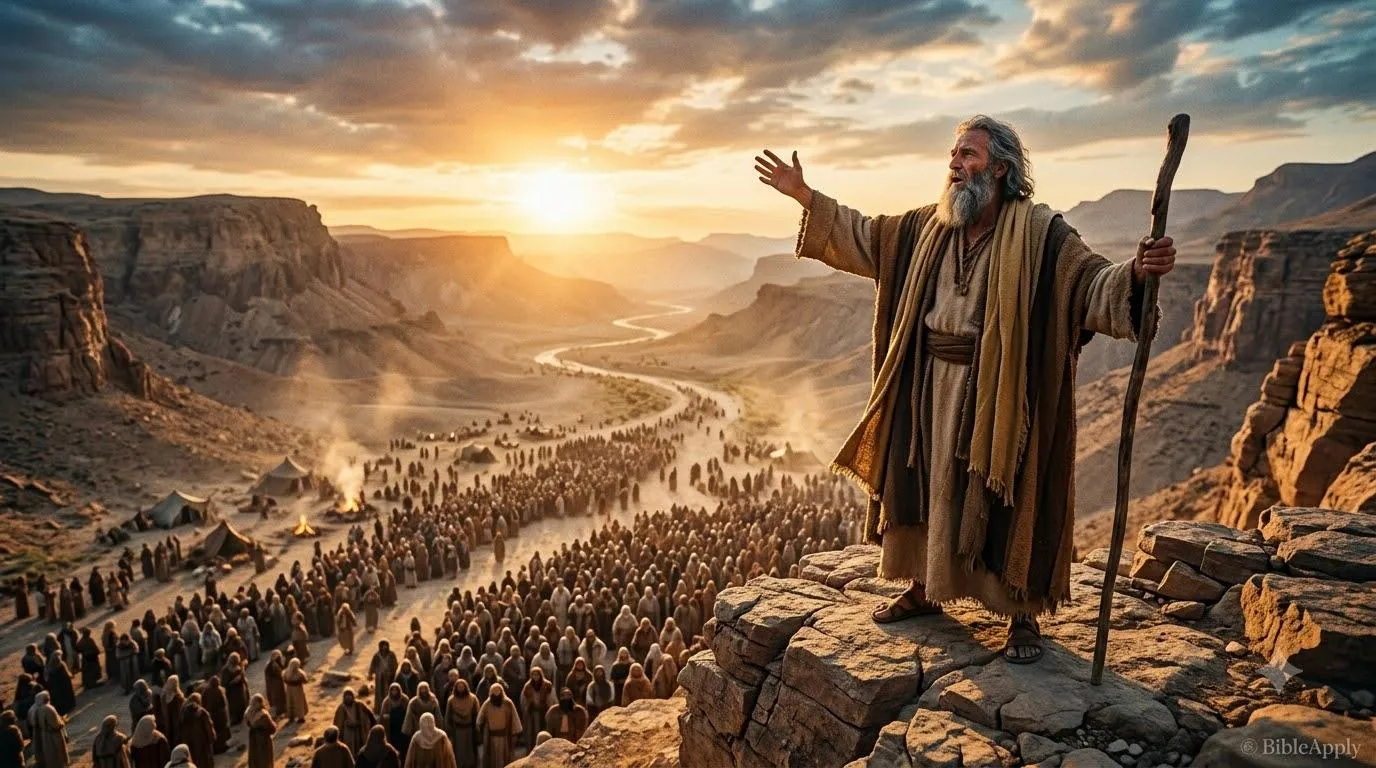
The book of Deuteronomy is one of the most significant and frequently quoted books in all of Scripture. Jesus Himself quoted it during His temptation in the wilderness. To understand Deuteronomy, we must first understand its title and setting. The English name “Deuteronomy” comes from the Greek Septuagint translation, Deuteronomion, which means “Second Law.” However, in the original Hebrew Bible, the book is named after its opening phrase: Elleh HaDevarim, meaning “These are the words.” Deuteronomy is not a completely new law, but rather a passionate, pastoral re-preaching of God’s covenant words to a new generation.
Historically, the setting of Chapter 1 is highly dramatic. It is the fortieth year after the Exodus from Egypt, in the eleventh month, on the first day of the month. The Israelites are camped on the plains of Moab, just east of the Jordan River. Across the river lies the Promised Land, the fulfillment of God’s ancient promises to Abraham, Isaac, and Jacob. But there is a shadow hanging over this camp. The older generation—the ones who saw the Red Sea part and ate the first manna from heaven—are all dead. Their bones are scattered across the wilderness because of their rebellion and unbelief. Now, the new generation stands on the precipice of destiny.
Moses, who is 120 years old and knows he will soon die and not enter the land himself, stands before this young congregation. Deuteronomy 1 is the beginning of his farewell address. It serves as a historical prologue, reminding the Israelites of where they have been, how they failed, and the unchanging faithfulness of the God who carried them. Moses is setting the stage to renew the covenant, urging this new generation not to repeat the fatal mistakes of their parents.
The Setting and the Sermon (Verses 1-5)
“These be the words which Moses spake unto all Israel on this side Jordan in the wilderness, in the plain over against the Red sea… (There are eleven days’ journey from Horeb by the way of mount Seir unto Kadesh-barnea.)” (Deuteronomy 1:1-2)
Moses begins by grounding his sermon in a specific time and place. This is not mythology; it is real history, occurring on the eastern side of the Jordan River. But verse 2 contains one of the most heartbreaking parentheticals in the entire Bible: “There are eleven days’ journey from Horeb [Sinai]… unto Kadesh-barnea.”
Kadesh-barnea was the southern border of the Promised Land. Geographically, it should have only taken the Israelites eleven days to travel from the mountain where they received the Law to the edge of their inheritance. Instead, it took them forty years. Why? Because of their unbelief. This single verse serves as a profound theological warning: what should have been a brief journey of faith was turned into a lifetime of wandering because of disobedience.
Verse 5 tells us that Moses “began to declare this law.” The Hebrew word used for “declare” or “explain” is baar, which originally meant to dig deeply, to make plain, or to engrave on stone. Moses isn’t just reciting facts; he is digging deep into the theological meaning of the Torah. He wants the law engraved on their hearts so they will obey it with love, not just legalistic duty.
The Command to Move Forward (Verses 6-8)
“The LORD our God spake unto us in Horeb, saying, Ye have dwelt long enough in this mount: Turn you, and take your journey, and go to the mount of the Amorites… behold, I have set the land before you: go in and possess the land which the LORD sware unto your fathers, Abraham, Isaac, and Jacob, to give unto them and to their seed after them.” (Deuteronomy 1:6-8)
If you want to explore this further, our in-depth guide on isaiah 41 10 breaks this down verse by verse.
Moses takes the people back in time to Mount Horeb (another name for Mount Sinai). God had given them the Law, the tabernacle, and the priesthood. But they had stayed at the mountain for nearly a year. It was a place of profound spiritual revelation, but it was not their final destination. God tells them, “You have dwelt long enough in this mount.”
Theologically, this represents the danger of spiritual complacency. The Israelites were comfortable at Sinai. They had a routine, they had the daily manna, and they had the manifest presence of God. But God had a mission for them. They were called to conquer the Canaanites and establish a holy nation that would be a light to the Gentiles. True biblical faith is dynamic, not static. God calls His people to move forward into the promises He has sworn.
For a deeper study, see our guide on Jeremiah 29:11 Meaning: For I Know the Plans I Have for You which many readers have found helpful.
Notice the foundation of God’s command: “which the LORD sware unto your fathers.” The conquest of Canaan wasn’t an imperial land grab; it was the fulfillment of an ancient, unilateral covenant. God is reminding them that their future success rests entirely on His past promises.
The Burden of Leadership (Verses 9-18)
Before recounting the march to Kadesh-barnea, Moses inserts a seemingly administrative memory: the appointment of judges.
“And I spake unto you at that time, saying, I am not able to bear you myself alone… How can I myself alone bear your cumbrance, and your burden, and your strife— (Deuteronomy 1:9, 12)
Moses was the greatest prophet of the Old Testament, yet he was deeply aware of his human limitations. The sheer numerical growth of Israel—fulfilling God’s promise to make them like the “stars of heaven”—made it impossible for one man to govern them. The Hebrew word for burden here implies a heavy, crushing weight.
Moses delegates authority to wise, understanding, and respected men from each tribe. He gives them a strict charge regarding justice: they must not show partiality. “Ye shall not respect persons in judgment; but ye shall hear the small as well as the great; ye shall not be afraid of the face of man; for the judgment is God’s” (v. 17).
In the ancient Near East, justice was often sold to the highest bidder, and the poor had no voice. But Israel’s legal system was to reflect the character of Yahweh. Because God is perfectly just and shows no partiality, His representatives must judge righteously. This section underscores that the kingdom of God is built on both righteous leadership and equitable justice.
The Tragedy at Kadesh-Barnea: Fear and Unbelief (Verses 19-33)
This is the emotional and theological core of the chapter. Moses recounts the fatal moment at Kadesh-barnea when the previous generation refused to enter the Promised Land.
They sent twelve spies into the land, who returned with the fruit of the valley and a good report: “It is a good land which the LORD our God doth give us” (v. 25). But the people rebelled. They were terrified by the size of the Canaanite cities and the giant inhabitants, the sons of the Anakim.
The root of their rebellion is exposed in verse 27:
“And ye murmured in your tents, and said, Because the LORD hated us, he hath brought us forth out of the land of Egypt, to deliver us into the hand of the Amorites, to destroy us.”
This is the anatomy of all sin. At its core, sin is a failure to trust the goodness of God. The Israelites looked at the fortified walls and the giants, and instead of remembering the ten plagues and the parted Red Sea, they concluded that God must hate them. They projected their own fear onto God’s character.
Also Read:
Moses had tried to encourage them by pointing to God’s fatherly care:
“The LORD your God which goeth before you, he shall fight for you, according to all that he did for you in Egypt before your eyes; And in the wilderness, where thou hast seen how that the LORD thy God bare thee, as a man doth bear his son, in all the way that ye went, until ye came into this place.” (Deuteronomy 1:30-31)
The Hebrew verb used here for “bare” or “carried” is nasa. It paints a beautiful, intimate picture of a weary child being scooped up and carried on the shoulders of a strong, loving father. God wasn’t a distant taskmaster; He was a devoted Father who had carried them through the scorching desert, provided fire by night and a cloud by day. Yet, as verse 32 tragically states, “Yet in this thing ye did not believe the LORD your God.”
The Judgment of God and the Cost of Rebellion (Verses 34-40)
God’s response to their stubborn unbelief is swift and severe. He swears an oath that not one of the evil generation will see the good land, except for Caleb and Joshua, who “wholly followed the LORD.”
The judgment reveals God’s absolute holiness. God is incredibly patient, but there is a line where His patience gives way to righteous judgment. The generation that continually despised His grace was sentenced to die in the wilderness.
Moses also includes himself in this judgment: “Also the LORD was angry with me for your sakes, saying, Thou also shalt not go in thither” (v. 37). Though Moses’ specific sin of striking the rock happens later in the historical timeline (Numbers 20), he includes it here to show solidarity with the people. It demonstrates a profound theological truth: leadership is costly, and those who represent God are held to the strictest standards. Even the great Moses could not rely on his past resume to excuse his disobedience.
The Presumption of the Flesh (Verses 41-46)
The chapter concludes with a tragic postscript. Upon hearing God’s judgment, the Israelites suddenly changed their minds.
Many believers wrestle with the question of psalm 23 kjv — and Scripture has profound, life-changing answers.
If you want to explore this further, our in-depth study on romans 8 28 breaks this down verse by verse.
This topic connects with Psalm 91 Meaning: He Who Dwells in the Shelter, one of the most-searched biblical questions today.
“Then ye answered and said unto me, We have sinned against the LORD, we will go up and fight, according to all that the LORD our God commanded us.” (Deuteronomy 1:41)
They strapped on their weapons and marched up the mountain, assuming they could simply reverse their mistake. But God warned them: “Go not up, neither fight; for I am not among you.”
They went up anyway, acting in pride and presumption. The result was a massacre. The Amorites chased them “as bees do” and destroyed them in Seir. When the survivors returned, they “wept before the LORD; but the LORD would not hearken to your voice, nor give ear unto you” (v. 45).
This teaches a vital distinction between worldly sorrow and godly repentance. The Israelites were not crying because they had grieved God’s heart; they were crying because they didn’t like the consequences of their sin. They tried to accomplish in the flesh what could only be done by the Spirit’s presence. Without God among them, their military might was useless.
Gospel Connection: Finding True Rest
Deuteronomy 1 is not just an ancient history lesson; it is a profound gospel foreshadowing. In the New Testament, the author of Hebrews points directly back to this rebellion in the wilderness (Hebrews 3 and 4). He warns Christians, “Take heed, brethren, lest there be in any of you an evil heart of unbelief, in departing from the living God” (Hebrews 3:12).
The Israelites failed to enter the Promised Land because of unbelief. They lacked a mediator who could permanently change their hearts. This points us to our need for a Greater Moses. Jesus Christ is the ultimate mediator who perfectly obeyed the Father. Where Israel failed in the wilderness, Jesus succeeded (Matthew 4).
Furthermore, while the law of Moses could point out the sin of the people, it could not save them. Moses himself died outside the Promised Land, representing the inability of the Law to bring us into eternal rest. Only Joshua (whose name is the Hebrew equivalent of Jesus) could lead the people into the inheritance. Today, Jesus leads us into the true Sabbath rest—salvation by grace through faith.
3 Practical Applications from Deuteronomy 1
-
Don’t Turn an 11-Day Journey into a 40-Year Wilderness Wandering: The Israelites’ journey was delayed for decades not because God was unfaithful, but because they refused to trust Him. When God calls you to step out in faith—whether in obedience, repentance, or ministry—do not let fear paralyze you. Delayed obedience is disobedience, and unbelief always leads to unnecessary spiritual wandering.
-
Remember that God is a Loving Father Who Carries You: When you face “giants” in your life (financial crises, health scares, broken relationships), you will be tempted to think God hates you or has abandoned you. In those moments, remember the beautiful imagery of Deuteronomy 1:31. God carries you like a father carries his son. Look back at how He has provided for you in the past, and let that history fuel your trust for the future.
-
Beware of Presumption and “Worldly Sorrow”: The Israelites tried to fight their battles without God’s presence, and they wept when they failed. But their tears were tears of regret, not true repentance. True repentance is a turning of the heart back to God, not just a desire to escape punishment. Never presume that you can accomplish God’s work in your own strength. If God is not in it, even your best efforts will end in defeat.
Also Read
- James 1 Summary & Meaning: Trials, Temptation, and True Religion
- Hebrews 1 Summary & Meaning: The Supremacy of the Son
- Joshua 1 Summary & Meaning: Stepping into God’s Promises
Read Deuteronomy 1
Dive into the full scripture text for deeper study.
Chapter 2: The Desert Years: Passing Through the Nations
God explicitly commanded Israel not to provoke these nations, as their lands were divinely allotted to them. However, when King Sihon of Heshbon refused Israel safe passage and marched out to battle, the Lord delivered him into their hands. This decisive victory marked the beginning of Israel's conquest and a tangible proof that God was fighting for them.
Chapter 3: Victory in Transjordan and Moses' Plea
Moses then details the distribution of this conquered land to the tribes of Reuben, Gad, and the half-tribe of Manasseh, on the condition that their warriors cross the Jordan to help their brothers conquer Canaan. The chapter concludes with Moses' heartbreaking plea to God, begging to enter the Promised Land. God denies the request due to Moses' earlier disobedience, instructing him instead to commission Joshua as his successor.
Chapter 4: A Call to Unwavering Obedience
Moses strongly warns against the deadly snare of idolatry, reminding them of the terrifying, formless voice of God at Horeb. They must not make any physical representation of God. He prophesies that future rebellion will lead to exile, but graciously promises that if they seek God wholeheartedly from foreign lands, He will mercifully restore them, for He is a compassionate God.
Chapter 5: The Covenant Renewed: The Ten Commandments
He recounts the terrifying majesty of God's presence on the mountain—the fire, the cloud, and the booming voice. The people, overwhelmed by fear of death, had begged Moses to act as their mediator. Moses reminds them of God's desire for their continual reverence, yearning that their hearts would always fear Him and keep His commandments so that they might prosper.
Chapter 6: The Shema: The Greatest Commandment
This total devotion is to be woven into the fabric of daily life. Parents are instructed to diligently teach these truths to their children—talking about them at home, on the road, and from morning to night. Moses warns them not to forget God once they settle into the prosperous, ready-made cities of Canaan, lest they turn to foreign gods.
Chapter 7: A Holy People Chosen by Grace
Moses reminds the Israelites that their election was not based on their size, power, or righteousness, for they were the most insignificant of peoples. Rather, God chose them solely out of His sovereign, steadfast love and His faithfulness to the patriarchal promises. Because of this divine grace, they are called to be a holy, set-apart people, completely devoted to their covenant-keeping God.
Chapter 8: Remembering God in the Good Land
As they prepare to enter a land flowing with water, wheat, vines, and resources, Moses issues a stern warning against spiritual amnesia. He cautions that prosperity often breeds dangerous pride. When they are wealthy and comfortable, they must not deceive themselves into thinking their own strength brought them wealth, but must remember the Lord.
Chapter 9: Not Because of Righteousness
To prove their stubbornness, Moses recounts their horrifying rebellion at Mount Sinai with the Golden Calf. While he was receiving the stone tablets, they were already breaking the covenant. Moses reminds them how his intense, forty-day intercession alone saved them from God’s righteous wrath, emphasizing their total dependence on God's unmerited mercy rather than their own virtue.
Chapter 10: The Second Tablets and God's Requirement
Moses then summarizes God’s ultimate desire for His people: to fear Him, walk in His ways, love Him, and serve Him wholeheartedly. He calls them to 'circumcise their hearts,' meaning to strip away their stubbornness and yield entirely to God, who defends the cause of the fatherless, widow, and foreigner.
Chapter 11: The Crucial Choice: Blessings or Curses
He sets before the nation a stark, defining choice: a blessing if they obey God's commands, and a curse if they turn away to serve other gods. He instructs them to visually represent this choice by proclaiming the blessings from Mount Gerizim and the curses from Mount Ebal upon entering the land, cementing their commitment to the covenant.
Chapter 12: The Single Sanctuary of Worship
This centralization of worship is designed to protect the purity of Israel's faith and prevent the syncretism of mixing Yahweh worship with pagan practices. Moses emphasizes joyous, communal celebration in God's presence, while strictly warning them not to inquire about or imitate the detestable religious rituals of the displaced nations.
Chapter 13: Guarding Against Idolatry
This strict mandate extends even to the closest relationships; if a brother, child, or spouse secretly incites someone to serve other gods, they must be shown no pity and stoned. Furthermore, if an entire Israelite city turns to idolatry, it must be completely destroyed and placed under the ban, ensuring the cancer of false worship is eradicated.
Chapter 14: Clean and Unclean Food, and the Tithe
The chapter then details the laws of tithing. Every year, a tenth of the harvest is to be brought to the central sanctuary for a joyous feast. Every third year, the tithe is kept locally to support the Levites, orphans, widows, and foreigners, ensuring provision for the most vulnerable.
Chapter 15: The Sabbatical Year of Release
Furthermore, Hebrew slaves must be freed in the seventh year and generously supplied with provisions to start their new lives. If a slave loves his master and wishes to stay, he may become a permanent servant. Finally, Moses commands that all flawless firstborn male animals be dedicated and sacrificed to the Lord.
Chapter 16: The Annual Pilgrimage Festivals
The Festival of Weeks (Pentecost) celebrates the spring wheat harvest, prompting a freewill offering of gratitude. Finally, the Festival of Tabernacles (Booths) is a joyful, week-long autumn celebration after the final harvest, remembering their time in the wilderness. The chapter concludes by commanding the appointment of righteous judges who will govern impartially, accepting no bribes, and pursuing absolute justice.
Chapter 17: Courts of Justice and the Future King
Looking ahead to a time when Israel will demand a monarchy, Moses lays out strict regulations for the future king. He must be chosen by God, an Israelite, and must not multiply horses, wives, or wealth, which would lead his heart astray. Crucially, the king must write a personal copy of the law and read it daily to remain humble and obedient.
Chapter 18: Priests, Prophets, and Occult Practices
Instead of seeking supernatural guidance from the occult, God promises to raise up a true Prophet like Moses from among their own people. The people are commanded to listen to this Prophet. Moses provides a test for distinguishing true prophets from false ones: if a prophet’s prediction does not come true, he is not speaking for the Lord.
Chapter 19: Cities of Refuge and Laws of Witness
However, intentional murderers who flee to these cities must be handed over to the avenger of blood. Moses also forbids the moving of ancient boundary markers, protecting ancestral property rights. Finally, he establishes the rule that conviction requires at least two or three witnesses, and mandates strict, equal punishment for anyone caught giving false testimony.
Chapter 20: Rules of Warfare
When attacking foreign cities outside the Promised Land, they must offer terms of peace; if rejected, the men are killed but women and children spared. However, for the cities of the Canaanites within the Promised Land, they are commanded to leave nothing alive, to prevent the spread of detestable idolatry.
Chapter 21: Atonement, Family Laws, and Dignity
Other laws regulate the humane treatment of female captives taken as wives, and protect the inheritance rights of the firstborn son, even if his mother is unloved. A chronically rebellious, unmanageable son is to be stoned to remove evil from the community. Finally, a criminal executed and hung on a tree must be buried the same day, as a cursed body defiles the land.
Chapter 22: Purity, Protection, and Propriety
Moses forbids mixing seeds, plowing with an ox and donkey together, and mixing fabrics, teaching them separation and distinctness in daily life. The chapter also details stringent laws concerning sexual immorality, adultery, and rape, protecting the vulnerable while demanding severe punishment for those who violate the sanctity of marriage and purity.
Chapter 23: Exclusions, Inclusions, and Camp Purity
Laws for maintaining strict sanitary and ceremonial purity within the military camp are given, because the holy God walks among them. Moses also institutes compassionate social laws: escaped slaves from foreign masters are given asylum, charging interest to fellow Israelites is forbidden, and vows made to the Lord must be promptly fulfilled.
Chapter 24: Protection for the Vulnerable
Crucially, Moses protects the poor by forbidding lenders from entering a debtor's house to take a pledge, or taking a millstone that is essential for life. Employers must pay poor workers daily. Finally, farmers are commanded to leave gleanings in their fields, olive trees, and vineyards for the foreigner, fatherless, and widow.
Chapter 25: Justice, Fairness, and the Amalekite Curse
The chapter commands absolute honesty in business, forbidding the use of differing, deceptive weights and measures, for God detests dishonest scales. Finally, Moses issues a chilling decree regarding the Amalekites. Because they viciously attacked the weary stragglers of Israel during the Exodus, Israel is commanded to completely blot out the memory of Amalek once they are settled in the land.
Chapter 26: Firstfruits and the Covenant Oath
After distributing the third-year tithe to the vulnerable, they are to declare their obedience before God. The chapter concludes with a mutual declaration: Israel formally declares Yahweh to be their God, and Yahweh declares Israel to be His treasured possession, set highly above all nations.
Chapter 27: The Stones on Mount Ebal
Then, a massive covenant renewal ceremony is mandated. Half the tribes are to stand on Mount Gerizim to pronounce blessings, and the other half on Mount Ebal to pronounce curses. The Levites will recite specific curses against secret sins—idolatry, dishonoring parents, moving boundaries, and sexual perversion—and all the people must corporately agree by shouting, 'Amen!'
Chapter 28: The Blessings and the Curses
However, if they rebel and abandon the covenant, catastrophic curses will fall upon them. Moses lists horrifying judgments: incurable diseases, severe drought, continuous defeat in battle, madness, and starvation. Ultimately, prolonged disobedience will result in violent conquest by a foreign, merciless nation and a tragic exile, scattering them across the earth.
Chapter 29: The Covenant Renewed in Moab
He warns that the covenant applies to everyone present and to future generations. If any individual, clan, or tribe harbors a root of bitterness and turns to idolatry, God's burning anger will obliterate them. Moses warns that when future generations see the land left as a burning wasteland, the world will know it was because Israel forsook the Lord.
Chapter 30: The Choice: Life or Death
Moses declares that God's commandment is not too difficult or out of reach. It is not up in heaven or across the sea, but in their mouths and hearts. He sets before them a final, ultimate choice: life and prosperity, or death and destruction. He begs them to 'choose life.'
Chapter 31: Joshua Appointed and the Law Written
Moses then writes down the entire law and entrusts it to the Levitical priests, commanding that it be read aloud to the whole nation every seven years during the Festival of Tabernacles. God calls Moses and Joshua to the Tent of Meeting, where God tragically foretells that after Moses dies, the people will inevitably prostitute themselves to foreign gods and break the covenant.
Chapter 32: The Song of Moses
The song recounts how God found Israel in a barren wasteland, fiercely protected them, and fed them richly, yet they grew fat and 'kicked,' abandoning their Creator for worthless demons. God threatens to destroy them but relents for the sake of His own holy name among the nations. The song ends with God's promise of ultimate vengeance on His enemies and atonement for His land. God then orders Moses up Mount Nebo to die.
Chapter 33: Moses Blesses the Tribes
He then goes through the tribes, offering specific prayers and poetic declarations of their future prosperity, military strength, and secure inheritance. He blesses Levi's priesthood, Joseph's abundant land, and Judah's power. Moses concludes with a sweeping, glorious praise of God, declaring that Israel is uniquely blessed and secure because the eternal God is their refuge and underlying support.
Chapter 34: The Death of Moses
There, Moses, the servant of the Lord, dies at 120 years old, with his eyes still clear and his strength unabated. God Himself buries Moses in a secret valley in Moab. The Israelites mourn for thirty days. Joshua takes command, filled with the spirit of wisdom, but the chapter concludes that no prophet has ever arisen in Israel like Moses, whom the Lord knew face to face.
Conclusion
We hope this chapter-by-chapter summary of Deuteronomy has helped you better understand God's Word. To continue your study, explore our other Bible Chapter Summaries or read our detailed Verse Meanings.