Revelation Chapter Summaries
A complete, chapter-by-chapter guide to the Book of Revelation. Read deep dives into the meaning, historical context, and modern application of every chapter.
Welcome to our complete guide to the Book of Revelation. Below you will find a chapter-by-chapter summary that flows through the entire narrative, helping you understand the context, meaning, and application of this profound book.
Revelation Chapter 1 Summary
The Book of Revelation stands as the Bible’s grand finale, a breathtaking culmination of redemptive history, prophetic fulfillment, and divine justice. Written by the Apostle John around A.D. 95, during the reign of the Roman Emperor Domitian, this book is steeped in the historical reality of Christian persecution. At this time, the cult of emperor worship was fiercely enforced across the Roman Empire, demanding that all citizens declare, “Caesar is Lord.” Christians, recognizing Jesus as their only Lord, faced severe economic, social, and physical consequences for their allegiance.
John himself was exiled to the desolate island of Patmos “on account of the word of God and the testimony of Jesus” (Revelation 1:9). In a world where the mighty Roman Empire sought to crush the fledgling Christian church, Revelation was given to offer a cosmic, heavenly perspective: earthly empires will inevitably fall, but the Kingdom of God will endure forever.
Revelation Chapter 1 serves as the foundational prologue for the entire book. It is not merely a table of contents for future events; it is a profound theological reset. It pulls back the curtain on reality to reveal the current, exalted state of Jesus Christ. The Jesus we meet in Revelation 1 is not the suffering servant hanging on a Roman cross, nor is He the humble carpenter from Nazareth. He is the cosmic Lord, the reigning King, and the righteous, terrifying Judge. This chapter establishes the undeniable authority of the message and prepares both John and the reader for the awe-inspiring visions that follow, anchoring the church’s hope in the absolute supremacy of Christ.
The Prologue and the Promise (Revelation 1:1-3)
The Unveiling of Jesus Christ
“The revelation of Jesus Christ, which God gave him to show to his servants the things that must soon take place. He made it known by sending his angel to his servant John…” (Revelation 1:1)
The opening words of the book provide its title and its very essence. The English word “revelation” translates the Greek word apokalypsis, which literally means “an unveiling,” “an uncovering,” or “a drawing back of the veil.” In the ancient world, an apocalypse was a specific genre of literature that revealed heavenly secrets to provide comfort and hope to people suffering under the weight of present distress.
However, this is not merely a revelation about future events or timelines; it is emphatically the revelation of Jesus Christ. He is both the source of the prophetic message and the central subject of the glorious vision. The veil of human history and earthly politics is pulled back to reveal the sovereign Christ, who is actively pulling the strings of the cosmos.
The Promised Blessing
“Blessed is the one who reads aloud the words of this prophecy, and blessed are those who hear, and who keep what is written in it, for the time is near.” (Revelation 1:3)
Revelation holds the unique distinction of being the only book in the Bible that comes with a built-in, explicit promise of blessing for those who read and obey it. In the first-century church, literacy was not universal, and the scriptures were primarily consumed audibly as they were read aloud by a lector in the gathered assembly. This verse sets the pastoral tone for the entire book: it is a deeply practical book meant to be heard, understood, and kept (obeyed in daily life). The urgency is grounded in the phrase “the time is near,” a prophetic reminder that the events inaugurated by Christ’s first coming are hurtling toward their divine consummation.
Grace and Peace from the Triune God (Revelation 1:4-8)
The Divine Sender
Many believers wrestle with the question of isaiah 41 10 — and Scripture has profound, life-changing answers.
Believers seeking more clarity will appreciate our full study on Jeremiah 29:11 Meaning: For I Know the Plans I Have for You.
If you want to explore this further, our in-depth study on jeremiah 29 11 breaks this down verse by verse.
John addresses his apocalyptic letter to the seven churches in the Roman province of Asia (modern-day western Turkey). His greeting of “grace to you and peace” is standard apostolic protocol, but the source of this grace is breathtaking in its Trinitarian scope.
God the Father is described as “him who is and who was and who is to come” (v. 4), a majestic, eternal expansion of the divine name Yahweh given to Moses at the burning bush in Exodus 3:14. The Holy Spirit is symbolized as “the seven spirits who are before his throne” (v. 4). This language does not suggest there are seven distinct Holy Spirits. Rather, the number seven in Jewish apocalyptic literature represents perfection, completeness, and absolute fullness. This imagery draws heavily from Isaiah 11:2, which outlines the sevenfold ministry of the Spirit resting upon the root of Jesse, the Messiah.
The Exalted Titles of Christ
“…and from Jesus Christ the faithful witness, the firstborn of the dead, and the ruler of kings on earth.” (Revelation 1:5)
Jesus is given three monumental titles here, each corresponding perfectly to His past, present, and future redemptive work:
- The Faithful Witness: Pointing to His earthly ministry and obedient death. He spoke the truth of God perfectly, even unto death. (The Greek word for witness is martys, from which we get the English word “martyr”).
- The Firstborn of the Dead: Pointing to His triumphant resurrection. He is not just the first chronologically to be raised to eternal life, but the “firstborn” (Greek: prototokos), a theological title indicating preeminence, sovereignty, and the unshakeable guarantee that His followers will also experience resurrection bodies.
- The Ruler of Kings on Earth: Pointing to His current and future cosmic reign. Despite the tyrannical claims of Caesar, Domitian, or any earthly dictator across history, Jesus holds the ultimate scepter. He is the King of kings.
A Doxology of Redemption
“To him who loves us and has freed us from our sins by his blood and made us a kingdom, priests to his God and Father, to him be glory and dominion forever and ever. Amen.” (Revelation 1:5-6)
Contemplating the glory of the Trinity, John cannot contain himself and breaks out into spontaneous worship. Notice the shift in tenses: Christ currently loves us (ongoing, unfailing, present-tense Agape), and He has freed us from our sins by His blood (a definitive, completed, past-tense action).
This directly echoes the grand narrative of the Exodus, where God redeemed Israel from slavery to make them a kingdom of priests (Exodus 19:6). Through the violence of the cross, Jesus has forged a new, multi-ethnic, global kingdom of believers who serve God as priests, mediating His presence to a lost world.
Also Read:
God’s eternal nature is stamped again in verse 8: “I am the Alpha and the Omega,” says the Lord God… The first and last letters of the Greek alphabet encompass everything in between. God is the initiator of history and its final, sovereign conclusion.
The Vision of the Glorified Son of Man (Revelation 1:9-16)
Exiled on Patmos
John establishes his deep pastoral solidarity with the suffering churches, identifying himself not with lofty titles, but as their “brother and partner in the tribulation and the kingdom and the patient endurance that are in Jesus” (v. 9). Patmos was a rugged, rocky island in the Aegean Sea used by Rome as a harsh penal colony. John’s “crime” was his bold preaching of the gospel.
Yet, physical isolation from the church did not mean spiritual isolation from God. John notes he was “in the Spirit on the Lord’s day” (Sunday, the day of Christ’s resurrection), demonstrating that true worship and profound prophetic encounters are not bound by physical location or circumstance.
The Voice Like a Trumpet
Suddenly, John hears a voice behind him, loud and penetrating as a trumpet, commanding him to write down what he sees in a book and send it to the seven churches: Ephesus, Smyrna, Pergamum, Thyatira, Sardis, Philadelphia, and Laodicea. Turning to see the source of the voice, John is confronted with a vision that completely shatters his physical equilibrium.
Christ Among the Lampstands
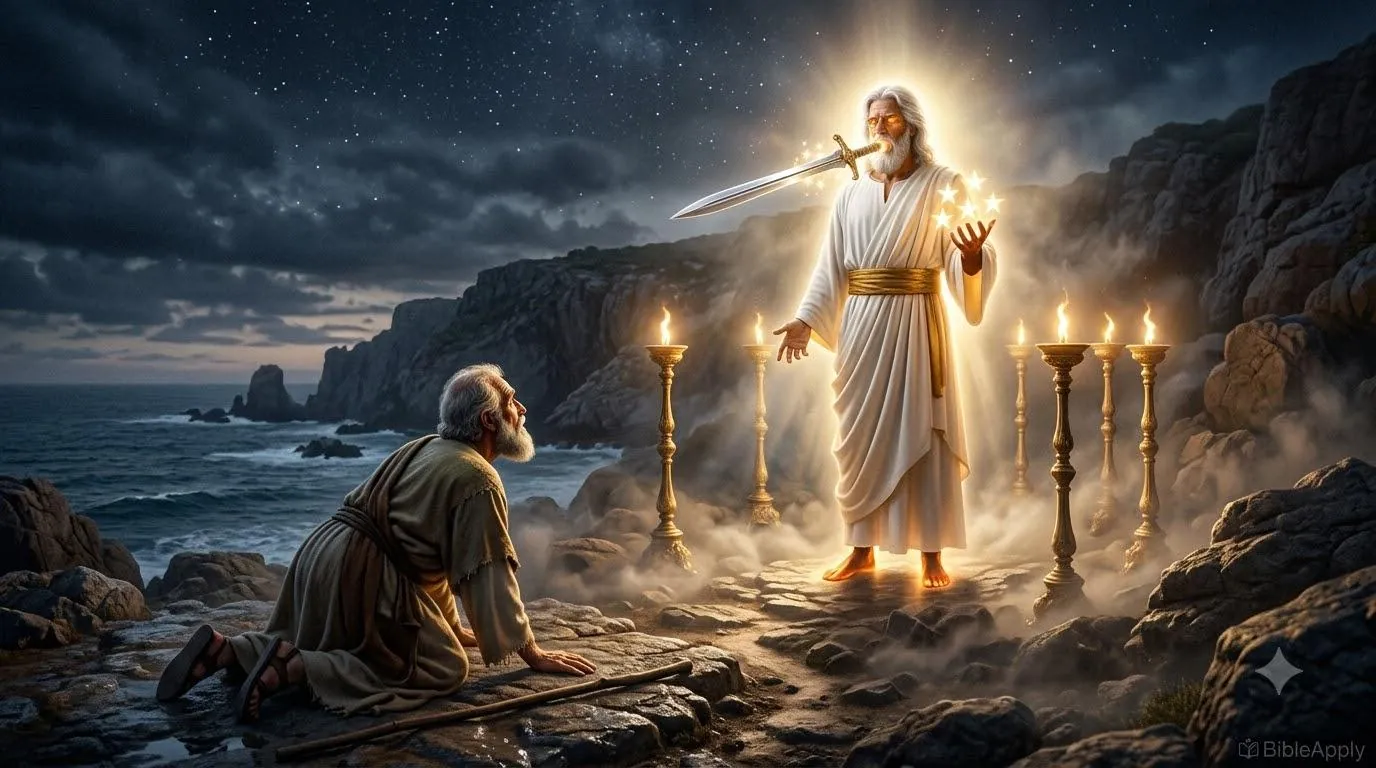
“Then I turned to see the voice that was speaking to me, and on turning I saw seven golden lampstands, and in the midst of the lampstands one like a son of man…” (Revelation 1:12-13)
The seven golden lampstands represent the seven churches (as explicitly explained by Jesus in verse 20). This imagery is rich with meaning: the church’s divine purpose is to bear light in a dark world, just as the menorah provided light in the Holy Place of the ancient tabernacle. But the most critical detail is that Jesus is walking in the midst of them. Even when the church is persecuted, deeply flawed, or struggling with false teaching, Christ is intimately present with His people.
John describes Jesus using rich, evocative Old Testament imagery:
- Clothed with a long robe and a golden sash: This is the sacred attire of the High Priest, indicating that Jesus is currently interceding for His people before the Father.
- Head and hair white as white wool, like snow: This breathtaking imagery is pulled directly from Daniel 7:9, which describes God the Father, the “Ancient of Days.” By applying this visual to Jesus, John is making a radical, unambiguous claim of Christ’s full deity, eternal nature, and perfect wisdom.
- Eyes like a flame of fire: Representing divine omniscience and penetrating, inescapable judgment. Nothing is hidden from His sight; He sees the true spiritual condition of His churches.
- Feet like burnished bronze, refined in a furnace: Bronze was the metal used for the altar of sacrifice in the temple. Feet of bronze symbolize unyielding strength, moral purity, and the trampling of enemies in holy judgment.
- Voice like the roar of many waters: Reminiscent of the crashing ocean waves around the island of Patmos and echoing Ezekiel 43:2, this symbolizes the overwhelming, irresistible, and majestic authority of God’s voice.
- In His right hand He held seven stars: The right hand is the universal symbol of sovereign power and protection. The stars represent the angels (or heavenly messengers/pastors) of the churches. Jesus holds the leadership, destiny, and security of His church tightly in His grip.
- From His mouth came a sharp two-edged sword: This represents the devastating power of the Word of God (Hebrews 4:12). Jesus does not conquer His enemies with a literal, physical sword made of steel, but by the sheer, omnipotent power of His spoken decree.
- Face like the sun shining in full strength: Recalling the blinding glory of the Mount of Transfiguration (Matthew 17:2), this points to His unapproachable holiness and radiant glory.
The Touch of Grace and the Prophetic Commission (Revelation 1:17-20)
“Fear Not”
If you want to explore this further, our in-depth guide on joshua 1 9 breaks this down verse by verse.
For a deeper study, see our guide on Psalm 91 Meaning: He Who Dwells in the Shelter which many readers have found helpful.
“When I saw him, I fell at his feet as though dead. But he laid his right hand on me, saying, ‘Fear not, I am the first and the last, and the living one. I died, and behold I am alive forevermore, and I have the keys of Death and Hades.’” (Revelation 1:17-18)
When confronted with the unfiltered, blinding glory of the resurrected Christ, the only appropriate response for a frail human being—even John, the “disciple whom Jesus loved”—is to collapse in utter terror and absolute reverence. Yet, in a moment of profound tenderness, the very same right hand that holds the cosmos and the seven stars reaches out to gently touch John.
Jesus speaks the timeless comfort of the gospel: “Fear not.” Why shouldn’t we fear? Because Jesus is the “First and the Last” (an exclusive title for Yahweh in Isaiah 44:6). He is the Living One who conquered the grave. In the Greco-Roman worldview, the realm of the dead (Hades) was a place of dreadful finality, and keys symbolized absolute authority. Jesus declares that He has violently ripped the keys of Death and Hades from the enemy. He alone decides who enters and who leaves. For the persecuted, first-century Christian facing execution in the arena, this is the ultimate comfort: Rome may hold the keys to the prison cell, but Christ holds the keys to death itself.
The Divine Outline of Revelation
Jesus commands John, “Write therefore the things that you have seen, those that are and those that are to take place after this” (v. 19). The vast majority of theologians view this verse as the inspired, structural outline of the entire Book of Revelation:
- “The things that you have seen”: Chapter 1 (The awe-inspiring vision of the glorified Christ).
- “Those that are”: Chapters 2-3 (The current state, rebukes, and commendations of the seven churches).
- “Those that are to take place after this”: Chapters 4-22 (The future tribulation, the final defeat of evil, the return of Christ, and the descent of the New Jerusalem).
Theological Weight and the Gospel Connection
Revelation 1 is an unparalleled Christological masterpiece. It forcefully and beautifully unites the Old Testament theology of God (Yahweh) with the New Testament revelation of Jesus. The exact same divine attributes ascribed to God the Father—eternal existence, sovereign judgment, radiant glory, and titles like “First and Last”—are explicitly given to Jesus Christ.
This chapter protects the modern church from creating a domesticated, comfortable, culturally palatable version of Jesus. It is easy to emphasize only the gentle Shepherd who carries lambs and the suffering Servant who heals the sick, but Revelation 1 reminds us that the Lamb who was slain is also the roaring Lion of the tribe of Judah. He is profoundly dangerous to His enemies but intensely loving and fiercely protective of His bride. The gospel message in Revelation 1 is a gospel of absolute, unstoppable victory. Because Christ bled, we are forgiven. Because Christ lives, death is defeated forever. Because Christ reigns with eyes of fire and a sword in His mouth, the church can endure any suffering.
3 Practical Applications from Revelation 1
-
Fear Not the Future, for Christ Holds the Keys
It is incredibly easy to look at the state of the world, political upheaval, and escalating cultural hostility toward Christianity and feel overwhelmed by anxiety. However, Revelation 1 reminds us that human history is not spiraling out of control. Jesus stands sovereign over time, governments, and eternity. Furthermore, because Jesus holds the keys of Death and Hades, believers are totally liberated from the fear of death. We can face sickness, aging, and mortality with profound courage, knowing our Savior has already blazed the trail through the grave and holds our final destiny securely in His hands. -
Be a Faithful Lampstand in a Dark World
The image of the church as a lampstand is a severe calling to moral clarity and holiness. Lampstands do not generate their own light; their sole purpose is to hold up the light of the oil burning within them. Our job is not to be the savior of the world, nor to win popularity contests, but to faithfully and unashamedly reflect the light of Christ to a dark culture. Even when the church feels weak, marginalized, or imperfect, we must remember that Jesus is actively walking in our midst. His presence is the only source of our power and relevance. -
Live in the Blessing of Reading and Obeying the Word
Revelation promises a divine blessing not to those who can cleverly decode every obscure apocalyptic symbol or map out end-times timelines perfectly, but simply to those who read and keep what is written. We should approach Scripture not just as an intellectual or academic exercise, but as a transformational encounter with the Living Word. Make a firm commitment to read the Bible consistently, listen to it preached faithfully, and most importantly, align your daily habits, thoughts, and actions with its truth. “The time is near”—let us live our lives in a state of holy readiness and joyful anticipation of our King’s return.
Also Read
- Philemon 1 Summary & Meaning: The Radical Call of Christian Brotherhood
- 1 Samuel 1 Summary & Meaning: The Power of Desperate Prayer and Dedication
- Haggai 1 Summary & Meaning: Consider Your Ways
Read Revelation 1
Dive into the full scripture text for deeper study.
Revelation Chapter 2 Summary
A detailed narrative summary for Revelation 2 is currently being prepared by our theologians.
Revelation Chapter 3 Summary
A detailed narrative summary for Revelation 3 is currently being prepared by our theologians.
Revelation Chapter 4 Summary
A detailed narrative summary for Revelation 4 is currently being prepared by our theologians.
Revelation Chapter 5 Summary
A detailed narrative summary for Revelation 5 is currently being prepared by our theologians.
Revelation Chapter 6 Summary
A detailed narrative summary for Revelation 6 is currently being prepared by our theologians.
Revelation Chapter 7 Summary
A detailed narrative summary for Revelation 7 is currently being prepared by our theologians.
Revelation Chapter 8 Summary
A detailed narrative summary for Revelation 8 is currently being prepared by our theologians.
Revelation Chapter 9 Summary
A detailed narrative summary for Revelation 9 is currently being prepared by our theologians.
Revelation Chapter 10 Summary
A detailed narrative summary for Revelation 10 is currently being prepared by our theologians.
Revelation Chapter 11 Summary
A detailed narrative summary for Revelation 11 is currently being prepared by our theologians.
Revelation Chapter 12 Summary
A detailed narrative summary for Revelation 12 is currently being prepared by our theologians.
Revelation Chapter 13 Summary
A detailed narrative summary for Revelation 13 is currently being prepared by our theologians.
Revelation Chapter 14 Summary
A detailed narrative summary for Revelation 14 is currently being prepared by our theologians.
Revelation Chapter 15 Summary
A detailed narrative summary for Revelation 15 is currently being prepared by our theologians.
Revelation Chapter 16 Summary
A detailed narrative summary for Revelation 16 is currently being prepared by our theologians.
Revelation Chapter 17 Summary
A detailed narrative summary for Revelation 17 is currently being prepared by our theologians.
Revelation Chapter 18 Summary
A detailed narrative summary for Revelation 18 is currently being prepared by our theologians.
Revelation Chapter 19 Summary
A detailed narrative summary for Revelation 19 is currently being prepared by our theologians.
Revelation Chapter 20 Summary
A detailed narrative summary for Revelation 20 is currently being prepared by our theologians.
Revelation Chapter 21 Summary
A detailed narrative summary for Revelation 21 is currently being prepared by our theologians.
Revelation Chapter 22 Summary
A detailed narrative summary for Revelation 22 is currently being prepared by our theologians.
Conclusion
We hope this chapter-by-chapter summary of Revelation has helped you better understand God's Word. To continue your study, explore our other Bible Chapter Summaries or read our detailed Verse Meanings.