

Quick Answer: The hypostatic union is the core Christian doctrine explaining how Jesus Christ is simultaneously fully God and fully man.
The phrase “hypostatic union” sounds like it belongs in a dusty seminary classroom, not everyday life. Yet, it describes the very core of the Christian faith. It answers a staggering claim: that one individual possessed two entirely distinct, unblended natures—infinite divinity and finite humanity.
This claim naturally sparks questions. How can someone be both fully God and fully man? Did Jesus know everything as God, yet have to learn as a child? Did He experience true temptation?
Human logic struggles with paradox. We prefer categories that don’t overlap—finite or infinite, created or uncreated. When the Bible presents Jesus Christ as both, it stretches our minds.
But this doctrine isn’t just theological trivia. If Jesus isn’t truly God, His sacrifice lacks the infinite worth to pay for sin. If He isn’t truly man, He can’t represent us as our substitute. Our understanding of salvation hinges entirely on who Jesus actually is.
We don’t study the hypostatic union to solve a math problem. We study it to see the lengths the Creator went to redeem us. By looking closely at this doctrine, we find the beating heart of the Gospel. It’s a reality that comforts the broken and anchors our faith.
A Pastoral Note: The two natures of Christ sound abstract until your life falls apart. When I sit in ICU waiting rooms with grieving families, nobody wants a theology lecture. They want to know if God actually cares. The incarnation means Jesus didn’t just shout instructions from heaven. He took on flesh, felt the sting of betrayal, sweat blood, and suffocated on a Roman cross. He knows your pain because He lived it.
The Biblical Foundation of the Hypostatic Union
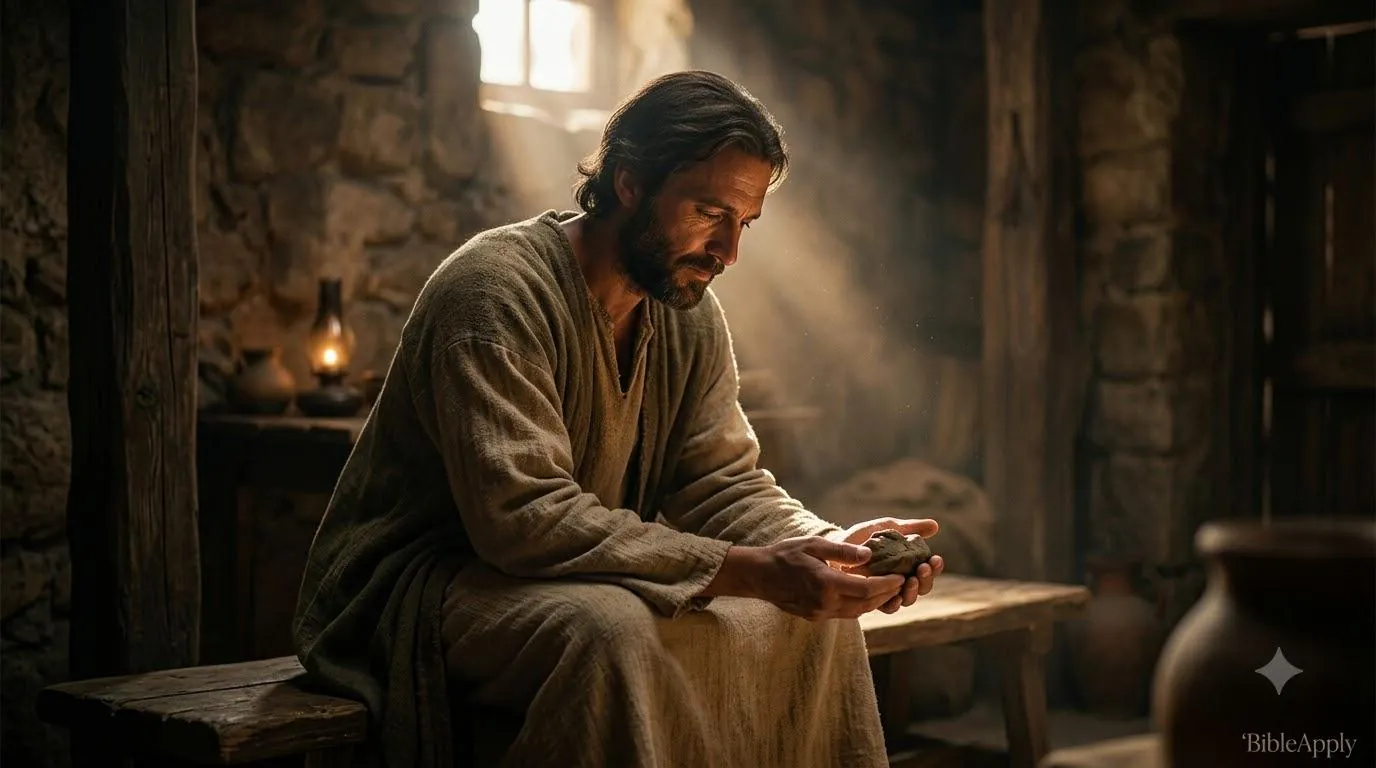
You won’t find the term “hypostatic union” in your Bible. It’s simply shorthand for what Scripture reveals about the person of Christ. To grasp it, we have to look at the two distinct pillars of His identity: His uncompromised deity and His genuine humanity.
The Unmitigated Deity of Christ
From the opening verses of John’s Gospel, the divine nature of the Word is clear. Scripture doesn’t present Jesus as a highly exalted human. It presents Him as Yahweh Himself. The places where Jesus claims to be God form the bedrock of our faith.
“In the beginning was the Word, and the Word was with God, and the Word was God. He was in the beginning with God. All things were made through him, and without him was not any thing made that was made.” (John 1:1-3, ESV)
The Apostle Paul is just as blunt. Writing to the Colossians, he actively fought against early teachings that tried to shrink Christ’s status.
“For in him the whole fullness of deity dwells bodily…” (Colossians 2:9, ESV)
The Greek word translated “deity” here is theotēs. It doesn’t just mean “divine qualities.” It points to the very essence of God.
Paul is saying everything that makes God God dwells fully in Christ. He is uncreated, eternal, and shares the exact same essence as the Father.
The Authentic Humanity of Christ
To the ancient Greek mind, the physical world was inherently corrupt. So the claim that the eternal Word became true flesh was scandalous. Jesus didn’t just “appear” human—a heresy known as Docetism. He actually took on our nature.
“And the Word became flesh and dwelt among us, and we have seen his glory, glory as of the only Son from the Father, full of grace and truth.” (John 1:14, ESV)
The writer of Hebrews explains exactly why this genuine humanity was necessary to save us:
“Since therefore the children share in flesh and blood, he himself likewise partook of the same things, that through death he might destroy the one who has the power of death, that is, the devil… Therefore he had to be made like his brothers in every respect, so that he might become a merciful and faithful high priest in the service of God, to make propitiation for the sins of the people.” (Hebrews 2:14, 17, ESV)
Jesus experienced real human limitations. He grew in wisdom and stature (Luke 2:52). He knew physical thirst (John 19:28), bone-deep exhaustion (John 4:6), and grief, weeping at the tomb of His friend (John 11:35).
He had a human body, a human mind, and a human soul. This affirms the dignity of the physical body, which shapes the Christian hope of a future physical resurrection.
Theological Deep Dive: Understanding the Union
If Jesus is 100% God and 100% man, how do these two natures actually work together in one person? This is exactly what the hypostatic union defines.
The Definition of “Hypostasis”
The word “hypostatic” comes from the Greek noun hypostasis, meaning “person” or “substance.” When we talk about this union, we mean the joining of two distinct natures—divine and human—within the one single person of the Son of God.
The early church fought hard to find the right language for this paradox. That struggle culminated at the Council of Chalcedon in AD 451.
The Chalcedonian Creed provided a definitive summary that Orthodox, Catholic, and Protestant traditions still affirm today. It declared Christ is one person with two natures, united in four specific ways:
- Without confusion: The two natures aren’t blended together to create a third, hybrid nature.
- Without change: Neither the divine nor the human nature is altered by the union.
- Without division: The two natures can’t be split into two separate persons.
- Without separation: The union of these two natures is eternal; they will never be torn apart.
The Son of God didn’t shed His deity to become human. His deity didn’t swallow up His humanity, either. Instead, the eternal Second Person of the Trinity added a human nature to Himself. He remained exactly what He always was (God), while becoming something He had never been (man).
The Communication of Properties
Because there is only one Person, the attributes of both natures can be ascribed to that one Person. Theologians call this the communication of properties (communicatio idiomatum).
For example, when Jesus was crucified, we can truly say “the Son of God died.” His divine nature cannot die, because God is immortal. But because His human nature is perfectly united to His Person, the action belongs to the Person.
Conversely, when Jesus walked on water, He did so by divine power. But it was the one Person, Jesus, who physically stepped on the waves.
This explains the seemingly contradictory statements in Scripture. Jesus could say, “Before Abraham was, I am” (John 8:58), speaking from His divine nature.
Yet He could also say regarding His second coming, “concerning that day or that hour, no one knows… but only the Father” (Mark 13:32). Here, He spoke according to the limits of His human nature. Both are true of the one Person.

Common Heresies and Misconceptions
Throughout church history, people have tried to “solve” this mystery by emphasizing one nature and minimizing the other. Looking at these historical errors actually helps clarify the truth.
Apollinarianism: Partial Humanity
In the 4th century, Apollinaris taught that Jesus had a human body, but His human mind was replaced by the divine Logos. Essentially, he argued Jesus was “God in a bod.”
The Correction: If Jesus didn’t have a human mind, He wasn’t fully human. As early church leader Gregory of Nazianzus wrote, “That which He has not assumed He has not healed.” Christ had to take on full humanity to redeem full humanity.
Nestorianism: Two Separate Persons
Nestorianism pushed the two natures so far apart it resulted in two separate persons. It viewed Christ as a divine person and a human person coexisting in the same body, acting in tandem but never truly uniting.
The Correction: The Bible consistently speaks of Jesus as a single “I.” The Word became flesh; He didn’t just hang around with a human being.
Eutychianism: A Blended Nature
Eutyches taught that Christ’s human nature was completely absorbed by His divine nature—like a drop of vinegar dissolved in the ocean. This created a single, blended nature that was a third thing entirely.
The Correction: The two natures remain distinct without confusion or change. Christ must remain fully God to save us, and fully man to represent us.
The “Kenosis” Controversy
A common modern misconception comes from Philippians 2:7, which says Christ “emptied himself.” Some take this to mean Jesus temporarily gave up His divine attributes—like omniscience or omnipresence—while on earth.
The Correction: God cannot stop being God. His attributes are His essence. The “emptying” wasn’t a subtraction of deity, but an addition of humanity.
Christ didn’t give up His divine traits. Instead, He willingly veiled His glory and restricted the independent use of His power, living in submission to the Father by the power of the Holy Spirit.
3 Reasons the Hypostatic Union Matters
This doctrine isn’t just a theological puzzle. It anchors everyday reality for the believer.
1. We Have a High Priest Who Sympathizes
Because Jesus took on true humanity, He isn’t a detached deity observing us from afar. He stepped into the grit and sorrow of human life.
“For we do not have a high priest who is unable to sympathize with our weaknesses, but one who in every respect has been tempted as we are, yet without sin. Let us then with confidence draw near to the throne of grace, that we may receive mercy and find grace to help in time of need.” (Hebrews 4:15-16, ESV)
Jesus knows the sting of betrayal. He knows exhaustion. When you bring your grief to Him, you are praying to a God who has wept human tears. His divine nature ensures He has the power to help; His human nature ensures He has the compassion to understand.
2. Our Salvation is Secure
Our salvation entirely depends on this union. To satisfy justice, humanity owed a debt of perfect obedience and a penalty for sin. Only a true human could act as our substitute to pay that debt.
But no mere human could endure the infinite wrath of God against sin. And no ordinary human could perfectly obey the law without failing.
It required an infinite person to bear an infinite punishment. Our Savior had to be man to take our place, and God for His sacrifice to carry infinite merit.
This guarantees the work of the cross was entirely sufficient. Your salvation is secure because it rests squarely on the shoulders of the God-Man.
3. A Model for Radical Humility
The incarnation is the clearest display of humility in history. The Apostle Paul points to this union as the primary motivation for how we treat others:
“Have this mind among yourselves, which is yours in Christ Jesus, who, though he was in the form of God, did not count equality with God a thing to be grasped, but emptied himself, by taking the form of a servant…” (Philippians 2:5-7, ESV)
The Creator of the cosmos united Himself to human flesh. He subjected Himself to infancy, washed dirty feet, and submitted to a humiliating death.
If He did that, there is no room for pride in the Christian life. The hypostatic union calls us to self-sacrificial love, putting the needs of others before our own. We are called to reflect the One who bridged the gap between heaven and earth.