

Quick Answer: Jesus never said the exact phrase “I am God.” However, he forgave sins, accepted worship, and used the divine name for himself—actions reserved exclusively for Yahweh in first-century Judaism.
For centuries, the true identity of Jesus of Nazareth has sparked intense debate. To the modern mind, the idea that a first-century Jewish rabbi might be the Creator of the universe in human flesh seems preposterous. Many respect Jesus as a moral teacher or courageous prophet, yet stumble at the assertion of his absolute deity.
Did Jesus actually claim to be God? Skeptics often wonder if later Christians simply invented this idea over the centuries and projected it backward onto a humble, mortal teacher. To answer this, we have to look closely at the earliest historical records.
This question touches the core of major world religions. Islam highly honors Jesus (known as Isa) as a prophet and the Messiah, but strictly denies his divinity. Judaism views him as a historical teacher, but not the Messiah or God. Adherents of these faiths, along with secular skeptics, frequently assert that Jesus himself never intended to be worshipped.
They argue that a close reading of the Gospels reveals a man devoted to God, but never one who confused himself with God. In a pluralistic society, claiming any single historical figure is the exclusive revelation of God often strikes people as arrogant.
But the earliest historical records paint a different picture. It’s true that Jesus didn’t walk through the streets of Jerusalem shouting, “I am God; worship me!” Instead, his words and actions pointed to a divine self-understanding.
To grasp his claims, we have to read them through the lens of first-century Judaism rather than modern Western expectations. When we do, we discover that Jesus’s claims to divinity were so explicit and provocative that they ultimately led to his execution.
A Pastoral Note: If you struggle to buy the idea that a Jewish carpenter was God in human flesh, you’re not alone. I’ve sat with plenty of folks who want to respect Jesus as a teacher but hit a wall at his divinity. The tension is real, and it’s meant to be wrestled with. But if you strip away the Sunday school polish and read the Gospels raw, Jesus leaves us no middle ground. He forces us to decide if he’s a madman, a liar, or exactly who he showed himself to be.
The Explicit Statements of Jesus
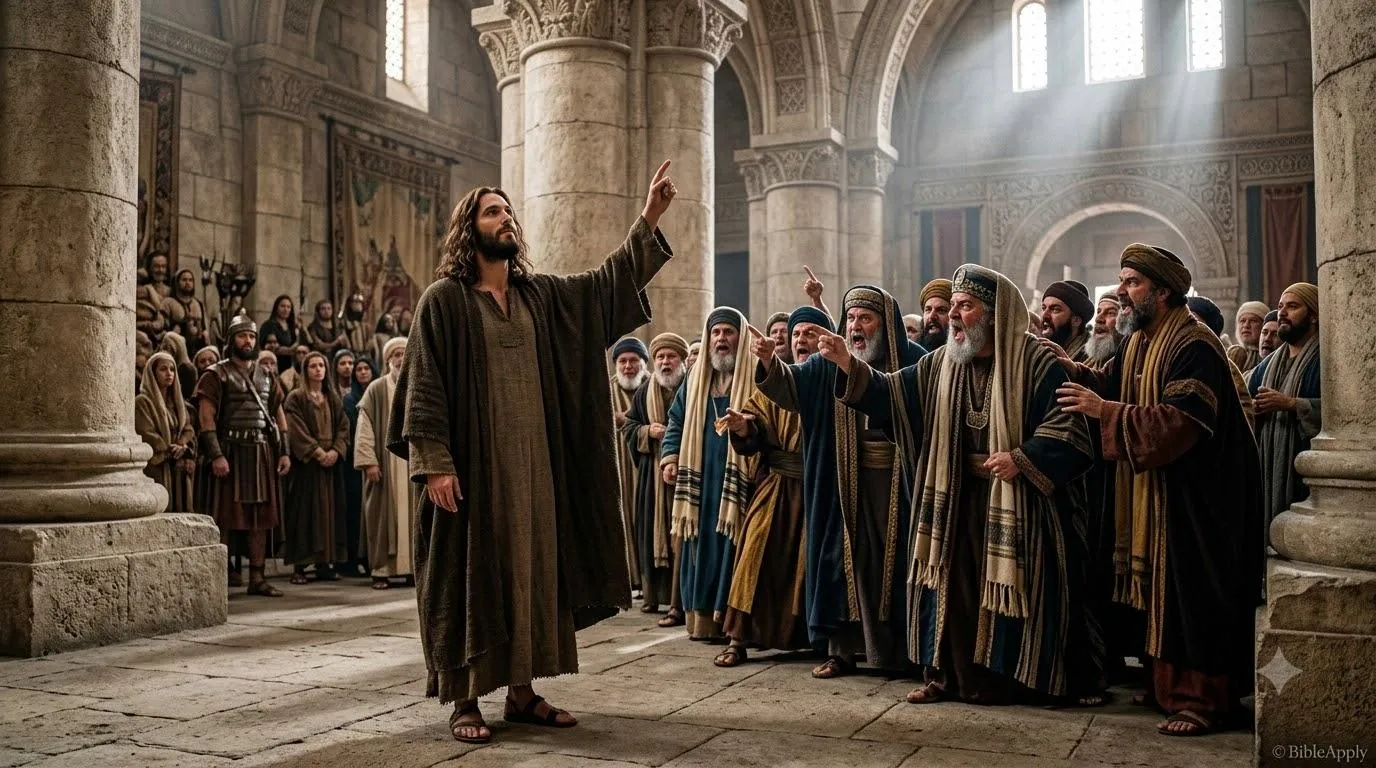
To a modern reader, the lack of a singular sentence like “I am God” might seem like evidence against Christ’s deity. But in the context of strict first-century Jewish monotheism, a blunt statement like that would have been immediately dismissed as lunacy.
Instead, Jesus made his identity known through theologically loaded statements. His Jewish listeners had no doubts about what he was claiming.
The “I Am” Statements and the Divine Name
One of the most striking pieces of evidence is Jesus’s deliberate use of the divine name. In Exodus 3:14, when Moses asks God for his name at the burning bush, God responds, “I AM WHO I AM” (Yahweh). This name was so sacred that Jewish people would not even pronounce it out loud, substituting Adonai (Lord) instead.
In the Gospel of John, Jesus repeatedly applies this divine title to himself. The climax happens during a heated debate with religious leaders about his authority:
“Your father Abraham rejoiced that he would see my day. He saw it and was glad.” So the Jews said to him, “You are not yet fifty years old, and have you seen Abraham?” Jesus said to them, “Truly, truly, I say to you, before Abraham was, I am.” (John 8:56-58, ESV)
Notice the grammar. Jesus didn’t say, “Before Abraham was, I was.” That would merely be a claim to pre-existence. He said, “I am.”
By using this present-tense phrasing, he directly echoed the divine name of Exodus 3. The crowd’s reaction proves they understood exactly what he meant: “So they picked up stones to throw at him” (John 8:59). In their eyes, he had committed blasphemy by claiming the eternal divine name.
Claiming Equality with the Father
Jesus claimed a relationship with God the Father that went far beyond that of a prophet. In John 10, he speaks of his role as the Good Shepherd. This is an image frequently used in the Old Testament for Yahweh Himself (like in Psalm 23, “The Lord is my shepherd”).
After claiming to give eternal life to his sheep, he drops a massive theological claim:
“I and the Father are one.” (John 10:30, ESV)
The violent response of the Jewish leaders is telling. They immediately grabbed stones to kill him. When Jesus asked which of his good works they were stoning him for, they didn’t mince words:
“It is not for a good work that we are going to stone you but for blasphemy, because you, being a man, make yourself God.” (John 10:33, ESV)
The original Greek sheds more light here. The word for “one” (hen) is neuter. This implies a unity of essence and power, rather than a unity of person. Jesus wasn’t claiming to be the exact same person as the Father. He was claiming to be of the exact same divine essence.
Implicit Claims: Actions Reserved for God
Jesus’s actions were just as explosive as his words. In the Jewish worldview, there were specific rights and actions reserved exclusively for Yahweh.
Any human attempting to perform these actions would be branded a blasphemer. Yet Jesus systematically assumed these divine privileges, demonstrating his deity through his deeds.
The Forgiveness of Sins
In Mark 2, four men lower their paralyzed friend through a roof to reach Jesus. Instead of immediately healing the man’s physical body, Jesus addresses his spiritual state:
“Son, your sins are forgiven.” (Mark 2:5, ESV)
The scribes sitting nearby immediately recognized the theological implications. They reasoned in their hearts: “Why does this man speak like that? He is blaspheming! Who can forgive sins but God alone?” (Mark 2:7).
Their theology was entirely correct. If you wrong me, I have the authority to forgive you. But if you wrong a stranger, I have no right to forgive you on their behalf.
Since all sins are ultimately an offense against the Creator, Jesus was acting as the offended party—God himself. To prove he actually had the unseen authority to forgive sins, he then miraculously healed the paralytic.
Authority Over the Sabbath and the Law
The Sabbath was a central pillar of Jewish identity, instituted by God at creation and codified in the Ten Commandments. Yet Jesus routinely healed on the Sabbath and allowed his disciples to break strict Pharisaical traditions.
When challenged by the religious elite, he didn’t just interpret the law differently like a competing rabbi. He claimed absolute sovereign authority over it:
“For the Son of Man is lord of the Sabbath.” (Matthew 12:8, ESV)
To claim lordship over the Sabbath was to claim the authority of the one who instituted it—Yahweh.
Similarly, in the Sermon on the Mount, Jesus repeatedly used an astonishing formula: “You have heard that it was said… But I say to you…” (Matthew 5). The prophets of the Old Testament always spoke with delegated authority, saying, “Thus says the LORD.” Jesus spoke with inherent divine authority. He placed his own words on the exact same level as the Torah.
Accepting Worship
In strict Jewish monotheism, worship was exclusively reserved for the Creator. Idolatry was the cardinal sin. Angels and righteous men in the Bible always vehemently reject worship when it is mistakenly offered to them (see Revelation 19:10 and Acts 10:25-26). Yet Jesus calmly accepted worship.
After Jesus walked on water and calmed a storm, the disciples “worshipped him, saying, ‘Truly you are the Son of God’” (Matthew 14:33). Following the resurrection, the doubting disciple Thomas fell before him, declaring, “My Lord and my God!” (John 20:28).
Jesus didn’t scold Thomas or correct his theology. Instead, he commended his faith. Thomas’s declaration in the original Greek is an unambiguous, rock-solid declaration of supreme deity.

Addressing Common Objections
When discussing the deity of Christ, skeptics often raise a few key objections.
1. “The term ‘Son of God’ just means a righteous person or king.”
It’s true that the phrase “son of God” can refer to angels, kings, or the nation of Israel in the Old Testament. But Jesus used the title in a completely unique way. He claimed an unshared relationship with the Father (referred to as the “only begotten” in John 3:16).
At his trial, the high priest asked him directly, “Are you the Christ, the Son of the Blessed?”
Jesus replied, “I am, and you will see the Son of Man seated at the right hand of Power, and coming with the clouds of heaven” (Mark 14:61-62). He explicitly combined the Messianic title with the apocalyptic vision of Daniel 7. He claimed to be the divine figure who shares God’s heavenly throne. The high priest tore his garments in response because he understood exactly what Jesus was claiming.
2. “Jesus said, ‘The Father is greater than I.’ Doesn’t this deny his deity?”
Historic Christian theology teaches that the Trinity consists of one God eternally existing in three distinct persons: Father, Son, and Holy Spirit. When the Son took on human flesh, he voluntarily submitted himself to the Father’s will for the sake of redemption (Philippians 2:5-8).
When Jesus said “The Father is greater than I” (John 14:28), he was referring to his temporary, earthly state of functional subordination. It wasn’t a denial of his divine essence. He was co-equal in nature, but willingly took on a submissive role during his earthly ministry.
3. “Later Christians invented the dogma of his deity centuries later.”
Historical evidence shows that the earliest Christian writings already established a high view of Christ. For example, Philippians 2:6-11 is widely recognized by scholars as an early hymn dating to within a decade or two of the crucifixion.
This ancient hymn boldly declares that Jesus was “in the form of God” and should be worshipped as Lord. The belief in Christ’s deity was not a late theological evolution engineered at the Council of Nicaea in the fourth century. It was the foundational conviction that launched the Christian movement from the very beginning.
Why Does This Matter?
If Jesus is exactly who he claimed to be, it changes everything about how we live. His divine identity demands a response.
1. Surrender to His Authority
If Jesus were merely a moral teacher, we could pick and choose which of his sayings we like. We could adopt his teachings on love while discarding his commands about money or ethics.
But if he is God incarnate, he holds absolute authority over our lives. We can’t treat him as an advisory consultant. Submitting to him means trusting that the Creator of the universe actually knows what is best for human flourishing.
2. Rest in His Forgiveness
Because Jesus is God, his death on the cross was not just the tragic end of a noble martyr. It was a sacrifice of infinite value. Only an eternal God could fully absorb the penalty for humanity’s rebellion against a holy Creator.
When Jesus says, “Your sins are forgiven,” he speaks with the authority of the Supreme Judge. You can rest knowing your sins are comprehensively paid for. You don’t have to exhaust yourself trying to earn salvation through religious performance; you simply receive it by faith.
3. Worship with Awe and Intimacy
The miracle of the incarnation means that the holy God of the universe has come near. God is not a distant watchmaker. He entered the messiness, pain, and sorrow of human history. He wept, bled, and died for us.
When we pray to Jesus, we are not speaking to a dead prophet in a tomb. We are talking to the living God who knows our weaknesses because he became one of us. This truth moves us past dutiful religious obligation into intimate worship of our Redeemer.