
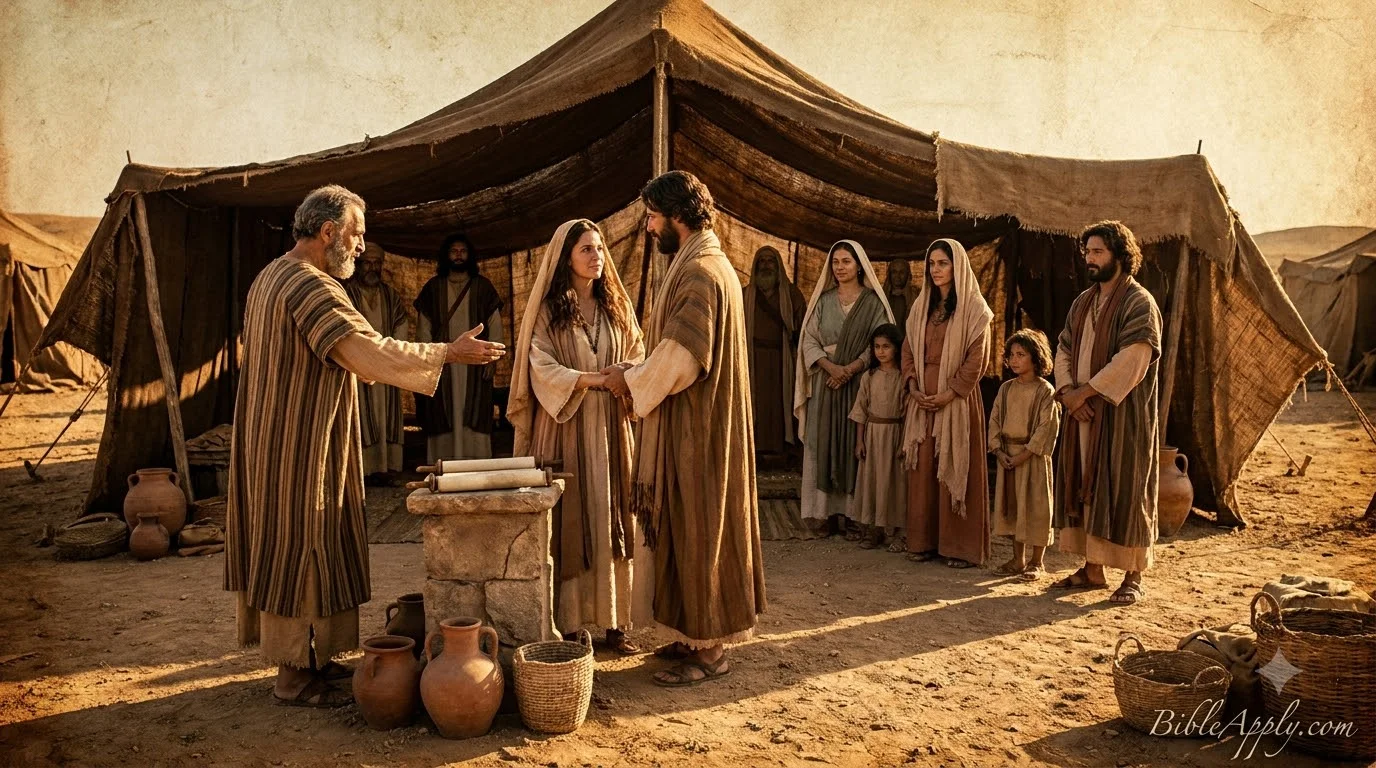
No, the Bible does not require a wedding to take place inside a church building. Scripture contains no command specifying a location for marriage ceremonies. Biblical marriages — from Isaac and Rebekah to the Wedding at Cana — occurred in homes, fields, and community gatherings long before church buildings existed. What matters is the covenant before God, not the venue.
When a young couple recently walked into my office to discuss their upcoming wedding, they looked distinctly nervous. The bride, twisting a paper napkin in her hands, finally blurted it out: “Pastor, we really want to get married in the national park where we had our first date, but my grandmother says if we don’t get married in a church, it won’t be a real Christian wedding. Is she right?”
It is a remarkably common anxiety. Pastors hear it constantly from couples who feel torn between their desire for a meaningful setting and the unspoken (and sometimes heavily spoken) assumption that a “proper” Christian marriage requires stained glass, wooden pews, and a center aisle. Families can become deeply divided over this question, with older generations often feeling that moving the ceremony to a secular venue somehow strips it of its sacredness.
But when we pull out our Bibles and begin looking for the verse that commands believers to wed inside a religious structure, we run into an interesting theological problem. There isn’t one. The scriptures are overflowing with instructions about the nature of marriage, the depth of the covenant, and the mutual submission required of husbands and wives. Yet, on the specific question of geographical coordinates? The text is entirely silent.
Let us explore what actually constitutes a Christian marriage ceremony in the eyes of God, tracing how weddings were performed in the Bible, understanding the profound difference between a civil contract and a spiritual covenant, and exploring how couples today can invite the presence of Christ into any venue they choose.
Where Did Biblical Characters Get Married?
To understand how foreign the concept of a “church wedding” would have been to the characters of Scripture, we simply have to look at the weddings recorded in the text. The Bible gives us numerous examples of marriages taking place in a wide variety of settings, none of them resembling our modern church sanctuaries.
Isaac and Rebekah’s Meeting in the Field
Consider the deeply moving account of Isaac and Rebekah in Genesis 24. Abraham had sent his servant back to his homeland to find a wife for his son, relying on God’s providence to guide the mission. When Rebekah finally arrives after her long journey, she does not walk down a decorated aisle toward an altar. She arrives by camel in the Negev, where Isaac had gone out to the field to meditate in the evening (Genesis 24:63).
The text simply tells us: “Then Isaac brought her into the tent of Sarah his mother and took Rebekah, and she became his wife, and he loved her” (Genesis 24:67). There was no temple, no synagogue, no officiating priest, and certainly no wedding march. There was family, a tent, and a profound commitment made under the vast ancient sky. The sacredness of their union was not dependent on a religious structure; it was founded on God’s covenantal promises to Abraham and Isaac’s willing acceptance of his bride.
Ruth and Boaz at the City Gate
Or look at the beautiful redemption story of Ruth and Boaz. When Boaz formally claims the right to redeem Naomi’s land and take Ruth as his wife, he does not go to the tabernacle. He goes to the city gate—the ancient equivalent of the town square or the local courthouse.
He gathers ten elders of the city and publicly declares his intentions. The witnesses respond with a beautiful blessing: “May the Lord make the woman, who is coming into your house, like Rachel and Leah, who together built up the house of Israel” (Ruth 4:11-12). The community witnessed the commitment, validating it not in a religious building, but in the center of civic life. The public nature of the commitment, witnessed by the elders, established the legitimacy of the marriage.
Jesus at the Wedding in Cana
Perhaps most famously, we have Jesus’s first miraculous sign at a wedding in Cana of Galilee (John 2:1-11). Notice the setting. It is not in the Temple in Jerusalem or even the local synagogue. It is a massive, multi-day community celebration hosted at a private home in a humble village. Jesus, His mother, and His disciples are simply guests mingling in a domestic space.
By performing His first miracle—turning water into wine—in a private home during a wedding feast, Christ profoundly sanctifies the institution of marriage. He blesses it with His presence and miraculous provision, demonstrating that the holy can happen in the completely ordinary, domestic spheres of our lives. He did not ask them to move the party to the synagogue before He would bless it.
The Invention of the “Church Wedding”
If the biblical patriarchs and even the apostles knew nothing of church weddings, where did this tradition come from? The history might surprise you.
For the first three centuries of the Christian era, believers had no church buildings at all. They met in catacombs, living rooms, and courtyards, constantly under the threat of persecution. Weddings were largely domestic affairs, modeled after traditional Roman or Jewish customs, but deliberately stripped of pagan sacrifices. A bishop or priest might offer a blessing, but it happened in the home or the marketplace.
Even as grand cathedrals began to rise across Europe in the Middle Ages, marriages often took place outside the church doors (in the church porch) rather than inside the sanctuary. The great Reformer Martin Luther, who radically shifted the Church’s understanding of marriage away from being a Roman Catholic sacrament and back toward a divine estate, famously declared in his 1529 Marriage Booklet that weddings were primarily a worldly matter belonging to the realm of government. He argued that while Christians should certainly seek a pastor’s blessing and pray over the union, the state had jurisdiction over the legality of the marriage.
John Calvin held a similar tension. He believed strongly in the spiritual significance of marriage but recognized its civic dimensions. In Geneva, under Calvin’s influence, marriages had to be celebrated in the church—not to make them magically holy, but to ensure they were public and free from the clandestine abuses that had plagued the era. Secret marriages were causing societal chaos, and public church weddings were a regulatory solution.
It wasn’t until the Catholic Church’s Council of Trent in 1563 that a decree (Tametsi) formally required marriages to be performed before a priest and two witnesses to be considered valid by the Church. This solidified the expectation of the “church wedding” in the Western mind, a cultural momentum that Protestantism eventually absorbed and perpetuated. We have inherited a tradition birthed more out of medieval legal reform than ancient biblical command.
The Heart of the Matter: Contract vs. Covenant
Why does this historical context matter for couples today? Because it frees us to understand what a Christian marriage actually is. We frequently conflate the civil contract with the theological covenant, assuming they are the exact same thing.
A civil contract is a legal arrangement recognized by the state. You can obtain it at a courthouse in ten minutes. It outlines rights, property, tax status, and next-of-kin privileges. It is important, and believers should abide by the laws of their land (Romans 13:1), but it is deeply incomplete from a biblical perspective. The state can marry you, but the state cannot make you a reflection of Christ’s love for the Church.
A Christian marriage, however, is a covenant. The Hebrew word used throughout the Old Testament is berith (Strong’s H1285), which implies a binding, solemn agreement, often sealed by blood or sacrifice. When the prophets wanted to describe God’s unwavering, fierce, and faithful love for His people, they reached for the language of berith.
Marriage is designed to be a living, breathing picture of the gospel—a micro-demonstration of Christ’s love for the bride, the Church (Ephesians 5:31-32). That kind of covenant transcends geography. It requires mutual sacrifice, dying to self, and a vow to remain faithful when circumstances become difficult.
As the great 20th-century theologian Dietrich Bonhoeffer wrote in a wedding sermon from his prison cell: “It is not your love that sustains the marriage, but from now on, the marriage that sustains your love.” Bonhoeffer understood that a covenant is stronger than human affection; it is a divine mandate that holds two people together when their own strength fails.
The covenant is established by the vows made before God and witnesses, not by the architectural features of the room where those vows are spoken.
Navigating Modern Scenarios
If you are planning a wedding and grappling with venue choices, how do you honor the Lord in settings outside a church building? Let’s consider a few practical scenarios that modern couples often face.
The Outdoor Wedding
God created the outdoors, and there is immense theological beauty in being married amidst His creation. The Psalms declare that “the heavens declare the glory of God, and the sky above proclaims his handiwork” (Psalm 19:1). A meadow, a beach, or a mountain overlook can be profoundly beautiful places to worship the Creator while entering into a marriage covenant.
The theological challenge of an outdoor wedding isn’t the presence of God (He is omnipresent); it is merely the logistics of sound amplification and weather. You want your community to actually hear and witness the vows. Standing under the sky reminds us of the grandeur of God, much like Isaac and Rebekah’s union in the fields of the Negev.
The Destination Wedding
Couples sometimes choose beautiful, far-flung locations for their ceremonies. While there is nothing inherently unbiblical about this, a pastoral word of caution is always warranted here. The biblical model of a wedding heavily emphasizes the community of witnesses—the family and fellow believers who will support the couple in the decades to come.
If a destination wedding excludes your core community because of prohibitive costs or complicated travel, you might miss out on the vital communal aspect of the covenant. A marriage is not an island; it is planted within the body of believers. If you do choose a destination, consider how you can involve your local church community upon your return.
The Courthouse Ceremony with a Later Blessing
Sometimes, due to visa issues, military deployments, or health insurance needs, couples must be legally married quickly at a courthouse. I have counseled many couples who feel deep guilt over this, wondering if they are missing out on God’s best.
This is a perfectly legitimate path. You can establish the civil contract first to satisfy legal requirements, and later gather your church community for a formal covenant ceremony, complete with vows, rings, and prayers of dedication. God is not offended by bureaucratic realities; He cares about the posture of your hearts. The great theologians like Luther would remind us that you have handled the earthly realm appropriately and are now inviting the spiritual blessing of the community.
Building a Christian Ceremony Anywhere
If the building itself does not make a wedding Christian, what does? A Christian wedding is defined by the content, the participants, and the ultimate focus of the ceremony. If you are getting married in a renovated barn, a hotel ballroom, or a national park, here is a practical checklist of elements that center Christ in the celebration.
1. The Vows of Covenant Your vows should clearly reflect the lifelong, unconditional nature of a biblical covenant. While writing your own vows can be sweet, there is immense weight in utilizing historic vows that millions of believers have spoken before you. Promising to be faithful “for better, for worse, for richer, for poorer, in sickness and in health, until death do us part” explicitly rejects the modern consumer approach to relationships. It speaks the language of berith.
2. The Reading of Scripture The Word of God should be central to the event. Have believers in your life read passages that speak truth over your union, perhaps from Colossians 3:12-14 or Romans 12:9-12. Let the scriptures dictate the tone of the gathering. (If you want to explore more options, consider reviewing our guide on what the Bible says about marriage).
3. Intentional Prayer and Worship A Christian wedding is an act of worship. There should be moments dedicated to praying over the couple, asking for the Holy Spirit’s guidance and protection. Many couples choose to take communion together or have their parents and pastoral leaders lay hands on them in prayer. Invite your guests to participate by singing a hymn or a worship song.
4. Pastoral Leadership Having a minister or spiritually mature elder officiate the wedding helps root the ceremony in the authority of the Church, even if the Church is gathered in a secular venue. They can preach a brief homily that clearly articulates the gospel, reminding everyone present that earthly marriage is merely a shadow of the ultimate marriage between Christ and His Bride.
5. The Community as Active Witnesses Do not let your guests simply be spectators at a performance. Invite them into the covenant process. Ask the officiant to invite the congregation to pledge their support for your marriage, responding with a hearty “We will!” when asked if they will help uphold your vows and support your family in the years to come.
The True Dwelling Place of the Spirit
God’s presence is not confined to buildings made by human hands (Acts 17:24). The great theologian St. Augustine famously taught that the true Church is the invisible body of believers throughout all time, not a physical institution or a set of walls. When the veil of the Temple was torn in two at the crucifixion, the barrier between the sacred and the secular was shattered forever.
Under the New Covenant, the Church is not a building; it is the gathered people of God. The Apostle Paul reminds us that our very bodies are temples of the Holy Spirit (1 Corinthians 6:19). Therefore, when two Spirit-filled believers stand before a gathering of their fellow saints to make a covenant of lifelong faithfulness, they bring the “church” with them to that meadow, that ballroom, or that beach.
The couple I mentioned earlier who came to my office? They did get married in the national park. We stood under a canopy of ancient redwood trees, with the scent of pine in the air. The wind blew through the branches, the congregation sang “Be Thou My Vision” without accompaniment, and the couple made a profound, unshakeable covenant before God and their community. It was deeply holy, entirely biblical, and beautifully Christian.
The location was simply the canvas; the covenant was the masterpiece.
You may also want to explore Does God Care Who I Marry?, How Should Christians Approach Dating?, and our guide on Biblical Forgiveness for building a strong marriage foundation.