Philemon Chapter Summaries
A complete, chapter-by-chapter guide to the Book of Philemon. Read deep dives into the meaning, historical context, and modern application of every chapter.
Jump to Chapter
Welcome to our complete guide to the Book of Philemon. Below you will find a chapter-by-chapter summary that flows through the entire narrative, helping you understand the context, meaning, and application of this profound book.
Philemon Chapter 1 Summary
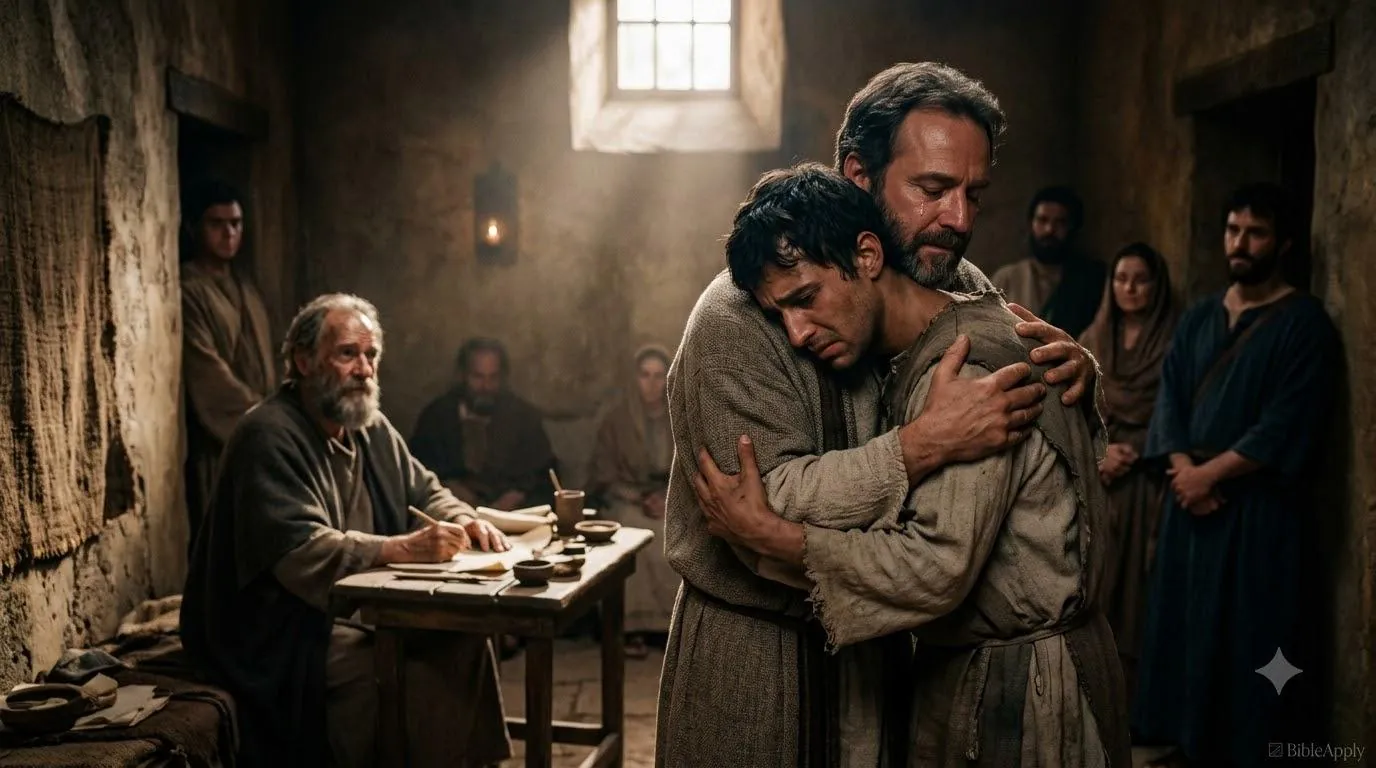
The book of Philemon is the shortest of the Apostle Paul’s letters, yet it packs one of the most profound theological punches in the entire New Testament. Unlike Romans or Ephesians, which are sweeping theological treatises, Philemon is a deeply personal, single-chapter letter written to address a specific, messy human conflict. Penned from a Roman prison cell around AD 60-62, this letter represents theology lived out in the crucible of everyday relationships. It establishes how the earth-shattering reality of the Gospel must inevitably reshape our social structures, our approach to forgiveness, and our understanding of human dignity.
To grasp the weight of Philemon 1, we must first understand its historical context. The letter is addressed to Philemon, a wealthy and prominent Christian leader in the city of Colossae who hosted a house church. The conflict centers around a man named Onesimus, a slave who had stolen from Philemon and fled to the sprawling metropolis of Rome to hide. In the Roman Empire, slavery was not racially based, but it was brutally institutionalized. The paterfamilias (head of the household) held absolute power, even the power of life and death, over his slaves. A runaway slave (fugitivus) who was caught could face horrific torture, branding with the letter “F” on their forehead, or even crucifixion. But in a twist of divine providence, while hiding in Rome, Onesimus encountered the imprisoned Apostle Paul. He heard the Gospel, was radically transformed by the grace of Jesus Christ, and became a beloved helper to Paul.
Now, Paul is doing the unthinkable: he is sending Onesimus back to Philemon. However, he is not sending him back merely as a returning piece of property, but as a beloved brother in Christ. This singular chapter is a masterclass in Christian persuasion and pastoral grace. It demonstrates how the Gospel destroys the social and cultural barriers of the ancient world. It challenges the harsh legal norms of Roman society by introducing a transcendent, heavenly ethic: the undeniable brotherhood of all believers. Through his brilliant appeal, Paul provides one of the clearest, most moving pictures of imputation and divine grace found anywhere in Scripture.
Paul’s Greeting and Thanksgiving (Verses 1-7)
“I thank my God, making mention of thee always in my prayers, Hearing of thy love and faith, which thou hast toward the Lord Jesus, and toward all saints; That the communication of thy faith may become effectual by the acknowledging of every good thing which is in you in Christ Jesus.” (Philemon 1:4-6, KJV)
Paul begins by establishing the relational groundwork for his difficult request. Notice that he introduces himself not with his usual title of authority (“Paul, an apostle”), but rather as a “prisoner of Jesus Christ.” This immediate vulnerability disarms Philemon and sets a tone of mutual submission rather than authoritative decree. Paul is writing alongside Timothy to Philemon, Apphia (likely Philemon’s wife), Archippus (possibly his son or a church leader), and the entire church that meets in their home. This indicates that while the letter is highly personal, the issue of reconciliation is a matter for the entire covenant community to witness.
In his thanksgiving, Paul praises Philemon for his enduring faith in Christ and his active love toward the saints. The Greek word used for “communication” or “fellowship” in verse 6 is koinonia. This is a rich, multifaceted word that implies deep partnership, mutual sharing, and active participation. Paul is telling Philemon that our Christian faith reaches its full potential—it becomes “effectual”—when we actively share in it and recognize the good things God has given us in Christ. True faith is never meant to be isolated; it must be expressed in koinonia with others.
Furthermore, Paul mentions how Philemon has refreshed the “bowels” (Greek: splagchna) of the saints (v. 7). In ancient Greek physiology, the splagchna referred to the internal organs (the heart, liver, and lungs), which were considered the literal seat of deep emotion, compassion, and affection. Where modern English speakers might say, “You have a good heart,” Paul is saying, “Your deepest affections are aligned with Christ, and you have brought deep emotional and spiritual refreshment to God’s people.” Philemon is a man of profound, active love, and Paul is about to ask him to stretch that love further than he ever has before.
Many believers also ask Jeremiah 29:11 Meaning: For I Know the Plans I Have for You — and the Bible gives us a clear, powerful answer.
The Heart of the Appeal: Love Over Law (Verses 8-14)
“Wherefore, though I might be much bold in Christ to enjoin thee that which is convenient, Yet for love’s sake I rather beseech thee, being such an one as Paul the aged, and now also a prisoner of Jesus Christ. I beseech thee for my son Onesimus, whom I have begotten in my bonds:” (Philemon 1:8-10, KJV)
If you want to explore this further, our in-depth guide on isaiah 41 10 breaks this down verse by verse.
If you want to explore this further, our in-depth study on jeremiah 29 11 breaks this down verse by verse.
Having established Philemon’s character, Paul pivots to the core of his request. As an appointed Apostle of Christ, Paul possesses the absolute authority to command Philemon to do the right thing (“that which is convenient” or proper). However, he deliberately lays aside his apostolic rights. Why? Because true, transformative obedience cannot be coerced by law; it must flow organically from love. Forced forgiveness is not forgiveness at all. God desires a willing heart, and Paul mirrors this divine patience by giving Philemon the freedom to choose grace over vengeance.
Notice the dramatic, emotional pause in verse 10. In the original Greek structure, Paul delays mentioning Onesimus’s name until the very end of the sentence. He builds anticipation, referring to him tenderly as “my son… whom I have begotten in my bonds.” He is identifying the runaway slave as his own spiritual child, born into the faith within the grim walls of a Roman prison.
Paul then employs a brilliant, theologically rich play on words. In Greek, the name Onesimus literally translates to “useful” or “profitable.”
Also Read:
“Which in time past was to thee unprofitable, but now profitable to thee and to me:” (Philemon 1:11, KJV)
Paul acknowledges the painful past: Onesimus had failed to live up to his name. Through his rebellion, theft, and escape, he had become “unprofitable.” But the Gospel is in the business of transformation. In Christ, Onesimus has been radically changed from a liability into a tremendous asset. He is now truly “profitable” to both Paul and Philemon. This reflects the broader narrative of salvation: before Christ, we are spiritually dead and unprofitable in our sin; through the Gospel, we are repurposed, given new life, and made tremendously useful for the Kingdom of God.
Divine Providence and True Brotherhood (Verses 15-16)
“For perhaps he therefore departed for a season, that thou shouldest receive him for ever; Not now as a servant, but above a servant, a brother beloved, specially to me, but how much more unto thee, both in the flesh, and in the Lord— (Philemon 1:15-16, KJV)
Here we encounter one of the most magnificent expressions of divine providence in the New Testament. Paul uses the passive voice (“he therefore departed,” or more literally, “was separated”) to gently suggest that a higher hand was at work. While Onesimus was fully responsible for his sinful rebellion and theft, God was sovereignly superintending the entire situation. Just as Joseph told his brothers in Genesis 50:20, “Ye thought evil against me; but God meant it unto good,” Paul is showing Philemon that God permitted a temporary, earthly loss so that Philemon might gain an eternal brother. God’s unseen hand was weaving human failure into a masterpiece of redemption.
The social and cultural implications of verse 16 are nothing short of revolutionary. While Paul does not explicitly launch a political manifesto calling for the legal abolition of the Roman slave trade, he does something far more subversively powerful: he plants a theological time-bomb that will eventually destroy the institution of slavery from the inside out.
Paul commands Philemon to receive Onesimus “not now as a servant, but above a servant, a brother beloved.” This fundamentally alters the relationship. You can own a tool, you can own an animal, and in Roman law, you could own a slave. But you cannot own a brother. The cross of Jesus Christ violently levels the ground at the foot of Calvary, erasing the rigid master-slave hierarchy of the ancient world and replacing it with the familial equality of the Kingdom of God. Philemon is being asked to look at the man who wronged him, the man society says he can legally execute, and embrace him as a co-heir of eternal glory.
The Principle of Imputation: Paul’s Christlike Offer (Verses 17-21)
“If thou count me therefore a partner, receive him as myself. If he hath wronged thee, or oweth thee ought, put that on mine account; I Paul have written it with mine own hand, I will repay it: albeit I do not say to thee how thou owest unto me even thine own self besides.” (Philemon 1:17-19, KJV)
This is the theological climax of the epistle. In these few verses, Paul acts out the very heart of the Gospel, providing us with a flawless, real-world illustration of imputation and substitutionary atonement.
Many believers also ask Psalm 91 Meaning: He Who Dwells in the Shelter — and the Bible gives us a clear, powerful answer.
Paul asks Philemon to welcome Onesimus exactly as if he were welcoming the Apostle Paul himself. He is asking Philemon to transfer the respect, love, and honor due to Paul onto the runaway slave. Then, Paul takes the massive, unpaid debt of Onesimus—whatever he stole, whatever it cost to replace him—and places it squarely on his own shoulders. “Put that on mine account,” Paul writes. He even takes the pen from his scribe to sign a legally binding I.O.U. in his own handwriting: “I will repay it.”
This is precisely what Jesus Christ does for us. We are the runaway slaves. We are the ones who robbed our Heavenly Master of the glory due His name, rebelled against His household, and incurred a massive moral debt that we could never repay. But Jesus Christ intercepts us in our rebellion. He stands between a holy God and sinful humanity, and He declares, “Receive them as myself. Treat them with the righteousness and love that You owe to Me.”
In theology, this is known as double imputation. On the cross, our insurmountable debt of sin was imputed (credited) to Christ’s account, and He paid it in full with His blood. Simultaneously, Christ’s perfect righteousness is imputed to our account. Just as Paul absorbed Onesimus’s debt to secure his freedom, Christ absorbed the wrath of God so that we could be welcomed into the Father’s house, not as slaves, but as beloved sons and daughters. Paul is not just preaching the Gospel; he is incarnating it.
Final Greetings and the Hope of Reunion (Verses 22-25)
“But withal prepare me also a lodging: for I trust that through your prayers I shall be given unto you.” (Philemon 1:22, KJV)
Paul concludes his letter with a blend of confidence and gentle accountability. He states his belief that Philemon will do “more than I say”—a subtle hint that Philemon should not only forgive Onesimus but perhaps legally emancipate him entirely so he can return to minister alongside Paul.
Remarkably, Paul then asks Philemon to prepare a guest room. This serves a dual purpose. First, it expresses Paul’s genuine hope that he will be released from Roman imprisonment. Second, it serves as a form of loving accountability. Paul is essentially saying, “I am coming to visit soon, and I expect to see you and Onesimus sitting at the table together in koinonia fellowship.” The letter ends with greetings from Paul’s companions, including Mark, Aristarchus, Demas, and Luke, reminding Philemon once again that his personal decisions of forgiveness have community-wide significance in the body of Christ.
3 Practical Applications from Philemon 1
- Forgiveness is Costly but Non-Negotiable: True forgiveness always involves a transfer of pain and cost. When someone wrongs you, a debt is created. You can either demand that they pay it back (through vengeance, anger, or legal action), or you can absorb the cost yourself, just as Paul absorbed Onesimus’s debt and Christ absorbed ours. The Gospel demands that we release others from their debts because we have been released from an infinitely greater debt by God.
- God is Sovereignly Working in Your Messiest Situations: Philemon 1 is a powerful testament to the unseen providence of God. Even in the midst of betrayal, loss, rebellion, or broken relationships, God is orchestrating events behind the scenes to bring about redemption. What feels like an irredeemable loss today may be the very instrument God uses to bring about profound spiritual transformation tomorrow. Trust that He is writing a larger story.
- The Gospel Must Destroy Our Prejudices and Social Barriers: In the Kingdom of God, earthly titles, tax brackets, ethnicities, and social classes are rendered entirely irrelevant. If the Gospel could turn a Roman master and a runaway slave into equal brothers, it must also obliterate the divisions in our modern world. We are called to look at our fellow believers—regardless of their background or societal status—not through the lens of worldly metrics, but as equally dignified, deeply beloved members of our eternal family.
Also Read
- Hosea 1 Summary & Meaning: A Marriage of Brokenness and Grace
- Judges 1 Summary & Meaning: The Tragedy of Incomplete Obedience
- Mark 1 Summary & Meaning: The Arrival of the Servant King
Read Philemon 1
Dive into the full scripture text for deeper study.
Conclusion
We hope this chapter-by-chapter summary of Philemon has helped you better understand God's Word. To continue your study, explore our other Bible Chapter Summaries or read our detailed Verse Meanings.