Joshua Chapter Summaries
A complete, chapter-by-chapter guide to the Book of Joshua. Read deep dives into the meaning, historical context, and modern application of every chapter.
Welcome to our complete guide to the Book of Joshua. Below you will find a chapter-by-chapter summary that flows through the entire narrative, helping you understand the context, meaning, and application of this profound book.
Chapter 1: The Commission of Joshua
The Historical and Cultural Context of Joshua 1
The book of Joshua marks a monumental and dramatic turning point in the biblical narrative. For forty grueling years, the nation of Israel has wandered in the desolate wilderness under the leadership of Moses. They have received the Law at Mount Sinai, built the tabernacle for the presence of God, and experienced the miraculous daily provision of manna and water from the rock. Yet, because of a tragic failure of faith at Kadesh-barnea (Numbers 13-14), an entire generation has perished in the desert due to unbelief. Now, poised on the eastern banks of the Jordan River in the plains of Moab, a new, younger generation stands ready to cross over and inherit the land God promised to their forefather Abraham centuries earlier (Genesis 12:1-3).
Chapter 1 opens in the immediate aftermath of a profound and staggering loss: the death of Moses. Moses was not merely a political or military leader; he was the great prophet, the lawgiver, the miracle worker, and the intimate mediator between God and Israel, who spoke to the Lord “face to face” (Deuteronomy 34:10). His departure could have easily sent the fragile nation into a spiral of despair, fragmentation, and chaos. However, God’s redemptive plan is never hindered by the passing of His servants. The torch of leadership is passed to Joshua, the son of Nun, a man who had faithfully served as Moses’s aide (mesharet, meaning minister or servant) and had demonstrated unwavering faith when he spied out the land decades prior.
Joshua 1 is foundational because it sets the theological, spiritual, and military framework for the entire conquest of Canaan. It is a chapter about transition, divine commissioning, and the indispensable role of God’s Word in the life of a believer. The crossing of the Jordan and the taking of the land are not ultimately about military might or tactical genius, but about covenant faithfulness. The chapter vividly demonstrates that possessing the promises of God requires radical obedience, sustained courage, and absolute, moment-by-moment reliance on the presence of the Lord.
Section by Section Theological Analysis
God’s Commission: A Promise of Presence (Joshua 1:1-5)
“After the death of Moses the servant of the LORD, the LORD said to Joshua the son of Nun, Moses’ assistant, ‘Moses my servant is dead. Now therefore arise, go over this Jordan, you and all this people, into the land that I am giving to them, to the people of Israel.’” (Joshua 1:1-2, BSB)
God’s address to Joshua is stark, direct, and incredibly practical. “Moses my servant is dead.” There is no prolonged period of mourning or paralyzing grief permitted here; the time for weeping has officially ended (Deuteronomy 34:8). The blunt phrase serves as a divine reset for the entire nation. God is declaring that while human leaders are temporal and eventually pass away, His covenant promises are eternal. The work of God outlives the workers of God. The kingdom moves forward.
God then reiterates the ancient land promise given to the patriarchs (Genesis 12:7, 15:18). He gives Joshua an extraordinary and sweeping guarantee: “Every place that the sole of your foot will tread upon I have given to you, just as I promised to Moses” (v. 3). Notice the fascinating theological tension here between divine sovereignty and human responsibility. The land is already “given” (a perfect tense concept in the divine mind; it is a done deal), yet the Israelites must still “tread” upon it (active, courageous human participation). God’s sovereignty does not negate our responsibility; rather, it empowers it.
The ultimate assurance given to Joshua is not a flawless military strategy, but the promise of divine presence. “No man shall be able to stand before you all the days of your life. Just as I was with Moses, so I will be with you. I will not leave you or forsake you” (v. 5). The Hebrew word for “forsake” (‘azab) means to abandon, leave destitute, or let loose. God is promising an ironclad grip on Joshua’s life. This promise anchors Joshua’s soul. In biblical theology, God’s presence (Immanuel—God with us) is the ultimate differentiator between success and failure in the kingdom of God.
Related to this, you may want to read Jeremiah 29:11 Meaning: For I Know the Plans I Have for You for additional biblical perspective.
The Call to Courage and the Centrality of the Word (Joshua 1:6-9)
“Be strong and courageous, for you shall cause this people to inherit the land that I swore to their fathers to give them. Only be strong and very courageous, being careful to do according to all the law that Moses my servant commanded you.” (Joshua 1:6-7, BSB)
Three distinct times in this brief section, God commands Joshua to “be strong and courageous.” In the original Hebrew, these words are chazaq and amats. Chazaq conveys the idea of seizing, holding fast, being firm, or growing strong. Amats relates to mental and physical alertness, being stout-hearted, or resolute in the face of terror. God does not command courage because the task ahead will be easy; He commands it precisely because the obstacles will be absolutely terrifying. Canaan is filled with fortified cities with walls reaching to the sky, and giant warriors (the Anakim) who make normal men look like grasshoppers.
But upon what, exactly, is this immense courage to be built? It is not built on self-confidence, positive thinking, or military prowess, but solely on the Word of God.
“This Book of the Law shall not depart from your mouth, but you shall meditate on it day and night, so that you may be careful to do according to all that is written in it. For then you will make your way prosperous, and then you will have good success.” (Joshua 1:8, BSB)
Here we find one of the most famous and pivotal verses in the Old Testament. The “Book of the Law” refers primarily to the book of Deuteronomy, the covenant renewal document Moses had just delivered to the people. The command to “meditate” translates the Hebrew word hagah, which literally means to mutter, murmur, growl (like a lion over its prey), or ponder deeply. It is not an eastern mystical emptying of the mind, but rather a robust biblical filling of the mind.
Joshua is instructed to chew on the Word of God continually. It must be in his mouth and on his mind “day and night.” The success of his upcoming military campaigns depends entirely on his submission to the Scriptures. True prosperity in God’s economy is not defined by material wealth, but by faithful adherence to His covenant. If Joshua leads according to the Word, God guarantees “good success” (Hebrew: sakal, meaning to have insight, act prudently, and prosper).
Preparing for the Promise (Joshua 1:10-15)
Following God’s overwhelming divine commission, Joshua does not hesitate. He immediately springs into action, demonstrating his faith. He commands the officers of the people to instruct the camp to prepare provisions, for in a mere three days they will cross the mighty Jordan River. It is worth noting that this crossing would take place during the harvest season when the Jordan was at flood stage (Joshua 3:15). Crossing it naturally was humanly impossible. By telling them to prepare, Joshua is essentially saying, “Get ready for a miracle.”
Also Read:
- 2 Samuel 1 Summary & Meaning: The Lament of the Anointed
- Habakkuk 1 Summary & Meaning: The Prophet’s Complaint and God’s Astonishing Providence
- Ruth 1 Summary & Meaning: A Journey from Bitterness to Covenant Loyalty
A critical detail emerges in verses 12-15 when Joshua directly addresses the Reubenites, the Gadites, and the half-tribe of Manasseh. These specific tribes had already received their inheritance on the eastern side of the Jordan from Moses (Numbers 32). They had their land. They could easily have stayed in their comfort, built their homes, and let the rest of the nation fight the brutal battles ahead.
Instead, Joshua reminds them of their solemn obligation. They are commanded to leave their wives, children, and livestock behind in safety, while the men of war cross over fully armed to fight fiercely alongside their brothers until the whole land is conquered. This highlights the beautiful biblical principle of corporate solidarity. The inheritance is not fully realized until all the tribes have found their rest. It serves as a powerful picture of unity within the body of believers—we must never settle for our own spiritual or physical comfort while our brothers and sisters are still engaged in warfare and struggle.
The People’s Pledge of Allegiance (Joshua 1:16-18)
“And they answered Joshua, ‘All that you have commanded us we will do, and wherever you send us we will go. Just as we obeyed Moses in all things, so we will obey you. Only may the LORD your God be with you, as he was with Moses!’” (Joshua 1:16-17, BSB)
The chapter concludes with a remarkable, resounding display of submission and unity from the people of Israel. They pledge their total, unreserved allegiance to Joshua’s new leadership. The previous generation that perished in the wilderness was endlessly characterized by grumbling, stubborn rebellion, and a wicked desire to return to the slavery of Egypt. This new generation, however, is characterized by obedience, readiness, and faith.
Interestingly, the people offer a solemn condition and a warning to Joshua. They echo God’s own prior exhortation: “Only be strong and courageous” (v. 18). Furthermore, they pronounce a death sentence on anyone who rebels against Joshua’s commands. They recognize that their obedience to Joshua is directly tied to Joshua’s obedience to God and God’s manifest presence resting upon him. They will follow him fiercely, as long as he is following the Lord faithfully.
The Theological and Gospel Connection: Jesus as the Greater Joshua
When we read the book of Joshua, we are not merely reading a dry historical account of ancient Israel’s military conquests; we are reading a profound, living theological text that points directly and beautifully to Jesus Christ.
This topic connects with Psalm 91 Meaning: He Who Dwells in the Shelter, one of the most-searched biblical questions today.
First, consider the name itself. In Hebrew, Joshua is Yehoshua, which means “Yahweh is salvation” or “The LORD saves.” The Greek equivalent of this name, used in the New Testament and the Septuagint, is Iesous, or Jesus. Joshua is a spectacular, vivid “type” (foreshadowing) of Christ.
Moses represents the Law. The Law is holy, righteous, and perfectly good, but it has a fatal limitation for fallen humanity: it cannot bring people into the Promised Land of salvation. The Law can only lead you through the wilderness, expose your sin, point out your flaws, and bring you to the absolute edge of the promise. Moses had to die before Israel could enter Canaan. The Law cannot save us; it can only condemn us and show us our need for a Savior.
We desperately need a Joshua to lead us in. Jesus (our true and better Joshua) succeeds exactly where the Law fails. Jesus crosses the muddy, terrifying waters of death and judgment on our behalf, completely defeats our spiritual enemies (sin, death, and Satan), and brings us safely into the eternal rest that God promised.
As the author of Hebrews profoundly points out, “For if Joshua had given them rest, God would not have spoken of another day later on. So then, there remains a Sabbath rest for the people of God” (Hebrews 4:8-9). The physical land of Canaan was merely a shadow of the ultimate, eternal rest we find in Christ’s finished work on the cross.
Furthermore, God’s stunning promise to Joshua—“I will not leave you or forsake you”—is explicitly repeated and applied to the New Testament church in Hebrews 13:5. Because Christ has inaugurated the new covenant with His blood and secured our eternal inheritance, we live with the unbreakable promise of His abiding presence through the indwelling Holy Spirit. We can face our own impossible battles because the Greater Joshua has already won the war.
3 Practical Applications from Joshua 1
1. Meditate on God’s Word Daily for True Success
God’s divine prescription for Joshua’s success wasn’t sharpening swords, mastering chariot warfare, or studying Canaanite battle tactics; it was sharpening his mind on the Holy Scriptures. The modern world defines success by wealth, status, followers, and power. God defines success as faithful obedience to His Word. If you want to be truly “prosperous” in the kingdom of God, you must cultivate a daily, unrelenting habit of meditating on Scripture. Do not just speed-read it to check a box; hagah (mutter and ponder) it. Let it marinate in your mind throughout the day so that it radically shapes your decisions, reactions, and desires.
2. Lean on God’s Presence, Not Your Own Competence
Joshua had massive, seemingly impossible shoes to fill. Following a legendary leader like Moses could easily induce paralyzing anxiety and imposter syndrome. However, God didn’t try to boost Joshua’s self-esteem by saying, “You are smart enough, strong enough, and people like you.” God simply said, “I will be with you.” When you face daunting tasks, painful transitions, or terrifying trials in your life, your confidence must not rest in your own limited competence. Your courage must be derived entirely from the unwavering promise of Immanuel—God is with you, and He will never, ever abandon you.
3. Move Forward in Courageous Faith
“Moses my servant is dead. Now therefore arise, go over…” There comes a defining time in the life of every believer when we must stop looking backward and start stepping forward. Perhaps you are mourning a past season, grieving a massive failure, or regretting a lost opportunity. While grief is a necessary human process, it cannot be your permanent spiritual residence. God is calling you to arise and step into the new promises and assignments He has for your future. It requires tremendous courage to step into the unknown, but when God commands you to go, He always goes before you. Step out in faith, knowing that the battle belongs to the Lord.
Also Read
- 1 Samuel 1 Summary & Meaning: The Power of Desperate Prayer and Dedication
- Ecclesiastes 1 Summary & Meaning: Chasing the Wind
- Haggai 1 Summary & Meaning: Consider Your Ways
Read Joshua 1
Dive into the full scripture text for deeper study.
Chapter 2: Rahab and the Two Spies
She confesses her profound belief in Israel's God, recounting how the fear of the Lord has paralyzed her people since the parting of the Red Sea. In exchange for her protection, she secures an oath from the spies to spare her family during the impending invasion. They instruct her to tie a scarlet cord in her window as a sign. The spies then successfully evade the king's search parties and return to Joshua, confident that God has delivered the land into their hands.
Chapter 3: Crossing the Jordan River
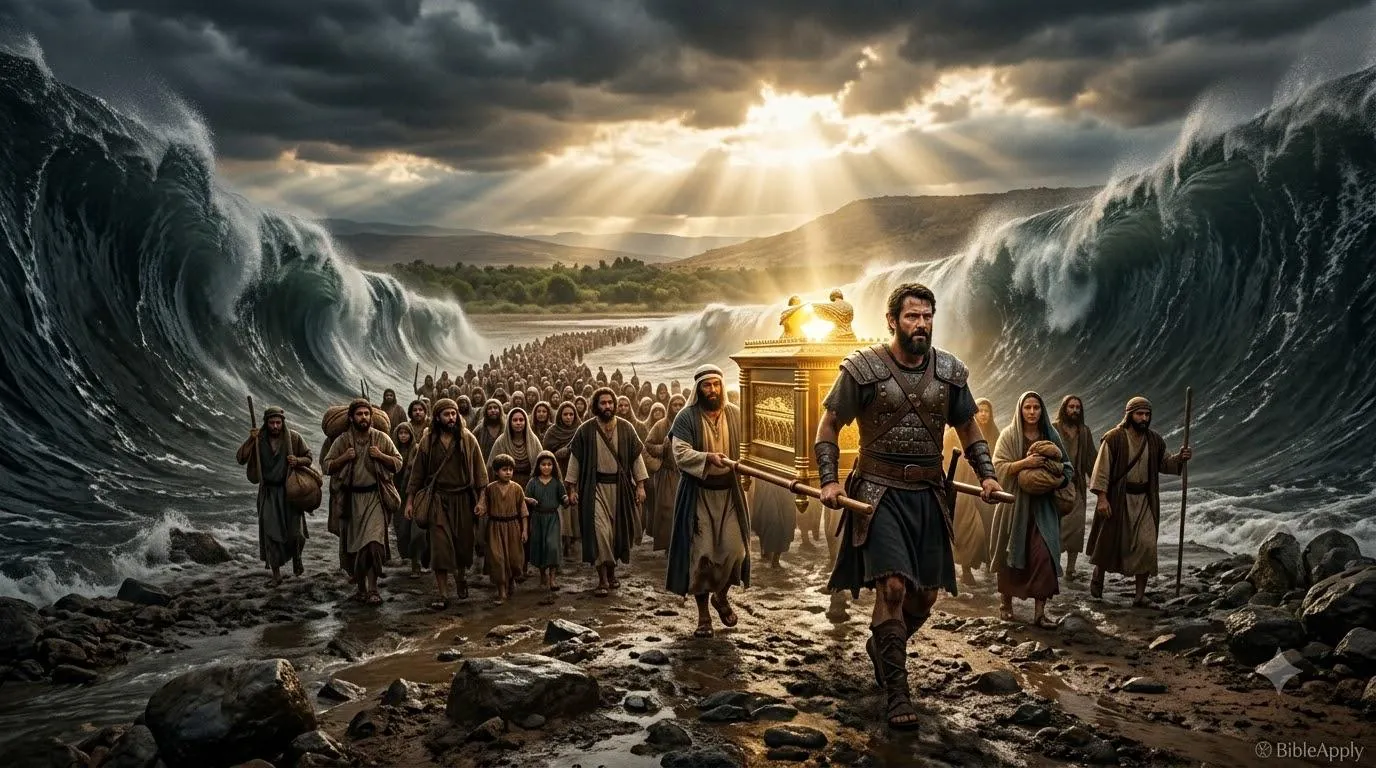
Joshua tells the people to consecrate themselves in preparation for God's imminent wonders. The Lord promises to exalt Joshua in the eyes of all Israel, proving His divine endorsement. As the priests carrying the Ark step into the rushing waters, the river miraculously stops flowing upstream at the town of Adam, piling up in a heap. The priests stand firmly on dry ground in the middle of the riverbed while the entire nation of Israel safely crosses over.
Chapter 4: The Memorial Stones
These twelve stones are carried to their campsite at Gilgal and set up as a permanent memorial. Joshua explains that when future generations ask about the stones, they will serve as a lasting testimony of the day God dried up the Jordan River, just as He did the Red Sea. Joshua also sets up another twelve stones in the middle of the riverbed itself. Once the priests carrying the Ark finally step out of the river, the waters violently return to flood stage, securing the Israelites' awe of God and reverence for Joshua.
Chapter 5: Consecration at Gilgal
While healing at Gilgal, the Israelites celebrate the Passover on the plains of Jericho. The very next day, they eat the produce of the land, and the daily provision of manna miraculously ceases forever. As Joshua surveys Jericho, he is suddenly confronted by a man with a drawn sword. Joshua asks if he is friend or foe, but the man reveals himself as the Commander of the Lord's Army. Joshua falls facedown in worship, and is told to remove his sandals because the ground is holy.
Chapter 6: The Fall of Jericho
On the seventh day, they march around the city seven times. On the final lap, as the priests blow a long blast on the horns, Joshua commands the people to shout, declaring that God has given them the city. The massive walls of Jericho instantaneously collapse, allowing the Israelites to charge straight in. They devote the entire city to destruction as an offering to God, sparing only Rahab and her family as promised. Joshua issues a chilling curse on anyone who attempts to rebuild the city's foundations.
Chapter 7: Achan's Sin and the Defeat at Ai
Joshua falls before the Ark in deep distress. God reveals that Israel has sinned and violated the covenant, declaring He will not be with them until the accursed things are destroyed. The next morning, through a process of elimination by tribes and clans, Achan is exposed. He confesses to stealing a beautiful Babylonian garment, silver, and gold. Achan and his family, along with the stolen items, are stoned to death and burned in the Valley of Achor, appeasing the Lord's burning anger.
Chapter 8: The Destruction of Ai
Once the city is left defenseless, Joshua signals with his javelin, and the ambush force storms Ai, setting it ablaze. The men of Ai are caught between the two Israelite armies and utterly annihilated. Israel takes the livestock and plunder as God permitted. Afterward, Joshua journeys to Mount Ebal, where he builds a stone altar and offers sacrifices. He then reads the entire Book of the Law—the blessings and the curses—to the whole assembly of Israel, reaffirming their covenant with God.
Chapter 9: The Gibeonite Deception
They approach Joshua at Gilgal, claiming they have heard of God's great miracles and wish to make a peace treaty. The Israelite leaders examine the dry bread and, crucially, fail to inquire of the Lord. Joshua and the leaders swear an oath of peace. Three days later, they discover they have been completely duped; the Gibeonites are actually local neighbors. Bound by their sacred oath, Israel cannot destroy them. Instead, Joshua curses them to become perpetual woodcutters and water carriers for the congregation and the altar of the Lord.
Chapter 10: The Sun Stands Still
In the heat of the pursuit, Joshua boldly prays for the sun and moon to stand still to allow for a complete victory. Miraculously, the sun halts in the middle of the sky for nearly a full day. The five kings are discovered hiding in a cave and are subsequently executed. Joshua then systematically sweeps through the southern region, utterly destroying city after city just as the Lord commanded.
Chapter 11: Conquest of the North
Joshua launches a sudden, decisive attack, hamstringing their horses and burning their chariots, utterly destroying the northern coalition. Hazor, the head of the kingdoms, is burned to the ground. Joshua faithfully executes every command Moses had given him from the Lord, leaving nothing undone. This chapter summarizes the sweeping nature of Joshua's campaigns, noting that the wars took a long time, but ultimately, Israel captured the entire region, and the land finally had rest from war.
Chapter 12: The Roster of Defeated Kings
The text then pivots to the western side of the Jordan, meticulously listing the thirty-one kings defeated by Joshua and the Israelites. This expansive roll call, spanning from Jericho to Hazor, highlights the sheer scale of the victory God granted His people, completely dismantling the established Canaanite power structures across the hill country, the plains, and the Negev.
Chapter 13: Dividing the Remaining Land
The chapter then retrospectively outlines the land already distributed by Moses to the eastern tribes—Reuben, Gad, and the half-tribe of Manasseh. A crucial detail is repeated regarding the tribe of Levi: they receive no territorial inheritance because the sacrifices made by fire to the Lord, and the Lord God Himself, are their designated inheritance, ensuring their focus remains on spiritual service rather than land ownership.
Chapter 14: Caleb's Bold Request
Now eighty-five years old, Caleb declares he is just as vigorous and ready for battle as he was in his youth. He boldly requests the hill country of Hebron, heavily fortified and inhabited by the formidable Anakites, trusting that the Lord will help him drive them out. Recognizing his enduring faith, Joshua blesses Caleb and officially grants him Hebron as a permanent inheritance.
Chapter 15: The Allotment for Judah
Within this allotment, Caleb takes center stage as he marches on Hebron, successfully driving out the three sons of Anak. He then offers his daughter Aksah in marriage to the man who captures the nearby city of Debir. Othniel achieves this feat, and Aksah boldly asks her father for springs of water to accompany her arid land, which Caleb grants. The chapter ends with a stark note: the men of Judah could not dislodge the Jebusites living in Jerusalem.
Chapter 16: The Allotment for Ephraim
The text delineates the specific borders of Ephraim's territory, noting that they also possessed several enclave towns scattered within the borders of their brother tribe, Manasseh. However, a significant failure is recorded at the end of the chapter: the Ephraimites do not drive out the Canaanites living in the city of Gezer. Instead, these Canaanites are subjected to forced labor, a compromise that would later bring significant spiritual and political trouble to the nation.
Chapter 17: The Allotment for Manasseh
Like Ephraim, Manasseh fails to completely clear their territory, as the Canaanites are determined to live in the region, boasting iron chariots. The tribes of Joseph (Ephraim and Manasseh) complain to Joshua that their singular allotment is too small for their massive population. Joshua cleverly challenges their pride, telling them to clear the heavily forested hill country and prove their strength by driving out the heavily armed Canaanites, assuring them of victory if they rely on God.
Chapter 18: The Allotment for Benjamin
The surveyors travel throughout the land, writing down descriptions of the towns and dividing the region into seven parts. They return to Shiloh, where Joshua casts lots in the presence of the Lord. The first lot falls to the tribe of Benjamin. Their fiercely contested territory is strategically located between the powerhouse tribes of Judah and Ephraim, encompassing key cities like Jericho, Bethel, and significantly, Jerusalem (Jebus).
Chapter 19: The Final Tribal Allotments
The final lot falls to the tribe of Dan. However, they struggle to secure their coastal inheritance against the fierce Philistines and Amorites. Consequently, the Danites migrate far to the north, conquering the isolated city of Leshem, renaming it Dan, and settling there. Once all the land is distributed, the Israelites honor Joshua by granting him the specific town he requests, Timnath Serah in the hill country of Ephraim, where he builds up the town and settles.
Chapter 20: The Cities of Refuge
The accused can flee to one of these cities, present their case to the elders at the city gate, and receive asylum. They must stand trial before the assembly and, if found innocent of premeditated murder, remain safely in the city until the death of the reigning high priest. Three cities are designated west of the Jordan (Kedesh, Shechem, and Hebron) and three are confirmed on the eastern side (Bezer, Ramoth, and Golan), ensuring accessibility for all Israelites.
Chapter 21: Towns for the Levites
A total of forty-eight towns are distributed by lot among the three Levitical clans: the Kohathites (including the priests), the Gershonites, and the Merarites. The chapter concludes with a powerful theological summary: the Lord gave Israel all the land He had sworn to their ancestors. Not a single one of God's good promises failed; every word was fulfilled, and the Lord gave them rest on every side.
Chapter 22: The Altar of Witness
Phinehas the priest leads a delegation to confront them. The eastern tribes urgently explain that the altar is not for sacrifices, but a replica of the Lord's altar. It is a permanent "witness" to future generations that despite the geographical barrier of the river, they are part of Israel and worship the true God. This explanation deeply satisfies Phinehas and the western leaders, averting a catastrophic war and preserving national unity.
Chapter 23: Joshua's Farewell Address
Joshua urgently commands them to be strictly faithful to the Book of the Law of Moses. He sternly warns against intermarrying with the remaining Canaanites or adopting their idolatrous practices. He lays out a stark binary choice: if they cling to the Lord, they will prosper, but if they violate the covenant and serve other gods, the Lord's anger will burn against them, and they will perish quickly from the good land He gave them.
Chapter 24: The Covenant Renewed at Shechem
The people adamantly vow to serve God. Joshua warns them of the heavy cost of discipleship, declaring that God is holy and jealous and will not forgive rebellion. The people insist on their loyalty, and Joshua sets up a large stone under an oak tree as a witness to their covenant. The book concludes with the death and burial of Joshua at age 110, the burial of Joseph's bones, and the death of Eleazar the priest.
Conclusion
We hope this chapter-by-chapter summary of Joshua has helped you better understand God's Word. To continue your study, explore our other Bible Chapter Summaries or read our detailed Verse Meanings.