Jonah Chapter Summaries
A complete, chapter-by-chapter guide to the Book of Jonah. Read deep dives into the meaning, historical context, and modern application of every chapter.
Welcome to our complete guide to the Book of Jonah. Below you will find a chapter-by-chapter summary that flows through the entire narrative, helping you understand the context, meaning, and application of this profound book.
Chapter 1: Running from the Call
The book of Jonah stands as a profound anomaly among the Minor Prophets. While other prophetic books primarily record the oracles and messages delivered by the prophets, Jonah is almost entirely narrative—a biographical account of a rebellious prophet running from his divine commission. Set against the backdrop of the 8th century BC, during the reign of Jeroboam II in Israel, the historical context is crucial. Jonah was not a novice; according to 2 Kings 14:25, he was an established prophet who had successfully predicted the expansion of Israel’s borders. Yet, when tasked with an unprecedented mission to the heart of Gentile territory, his theological and nationalistic framework collapsed.
Nineveh, the capital of the Assyrian Empire, was not just another pagan city; it was the epicenter of brutality, a rising superpower known for flaying its enemies and stacking skulls as monuments of terror. Israel had every political and human reason to despise Assyria and desire its annihilation. When God commands Jonah to go to Nineveh and preach against its wickedness, the command deeply offends Jonah’s sense of justice and his nationalistic pride. He knows that Yahweh is a merciful God, and he fears that his preaching might actually lead to Nineveh’s repentance and salvation (a fear he explicitly states later in chapter 4).
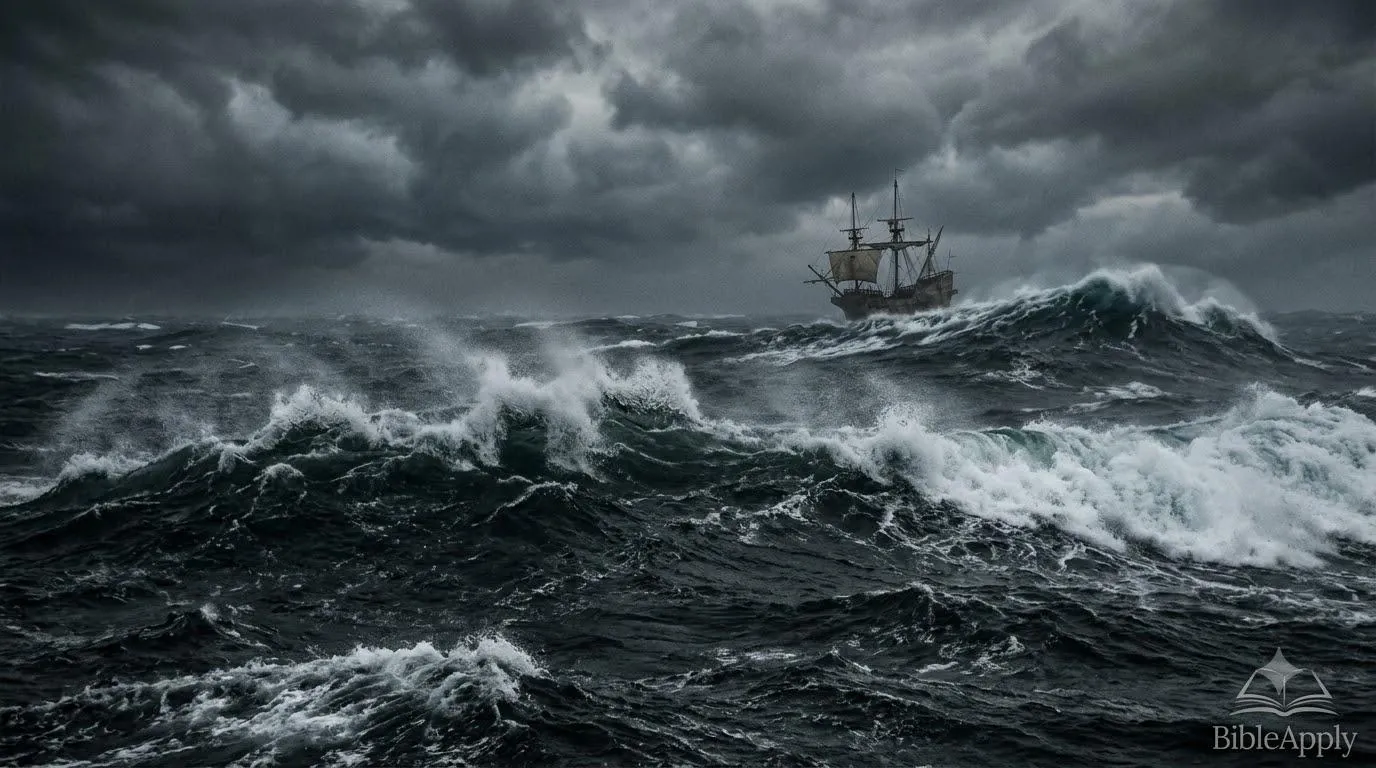
Jonah Chapter 1 sets this cosmic stage, contrasting the sovereign, active will of God with the stubborn, passive resistance of His servant. It is a masterful, ironic narrative where a Hebrew prophet acts more like a pagan, and pagan sailors demonstrate more fear of Yahweh than the prophet himself. Through the crashing waves, the desperate sailors, and the silent prophet descending into the belly of a ship, Jonah 1 forces the reader to confront a terrifying and comforting truth: the relentless grace of God will pursue His people even into the darkest depths of their disobedience.
God’s Call and Jonah’s Flight (Jonah 1:1-3)
The Word of the Lord Comes to Jonah
“Now the word of the LORD came unto Jonah the son of Amittai, saying, Arise, go to Nineveh, that great city, and cry against it; for their wickedness is come up before me.” (Jonah 1:1-2, KJV)
The chapter begins with the standard prophetic formula: “the word of the LORD came.” In the Hebrew text, the imperatives are sharp and urgent: qum (arise), lekh (go), and qara (cry out). God is the initiator. He sees the “wickedness” (Hebrew ra’ah) of Nineveh. The theological weight here is immense: Yahweh is not merely a localized, tribal deity of Israel; He is the Sovereign Lord of the nations. The moral decay of a Gentile empire in Mesopotamia registers in the throne room of heaven. God’s holiness demands that sin be addressed, but His sending of a prophet indicates a merciful warning before judgment.
Tarshish: The Opposite Direction
“But Jonah rose up to flee unto Tarshish from the presence of the LORD, and went down to Joppa; and he found a ship going to Tarshish: so he paid the fare thereof, and went down into it, to go with them unto Tarshish from the presence of the LORD.” (Jonah 1:3, KJV)
Jonah’s response is immediate, but not obedient. He hears “Arise and go to Nineveh,” and he arises—only to flee in the exact opposite direction. Nineveh was roughly 500 miles to the northeast. Tarshish, likely located on the southern coast of Spain, was over 2,000 miles to the west, at the very edge of the known world.
Notice the chilling repetition of the phrase “from the presence of the LORD” (Hebrew: milliphne Yahweh). Jonah was a prophet; he knew Psalm 139 and understood omnipresence intellectually. However, in the Old Testament context, fleeing the “presence” of the Lord meant fleeing his office, his commission, and the land of Israel where God’s localized presence dwelt in the temple. He was resigning from his post.
The text emphasizes a downward trajectory in his rebellion: Jonah went down to Joppa, and went down into the ship. When we run from God, the spiritual trajectory is always a descent. Sin requires us to finance our own destruction—he “paid the fare thereof.” God’s path is often freely given by grace, but rebellion will cost you everything you have.
If this resonates with you, our deep dive into Jeremiah 29:11 Meaning: For I Know the Plans I Have for You explores the scriptural foundation further.
The Divine Storm and the Sleeping Prophet (Jonah 1:4-6)
God Hurls a Great Wind
“But the LORD sent out a great wind into the sea, and there was a mighty tempest in the sea, so that the ship was like to be broken.” (Jonah 1:4, KJV)
If you want to explore this further, our in-depth guide on isaiah 41 10 breaks this down verse by verse.
Jonah may have abandoned his mission, but God had not abandoned Jonah. The text literally says the Lord “hurled” (tul) a great wind onto the sea. The storm is not a random meteorological event; it is the physical manifestation of divine pursuit. It is the “hound of heaven” tracking down a runaway child. The Hebrew grammar animates the ship itself, personifying it as “thinking” it was going to break apart.
The Irony of the Pagan Sailors
“Then the mariners were afraid, and cried every man unto his god, and cast forth the wares that were in the ship into the sea, to lighten it of them. But Jonah was gone down into the sides of the ship; and he lay, and was fast asleep.” (Jonah 1:5, KJV)
Here the narrator employs brilliant, stinging irony. The pagan sailors are terrified. They pray (albeit to false gods) and they act practically, throwing cargo overboard to save lives. Meanwhile, the only man on board who actually knows the Creator of the sea is fast asleep in the hold.
Jonah’s sleep is not the sleep of trusting faith (like Jesus in the boat in Mark 4); it is the deep, comatose sleep of spiritual depression and willful apathy. The Hebrew word for sleep here (radam) suggests a heavy, unnatural slumber. Sin numbs us. It anesthetizes the conscience to the reality of the destruction we are bringing upon ourselves and those around us.
The Captain’s Rebuke
“So the shipmaster came to him, and said unto him, What meanest thou, O sleeper? arise, call upon thy God, if so be that God will think upon us, that we perish not.” (Jonah 1:6, KJV)
The irony deepens when the pagan captain uses the exact same Hebrew word God used in verse 2: qum (Arise!). God said, “Arise, go to Nineveh.” The captain says, “Arise, call upon thy God.” Jonah cannot escape the divine imperative. Even when he plugs his ears to the voice of God, the Lord uses a pagan sailor to preach his own sermon back to him.
Casting Lots and Discovering the Culprit (Jonah 1:7-10)
The Lot Falls on Jonah
“And they said every one to his fellow, Come, and let us cast lots, that we may know for whose cause this evil is upon us. So they cast lots, and the lot fell upon Jonah.” (Jonah 1:7, KJV)
In the ancient Near East, casting lots was a common way of discerning divine will. While it seems superstitious to the modern mind, Proverbs 16:33 reminds us, “The lot is cast into the lap, but its every decision is from the LORD.” God sovereignly governs the tumbling of the lots to single out His runaway prophet. There is no anonymity in the kingdom of God; our hidden sins will eventually find us out (Numbers 32:23).
Also Read:
- Acts 1 Summary & Meaning: The Ascension and the Waiting Church
- Ecclesiastes 1 Summary & Meaning: Chasing the Wind
- Habakkuk 1 Summary & Meaning: The Prophet’s Complaint and God’s Astonishing Providence
Jonah’s Confession: I Fear the Lord
“Then said they unto him, Tell us, we pray thee… What is thine occupation? and whence comest thou? what is thy country? and of what people art thou? And he said unto them, I am an Hebrew; and I fear the LORD, the God of heaven, which hath made the sea and the dry land.” (Jonah 1:8-9, KJV)
Bombarded with questions, Jonah finally speaks. His confession is a masterpiece of theological accuracy and practical hypocrisy. He declares, “I fear Yahweh, the God of heaven, who made the sea and the dry land.” He professes to fear the God of the sea, while simultaneously trying to escape Him via a boat on the sea!
This reveals a profound truth about nominal faith: we can possess impeccable, orthodox theology while our lives display blatant rebellion. Jonah knew the right catechism answers, but his heart was far from God.
The Sailors’ Profound Terror
“Then were the men exceedingly afraid, and said unto him, Why hast thou done this? For the men knew that he fled from the presence of the LORD, because he had told them.” (Jonah 1:10, KJV)
When the sailors realize that Jonah is on the run from the Creator of the very waves that are currently trying to drown them, their fear escalates from natural fear of a storm to theological terror. “Why hast thou done this?” is a question of profound moral clarity from pagans addressed to a prophet. They cannot fathom the sheer lunacy of defying the God of the universe.
The Ultimate Sacrifice: Thrown into the Sea (Jonah 1:11-16)
“Pick Me Up and Throw Me into the Sea”
“Then said they unto him, What shall we do unto thee, that the sea may be calm unto us? for the sea wrought, and was tempestuous. And he said unto them, Take me up, and cast me forth into the sea; so shall the sea be calm unto you: for I know that for my sake this great tempest is upon you.” (Jonah 1:11-12, KJV)
Jonah finally accepts the reality of God’s inescapable judgment. He knows the storm is the wrath of God directed at him, and he proposes a radical solution: he must be thrown overboard.
Scholars debate Jonah’s motive here. Is it a noble act of self-sacrifice to save the sailors, or is it the ultimate act of stubbornness—preferring death over obeying God and going to Nineveh? Given Jonah’s bitter attitude in chapter 4, it is highly likely that this was a suicidal attempt to permanently escape his mission. He would rather drown in the Mediterranean than see Assyrians saved.
The Sailors’ Desperate Plea to Yahweh
“Nevertheless the men rowed hard to bring it to the land; but they could not… Wherefore they cried unto the LORD, and said, We beseech thee, O LORD, we beseech thee, let us not perish for this man’s life, and lay not upon us innocent blood: for thou, O LORD, hast done as it pleased thee.” (Jonah 1:13-14, KJV)
The sailors, displaying more nobility than the prophet, try to row back to shore (literally, they “dug in” their oars). But human effort cannot overcome divine judgment. Finally, they abandon their false gods entirely and pray directly to Yahweh. They recognize God’s sovereignty (“thou, O LORD, hast done as it pleased thee”) and plead for mercy before throwing Jonah into the raging waters.
Many believers also ask Psalm 91 Meaning: He Who Dwells in the Shelter — and the Bible gives us a clear, powerful answer.
The Calming of the Storm and True Worship
“So they took up Jonah, and cast him forth into the sea: and the sea ceased from her raging. Then the men feared the LORD exceedingly, and offered a sacrifice unto the LORD, and made vows.” (Jonah 1:15-16, KJV)
The moment Jonah hits the water, the chaotic storm abruptly ceases. The sudden, supernatural calm is more terrifying than the storm itself. The sailors transition from fearing the storm to fearing Yahweh. They offer sacrifices and make vows. In a beautiful twist of irony, Jonah, who refused to go be a missionary to the Gentiles in Nineveh, accidentally becomes a missionary to the Gentile sailors on the boat. God’s purpose of drawing the nations to Himself will be accomplished, even through a disobedient servant.
The Great Fish: Judgment as Severe Mercy (Jonah 1:17)
The Lord Appoints a Great Fish
“Now the LORD had prepared a great fish to swallow up Jonah. And Jonah was in the belly of the fish three days and three nights.” (Jonah 1:17, KJV)
Jonah plunges into the chaotic abyss, expecting to die. But God is not finished with him. Just as God “hurled” the wind, He now “prepared” or “appointed” (Hebrew: manah) a great fish.
In popular culture, the fish is often seen as the punishment. Theologically, however, the fish is salvation. The sea was the judgment; the fish was the rescue vehicle. It is a severe mercy. God subjects Jonah to the horrific, claustrophobic darkness of a fish’s digestive tract not to destroy him, but to preserve his life and strip him of his pride. God will go to terrifying lengths to save His children from their own destructive choices.
A Shadow of Christ (Gospel Connection)
The end of Jonah 1 points incredibly powerfully to Jesus Christ. Jesus Himself explicitly connected His ministry to the prophet Jonah: “For as Jonah was three days and three nights in the belly of a huge fish, so the Son of Man will be three days and three nights in the heart of the earth” (Matthew 12:40).
But the parallels go deeper. Both Jonah and Jesus were in a boat during a terrible storm. Both were surrounded by terrified men. Both were asleep. However, while Jonah was thrown into the sea because of his own sin to calm the storm, Jesus threw Himself into the sea of God’s wrath on the cross for our sin. Jonah was the guilty prophet who had to be sacrificed so the sailors could live; Jesus is the innocent, perfect Prophet who willingly absorbed the storm of God’s justice so that we might be saved. When Jesus cried out, “Peace, be still,” the waves obeyed Him, proving He is the “God of heaven, who made the sea and the dry land.”
3 Practical Applications from Jonah 1
-
You Cannot Outrun the Presence of God Jonah attempted to geographically escape an omnipresent God. While we may not buy a boat ticket to Tarshish, we often try to compartmentalize our lives, hiding our sins in the “cargo hold” of our hearts, thinking God does not see. But Psalm 139 reminds us there is nowhere we can flee from His Spirit. Running from God is not only disobedient, it is exhausting and futile. True peace is found in turning around (repentance) and surrendering to His presence, rather than fleeing from it.
-
Disobedience Always Has Collateral Damage Sin is never strictly private. Jonah’s personal rebellion put an entire ship of innocent sailors at risk of death. When we choose to disobey God—whether through addiction, pride, selfishness, or apathy—we unleash storms that batter the people around us: our families, our spouses, our coworkers, and our churches. The myth of the modern age is “my sin only hurts me.” Jonah 1 completely dismantles this lie; your rebellion is a storm that will rock the boats of everyone you love.
-
God’s Sovereign Grace Extends to the Unlikely Chapter 1 brilliantly showcases God’s heart for those outside the covenant community. While the religious prophet was asleep, the pagan sailors were waking up to the reality of the true God. God used the rebellion of His prophet and the terror of a storm to bring a crew of idolatrous mariners to genuine worship of Yahweh. It is a powerful reminder that God is constantly working to draw the lost to Himself, and His grace is often poured out on the most unlikely candidates. God’s mission will not be thwarted.
Also Read
- Ecclesiastes 1 Summary & Meaning: Chasing the Wind
- Colossians 1 Summary & Meaning: The Supremacy and Sufficiency of Christ
- Revelation 1 Summary & Meaning: The Unveiling of the Glorified Christ
Read Jonah 1
Dive into the full scripture text for deeper study.
Chapter 2: A Prayer from the Depths
Yet, in his most desperate moment, he remembers the Lord, and his prayer rises to God's holy temple. Jonah contrasts the emptiness of those who cling to worthless idols with his own renewed commitment to God. He vows to offer sacrifices with songs of thanksgiving and to fulfill his promises, declaring that salvation comes from the Lord. Hearing Jonah's prayer of repentance, God commands the fish to vomit Jonah onto dry land.
Chapter 3: The City Repents
Astoundingly, the Ninevites believe God. From the greatest to the least, they declare a fast and put on sackcloth. When the news reaches the king of Nineveh, he steps down from his throne, covers himself in sackcloth, and sits in the dust. He issues a decree demanding that every person and animal fast and urgently cry out to God, urging everyone to turn from their evil ways and violence. Seeing their genuine repentance and how they turned from their wicked paths, God shows compassion and chooses not to bring the destruction He had threatened.
Chapter 4: The God of Compassion
Jonah leaves the city and builds a shelter, sitting in its shade to see what might still happen to Nineveh. God provides a leafy plant to give Jonah comfort, which makes him very happy. But at dawn the next day, God sends a worm to chew the plant, causing it to wither. As a scorching east wind and hot sun beat down on Jonah, he once again wishes to die. God challenges Jonah, pointing out his pity for a temporary plant he didn't even cultivate. The Lord concludes by asking why He shouldn't have concern for the great city of Nineveh, which has more than 120,000 spiritually blind people, as well as many animals.
Conclusion
We hope this chapter-by-chapter summary of Jonah has helped you better understand God's Word. To continue your study, explore our other Bible Chapter Summaries or read our detailed Verse Meanings.