Jeremiah Chapter Summaries
A complete, chapter-by-chapter guide to the Book of Jeremiah. Read deep dives into the meaning, historical context, and modern application of every chapter.
Jump to Chapter
Welcome to our complete guide to the Book of Jeremiah. Below you will find a chapter-by-chapter summary that flows through the entire narrative, helping you understand the context, meaning, and application of this profound book.
Chapter 1: The Call of a Reluctant Prophet
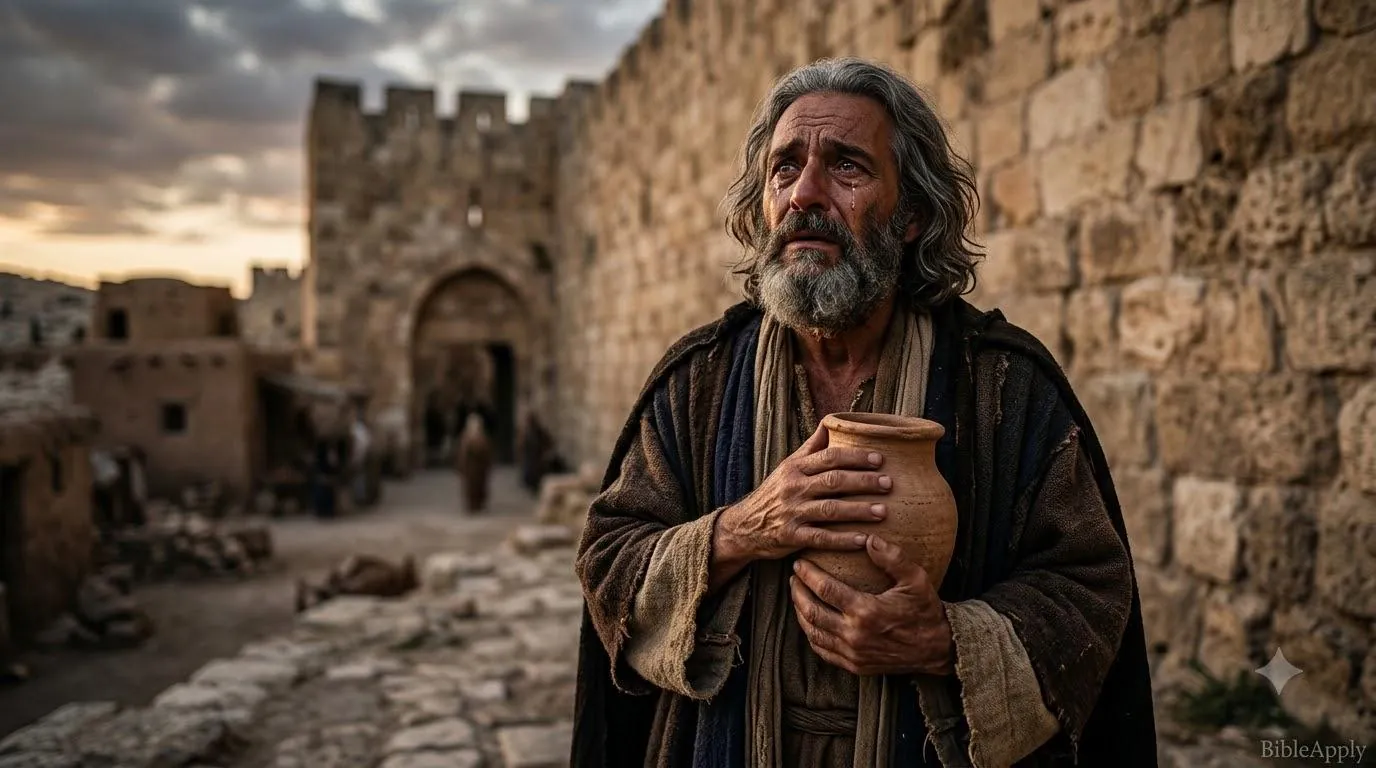
Jeremiah 1 Summary & Meaning: The Call of the Weeping Prophet
Introduction: The Stage is Set for Judgment
The Book of Jeremiah opens during one of the most tumultuous and spiritually dark periods in Israel’s history. Written in the waning days of the southern kingdom of Judah, the narrative spans a timeline of about forty years, beginning in the thirteenth year of King Josiah’s reign (approx. 627 BC) and culminating in the tragic destruction of Jerusalem by the Babylonians in 586 BC. The spiritual climate of Judah was one of deep compromise, idolatry, and false security. Despite the reforms of King Josiah, the hearts of the people remained far from God, steeped in syncretism and rebellion.
Jeremiah, often referred to as the “Weeping Prophet,” was born into a priestly family in the small village of Anathoth, just a few miles north of Jerusalem. He was not a king, a wealthy aristocrat, or a popular public figure. He was an ordinary man thrust into an extraordinary and heartbreaking calling. His ministry would be marked by relentless rejection, imprisonment, and sorrow as he tirelessly warned a stubborn nation of impending judgment. Yet, beneath the heavy warnings of destruction lay a profound undercurrent of God’s relentless hesed (covenant love) and a future hope of restoration.
Chapter 1 serves as the foundational prologue for the entire book. It establishes Jeremiah’s divine credentials, emphasizing that the prophet’s message did not originate from his own intellect or ambition, but from the sovereign decree of Yahweh. It is a chapter about divine foreknowledge, the anatomy of a spiritual calling, and the tension between human inadequacy and God’s empowering presence.
The Divine Origin of the Calling (Jeremiah 1:1-5)
Rooted in Historical Reality
“The words of Jeremiah the son of Hilkiah, of the priests that were in Anathoth in the land of Benjamin: To whom the word of the Lord came in the days of Josiah the son of Amon king of Judah, in the thirteenth year of his reign.” (Jeremiah 1:1-2, KJV)
Unlike ancient mythological texts, the Bible roots its prophetic revelations in concrete history. The opening verses anchor Jeremiah’s ministry to specific kings—Josiah, Jehoiakim, and Zedekiah. This specificity highlights that God’s word breaks into real human history. God is not a distant deity detached from the political and social upheavals of the world; He is actively governing human affairs.
The Doctrine of Foreknowledge
“Before I formed thee in the belly I knew thee; and before thou camest forth out of the womb I sanctified thee, and I ordained thee a prophet unto the nations.” (Jeremiah 1:5, KJV)
Verse 5 is one of the most profound theological statements in the Old Testament regarding God’s sovereignty and the sanctity of life. God reveals three distinct actions concerning Jeremiah before he was even conceived:
- “I knew thee” (Hebrew: yada). This is not mere intellectual awareness. In Hebrew, yada denotes intimate, relational knowledge. God possessed an intimate relationship with Jeremiah before the foundation of the world.
- “I sanctified thee” (Hebrew: qadash). To sanctify means to set apart for a holy use. God had a specific, consecrated purpose for Jeremiah’s life.
- “I ordained thee” (Hebrew: nathan). Literally “to give” or “to appoint.” Jeremiah was a gift to the nations, a mouthpiece for the Divine.
This passage directly challenges modern notions of identity and purpose. Jeremiah’s identity was not self-constructed; it was divinely bestowed. Theologically, this echoes the New Testament doctrine of election found in Ephesians 1:4, demonstrating that God’s calling is rooted in grace and His eternal decrees, long before human performance or volition.
The Human Objection and Divine Reassurance (Jeremiah 1:6-10)
The Plea of Inadequacy
“Then said I, Ah, Lord God! behold, I cannot speak: for I am a child.” (Jeremiah 1:6, KJV)
Faced with the overwhelming weight of a divine commission, Jeremiah’s immediate response is fear and self-doubt. He identifies himself as a “child” or “youth” (Hebrew: na’ar). While he was likely in his late teens or early twenties, his objection was not merely about chronological age; it was a deep sense of inadequacy, inexperience, and lack of eloquence.
If this resonates with you, our deep dive into Jeremiah 29:11 Meaning: For I Know the Plans I Have for You explores the scriptural foundation further.
This mirrors the response of almost every major biblical leader when called by God. Moses claimed he was slow of speech (Exodus 4:10). Isaiah lamented his unclean lips (Isaiah 6:5). Gideon pointed to his insignificant family lineage (Judges 6:15). God often chooses those who are acutely aware of their own weakness so that the ensuing power is unmistakably recognized as His own (2 Corinthians 12:9).
The Touch of Empowerment
“But the Lord said unto me, Say not, I am a child: for thou shalt go to all that I shall send thee, and whatsoever I command thee thou shalt speak. Be not afraid of their faces: for I am with thee to deliver thee, saith the Lord. Then the Lord put forth his hand, and touched my mouth. And the Lord said unto me, Behold, I have put my words in thy mouth.” (Jeremiah 1:7-9, KJV)
God does not validate Jeremiah’s insecurities; He dismisses them. The remedy for Jeremiah’s fear was not an increase in self-esteem, but an assurance of God’s presence: “I am with thee to deliver thee.”
God then performs a deeply symbolic and sacramental act: He touches Jeremiah’s mouth. This divine touch imparts the authority and the actual words that Jeremiah is to speak. He is transformed into a true prophet, a nabi (one who is called to speak for God). The message is not his own.
A Ministry of Tearing Down and Building Up
“See, I have this day set thee over the nations and over the kingdoms, to root out, and to pull down, and to destroy, and to throw down, to build, and to plant.” (Jeremiah 1:10, KJV)
Jeremiah is given a twofold commission characterized by six verbs. Four are destructive (“root out,” “pull down,” “destroy,” “throw down”) and two are constructive (“build,” “plant”). This ratio perfectly encapsulates Jeremiah’s ministry and the broader narrative of redemption. Before new life can grow, the rotten foundations of sin, idolatry, and false religion must be demolished.
Theologically, this points directly to the Gospel. The cross of Jesus Christ is the ultimate tearing down of sin, death, and human righteousness, while the resurrection is the ultimate building up and planting of the new creation. The prophetic word must diagnose the fatal disease (sin) before it can offer the cure of grace.
The Two Visions: The Almond Branch and the Boiling Pot (Jeremiah 1:11-16)
To confirm His word and clarify the message, God gives Jeremiah two visual aids.
Also Read:
The Vision of the Almond Branch (Verses 11-12)
“Moreover the word of the Lord came unto me, saying, Jeremiah, what seest thou? And I said, I see a rod of an almond tree. Then said the Lord unto me, Thou hast well seen: for I will hasten my word to perform it.” (Jeremiah 1:11-12, KJV)
The first vision plays on a Hebrew pun. The word for almond tree (shaqed) sounds almost identical to the word for watching (shoqed). The almond tree was the first tree to blossom in Palestine, often flowering in late winter before the leaves even appeared. It was the “watcher” or the “awakener” of spring.
God uses this imagery to declare that He is actively watching over His word to fulfill it. The people of Judah had grown complacent, believing that God was slow to act or indifferent to their sin. But the almond branch is a guarantee that God’s promises—and His threats of judgment—will come to pass at the appointed time. He is awake, attentive, and sovereignly executing His plan.
The Vision of the Boiling Pot (Verses 13-16)
“And the word of the Lord came unto me the second time, saying, What seest thou? And I said, I see a seething pot; and the face thereof is toward the north. Then the Lord said unto me, Out of the north an evil shall break forth upon all the inhabitants of the land.” (Jeremiah 1:13-14, KJV)
The second vision is far more ominous. Jeremiah sees a boiling caldron, tipped away from the north, ready to spill its scalding contents onto the south (Judah).
This represented the imminent Babylonian invasion. Babylon (though geographically east, their invasion route was from the north) would be the instrument of God’s divine wrath against Judah. Verse 16 makes the reason for this judgment explicitly clear: it is due to their apostasy, specifically forsaking God to burn incense to false deities and worshiping the works of their own hands. Idolatry is not merely a misguided religious practice; it is spiritual adultery that provokes the holy jealousy of God.
The Charge to Stand Firm (Jeremiah 1:17-19)
Preparation for Battle
“Thou therefore gird up thy loins, and arise, and speak unto them all that I command thee: be not dismayed at their faces, lest I confound thee before them.” (Jeremiah 1:17, KJV)
God issues a strict command to Jeremiah to prepare for war. To “gird up the loins” was an ancient practice of tucking one’s long tunic into a belt to allow for unhindered running or fighting. Jeremiah must brace himself mentally and spiritually for the resistance he is about to face. God warns him that if he succumbs to the fear of man, God will break him before his enemies. The fear of God must supersede the fear of people.
The Unbreakable Pillar
“For, behold, I have made thee this day a defenced city, and an iron pillar, and brasen walls against the whole land, against the kings of Judah, against the princes thereof, against the priests thereof, and against the people of the land. And they shall fight against thee; but they shall not prevail against thee; for I am with thee, saith the Lord, to deliver thee.” (Jeremiah 1:18-19, KJV)
God does not promise Jeremiah an easy life. In fact, He guarantees that everyone—kings, princes, priests, and the common people—will fight against him. Jeremiah will stand as a solitary figure against an entire culture.
Believers seeking more clarity will appreciate our full study on Psalm 91 Meaning: He Who Dwells in the Shelter.
However, God promises to make him indestructible in the spiritual sense. He will be a “defenced city,” an “iron pillar,” and “brasen walls.” The strength of the prophet does not lie in his personality, but in the invincibility of the God who called him. They will fight against him, but they will not prevail, because the presence of Yahweh guarantees the ultimate victory.
Theological Connections and Gospel Fulfillment
Jeremiah stands as a profound type of Christ in the Old Testament. Like Jesus, Jeremiah was rejected by his own people, deeply grieved over the destruction of Jerusalem, and suffered greatly for speaking the truth of God. Both were known as “men of sorrows, acquainted with grief” (Isaiah 53:3).
If you want to explore this further, our in-depth guide on psalm 23 kjv breaks this down verse by verse.
Many believers wrestle with questions like romans 8 28 — and Scripture has profound answers.
Jeremiah’s message of judgment highlights the unavoidable holiness of God, proving that sin cannot be ignored indefinitely. Yet, through this very prophet, God would later reveal the glorious promise of the New Covenant (Jeremiah 31), where the law would be written not on stone, but on the heart. The judgment announced in Chapter 1 is necessary, but it is not the final word. The ultimate Word is Christ, who took the scalding judgment of the “boiling pot” upon Himself on the cross, so that we might experience the mercy and covenant love of God.
3 Practical Applications from Jeremiah 1
-
Find Your Identity in God’s Design, Not the World’s Metrics. Jeremiah 1:5 reminds us that before you were even conceived, God knew you and had a purpose for your life. In a culture obsessed with self-creation and seeking validation from peers, this text anchors us. Your ultimate worth and identity are established by the Creator. When you feel insignificant, remember that the God of the universe has intentionally designed you for His glory.
-
The Cure for the Fear of Man is the Presence of God. It is natural to feel inadequate, like Jeremiah, when faced with overwhelming tasks or cultural opposition. We often fear rejection, mockery, or failure. God’s solution was not a pep talk, but a promise: “I am with thee.” When you face difficult conversations, when you must stand for biblical truth in a hostile environment, or when you are called to serve beyond your comfort zone, rely wholly on the empowering presence of the Holy Spirit rather than your own strength.
-
Be Prepared for Resistance When Standing for Truth. God told Jeremiah that the kings, priests, and people would fight against him. Speaking the truth in a compromised world will inevitably draw fire. As Christians, we are called to be “iron pillars” in a culture of shifting sands. We must lovingly but firmly speak the whole counsel of God—both the hard truths of sin and judgment, and the glorious hope of the Gospel. Do not be surprised by opposition; instead, trust that God will sustain you and that His Word will ultimately prevail.
Also Read
- Jonah 1 Summary & Meaning: Running from the Relentless Grace of God
- Song of Solomon 1 Summary & Meaning: The Dawning of Desire
- Romans 1 Summary & Meaning: The Power of the Gospel and the Wrath of God
Read Jeremiah 1
Dive into the full scripture text for deeper study.
Chapter 2: The Broken Betrothal
The tragedy of Israel's apostasy is twofold: they have forsaken God, the spring of living water, and they have dug their own broken cisterns that cannot hold water. Despite God’s constant provision and guidance, the people have stubbornly stained themselves with guilt, pursuing political alliances with Egypt and Assyria rather than trusting their Creator. Their relentless spiritual adultery has left them exposed, battered, and utterly without excuse before a holy God.
Chapter 3: The Call to Return
Yet, remarkably, the Lord issues a tender and earnest invitation for backsliding Israel to return. God promises to be merciful, asking only that they acknowledge their guilt and rebellion. If they repent, God will provide shepherds after His own heart to guide them with knowledge and understanding, painting a future where the Ark of the Covenant is no longer needed, for Jerusalem itself will be known as the Throne of the Lord.
Chapter 4: The Approaching Disaster
Jeremiah is overwhelmed with anguish, feeling the impending destruction deep in his core. He sees the earth rendered formless and empty, the mountains quaking, and the heavens darkened—a reversal of creation itself. The cities will be ruined, and the land left desolate, yet God promises not to completely destroy them. Despite the impending doom, Jerusalem foolishly attempts to beautify herself to win over her conquerors, but she is like a dying woman gasping for breath.
Chapter 5: The Utter Corruption of Judah
The people have become deeply complacent, convincing themselves that God will do nothing and that the prophets are merely full of wind. Consequently, God declares that His words in Jeremiah's mouth will be a fire that consumes the people like wood. An ancient and enduring nation will conquer them, destroying their harvests and fortified cities. Their idolatry has blinded them to the reality of their sin, leading to a society filled with deceit, oppression of the poor, and a terrifyingly corrupt leadership.
Chapter 6: The Siege of Jerusalem
Despite Jeremiah's desperate warnings, the people's ears are closed, and the word of the Lord has become an object of scorn to them. From the least to the greatest, everyone is greedy for unjust gain, and the religious leaders offer only superficial healing, falsely proclaiming 'Peace, peace' when there is none. Because they have rejected the ancient paths of righteousness and refused to walk in God's ways, their sacrifices are rejected, and the invading army will show no mercy, leaving the people in anguish.
Chapter 7: The Temple Sermon
The Lord exposes their blatant hypocrisy: they steal, murder, commit adultery, swear falsely, and burn incense to Baal, only to come into His house and claim they are safe to continue doing these detestable things. God reminds them of Shiloh, the former resting place of the tabernacle, which He destroyed because of Israel's wickedness. Unless they stop oppressing the alien, the fatherless, and the widow, God will cast them out of His sight, refusing even to hear Jeremiah's prayers for them.
Chapter 8: The Harvest is Past
The wise men and scribes are put to shame because they have rejected the word of the Lord, rendering their wisdom utterly useless. Their false sense of security will be shattered as their wives and fields are given to others. The chapter ends with Jeremiah’s heart-wrenching lament for his broken people. He mourns that the harvest is past, the summer has ended, and yet they are not saved, crying out for the Balm of Gilead to heal the deep wound of his nation.
Chapter 9: The Weeping Prophet
God calls for the wailing women to raise a dirge over Jerusalem, for the city will be reduced to a heap of ruins and a haunt for jackals. The people have stubbornly followed the dictates of their own hearts and the Baals, resulting in a diet of bitter food and poisoned water. The Lord declares that true glory does not come from wisdom, might, or riches, but solely from understanding and knowing Him, the God who exercises kindness, justice, and righteousness on earth.
Chapter 10: The Helplessness of Idols
In stark contrast to these lifeless objects, the Lord is the true and living God, the everlasting King whose wrath causes the earth to tremble. He is the Creator who made the earth by His power, founded the world by His wisdom, and controls the elements. As the impending disaster from the north draws nearer, Jeremiah prays for God's gentle correction, acknowledging that a man's life is not his own and asking God to pour out His wrath on the nations that do not know Him, rather than destroying His own people.
Chapter 11: The Broken Covenant
Because they have broken this sacred covenant, God declares He will bring upon them an inescapable disaster. When they cry out to Him in their distress, He will not listen, nor will the false gods they have set up in every town be able to save them. Tragically, the men of Anathoth—Jeremiah's own hometown—plot to murder him to silence his prophetic voice. God reveals this conspiracy to Jeremiah, promising to severely judge these treacherous men for seeking the life of His faithful messenger.
Chapter 12: Jeremiah's Complaint and God's Answer
God's response is both challenging and sobering. He asks Jeremiah: if racing against men on foot has tired him out, how will he compete with horses? If he struggles in a secure land, what will he do in the dense thickets of the Jordan? God warns Jeremiah that even his own family has betrayed him. The Lord then laments the necessity of abandoning His beloved inheritance to its enemies, but promises a future restoration for Judah and even for the surrounding nations, provided they learn the ways of God's people.
Chapter 13: The Linen Loincloth and Wine Jars
A second parable involves filling every jar with wine. When the people confidently respond that they already know jars should be filled, Jeremiah delivers the shocking interpretation: God will fill all the inhabitants of the land—kings, priests, prophets, and citizens—with the wine of drunkenness, causing them to smash against one another in fatal judgment. Because they have forgotten God and trusted in false idols, the Lord will expose their shame and strip away their glory, asking them how long it will be before they finally become clean.
Chapter 14: The Drought and the False Prophets
Jeremiah points out that false prophets are deceiving the people by promising peace and immunity from sword and famine. God fiercely denounces these prophets, stating He did not send them and that they will perish by the very sword and famine they claim will not happen. Jeremiah is left to weep continuously for the crushing blow dealt to his virgin daughter, Judah. He acknowledges their deep wickedness and pleads with God not to spurn them, remembering His covenant and waiting on Him as the only source of rain and hope.
Chapter 15: The Inescapable Judgment
Amidst this dreadful decree, Jeremiah sinks into deep personal despair, lamenting his birth and the constant conflict he faces despite his faithfulness. He reminds God that he joyfully consumed His words and bore His name, sitting alone because of God's hand upon him, yet feeling as though God is a deceptive brook that fails in the summer heat. The Lord gently but firmly rebukes Jeremiah, calling him to repent of his worthless words. God renews His promise to make Jeremiah a bronze wall, ensuring that if he speaks worthy words, he will be God's spokesman and will be delivered from the hands of the wicked.
Chapter 16: The Day of Disaster and Future Restoration
When the people inevitably ask why such a great disaster has been pronounced against them, Jeremiah is to explain that it is because they and their fathers have forsaken God, stubbornly following their own evil hearts and worshiping other gods worse than their ancestors ever did. Consequently, they will be violently cast out into a foreign land. Yet, a glimmer of hope remains: God promises a future restoration so magnificent that the exodus from Egypt will be forgotten, as He will gather them from the lands of their exile and return them to the land given to their fathers.
Chapter 17: The Deceitful Heart and the Sabbath
The prophet notes that the human heart is desperately wicked and deceitful above all things, fully known only to God, who searches the mind and rewards each person according to their deeds. Jeremiah pleads for healing and salvation from the Lord, his only refuge. In a practical test of their obedience, God commands Jeremiah to stand at the gates of Jerusalem and instruct the people to keep the Sabbath day holy by not carrying loads. If they obey, the city will stand forever, but if they profane the Sabbath, God will kindle an unquenchable fire in its gates.
Chapter 18: The Potter and the Clay
Jeremiah delivers this urgent message to Judah, urging them to turn from their evil ways to avoid the disaster God is shaping against them. Tragically, the people stubbornly refuse, declaring it is hopeless and choosing to follow their own wicked inclinations. In response to Jeremiah's faithful preaching, the people plot to destroy him, deciding to attack him with their tongues and ignore his words. Deeply wounded by this betrayal, Jeremiah prays for God's severe judgment upon his enemies, asking that their crimes not be forgiven and that they be overthrown in the time of God's anger.
Chapter 19: The Broken Flask
To vividly illustrate the finality of God's judgment, Jeremiah violently smashes the clay jar in front of the leaders. He declares that just as the jar is broken and cannot be mended, so the Lord will irreparably smash the nation and the city. The dead will be so numerous that they will have to be buried in Topheth until there is no more room. Returning to the temple court, Jeremiah publicly repeats this grim warning, stating that God is bringing unmitigated disaster because the people have stiffened their necks and refused to listen.
Chapter 20: Jeremiah Beaten and Persecuted
Following this humiliating ordeal, Jeremiah experiences a profound emotional crisis. He cries out to God, feeling deceived and overwhelmed by the constant mockery and derision he faces for preaching violence and destruction. He considers remaining silent, but God's word becomes like a burning fire shut up in his bones, impossible to hold in. Despite the plotting of his enemies, Jeremiah praises God, confident that the Lord is with him like a dread warrior. Yet, in the very next breath, he curses the day of his birth, consumed by the sorrow and shame of his agonizing calling.
Chapter 21: The Fall of Jerusalem Foretold
The Lord sets before the people two stark choices: the way of life and the way of death. Anyone who stays in the city will die by sword, famine, or pestilence, but those who surrender to the Chaldeans will spare their own lives as a prize of war. God has determined to hand the city over to the King of Babylon, who will burn it down. The royal house of Judah is urged to execute justice and rescue the oppressed immediately, lest God's unquenchable wrath consume them completely because of their evil deeds.
Chapter 22: Judgments Against Judah's Kings
Specific and harsh judgments are pronounced against individual kings. Shallum (Jehoahaz) will never return from exile in Egypt. Jehoiakim, who built his palace by unrighteousness and greed, will not be mourned but will receive the burial of a donkey, dragged away and dumped outside the gates. Finally, Coniah (Jehoiachin) is declared a despised, broken pot. God swears that even if Coniah were a signet ring on His right hand, He would pull him off. The chapter ends with a chilling decree that no descendant of Coniah will ever sit on the throne of David again.
Chapter 23: The Righteous Branch and False Prophets
The focus then shifts to a scathing rebuke of the false prophets, who fill the people with empty hopes by prophesying the delusions of their own minds rather than the word of the Lord. They falsely assure the wicked that peace is coming and that disaster will not strike. God declares He is against these prophets who steal His words and lead the people astray with reckless lies. God's true word is like a fire and a hammer that breaks rocks into pieces, and He promises severe punishment for those who continually mock His prophetic burden.
Chapter 24: The Good and Bad Figs
The Lord explains that the good figs represent the exiles in Babylon. Surprisingly, God declares He has sent them away for their own good. He promises to watch over them, eventually return them to the land, and give them a heart to know Him, establishing a renewed covenant relationship. In stark contrast, the bad figs represent King Zedekiah, his officials, and the survivors remaining in Jerusalem and Egypt. They will be entirely rejected, becoming an object of horror and reproach, destined for destruction by sword, famine, and plague until they are wiped off the land.
Chapter 25: Seventy Years of Exile
Jeremiah prophesies that this captivity will last exactly seventy years. After the seventy years are fulfilled, God will turn His judgment upon Babylon for their own sins, making their land an everlasting desolation. Jeremiah is then given a vision of a cup filled with the wine of God's wrath, which he must make all the nations drink. From Jerusalem to the furthest kingdoms, no one will escape the universal judgment. The Lord roars from on high, and the slain will cover the earth from one end to the other, leaving the rulers and shepherds howling with no place to flee.
Chapter 26: Jeremiah Threatened with Death
When the royal officials arrive, Jeremiah courageously defends himself, maintaining that the Lord truly sent him to prophesy these things and urging them to reform their ways. He places his life in their hands but warns that killing him will bring innocent blood upon the city. Some of the elders recall the prophet Micah, who similarly prophesied destruction in the days of Hezekiah and was spared. Although another prophet, Uriah, was recently extradited and executed by King Jehoiakim for the same message, Jeremiah is protected by Ahikam and saved from the mob.
Chapter 27: The Yoke of Babylon
Jeremiah then urgently addresses King Zedekiah, the priests, and the people of Judah, pleading with them to submit to Babylon and live. He warns them not to listen to the false prophets, diviners, and sorcerers who are promising that they will not serve the king of Babylon and that the temple articles will soon be returned. Jeremiah insists these prophets are lying; if they were true prophets, they would be pleading with God to prevent the remaining temple treasures from being taken. The painful reality is that the rest of the articles will indeed be carried off to Babylon until God eventually restores them.
Chapter 28: The False Prophet Hananiah
In a dramatic act of defiance, Hananiah takes the wooden yoke off Jeremiah's neck and breaks it, asserting that God will similarly break Nebuchadnezzar's yoke off all the nations within two years. Jeremiah quietly leaves, but God soon sends him back with a terrifying response. Because Hananiah broke a yoke of wood and encouraged the people to believe a lie, God will replace it with an unbreakable yoke of iron. Furthermore, Jeremiah prophesies Hananiah's death for preaching rebellion against the Lord. Within two months, Hananiah dies, vindicating Jeremiah's true prophetic authority.
Chapter 29: A Letter to the Exiles
God warns them not to be deceived by the false prophets living among them, reiterating that the exile will last a full seventy years. Only after this period will God fulfill His gracious promise to bring them back. He assures them, 'For I know the plans I have for you, plans to prosper you and not to harm you, plans to give you hope and a future.' The Lord promises that when they seek Him with all their heart, He will be found. The letter concludes by pronouncing doom upon Ahab, Zedekiah, and Shemaiah, false prophets in Babylon who are speaking lies and leading the exiles astray.
Chapter 30: Promises of Restoration
God encourages Jacob not to fear, promising to bring them back from distant lands to enjoy peace and security. While He will completely destroy the nations that scattered them, He will discipline Israel only with justice, not completely destroying them. Despite their wounds appearing incurable, God Himself will restore their health and heal their wounds. The city will be rebuilt on its ruins, the sound of rejoicing will return, and their ruler will be one of their own, drawing near to God. The fierce anger of the Lord will accomplish His ultimate purposes.
Chapter 31: The New Covenant
The pinnacle of this chapter, and perhaps the entire book, is the promise of a New Covenant. Unlike the old covenant written on stone tablets that the people broke, God will write this new covenant directly on their hearts and minds. He will be their God, and they will be His people. There will be no need to teach one another to know the Lord, for all will know Him, from the least to the greatest. God promises to forgive their wickedness and remember their sins no more, guaranteeing the permanent survival of Israel as a nation before Him.
Chapter 32: Jeremiah Buys a Field
After completing the purchase, Jeremiah prays, marveling at God's limitless power but questioning how this purchase makes sense when the city is being handed over to the Chaldeans. God responds by asking, 'Is anything too hard for me?' The Lord confirms that Jerusalem will indeed burn because of its relentless idolatry and rebellion. However, He immediately follows this with a promise of future restoration. God will gather the people back, give them singleness of heart and action, and make an everlasting covenant with them, rejoicing in doing them good and firmly planting them back in their land.
Chapter 33: The Promise of a Righteous Branch
God will cleanse the people from all their sins and restore the fortunes of both Judah and Israel. The desolate streets of Jerusalem will once again ring with the sounds of joy and gladness, the voices of brides and grooms, and the songs of those bringing thank offerings to the temple. Most importantly, God promises to fulfill His good word by causing a Righteous Branch to spring up from the line of David, who will execute justice and righteousness in the land. God establishes an unbreakable covenant with David and the Levitical priests, ensuring that Israel will never lack a king on the throne or a priest to offer sacrifices.
Chapter 34: A Covenant Broken
Tragically, as soon as the immediate threat seems to lift (likely due to a temporary withdrawal of the Babylonians), the people change their minds and force the men and women they had freed back into slavery. God is furious at this blatant profanation of His name and this broken covenant. Because they refused to proclaim true liberty, God proclaims a grim 'liberty' for them—liberty to fall by the sword, pestilence, and famine. The leaders who broke the covenant will be handed over to their enemies, and their corpses will become food for the birds of the air, as the Babylonian army returns to burn the city.
Chapter 35: The Faithfulness of the Rechabites
God then speaks to the men of Judah, contrasting the steadfast obedience of the Rechabites with Judah's stubborn rebellion. The Rechabites have meticulously followed the commands of their earthly forefather, yet the people of Judah have consistently ignored the commands of their Heavenly Father, despite God sending prophet after prophet to warn them. Because of Judah's refusal to listen, God will bring upon them all the disasters He has pronounced. However, because of their unwavering obedience, God promises the Rechabites that Jonadab son of Rechab will never fail to have a descendant to serve before Him.
Chapter 36: The King Burns Jeremiah's Scroll
The officials bring the scroll to King Jehoiakim, who is sitting in his winter apartment with a fire burning in the brazier. As the scroll is read to him, the king shows no fear or repentance. Instead, as every three or four columns are read, Jehoiakim arrogantly cuts them off with a scribe's knife and throws them into the fire, until the entire scroll is destroyed. He then orders the arrest of Jeremiah and Baruch, but the Lord hides them. God instructs Jeremiah to write a second scroll, repeating the original words and adding a curse upon Jehoiakim: he will have no one to sit on David's throne, and his dead body will be thrown out and exposed to the elements.
Chapter 37: Jeremiah Imprisoned
Taking advantage of the lifted siege, Jeremiah attempts to leave Jerusalem to claim some property in the territory of Benjamin. However, a guard arrests him at the gate, falsely accusing him of deserting to the Babylonians. The enraged officials beat Jeremiah and imprison him in a vaulted cell in the house of Jonathan the secretary, where he remains for a long time. Later, King Zedekiah secretly calls for him and asks if there is any word from the Lord. Jeremiah confirms that Zedekiah will be handed over to the king of Babylon. Jeremiah pleads not to be sent back to the dungeon, and Zedekiah moves him to the courtyard of the guard, providing him with a daily ration of bread until the city's supply runs out.
Chapter 38: Jeremiah in the Cistern
Shortly after his rescue, King Zedekiah summons Jeremiah for another secret meeting, promising not to kill him if he tells the truth. Jeremiah gives the king a final, desperate ultimatum: surrender to the Babylonian officers, and his life will be spared, and the city will not be burned. If he refuses, the city will fall, and he will not escape. Zedekiah admits he is afraid of the Judean defectors, but Jeremiah assures him he will not be handed over to them. Zedekiah begs Jeremiah to keep this conversation a secret from the officials, and Jeremiah remains in the courtyard of the guard until Jerusalem falls.
Chapter 39: The Fall of Jerusalem
Nebuchadnezzar slaughters Zedekiah's sons before his very eyes, along with the nobles of Judah. Then, in a final act of cruelty, he blinds Zedekiah, binds him in bronze chains, and takes him to Babylon. The Babylonians burn the royal palace and the houses of the people, tear down the walls of Jerusalem, and carry the remaining populace into exile, leaving only the poorest people behind. Amidst the chaos, Nebuchadnezzar gives strict orders to protect Jeremiah, allowing him to live freely. A special message is also given to Ebed-Melek the Ethiopian, assuring him that because he trusted in God, his life will be spared in the coming destruction.
Chapter 40: Jeremiah Remains in Judah
Gedaliah establishes his administration in Mizpah, encouraging the surviving Judean commanders and people scattered in the open country to settle down, serve the Chaldeans, and gather the summer harvest of wine, fruit, and oil. Many Judeans who had fled to Moab, Ammon, and Edom return upon hearing that a remnant has been left. However, Johanan, one of the commanders, privately warns Gedaliah that Baalis, the king of the Ammonites, has sent Ishmael to assassinate him. Tragically, Gedaliah dismisses the warning as a lie and refuses Johanan's offer to preemptively kill Ishmael.
Chapter 41: The Assassination of Gedaliah
Ishmael spares ten men who promise him hidden stores of food. He then takes the rest of the people in Mizpah captive, including the king's daughters, and sets out to cross over to the Ammonites. When Johanan and the other military leaders hear of these atrocities, they pursue Ishmael and catch up with him at the great pool in Gibeon. The captives are overjoyed and immediately join Johanan, while Ishmael manages to escape with eight of his men. Fearing terrible retaliation from the Babylonians for the murder of their appointed governor, Johanan and the rescued people head toward Egypt, stopping near Bethlehem.
Chapter 42: The Warning Against Going to Egypt
God promises that if they stay in Judah, He will build them up, plant them, and grant them mercy before the King of Babylon, so they need not fear him. However, God strictly warns them against going to Egypt. He knows they are already leaning toward fleeing there to escape war and famine. If they disobey and enter Egypt, the very sword and famine they fear will pursue them and overtake them there, and they will die in the land they sought for refuge. Jeremiah accuses them of hypocrisy, knowing they have already decided in their hearts to flee regardless of God's answer.
Chapter 43: The Flight to Egypt
In Egypt, God gives Jeremiah another prophetic sign. He instructs Jeremiah to bury large stones in the clay pavement at the entrance of Pharaoh's palace in Tahpanhes while the men of Judah watch. Jeremiah then proclaims that the Lord will bring King Nebuchadnezzar of Babylon to this very spot, where he will set his throne and his royal pavilion over these hidden stones. Nebuchadnezzar will strike Egypt, bringing death to those destined for death and captivity to those destined for captivity. He will burn the temples of the Egyptian gods, wrap himself in the land of Egypt, and depart in peace, demonstrating God's inescapable judgment.
Chapter 44: Judgment on the Idolatrous Remnant
In a shocking display of defiance, the people explicitly refuse to listen to Jeremiah. They argue that things went well for them when they burned incense to the 'Queen of Heaven,' and they attribute their current miseries to the cessation of this idolatry. Jeremiah responds forcefully, stating that it was precisely because of this idolatry that their land became a desolate curse. He seals their doom, proclaiming that God has sworn by His great name that all Judeans in Egypt will perish. As a sign that these threats will come true, God promises to hand Pharaoh Hophra of Egypt over to his enemies, just as He did with King Zedekiah.
Chapter 45: A Message to Baruch
God sends a specific, compassionate, yet corrective message to Baruch through Jeremiah. The Lord gently rebukes Baruch for seeking great things for himself during a time of national catastrophe. God is about to tear down what He has built and uproot what He has planted across the entire earth. In light of this sweeping judgment, it is not the time for personal ambition or ease. However, God promises Baruch a precious gift: wherever he goes amidst the impending disaster, his life will be spared as a prize of war. This assures Baruch of God's protective grace in the midst of turmoil.
Chapter 46: Judgment on Egypt
The second oracle predicts Nebuchadnezzar's invasion of Egypt itself. The Egyptians are depicted as a noisy but ineffective heifer, powerless to stop the Babylonian advance, which will cut down their forests and destroy their cities. Amon, the god of Thebes, and Pharaoh himself will be put to shame. However, God promises that after this destruction, Egypt will eventually be inhabited again. Amidst this judgment on a foreign superpower, God tenderly comforts His people, Jacob, telling them not to fear. Although they will be disciplined in just measure, they will ultimately be saved and brought back to live in peace.
Chapter 47: Judgment on the Philistines
The Lord declares that the day has come to destroy all the Philistines and to cut off every last defender of Tyre and Sidon. The destruction will be absolute, leaving the people in mourning, shaving their heads and cutting themselves in grief. The prophet addresses the sword of the Lord, asking how long it will be before it rests, urging it to return to its sheath. But the stark reality is acknowledged: how can the sword rest when the Lord has given it a divine command and appointed it to strike Ashkelon and the coastal plain?
Chapter 48: Judgment on Moab
Moab is compared to wine that has settled undisturbed on its dregs, never poured from vessel to vessel, but God will send pourers to empty his vessels and smash his jars. The joy and gladness of the fertile fields will be entirely stripped away, and there will be widespread wailing on every rooftop. God will break Moab like an undesirable vessel because they magnified themselves against the Lord. Terror, the pit, and the snare await them, and no one will escape. Yet, in the very last verse, God promises to restore the fortunes of Moab in the latter days.
Chapter 49: Judgments on Ammon, Edom, Damascus, Kedar, Hazor, and Elam
Kedar and Hazor, nomadic tribes in the Arabian desert, are slated for destruction by Nebuchadnezzar, who will scatter them to the winds and turn their lands into haunts for jackals. Finally, Elam, a distant eastern nation known for its archers, will have its bow broken. God will set His throne in Elam and destroy its king and officials, scattering its people to the four winds. However, as with Moab and Ammon, God promises to restore the fortunes of Elam in the latter days, demonstrating His sovereign authority over all the earth.
Chapter 50: Judgment on Babylon
God summons an assembly of great nations to march against Babylon, punishing her for rejoicing while pillaging God's heritage. The mother of Babylon will be deeply shamed. The Lord commands the attackers to shoot at her without sparing arrows, for she has sinned against Him. Babylon's arrogance has defied the Holy One of Israel, and God will bring disaster upon her. A sword will strike her officials, wise men, and treasures, and a devastating drought will dry up her waters. Like Sodom and Gomorrah, Babylon will be completely overthrown, never to be inhabited again.
Chapter 51: The Fall of Babylon
Jeremiah instructs the exiles to flee Babylon to escape God's fierce anger. The great city's broad walls will be leveled, and her high gates burned with fire. Jeremiah writes all these impending disasters in a scroll and gives it to Seraiah, commanding him to read it aloud when he arrives in Babylon. After reading it, Seraiah is to tie a stone to the scroll and throw it into the Euphrates River, declaring that just as the scroll sinks and does not rise, so Babylon will sink and be completely destroyed, never to rise again.
Chapter 52: The Destruction of Jerusalem Reviewed
Nebuzaradan, the captain of the Babylonian guard, burns the temple, the royal palace, and all the houses of Jerusalem, completely dismantling the city walls. He carries away the valuable temple furnishings—the bronze pillars, the sea, the stands, and all the utensils used in worship—along with thousands of captives. The chapter concludes with a surprising ray of hope decades later: Evil-Merodach, the new king of Babylon, releases King Jehoiachin of Judah from prison, speaks kindly to him, and provides him with a daily allowance and a seat of honor at the royal table for the rest of his life, hinting that the Davidic line is not entirely extinguished.
Conclusion
We hope this chapter-by-chapter summary of Jeremiah has helped you better understand God's Word. To continue your study, explore our other Bible Chapter Summaries or read our detailed Verse Meanings.