Hebrews Chapter Summaries
A complete, chapter-by-chapter guide to the Book of Hebrews. Read deep dives into the meaning, historical context, and modern application of every chapter.
Welcome to our complete guide to the Book of Hebrews. Below you will find a chapter-by-chapter summary that flows through the entire narrative, helping you understand the context, meaning, and application of this profound book.
Hebrews Chapter 1 Summary
The Book of Hebrews is a masterpiece of New Testament theology, written to a community of Jewish Christians who were facing mounting persecution. Exhausted by the trials of their faith, the social ostracization from their families, and the intense societal pressure of the first century, these early believers were profoundly tempted to abandon the Christian faith and return to the familiar, legalistic rhythms of Judaism. They were looking back at the shadows of the Old Covenant—the ancient sacrificial system, the Levitical priesthood, and the angelic mediators of the Law—and wondering if the new path they had chosen in Christ was truly worth the agonizing cost. The anonymous author of Hebrews pens this sermon-letter with a singular, majestic thesis designed to anchor their drifting souls: Jesus is better. He is superior to every Old Testament institution, prophet, priest, and angelic being.
Chapter 1 serves as the spectacular overture to this symphony of Christ’s supremacy. Rather than beginning with a traditional greeting, personal pleasantries, or a statement of authorship, the writer immediately launches into a breathtaking declaration of who Jesus is. He wastes no time in establishing the absolute preeminence of Christ. In the ancient Jewish mindset, the prophets were the venerated mouthpieces of God, and the angels were the glorious, fiery mediators of the Law at Mount Sinai. To prove that the New Covenant is infinitely superior to the Old, the author must first prove that the mediator of the New Covenant—Jesus Christ—is infinitely superior to both prophets and angels.
This opening chapter accomplishes exactly that. It lays the foundational Christology upon which the entire book of Hebrews rests. By intricately weaving together a tapestry of Old Testament quotations, the author demonstrates that Jesus is not merely a noble messenger or an exalted creature; He is the eternal Son, the sovereign Creator of the cosmos, and the exact representation of God’s nature. Understanding Hebrews 1 is absolutely essential for grasping the rest of the epistle, for if Christ is supreme over all creation, then to turn away from Him is to turn away from God Himself.
God’s Final Revelation in the Son (Hebrews 1:1-4)
The chapter opens with one of the most magnificent, grammatically elegant theological statements in all of Scripture, contrasting the fragmentary, piecemeal revelation of the past with the final, complete, and glorious revelation in Jesus Christ.
“God, who at sundry times and in divers manners spake in time past unto the fathers by the prophets, Hath in these last days spoken unto us by his Son, whom he hath appointed heir of all things, by whom also he made the worlds;” (Hebrews 1:1-2, KJV)
The Progression of Divine Revelation
In the Old Testament, God spoke “at sundry times and in divers manners” (or “in many and various ways”). He spoke through burning bushes, cryptic visions, midnight dreams, angelic visitations, and the thundering voices of the prophets. While this revelation was entirely true, divine, and necessary, it was progressive and incomplete. It was like pieces of a grand, beautiful mosaic being handed out one by one over centuries of redemptive history. But in “these last days”—the eschatological age inaugurated by the coming of Christ—God has spoken definitively and finally through His Son. Jesus is not just another prophet bringing a message from God; He is the message. He is the culmination, the climax, and the fulfillment of everything the prophets predicted. When God spoke through His Son, He said everything that ever needed to be said.
The Sevenfold Description of the Son’s Glory
In verses 2 through 4, the author unpacks a breathtaking sevenfold description of the Son that staggers the human imagination and leaves absolutely no doubt regarding His divine identity.
Believers seeking more clarity will appreciate our full study on Jeremiah 29:11 Meaning: For I Know the Plans I Have for You.
- Heir of all things: As the beloved Son, Jesus possesses the ultimate inheritance of the cosmos. Everything in the universe, visible and invisible, exists for Him and will ultimately be subject to Him.
- Creator of the worlds: The Greek word used here is aion, which can mean “ages” or “universe.” Jesus is the active agent of creation, the one through whom space, time, and matter were spoken into existence (John 1:3). He is not part of the creation; He is the Creator.
- The radiance of God’s glory: The Greek word for radiance is apaugasma (ἀπαύγασμα). It implies that Jesus shines with the uncreated, eternal light of God. Just as you cannot separate the sun from its brilliant rays of light, you cannot separate the Father from the Son. Jesus is the glorious emanation of the divine nature.
- The exact imprint of His nature: The Greek word here is charaktēr (χαρακτήρ), from which we derive the English word “character.” In the ancient Greco-Roman world, this term referred to the die used to stamp an image onto a wax seal or a coin, leaving an exact reproduction. Jesus is the flawless, visible stamp of the invisible God’s inner essence (hupostasis). To see Jesus is to see God Himself in perfect resolution (John 14:9).
- Upholding the universe by the word of His power: Christ is not only the Creator but the active Sustainer. He holds the very atoms of the universe together by His powerful word. If Christ were to stop speaking, the cosmos would dissolve into chaos.
- Making purification for sins: Here, the author hints at the priestly work of Christ, which will become the central, dominating theme of chapters 5-10. Jesus didn’t just create the world; He bled to redeem it.
- Sat down at the right hand of the Majesty on high: In the Old Testament tabernacle, there were no chairs, because a priest’s work of sacrificing animals was never finished. But Jesus “sat down.” His sitting signifies that the work of redemption is completely finished, and He now rules from the place of supreme, unrivaled authority.
Through these concentrated verses, the author establishes irrefutably that the Son is co-eternal, co-equal, and consubstantial with the Father.
The Son’s Superiority Over Angels (Hebrews 1:5-14)
Having established the supreme identity of the Son, the author immediately pivots to address a specific, pressing theological issue: the veneration of angels. In the first-century Jewish worldview, angels were held in the highest possible esteem. According to Jewish tradition and texts like Deuteronomy 33:2 and Acts 7:53, angels were the glorious mediators through whom God delivered the Law to Moses. If the Jewish Christians were tempted to return to the Law of Moses, they were implicitly elevating the angelic mediators of that Law above Christ.
Many believers wrestle with the question of romans 8 28 — and Scripture has profound, life-changing answers.
To systematically dismantle this dangerous thinking, the author presents an unbreakable chain of seven Old Testament quotations, proving beyond a shadow of a doubt that the Son is infinitely greater than any angelic being.
Also Read:
The Divine Sonship
“For unto which of the angels said he at any time, Thou art my Son, this day have I begotten thee? And again, I will be to him a Father, and he shall be to me a Son— (Hebrews 1:5, KJV)
Quoting Psalm 2:7 and 2 Samuel 7:14, the author highlights the unique, intimate relationship between God and Jesus. While angels are sometimes referred to collectively as “sons of God” in the Old Testament (Job 1:6), God never addresses any individual angel as the Son. This title is reserved exclusively for the Davidic King, the long-awaited Messiah. The term “begotten” here does not imply a beginning in time—for Christ is eternal—but rather refers to His exaltation, vindication, and public installation as King following His victorious resurrection (Romans 1:4).
Angels as Worshippers and Servants
“And again, when he bringeth in the firstbegotten into the world, he saith, And let all the angels of God worship him. And of the angels he saith, Who maketh his angels spirits, and his ministers a flame of fire.” (Hebrews 1:6-7, KJV)
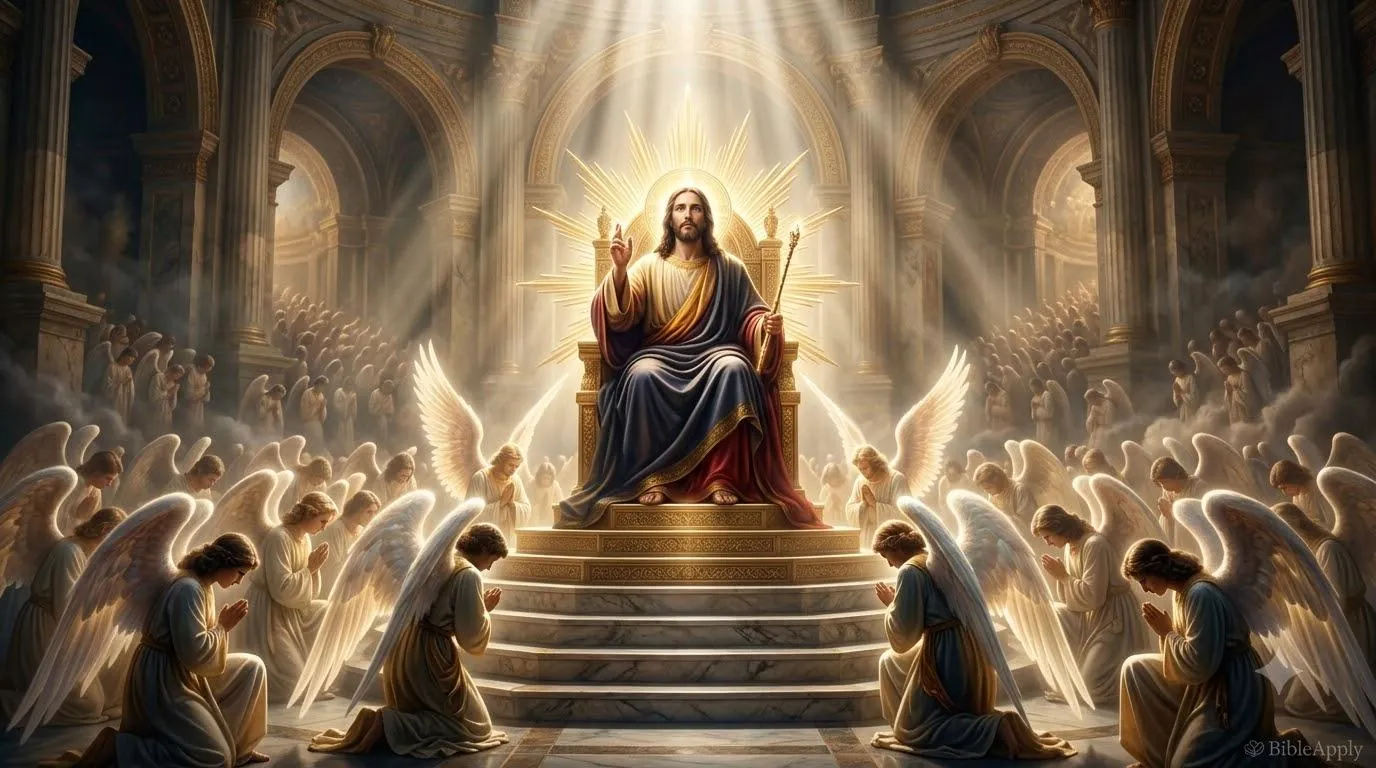
Drawing from Deuteronomy 32:43 (in the Septuagint) and Psalm 104:4, the distinction is made stark and undeniable: Jesus is the object of worship, and angels are the worshippers. Angels are magnificent, powerful, fiery ministers (servants) of God, shifting like wind and fire to do His bidding. But they are entirely subordinate to the “firstbegotten” (a title of supreme rank and privilege). If the angels of heaven bow down and worship Jesus, it is absolute theological absurdity for humans to forsake Jesus to return to a system mediated by angels.
The Eternal Throne of the Son
“But unto the Son he saith, Thy throne, O God, is for ever and ever: a sceptre of righteousness is the sceptre of thy kingdom… And, Thou, Lord, in the beginning hast laid the foundation of the earth; and the heavens are the works of thine hands:” (Hebrews 1:8, 10, KJV)
Here lies one of the most explicit declarations of the absolute deity of Christ in the entire New Testament. Quoting Psalm 45:6-7, the Father addresses the Son directly as “God” (ho Theos). The Son possesses an eternal throne and rules with absolute righteousness. Furthermore, quoting Psalm 102:25-27—a lament originally addressed to Yahweh, the eternal Creator—the author boldly attributes the creation of the heavens and the earth directly to Jesus (addressed as “Lord”). While the created universe will eventually wear out like an old garment and be rolled up, the Son remains immutable and eternal. “Thou art the same, and thy years shall not fail” (Hebrews 1:12). This speaks to the unchangeable, eternal immutability of Christ.
The Victorious King vs. The Ministering Spirits
“But to which of the angels said he at any time, Sit on my right hand, until I make thine enemies thy footstool? Are they not all ministering spirits, sent forth to minister for them who shall be heirs of salvation— (Hebrews 1:13-14, KJV)
The chapter concludes with a triumphant quote from Psalm 110:1, which happens to be the most frequently quoted Old Testament verse in the New Testament. God the Father invites the Son to sit at His right hand in a position of ultimate, sovereign triumph. No angel was ever given this immense honor. Angels are simply “ministering spirits” dispatched from the throne room of heaven to serve the very people whom Christ came to save—the “heirs of salvation.”
Theology & Gospel Connection
Hebrews 1 is a masterclass in Christ-centered biblical interpretation. The author looks back at the Hebrew Scriptures and sees the glory of Christ radiating from its pages. The theological weight of this chapter is immense: it provides a high Christology that protects the church from ancient and modern heresies alike. Jesus is not a created being (as the Arians and modern Jehovah’s Witnesses claim), nor is He merely an enlightened prophet (as Islam teaches). He is the apaugasma—the uncreated radiance of God’s very being.
Many believers also ask Psalm 91 Meaning: He Who Dwells in the Shelter — and the Bible gives us a clear, powerful answer.
The profound Gospel connection is found anchored in verse 3: “when he had by himself purged our sins, sat down on the right hand of the Majesty on high.” The eternal Creator, the one who sustains the swirling galaxies by His spoken word, condescended into human history to purge our sins. The concept of purging or purification (kotharismos) points directly to the brutal, bloody reality of the cross. The majesty of the Gospel is that the highest King stooped to the deepest depths to wash dirty sinners clean, and having accomplished it perfectly, He sat down. Our salvation is eternally secure because the one who secured it is the sovereign Lord of the universe.
3 Practical Applications from Hebrews 1
For the original, weary audience, Hebrews 1 was a theological battle cry to hold fast to their confession. For believers today, it offers profound, life-altering truth that demands a response.
1. Listen to the Final Word
Because Jesus is the ultimate, superior, and final revelation of God, we must prioritize His teachings and His Gospel above all else. In a modern world crowded with “new revelations,” self-help gurus, secular philosophies, and endless noise, we must remember that God has spoken definitively in His Son. We do not need a new word from God; we need to dive deeper into the final Word He has already given us. Are you listening to Jesus, or are you easily distracted by lesser voices? When you open the Scriptures, remember that you are hearing the voice of the Creator.
2. Rest in His Finished Work
Verse 3 tells us that after making purification for sins, Jesus “sat down.” This physical posture signifies ultimate completion and victory. In your spiritual life, you do not need to constantly strive to earn God’s favor or frantically try to add to Christ’s redemptive work. The purification for your sins is complete; the debt is paid. You can rest confidently in the grace of God, knowing that your salvation is not anchored in your shifting performance, but in the finished, perfect work of the Supreme King.
3. Trust His Sovereign Control
If Jesus is the one who “upholds the universe by the word of his power” (Hebrews 1:3), He is more than capable of upholding your life. When circumstances feel completely chaotic, when relationships fracture, or when unexpected suffering arises, remember that the exact imprint of God’s nature is seated firmly on the throne. The same word of power that keeps the planets in orbit is actively sustaining your faith and guiding your steps. As an “heir of salvation,” you are being served by angels and fiercely loved by the King who rules it all. Trust Him deeply.
Also Read
- Mark 1 Summary & Meaning: The Arrival of the Servant King
- Job 1 Summary & Meaning: The Testing of a Righteous Man
- Hosea 1 Summary & Meaning: A Marriage of Brokenness and Grace
Read Hebrews 1
Dive into the full scripture text for deeper study.
Hebrews Chapter 2 Summary
A detailed narrative summary for Hebrews 2 is currently being prepared by our theologians.
Hebrews Chapter 3 Summary
A detailed narrative summary for Hebrews 3 is currently being prepared by our theologians.
Hebrews Chapter 4 Summary
A detailed narrative summary for Hebrews 4 is currently being prepared by our theologians.
Hebrews Chapter 5 Summary
A detailed narrative summary for Hebrews 5 is currently being prepared by our theologians.
Hebrews Chapter 6 Summary
A detailed narrative summary for Hebrews 6 is currently being prepared by our theologians.
Hebrews Chapter 7 Summary
A detailed narrative summary for Hebrews 7 is currently being prepared by our theologians.
Hebrews Chapter 8 Summary
A detailed narrative summary for Hebrews 8 is currently being prepared by our theologians.
Hebrews Chapter 9 Summary
A detailed narrative summary for Hebrews 9 is currently being prepared by our theologians.
Hebrews Chapter 10 Summary
A detailed narrative summary for Hebrews 10 is currently being prepared by our theologians.
Hebrews Chapter 11 Summary
A detailed narrative summary for Hebrews 11 is currently being prepared by our theologians.
Hebrews Chapter 12 Summary
A detailed narrative summary for Hebrews 12 is currently being prepared by our theologians.
Hebrews Chapter 13 Summary
A detailed narrative summary for Hebrews 13 is currently being prepared by our theologians.
Conclusion
We hope this chapter-by-chapter summary of Hebrews has helped you better understand God's Word. To continue your study, explore our other Bible Chapter Summaries or read our detailed Verse Meanings.