Daniel Chapter Summaries
A complete, chapter-by-chapter guide to the Book of Daniel. Read deep dives into the meaning, historical context, and modern application of every chapter.
Welcome to our complete guide to the Book of Daniel. Below you will find a chapter-by-chapter summary that flows through the entire narrative, helping you understand the context, meaning, and application of this profound book.
Chapter 1: Faith in Exile
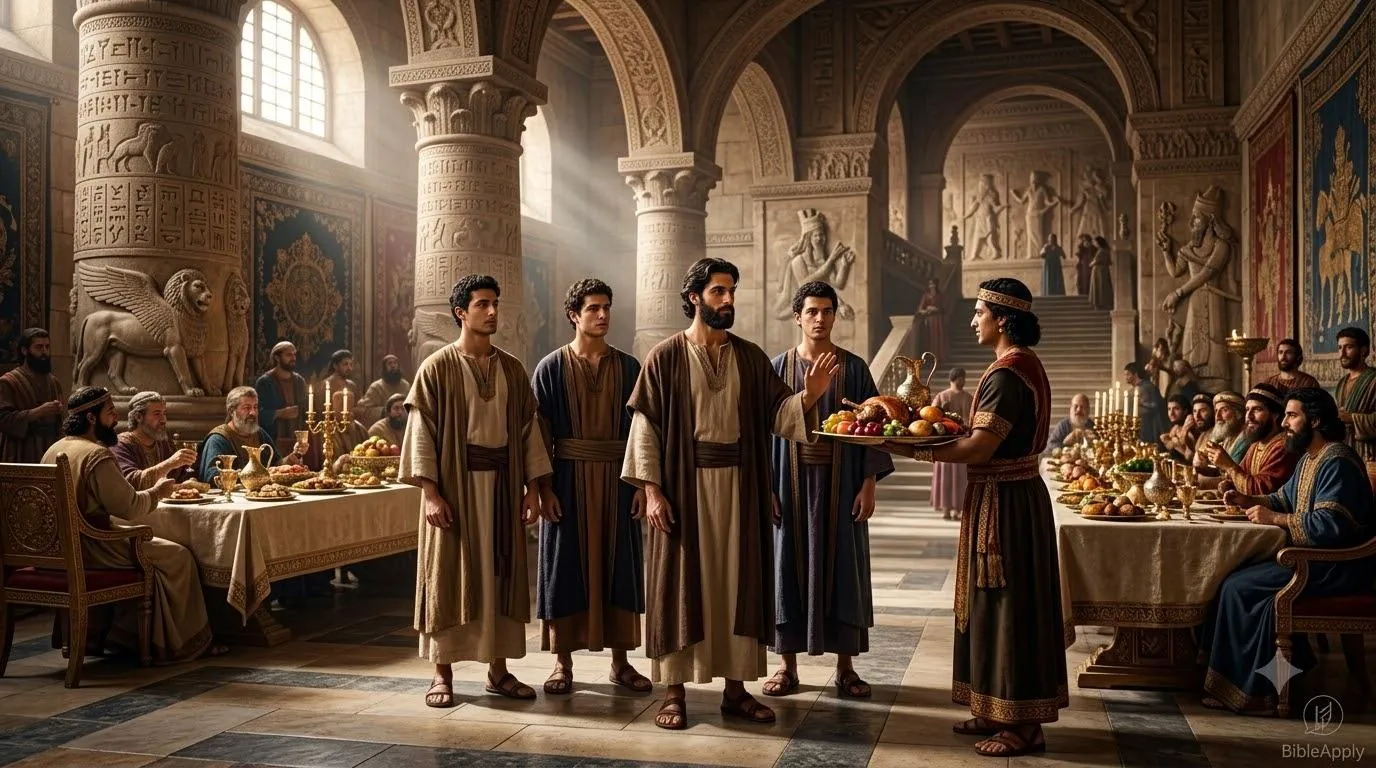
The Book of Daniel opens in the year 605 B.C., during a period of catastrophic devastation and heartbreak for the people of Judah. King Nebuchadnezzar of Babylon has laid siege to Jerusalem, plundered the sacred temple of Yahweh, and carried away the brightest and best of Israel’s youth into exile. For the Jewish people, this was not merely a military defeat or a political disaster; it was a profound theological crisis. Had the God of Israel been overpowered by Marduk, the chief deity of Babylon? Had God abandoned His covenant promises and forsaken His chosen people?
Daniel Chapter 1 serves as the foundational prologue for the entire book, setting the stage for the dramatic, cosmic clashes between the Kingdom of God and the kingdoms of men. It introduces us to four young Israelites—Daniel, Hananiah, Mishael, and Azariah—who are thrust into the center of the world’s most powerful pagan empire. Here, they face an intense, systematic program of cultural indoctrination designed to strip them of their Israelite identity and mold them into loyal, secularized servants of Babylon.
Yet, this chapter is not ultimately a story about the overwhelming power of Babylon, but about the unshakable sovereignty of God and the quiet, resolute faithfulness of His remnant. It demonstrates how believers can navigate a hostile, secular culture—neither wholly assimilating into its idolatries nor completely isolating from its people, but standing as distinct witnesses to the true King. Through the lens of Daniel 1, we learn what it means to live as faithful exiles in a modern world that constantly pressures us to bow to its idols.
The Sovereignty of God in Defeat (Verses 1-2)
“In the third year of the reign of Jehoiakim king of Judah came Nebuchadnezzar king of Babylon unto Jerusalem, and besieged it. And the Lord gave Jehoiakim king of Judah into his hand, with part of the vessels of the house of God: which he carried into the land of Shinar to the house of his god; and he brought the vessels into the treasure house of his god.” (Daniel 1:1-2)
The most critical phrase in these opening verses is easily overlooked: “And the Lord gave…” From a human perspective, it appeared that Nebuchadnezzar’s military brilliance and the sheer might of the Babylonian army had conquered Judah. The Babylonians undoubtedly viewed their victory as indisputable proof that their gods had triumphed over Yahweh. But the author of Daniel immediately corrects this misconception. Babylon did not win; Yahweh handed Judah over to them.
This judgment was the tragic culmination and fulfillment of generations of prophetic warnings (such as those spoken by Isaiah and Jeremiah) concerning Israel’s persistent idolatry and violation of the Mosaic Covenant. Even in what appeared to be God’s absolute defeat, God was completely in control, orchestrating history according to His divine, unalterable purposes.
Furthermore, the mention that the temple vessels were carried to the “land of Shinar” is highly significant. In the biblical narrative, Shinar is the ancient name for the region where the Tower of Babel was built (Genesis 11:2). By deliberately using this specific geographical term, the author is drawing a profound theological connection: Babylon is simply the latest manifestation of humanity’s ancient, unified rebellion against God. It is the ultimate “City of Man,” built on human pride and idolatry, standing in perpetual opposition to the “City of God.” The placement of Yahweh’s sacred vessels in the temple of a pagan god was intended to symbolize Yahweh’s subjugation. However, as the rest of the book will dramatically reveal, God will not share His glory with another.
The Strategy of Cultural Assimilation (Verses 3-7)
“And the king spake unto Ashpenaz the master of his eunuchs, that he should bring certain of the children of Israel, and of the king’s seed, and of the princes; Children in whom was no blemish, but well favoured, and skilful in all wisdom, and cunning in knowledge, and understanding science, and such as had ability in them to stand in the king’s palace, and whom they might teach the learning and the tongue of the Chaldeans.” (Daniel 1:3-4)
Nebuchadnezzar was a brilliant and ruthless empire-builder. He understood that the most effective way to permanently subjugate a conquered nation was not merely through brute force and military occupation, but through ideological conquest. His strategy was to take the royal and noble youth of Judah—the future leaders and influencers of the nation—and thoroughly indoctrinate them. He aimed to make them Babylonian in their thinking, their loyalties, and their worldview.
This systemic brainwashing program consisted of a three-pronged attack on their covenant identity:
For a deeper study, see our guide on Jeremiah 29:11 Meaning: For I Know the Plans I Have for You which many readers have found helpful.
1. Isolation and Education
The young men were violently separated from their families, their temple, and the Promised Land. They were immersed in an elite, three-year university program to learn the “learning and the tongue of the Chaldeans.” This meant studying Akkadian and Sumerian languages, as well as Babylonian literature, astrology, magic, and pagan mythology (such as the Enuma Elish creation myth). They were being actively trained to think like Babylonians and to view the world through a pagan lens.
2. Dependence and Fellowship
The king provided them with a daily provision of his own royal food and wine. This was not a gesture of hospitality; it was designed to cultivate a sense of gratitude, obligation, and total dependence on Nebuchadnezzar. He wanted these young men to feel that their prosperity, survival, and future success came directly from his benevolent hand, not Yahweh’s.
3. Erasure of Identity (Renaming)
Finally, and perhaps most devastatingly, their names were changed. In the ancient Near East, a name represented one’s core identity, character, and destiny.
- Daniel (meaning “God is my Judge”) was changed to Belteshazzar (“Bel protect his life” - honoring the Babylonian god Bel/Marduk).
- Hananiah (meaning “Yahweh is gracious”) became Shadrach (“Command of Aku” - the Sumerian moon god).
- Mishael (meaning “Who is what God is—) was renamed Meshach (“Who is what Aku is—).
- Azariah (meaning “Yahweh has helped”) was changed to Abednego (“Servant of Nego/Nebo” - the Babylonian god of wisdom and writing).
The empire sought to erase the name of Yahweh from their lips and their minds, replacing it with the names of false gods. Babylon was communicating a chilling message: “Your past is dead; your God has failed; you belong to us now.”
The Courage of Conviction (Verse 8)
“But Daniel purposed in his heart that he would not defile himself with the portion of the king’s meat, nor with the wine which he drank: therefore he requested of the prince of the eunuchs that he might not defile himself.” (Daniel 1:8)
This verse stands as the pivotal turning point of the chapter. Daniel and his three friends accepted the Babylonian education, and they even answered to their new pagan names, but they drew a hard, non-negotiable line at the king’s table.
Why was the food such a critical issue? While it certainly involved the kosher dietary laws of Leviticus 11, the problem ran much deeper than mere rule-keeping. In the ancient world, eating meat and drinking wine from the king’s table was an intimate act of fellowship, covenant, and political allegiance. Furthermore, the king’s meat and wine had almost certainly been ritually offered to Babylonian idols before being served.
To eat the king’s food was to publicly participate in pagan worship and to accept Nebuchadnezzar as their ultimate sovereign and provider. Daniel recognized that while he could learn the wisdom of Babylon, he could not integrate its worship into his soul. He could study their myths, but he refused to swallow their theology.
Also Read:
The Hebrew text says Daniel “purposed in his heart” (lit. sum al-leb, “placed upon his heart”). In ancient Hebrew anthropology, the heart (leb) is not merely the seat of fleeting emotion; it is the control center of the intellect, will, and moral decision-making. Daniel’s resolve was not an emotional reaction; it was a deeply rooted, premeditated conviction. He decided in advance that his loyalty to Yahweh was absolute, regardless of the personal cost.
Importantly, Daniel did not stage a violent revolt, a hunger strike, or a loud, self-righteous protest. He respectfully “requested” an exemption. His faith was unyielding, but his demeanor was gracious and respectful—a perfect, Christ-like model for believers living in a hostile secular society.
The Test of Faith and the Favor of God (Verses 9-16)
“Now God had brought Daniel into favour and tender love with the prince of the eunuchs.” (Daniel 1:9)
As Daniel takes his courageous stand, the narrative pulls back the curtain to reveal the invisible hand of God moving behind the scenes. Just as God had sovereignly “given” Judah into Babylon’s hands (v. 2), He now sovereignly gives Daniel “favour and tender love” (The Hebrew words here denote a deep, almost maternal compassion and covenantal loyalty) in the eyes of his captor, Ashpenaz.
When the chief official expresses fear that Daniel will become malnourished and that he will subsequently lose his head to the king’s wrath, Daniel proposes a brilliant and reasonable ten-day test: “Prove thy servants, I beseech thee, ten days; and let them give us pulse to eat, and water to drink” (v. 12).
“Pulse” (Hebrew: zeroim) refers to foods grown from seeds, essentially a humble, plant-based diet of vegetables, legumes, and grains. By choosing this diet, Daniel places his life entirely in God’s hands. Ten days was simply not enough time for a dietary change to naturally produce a dramatic physical difference. The outcome would have to be miraculous. It was a fast from the world’s luxuries to feast on God’s provision.
At the end of the ten days, Daniel and his friends looked noticeably healthier and better nourished than all the youths who had been indulging in the king’s rich delicacies. God honored their faithfulness by miraculously sustaining them. They definitively proved that true sustenance and life come from the Word of the Lord, not from the table of the empire.
True Wisdom and the Triumph of the Exiles (Verses 17-21)
“As for these four children, God gave them knowledge and skill in all learning and wisdom: and Daniel had understanding in all visions and dreams.” (Daniel 1:17)
The chapter concludes with a sweeping, undeniable vindication of the four young Israelites. While they diligently studied the literature of Babylon, the text makes it explicitly clear that it was Yahweh who “gave them knowledge and skill.” They excelled far beyond their peers, not because of their own natural brilliance or Babylonian training, but because of divine endowment.
This topic connects with Psalm 91 Meaning: He Who Dwells in the Shelter, one of the most-searched biblical questions today.
When King Nebuchadnezzar personally examines them at the end of their three-year training program, he finds them “ten times better than all the magicians and astrologers that were in all his realm” (v. 20). The Babylonian hartummim (magician-scholars) and assaphim (enchanters) were universally considered the intellectual elite of the ancient world. Yet, their dark arts and pagan wisdom were utterly no match for youths filled with the Spirit and wisdom of the living God.
The Gospel Connection: The Ultimate Righteous Exile
As we look at Daniel’s faithful obedience in a foreign land, we must read this chapter in light of the Gospel. Daniel serves as a powerful “type” or shadow pointing forward to Jesus Christ. Just as Daniel was exiled into Babylon and tempted with the king’s lavish feast, Jesus Christ is the ultimate Royal Exile. He left the infinite glory of heaven to dwell in the “Babylon” of this fallen, sinful world.
In the wilderness, Jesus was tempted by the enemy to compromise—to take the kingdoms of the world and the bread of the earth by bowing to Satan (Matthew 4). Like Daniel, but in an infinitely greater way, Jesus “purposed in his heart” to perfectly obey the Father. He refused to defile Himself with the corruptions of this world. Jesus trusted God even unto the ultimate test of the cross, where it appeared the empires of men had defeated Him. Yet, God vindicated Jesus through the resurrection, proving that the true King had triumphed. Because Christ was perfectly faithful as an exile for us, we can now receive His grace and His Spirit to be faithful exiles ourselves.
The Fall of the Empire
The chapter ends with a quiet, seemingly mundane chronological note that actually carries explosive theological weight:
“And Daniel continued even unto the first year of king Cyrus.” (Daniel 1:21)
Cyrus the Great was the Persian king who conquered Babylon in 539 B.C. Do not miss the profound, overarching irony of this single verse. Nebuchadnezzar conquered Daniel’s home and sought to absorb him into the eternal Babylonian empire. But where is Babylon now? It is dust. Nebuchadnezzar came and went. His grandson Belshazzar was slain in a single night. The invincible empire fell.
But Daniel outlasted them all. The young Jewish exile who refused to compromise his faith over a meal lived to see the absolute death of the empire that enslaved him. The kingdoms of this world will inevitably crumble, but the Word of the Lord endures forever.
3 Practical Applications from Daniel 1
- Faithfulness in Cultural Exile: Like Daniel, Christians today are called “sojourners and exiles” (1 Peter 2:11) living in a secular culture (a modern “Babylon”) that constantly attempts to redefine our identity and dictate our values. The world wants us to adopt its language, its ethics, and its worldview. Daniel teaches us that we do not have to isolate ourselves in secluded, religious bubbles to remain faithful. We can engage culture, excel in our education, and serve our secular vocations with excellence, provided we draw clear, uncompromising lines when it comes to worship, morality, and our obedience to God.
Many believers wrestle with questions like romans 8 28 — and Scripture has profound answers.
-
God is Sovereign Over Our Defeats: When Jerusalem fell and the temple was plundered, it looked as though God had completely lost control. But God was actually orchestrating history for His ultimate glory and the sanctification of His people. When you face devastating personal defeats, societal decline, or circumstances that seem wildly out of control, remember that God is still firmly on the throne. He is not surprised by the triumphs of “Babylon,” and He is actively working His sovereign, loving purposes even in the darkest, most painful valleys of your life.
-
The Courage of Conviction in the Small Things: Daniel’s monumental, lifelong stand for God began with a seemingly minor decision about what he would put on his dinner plate. Often, our spiritual integrity is lost not in massive, dramatic apostasies, but in small, subtle, daily compromises. When we yield ground on seemingly minor issues of obedience or personal holiness, we fatally weaken our resolve for the larger spiritual battles. Purpose in your heart now, before the intense crisis comes, that you will not defile yourself, and trust God to honor your quiet, steadfast obedience.
Also Read
- Ruth 1 Summary & Meaning: A Journey from Bitterness to Covenant Loyalty
- Judges 1 Summary & Meaning: The Tragedy of Incomplete Obedience
- Joel 1 Summary & Meaning: The Devastating Locust Plague and the Call to Lament
Read Daniel 1
Dive into the full scripture text for deeper study.
Chapter 2: The Colossal Dream
Daniel stands before the king, declaring that only the God of heaven reveals mysteries. He describes a massive, radiant statue with a head of gold, chest of silver, belly of bronze, legs of iron, and feet of mixed iron and clay. A stone, uncut by human hands, strikes the feet, shattering the statue and growing into a mountain that fills the earth. Daniel explains this represents a succession of human empires, culminating in a divine, eternal kingdom established by God. Nebuchadnezzar, in awe, falls prostrate and honors Daniel's God as the Lord of kings.
Chapter 3: The Fiery Furnace
Their response is unflinching: their God is able to deliver them, but even if He does not, they will never serve the king's gods. Furious, Nebuchadnezzar orders the furnace heated seven times hotter and has them bound and thrown in. The flames are so intense they kill the soldiers tossing them in. Yet, the king is stunned to see four men walking unbound in the fire, the fourth resembling a "son of the gods." They emerge completely unharmed, without even the smell of smoke, prompting the king to praise the Most High God.
Chapter 4: The King's Madness
Daniel interprets the dream, warning the king that he is the tree and urging him to renounce his sins and practice righteousness. A year later, while boasting of his own majesty in building Babylon, the prophecy is fulfilled. Driven away from humanity, Nebuchadnezzar lives like a wild animal, eating grass and growing eagle-like feathers. After seven years, his sanity is restored. He raises his eyes to heaven, honoring and glorifying the King of heaven, acknowledging God's absolute sovereignty over all mortal realms.
Chapter 5: The Writing on the Wall
The queen mother remembers Daniel, who is brought before the trembling king. Rejecting Belshazzar's offers of wealth, Daniel delivers a blistering rebuke, reminding him of Nebuchadnezzar's humbling and condemning his desecration of God's vessels. He then interprets the fatal inscription: God has numbered the days of Belshazzar's reign, he has been weighed on the scales and found wanting, and his kingdom will be divided among the Medes and Persians. That very night, Belshazzar is slain, and Darius the Mede takes the empire.
Chapter 6: The Lions' Den
Fully aware of the decree, Daniel returns home and continues his lifelong habit: praying three times a day with his windows open toward Jerusalem. His enemies catch him and force the reluctant king to throw his trusted official into the lions' den. After a sleepless, fasting night, Darius rushes to the den at dawn, crying out to Daniel. Miraculously, Daniel answers, declaring that God sent an angel to shut the lions' mouths because he was found innocent. Daniel is hoisted to safety, his accusers meet a grisly end, and Darius decrees that all nations must revere the living God.
Chapter 7: The Beasts and the Ancient of Days
The scene shifts to a majestic heavenly courtroom. The Ancient of Days takes his fiery throne, books are opened, and the boastful beast is slain. Then, "one like a son of man" approaches on the clouds of heaven, receiving an everlasting, indestructible dominion over all peoples and nations. An angelic guide explains that the beasts represent four earthly kingdoms, but ultimately, the holy people of the Most High will receive and possess the eternal kingdom forever, despite temporary suffering.
Chapter 8: The Ram and the Goat
Out of one of these horns grows another horn, starting small but expanding rapidly toward the Beautiful Land. It arrogantly sets itself against the Prince of the host, stopping the daily sacrifices and desecrating the sanctuary for 2,300 evenings and mornings. The angel Gabriel explains the vision: the ram is Medo-Persia, the goat is Greece, and its prominent horn is the first king (Alexander the Great). The fierce little horn represents a coming king of intrigue who will cause tremendous destruction before being broken by divine power.
Chapter 9: The Seventy Sevens
While Daniel is still praying, the angel Gabriel flies to him in swift flight to give him insight. Gabriel reveals a sweeping prophetic timeline concerning Israel and Jerusalem: a period of "seventy sevens" is decreed to finish transgression, atone for wickedness, and bring in everlasting righteousness. He outlines the rebuilding of the city in times of trouble, the coming and "cutting off" of the Anointed One, the destruction of the city and sanctuary, and the rise of a ruler who will establish a covenant and an abomination of desolation.
Chapter 10: The Spiritual Conflict
A hand touches him, and the being explains the delay: he had been battling the demonic "prince of the Persian kingdom" for twenty-one days until Michael, one of the chief princes, came to assist him. He reveals that unseen spiritual warfare rages behind human politics. The messenger strengthens Daniel, touching his lips and telling him not to fear, for he is highly esteemed. He prepares to outline what will happen to Daniel's people in the future, noting he must soon return to fight the prince of Persia and the coming prince of Greece.
Chapter 11: Kings of the South and North
The vision then meticulously traces the centuries of warfare, intrigue, and alliances between the King of the South (the Ptolemies of Egypt) and the King of the North (the Seleucids of Syria). The conflict culminates in a contemptible person who seizes the kingdom by intrigue. He will vent his fury on the holy covenant, desecrate the temple fortress, abolish the daily sacrifice, and set up the abomination that causes desolation. Though he will deceive many with flattery, the people who know their God will firmly resist him, leading to intense persecution and refining of the faithful.
Chapter 12: The Time of the End
Daniel is instructed to close up and seal the scroll until the time of the end, a period characterized by people frantically searching for knowledge. Two other beings appear by the river, and one asks how long it will be until these astonishing events are fulfilled. The man clothed in linen swears by Him who lives forever, giving prophetic timelines of days. Though Daniel does not fully understand, he is told to go his way. He receives the comforting promise that he will rest, and then rise to receive his allotted inheritance at the end of the days.
Conclusion
We hope this chapter-by-chapter summary of Daniel has helped you better understand God's Word. To continue your study, explore our other Bible Chapter Summaries or read our detailed Verse Meanings.