Acts Chapter Summaries
A complete, chapter-by-chapter guide to the Book of Acts. Read deep dives into the meaning, historical context, and modern application of every chapter.
Welcome to our complete guide to the Book of Acts. Below you will find a chapter-by-chapter summary that flows through the entire narrative, helping you understand the context, meaning, and application of this profound book.
Acts Chapter 1 Summary
The Book of Acts, properly titled “The Acts of the Apostles,” is the crucial bridge of the New Testament. It is the historical and theological connective tissue that links the life and ministry of Jesus Christ (the Gospels) to the life and theology of the early Church (the Epistles). Without Acts, we would flip from the resurrection of Jesus at the end of the Gospels directly into Paul’s letter to the Romans, leaving us with a staggering historical gap. We would be left wondering: How did a small, fearful band of Galilean fishermen transform into a global movement that would eventually topple the Roman Empire? Who is this man named Paul? How did the Gospel reach the Gentile world? Acts provides the vital answers.
Written by Luke, a Gentile physician, meticulous historian, and traveling companion of the Apostle Paul, Acts is the second volume of a two-part work addressed to “Theophilus” (a name meaning “lover of God”). While the Gospel of Luke details what Jesus began to do and teach in His physical body, the Book of Acts chronicles what Jesus continues to do and teach through His spiritual body—the Church—empowered by the Holy Spirit. To the original first-century audience, living under the shadow of a hostile Roman Empire and an antagonistic religious establishment in Jerusalem, Acts was a robust defense of the Christian faith. It demonstrated that the unstoppable spread of the Gospel was not a human rebellion, but the sovereign, predestined plan of God.
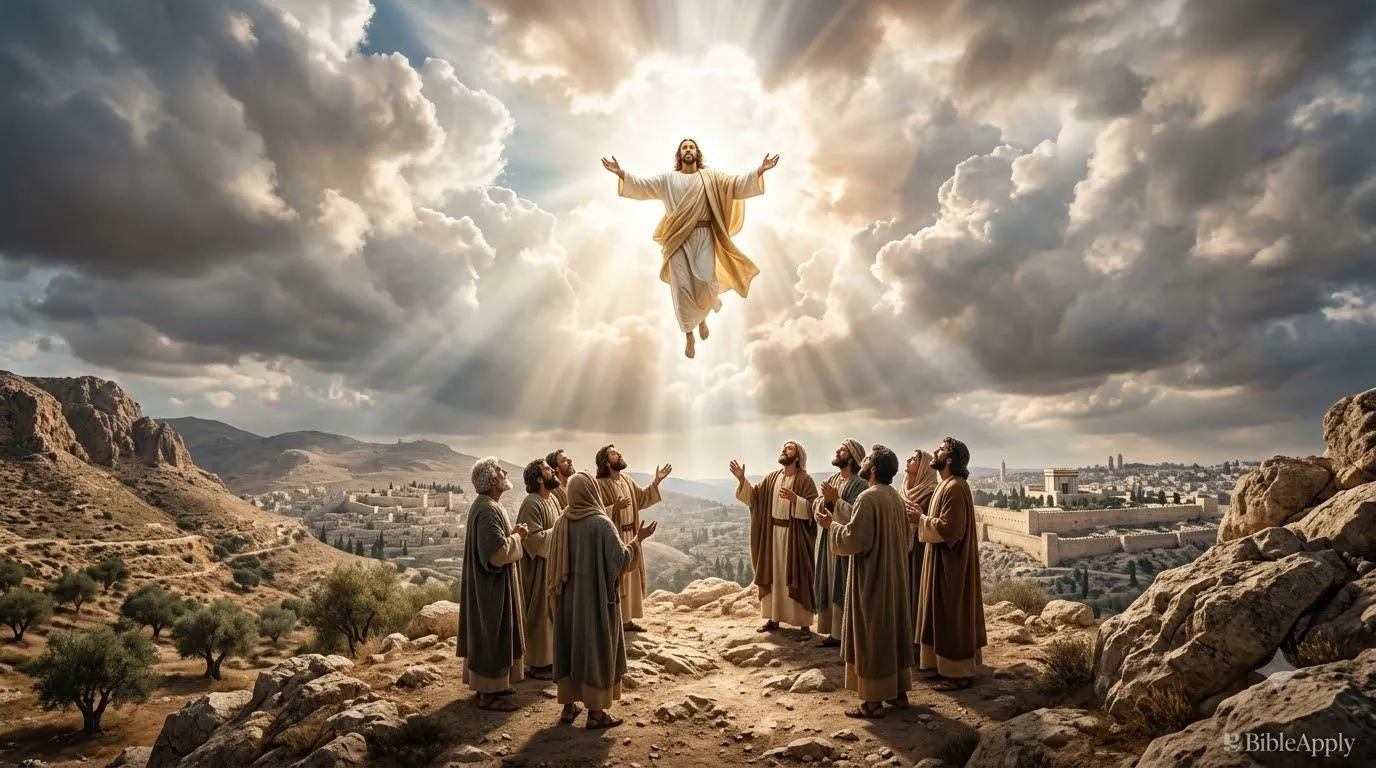
Chapter 1 sets the stage for this explosive expansion. It is a chapter of profound transition, lingering in the sacred space between the earthly ministry of Christ and the descent of the Holy Spirit at Pentecost. Here, we witness the final earthly words of the resurrected King, His glorious ascension into heaven to take His cosmic throne, and the obedient, prayerful waiting of His disciples. In this single chapter, Jesus shifts the disciples’ focus entirely—from a localized, geo-political kingdom to a global, spiritual mission that will echo into eternity.
The Infallible Proofs and the Kingdom (Verses 1-3)
“To whom also he shewed himself alive after his passion by many infallible proofs, being seen of them forty days, and speaking of the things pertaining to the kingdom of God:” (Acts 1:3, KJV)
Luke begins by anchoring the Christian faith in historical reality. Jesus did not merely leave behind a philosophy or a system of ethics; He left an empty tomb. The Greek word used for “infallible proofs” is tekmērion, a strong legal and philosophical term meaning a demonstrable proof or convincing evidence. This wasn’t a subjective spiritual vision or a mass hallucination; Jesus ate with them, allowed them to touch His scars, and taught them for forty days.
In Jewish thought and biblical history, forty is consistently the number of testing, preparation, and transition. Moses spent forty days on Mount Sinai receiving the Law to form the nation of Israel. Israel wandered for forty years in the wilderness, being purged of their Egyptian mindset. Jesus Himself fasted for forty days in the desert before launching His earthly ministry. Now, Jesus spends exactly forty days preparing His disciples for the birth of the New Covenant Church.
During this time, His primary topic of instruction was “the things pertaining to the kingdom of God.” He was fundamentally rewiring their theology. For three years, they had viewed Him through the lens of a conquering Messiah who would expel the Romans. Over these forty days, He opened their minds to see how the Old Testament scriptures pointed to a kingdom inaugurated by a suffering servant, validated by an empty tomb, and expanding not by the sword, but by the Spirit.
The Promise of Power (Verses 4-8)
“But ye shall receive power, after that the Holy Ghost is come upon you: and ye shall be witnesses unto me both in Jerusalem, and in all Judaea, and in Samaria, and unto the uttermost part of the earth.” (Acts 1:8, KJV)
Many believers wrestle with questions like jeremiah 29 11 — and Scripture has profound answers.
Jesus commands the disciples not to leave Jerusalem but to wait for the “Promise of the Father.” He draws a sharp theological distinction between the baptism of John (which was with water, symbolizing repentance) and the coming baptism of the Holy Spirit (which would bring absolute transformation and power). The Greek word used here is baptisthēsesthe, meaning to be fully immersed, submerged, or overwhelmed. Just as a piece of cloth is dipped into dye and permanently changed in its color and nature, the disciples were about to be plunged into the very presence and nature of God.
If this resonates with you, our deep dive into Jeremiah 29:11 Meaning: For I Know the Plans I Have for You explores the scriptural foundation further.
Yet, the disciples are still stubbornly clinging to their old paradigms. They ask, “Lord, wilt thou at this time restore again the kingdom to Israel— (v. 6). Their worldview is still painfully small. They are expecting a political revolution—the overthrow of Caesar and the installation of an earthly Davidic throne in Jerusalem. Jesus gently but firmly rebukes their obsession with apocalyptic timelines. He states that the Father alone holds the sovereign timetable (using the Greek words chronous and kairous—referring to chronological calendar time and the divinely appointed epochs or seasons).
Instead of a localized political kingdom, Jesus hands them a cosmic, world-altering mission, articulated in verse 8—the thesis statement for the entire Book of Acts. He promises them dynamis (power). While this is the root for our English word “dynamite,” a better understanding is intrinsic ability, miraculous power, and divine enablement. This power is not given for their own spiritual enjoyment; it has a razor-sharp purpose: to make them “witnesses.”
The Greek word for witness is martys (plural: martyres). In the first century, a witness in a Roman or Jewish court was simply someone who testified to what they had seen and heard. However, because these early Christians would relentlessly testify to the resurrection at the cost of their own blood, this exact word evolved into our modern English word martyr. Jesus is essentially saying, “You will be my martyrs. You will testify of me until it costs you everything.”
He also outlines the geographic expansion of the Gospel, which serves as the table of contents for the rest of the book:
- Jerusalem: The center of Judaism and the place of His crucifixion (Acts 1-7).
- Judea and Samaria: The surrounding regions, including the despised half-Jewish Samaritans, breaking centuries of racial prejudice (Acts 8-12).
- The uttermost part of the earth: The Gentile world, reaching all the way to Rome, the center of the known world (Acts 13-28).
The Ascension: The Coronation of the King (Verses 9-11)
“And when he had spoken these things, while they beheld, he was taken up; and a cloud received him out of their sight.” (Acts 1:9, KJV)
The Ascension is often the forgotten climax of the Gospel story, overshadowed by the Cross and the Resurrection. Yet, it carries immense theological weight. Jesus does not merely float away into the sky like a balloon; He ascends to take His rightful throne. In the ancient biblical world, to be enveloped in a cloud was a symbol of divine presence and authority. This was not a rain cloud; this was the Shekinah glory—the same visible, luminous manifestation of God’s presence that guided Israel in the wilderness, enveloped Mount Sinai, and filled the Holy of Holies in the Temple.
Theologically, the Ascension achieves three critical milestones for the believer:
- The Exaltation and Coronation: Jesus takes His seat at the right hand of God the Father, fulfilling the prophetic vision of Daniel 7 (the Son of Man approaching the Ancient of Days) and Psalm 110:1. His earthly humiliation is over; His heavenly, sovereign reign over all principalities and powers has officially begun.
- The High Priesthood: He enters the true heavenly sanctuary as our eternal High Priest, where He “ever liveth to make intercession” for us (Hebrews 7:25). We now have a sympathetic Advocate in the throne room of the universe.
- The Omnipresence: By leaving His localized physical body, Jesus ensures that He is not restricted to one geography. Through the coming of the Holy Spirit, Christ can now be intimately present with every believer, everywhere, simultaneously.
As the disciples stand paralyzed, gazing into the sky, two men in white apparel (angels) interrupt their awe. They offer a gentle rebuke and a glorious, foundational promise of Christian eschatology: “this same Jesus, which is taken up from you into heaven, shall so come in like manner as ye have seen him go into heaven” (v. 11). The angels bridge the gap between the Ascension and the Second Coming. The Jesus who left in physical, visible glory will return in physical, visible glory. In the meantime, the Church is not to be a community of star-gazers, but of active, mobilized witnesses.
The Upper Room: United in Prayer (Verses 12-14)
“These all continued with one accord in prayer and supplication, with the women, and Mary the mother of Jesus, and with his brethren.” (Acts 1:14, KJV)
If you want to explore this further, our in-depth guide on joshua 1 9 breaks this down verse by verse.
Also Read:
Obedient to Christ’s command, the disciples make a “Sabbath day’s journey” (about three-quarters of a mile, the maximum travel distance strictly allowed on the Sabbath by Rabbinic tradition) from the Mount of Olives back to Jerusalem. They retreat to an Upper Room, a place of safety and waiting.
The most striking feature of this gathering is its profound, supernatural unity. Luke uses the Greek word homothymadon, a beautiful compound word meaning “with one mind, with one accord, or with one shared passion.” This represents a staggering psychological and spiritual transformation. Just weeks earlier, these same men were driven by ego, arguing bitterly at the Last Supper over who was the greatest among them (Luke 22:24). Now, humbled by the agony of the cross, awe-struck by the resurrection, and stripped of their pride, they are bound together in desperate, dependent prayer.
Luke also carefully notes the presence of “the women,” including Mary the mother of Jesus, and His earthly brothers. This is the last time Mary is explicitly mentioned in the New Testament narrative, and she is found exactly where she belongs in biblical theology: not being worshipped as a co-redemptrix, but worshipping her Savior alongside the rest of the Church.
The presence of Jesus’ half-brothers (such as James and Jude) is a monumental apologetic proof for the historical reality of the resurrection. During Jesus’ earthly ministry, His brothers thought He was a madman and actively rejected His claims (Mark 3:21, John 7:5). What could possibly convince skeptical brothers to worship their own sibling as the Lord of the universe, eventually dying as martyrs for that belief? Only one thing: seeing Him physically alive after watching Him be crucified.
The Replacement of Judas and the Sovereignty of God (Verses 15-26)
“And they prayed, and said, Thou, Lord, which knowest the hearts of all men, shew whether of these two thou hast chosen, That he may take part of this ministry and apostleship, from which Judas by transgression fell, that he might go to his own place.” (Acts 1:24-25, KJV)
During this ten-day period of waiting between the Ascension and Pentecost, Peter steps into his role as the leader of the early community, which now numbers about 120 people. He stands up to address the agonizing elephant in the room: the betrayal, defection, and horrific suicide of Judas Iscariot.
For the disciples, Judas’s betrayal was a traumatic, gaping wound. How could one of the inner circle, who saw the miracles and preached the kingdom, betray the Son of God? Did God’s plan fail? Peter provides a profoundly comforting theological answer by turning to the authority of the Scriptures. Under the inspiration of the Holy Spirit, he quotes Psalms 69 and 109, demonstrating that Judas’s betrayal was not an accident that caught God off guard. It was foreseen in the sovereign, providential plan of God. The Scripture “must needs have been fulfilled” (v. 16). The rebellion of man is always subservient to the sovereignty of God.
For a deeper study, see our guide on Psalm 91 Meaning: He Who Dwells in the Shelter which many readers have found helpful.
Because Jesus had appointed Twelve Apostles (representing the twelve tribes of the new, restored spiritual Israel), the vacancy left by Judas—referred to as an episkopēn, meaning office or overseership—had to be filled. Peter outlines the strict, non-negotiable requirements for an Apostle: it must be a man who had accompanied them during the entirety of Jesus’ earthly ministry, from the baptism of John all the way to the Ascension. Most importantly, he had to be an eyewitness (martys) of the resurrection. The Apostle’s unique authority in the early church was not derived from their intellect, wealth, or rhetorical skill, but from their firsthand, incontrovertible experience of the risen Christ. This ensures that the foundation of the Church is built entirely on historical reality.
Two qualified candidates are put forward: Joseph (called Barsabas) and Matthias. The disciples pray a remarkable prayer, acknowledging Jesus as God. They call Him kardiognōsta, a unique Greek word meaning the “heart-knower.” They recognize that Jesus has already chosen the replacement; their job is simply to discover His will.
They then cast lots, and the lot falls to Matthias. To a modern reader, casting lots may seem like a primitive, arbitrary game of chance. But in the Old Testament framework, it was a sacred method of surrendering a deeply important decision entirely to the absolute sovereignty of God, as Proverbs 16:33 declares: “The lot is cast into the lap; but the whole disposing thereof is of the LORD.”
Notably, this is the very last time in biblical history that God’s people use lots to discern God’s will. Why? Because a few days later in Acts Chapter 2, the Holy Spirit will be poured out to dwell eternally within believers, providing direct internal guidance, wisdom, and conviction. The era of external, mechanical decision-making is closing forever; the new covenant era of Spirit-led discernment is about to dawn.
3 Practical Applications from Acts 1
If you want to explore this further, our in-depth study on romans 8 28 breaks this down verse by verse.
If you want to explore this further, our in-depth guide on psalm 23 kjv breaks this down verse by verse.
- Prioritize the Mission over the Mystery: The disciples were obsessed with the “when” (the timing of the geopolitical kingdom’s restoration), but Jesus completely redirected their focus to the “what” (being His faithful witnesses to the ends of the earth). Today, Christians often waste immense amounts of time and energy speculating about end-times timelines, secret prophetic knowledge, or exactly when Jesus will return. Christ’s command remains piercingly clear: stop staring up at the sky and get to work. Your primary calling is not to decode the future, but to be a bold witness for the Gospel exactly where God has placed you.
- Power is for Purpose, Not Prestige: Jesus promised the Holy Spirit (dynamis) for one specific, monumental reason: to empower the Church for evangelism and mission. The power of the Holy Spirit is not given to make us look super-spiritual, to give us an emotional thrill, or to elevate our status within the church. It is divine, supernatural enablement to proclaim the Gospel, heal the broken, and advance the Kingdom in a hostile world. If you want to experience God’s power in your life, you must be actively aligned with God’s mission.
- Wait Actively, Not Passively: When Jesus told the disciples to wait for the Holy Spirit, they did not sit around lazily, retreat to their fishing boats, or complain about the delay. They gathered in unity and devoted themselves constantly to prayer. Waiting on God is one of the hardest disciplines in the Christian life. When you are in a season of waiting—whether for a job breakthrough, a spouse, physical healing, or spiritual direction—do not wait passively. Wait with fervent, expectant prayer, anchor yourself in deep Christian community, and maintain a unified focus on the promises of Christ.
Also Read
- Deuteronomy 1 Summary & Meaning: The Tragedy of Unbelief
- Philemon 1 Summary & Meaning: The Radical Call of Christian Brotherhood
- Ezekiel 1 Summary & Meaning: The Glory of God in Exile
Read Acts 1
Dive into the full scripture text for deeper study.
Acts Chapter 2 Summary
A detailed narrative summary for Acts 2 is currently being prepared by our theologians.
Acts Chapter 3 Summary
A detailed narrative summary for Acts 3 is currently being prepared by our theologians.
Acts Chapter 4 Summary
A detailed narrative summary for Acts 4 is currently being prepared by our theologians.
Acts Chapter 5 Summary
A detailed narrative summary for Acts 5 is currently being prepared by our theologians.
Acts Chapter 6 Summary
A detailed narrative summary for Acts 6 is currently being prepared by our theologians.
Acts Chapter 7 Summary
A detailed narrative summary for Acts 7 is currently being prepared by our theologians.
Acts Chapter 8 Summary
A detailed narrative summary for Acts 8 is currently being prepared by our theologians.
Acts Chapter 9 Summary
A detailed narrative summary for Acts 9 is currently being prepared by our theologians.
Acts Chapter 10 Summary
A detailed narrative summary for Acts 10 is currently being prepared by our theologians.
Acts Chapter 11 Summary
A detailed narrative summary for Acts 11 is currently being prepared by our theologians.
Acts Chapter 12 Summary
A detailed narrative summary for Acts 12 is currently being prepared by our theologians.
Acts Chapter 13 Summary
A detailed narrative summary for Acts 13 is currently being prepared by our theologians.
Acts Chapter 14 Summary
A detailed narrative summary for Acts 14 is currently being prepared by our theologians.
Acts Chapter 15 Summary
A detailed narrative summary for Acts 15 is currently being prepared by our theologians.
Acts Chapter 16 Summary
A detailed narrative summary for Acts 16 is currently being prepared by our theologians.
Acts Chapter 17 Summary
A detailed narrative summary for Acts 17 is currently being prepared by our theologians.
Acts Chapter 18 Summary
A detailed narrative summary for Acts 18 is currently being prepared by our theologians.
Acts Chapter 19 Summary
A detailed narrative summary for Acts 19 is currently being prepared by our theologians.
Acts Chapter 20 Summary
A detailed narrative summary for Acts 20 is currently being prepared by our theologians.
Acts Chapter 21 Summary
A detailed narrative summary for Acts 21 is currently being prepared by our theologians.
Acts Chapter 22 Summary
A detailed narrative summary for Acts 22 is currently being prepared by our theologians.
Acts Chapter 23 Summary
A detailed narrative summary for Acts 23 is currently being prepared by our theologians.
Acts Chapter 24 Summary
A detailed narrative summary for Acts 24 is currently being prepared by our theologians.
Acts Chapter 25 Summary
A detailed narrative summary for Acts 25 is currently being prepared by our theologians.
Acts Chapter 26 Summary
A detailed narrative summary for Acts 26 is currently being prepared by our theologians.
Acts Chapter 27 Summary
A detailed narrative summary for Acts 27 is currently being prepared by our theologians.
Acts Chapter 28 Summary
A detailed narrative summary for Acts 28 is currently being prepared by our theologians.
Conclusion
We hope this chapter-by-chapter summary of Acts has helped you better understand God's Word. To continue your study, explore our other Bible Chapter Summaries or read our detailed Verse Meanings.