2 Peter Chapter Summaries
A complete, chapter-by-chapter guide to the Book of 2 Peter. Read deep dives into the meaning, historical context, and modern application of every chapter.
Welcome to our complete guide to the Book of 2 Peter. Below you will find a chapter-by-chapter summary that flows through the entire narrative, helping you understand the context, meaning, and application of this profound book.
2 Peter Chapter 1 Summary
Introduction
Second Peter is a striking, urgent, and deeply theological letter written by the Apostle Peter near the end of his life. Historical context indicates that Peter penned this epistle from a Roman prison around AD 64-68, fully aware that his execution under Emperor Nero was imminent. While his first letter was written to comfort persecuted believers, his second letter sounds a forceful alarm against false teachers who were infiltrating the church, corrupting its morals, and denying the future return of Jesus Christ.
Chapter 1 of 2 Peter sets the stage for this battle by cementing the foundation of Christian truth. Before Peter exposes the destructive heresies in chapter 2 or defends the Second Coming in chapter 3, he must first remind his readers of who they are, what they possess in Christ, and how their faith is anchored in immovable historical and prophetic reality. He is passing the baton of truth to the next generation.
At its core, 2 Peter 1 is a masterclass in Christian epistemology—how we know what we know, and how that knowledge transforms us. It moves majestically from the believer’s inner transformation through the Holy Spirit to the external, objective proof of Christ’s glory on the Mount of Transfiguration, culminating in the supreme authority of the written Word of God. This chapter bridges the gap between divine grace and human responsibility, declaring that because God has given us everything needed for life and godliness, we must diligently pursue spiritual maturity.
The Foundation of Christian Growth (2 Peter 1:1-4)
Precious Faith and Divine Power
The letter opens with a traditional greeting but quickly pivots into a profound theological declaration. Peter introduces himself as “Simeon Peter, a servant and apostle of Jesus Christ.” By using his Hebrew name, Simeon, he grounds his identity in his Jewish roots, while asserting his apostolic authority.
“To those who have obtained a faith of equal standing with ours by the righteousness of our God and Savior Jesus Christ…” (2 Peter 1:1, ESV)
Peter makes a stunning leveling statement here. The faith of the Gentile believers scattered across Asia Minor is of “equal standing” (Greek: isotimos, meaning equally precious or of equal value) with the faith of the apostles themselves. There is no caste system in Christianity. This equal standing is not earned; it is “obtained” (allotted or received by divine will) through the righteousness of Jesus Christ, who is explicitly called “our God and Savior”—one of the clearest declarations of the deity of Christ in the New Testament.
In verses 2-3, Peter moves to the mechanics of the Christian life. He states that God’s “divine power has granted to us all things that pertain to life and godliness.” Many believers live in a state of spiritual poverty, begging God for resources He has already provided. Peter insists that through the true knowledge (epignōsis) of Him who called us by His own glory and excellence, we already possess every spiritual asset necessary to live a holy life. There are no missing puzzle pieces. The power that raised Jesus from the dead is the same power currently at work within the believer.
Partakers of the Divine Nature
One of the most breathtaking concepts in all of Scripture is found in verse 4:
“by which he has granted to us his precious and very great promises, so that through them you may become partakers of the divine nature, having escaped from the corruption that is in the world because of sinful desire.” (2 Peter 1:4, ESV)
The phrase “partakers of the divine nature” (theias koinōnoi physeōs) has been heavily debated in church history. In Eastern Orthodoxy, this forms the basis for the doctrine of theosis (deification). However, Peter is not suggesting that humans become little gods or merge into the essence of the Creator, erasing the Creator-creature distinction.
For a deeper study, see our guide on Jeremiah 29:11 Meaning: For I Know the Plans I Have for You which many readers have found helpful.
Rather, to partake in the divine nature means to share in God’s moral attributes—His holiness, His love, His truth. Because of the indwelling Holy Spirit, believers are grafted into the life of God. We are given a new heart and new desires. This divine impartation is the exact mechanism by which we “escape the corruption that is in the world.” The world is decaying through epithymia (sinful lusts and desires). The only way to survive a decaying world is to be tethered to an eternal, incorruptible source of life. God’s “precious and very great promises” act as the tether that secures our souls to heaven while we walk on earth.
The Progression of Christian Virtue (2 Peter 1:5-11)
Supplementing Your Faith
Because God has granted us everything necessary for godliness (the indicative), we are now called to exert massive effort in spiritual growth (the imperative). The grace of God is opposed to earning, but it is not opposed to effort.
“For this very reason, make every effort to supplement your faith with virtue, and virtue with knowledge, and knowledge with self-control, and self-control with steadfastness, and steadfastness with godliness, and godliness with brotherly affection, and brotherly affection with love.” (2 Peter 1:5-7, ESV)
Peter lays out a sequence often called the “Chain of Virtues” or “Peter’s Ladder.” The word translated “supplement” or “add” (epichorēgeō) originally referred to a wealthy patron who generously funded a grand chorus for a Greek play. Peter is telling believers to lavishly and generously supply their faith with these qualities.
The progression is intentional:
- Faith is the bedrock. You cannot build a Christian life without it.
- Virtue (aretē) is moral excellence or heroic courage.
- Knowledge (gnōsis) is practical wisdom and discernment.
- Self-control (enkrateia) is mastering one’s desires rather than being mastered by them.
- Steadfastness (hypomonē) is patient endurance under pressure.
- Godliness (eusebeia) is reverence and practical piety toward God.
- Brotherly Affection (philadelphia) is the warmth of family love within the church.
- Love (agape) is the capstone. It is the self-sacrificing, unconditional love of God.
These traits are not a checklist to complete but a continuous cycle of growth. If they are “yours and abound” (v. 8), they keep you from being ineffective or unfruitful. Conversely, the one who lacks them is “so nearsighted that he is blind,” having forgotten that he was cleansed from his past sins (v. 9). Spiritual stagnation is a form of spiritual amnesia.
Making Your Calling and Election Sure
Peter follows this list of virtues with a startling command:
“Therefore, brothers, be all the more diligent to confirm your calling and election, for if you practice these qualities you will never fall.” (2 Peter 1:10, ESV)
How can a human “confirm” or “make sure” a divine election that happened before the foundation of the world (Ephesians 1:4)? Theologians have long wrestled with this text.
The key lies in understanding that Peter is writing from a human perspective concerning the evidence of salvation, not the source of it. God’s sovereign election is secure in the heavens, but how do you know you are elect? The proof of God’s hidden decree of election is the visible fruit of a transformed life. By practicing the virtues listed in verses 5-7, believers validate their faith, gain internal assurance of their salvation, and prove to the world that they belong to Christ.
Also Read:
- Leviticus 1 Summary & Meaning: The Call to Total Surrender and the Burnt Offering
- Job 1 Summary & Meaning: The Testing of a Righteous Man
- 2 Chronicles 1 Summary & Meaning: Solomon’s Request for Divine Wisdom
When a believer lives in this fruitful, diligent manner, Peter promises a glorious result: an “entrance into the eternal kingdom of our Lord and Savior Jesus Christ” will be richly provided for them (v. 11). The image is of a triumphant Olympic athlete returning to their home city, welcomed with a grand parade and a hero’s reception. This is the rich welcome awaiting the faithful saint in heaven.
Eyewitnesses of His Majesty (2 Peter 1:12-18)
A Reminder Before Death
As the chapter transitions, the tone becomes deeply personal. Peter knows his time on earth is short.
“I think it right, as long as I am in this body, to stir you up by way of reminder, since I know that the putting off of my body will be soon, as our Lord Jesus Christ made clear to me.” (2 Peter 1:13-14, ESV)
Jesus had prophesied Peter’s martyrdom decades earlier on the shores of the Sea of Galilee (John 21:18-19). Now, the shadow of the cross falls over Peter’s prison cell. His physical body is described simply as a “tent” (Greek: skēnōma). A tent is temporary, fragile, and meant for a brief journey, not a permanent dwelling. Because Peter knows he is about to strike his tent and go home, his priority is not novel teaching, but persistent reminding. True pastoral ministry often consists of reminding people of what they already know so they do not drift away in the current of culture.
The Transfiguration Mount
The false teachers were apparently mocking the apostolic teaching of the Second Coming of Christ, calling it a fabricated myth (Greek: mythos). Peter forcefully rejects this:
“For we did not follow cleverly devised myths when we made known to you the power and coming of our Lord Jesus Christ, but we were eyewitnesses of his majesty.” (2 Peter 1:16, ESV)
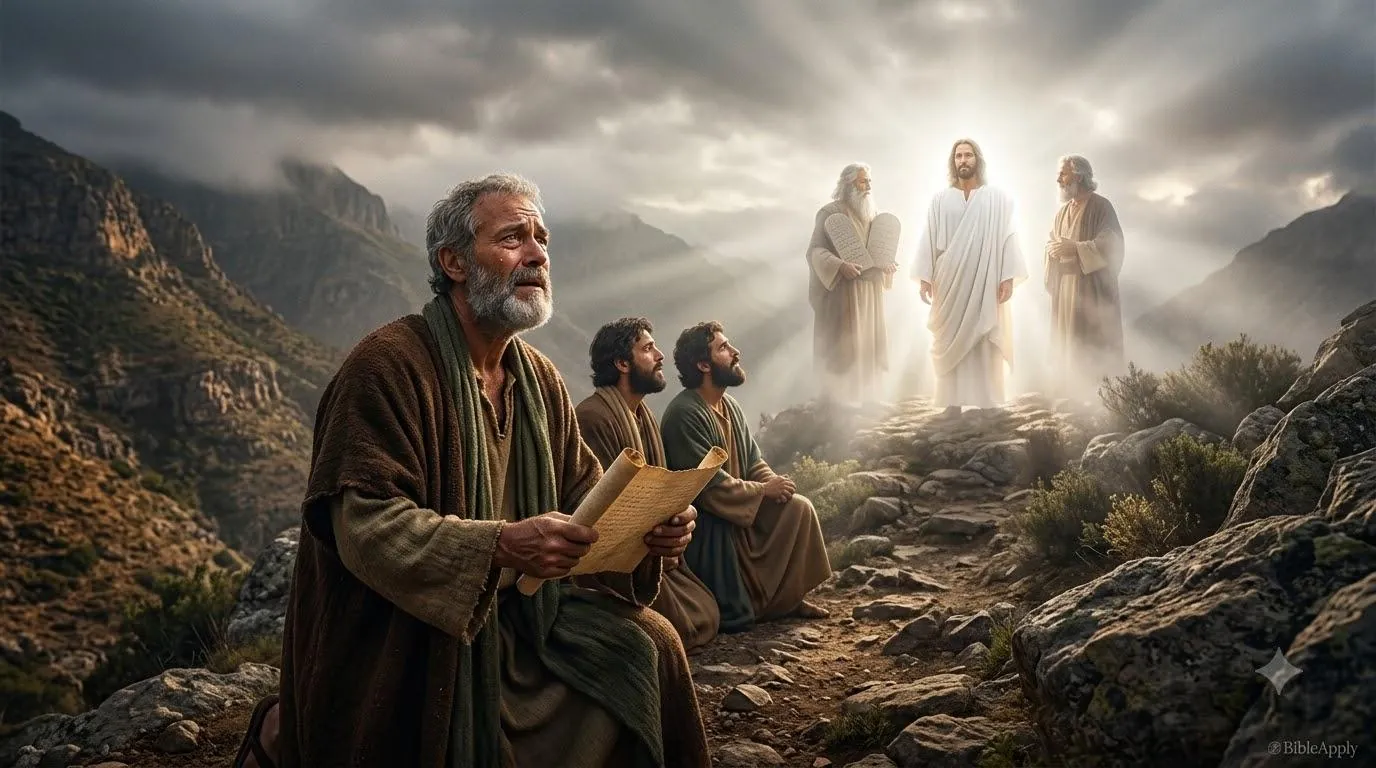
Christianity is not a philosophy based on cleverly devised fairy tales. It is grounded in historical events. To prove the reality of Christ’s future coming in glory, Peter reaches back to his defining experience on the Mount of Transfiguration (Matthew 17:1-8).
On that mountain, Peter, James, and John saw the veil of Jesus’ humanity temporarily pulled back. They saw His face shine like the sun and His garments become white as light. They received a preview, a trailer, of the eschatological glory of the Second Coming. Furthermore, they heard the voice of the Father (“the Majestic Glory”) declare, “This is my beloved Son, with whom I am well pleased.”
Peter is saying, “I didn’t invent the glory of Christ. I saw it with my own eyes. I heard the voice of God with my own ears.” The Transfiguration stands as unassailable empirical evidence that Jesus is the glorious King who will one day return to judge the world.
The Prophetic Word Made More Sure (2 Peter 1:19-21)
A Lamp Shining in a Dark Place
As powerful as Peter’s subjective, personal experience on the mountain was, he points to something even greater and more reliable.
If this resonates with you, our deep dive into Psalm 91 Meaning: He Who Dwells in the Shelter explores the scriptural foundation further.
“And we have the prophetic word more fully confirmed, to which you will do well to pay attention as to a lamp shining in a dark place, until the day dawns and the morning star rises in your hearts…” (2 Peter 1:19, ESV)
Scholars debate the exact translation of this phrase. Is Peter saying that the Transfiguration confirmed the Old Testament prophecies? Or is he saying that the written Word of God is more sure than his own dramatic vision? Given the context, the latter is the most potent and likely meaning.
Peter is elevating the written Scriptures above personal spiritual experiences. You might doubt a vision, your memory might fade, or an emotional high might dissipate, but the objective, written Word of God remains constant. In a dark, squalid world (the Greek word for “dark” here implies murky, dirty, and dismal), the Scripture is a blazing lamp. Believers must rivet their attention to it until “the day dawns” (the return of Christ) and the “morning star” (Christ Himself, Revelation 22:16) rises.
The Origin of Scripture
To close the chapter, Peter delivers one of the most critical statements in the entire Bible regarding the doctrine of inspiration:
“knowing this first of all, that no prophecy of Scripture comes from someone’s own interpretation. For no prophecy was ever produced by the will of man, but men spoke from God as they were carried along by the Holy Spirit.” (2 Peter 1:20-21, ESV)
The false teachers treated Scripture as mere human opinion that could be twisted to fit their immoral lifestyles. Peter refutes this by explaining the origin of the biblical text. The prophets did not dream up their messages based on their own clever interpretations of world events. The Bible is not a collection of human musings about the divine.
Instead, human authors “spoke from God as they were carried along by the Holy Spirit.” The Greek verb for “carried along” (pherō) was a nautical term used for a sailing ship being driven by the wind. The prophet was like a ship raising its sails, and the Holy Spirit was the wind that directed its course. The authors maintained their unique personalities, vocabularies, and historical contexts, but the Spirit sovereignly guided the process so that the final written product was exactly what God intended. Scripture is breathed out by God, entirely authoritative, and entirely without error.
3 Practical Applications from 2 Peter 1
1. Stop Begging for What You Already Have
Too often, Christians live in spiritual defeat because they believe they are missing a crucial ingredient for holiness. Peter shatters this illusion in verse 3. Through the Holy Spirit, God has already granted you all things that pertain to life and godliness. You have the power to resist that addiction. You have the grace to forgive that deep wound. You have the strength to remain faithful in your marriage. The application is not to seek a second blessing or a new secret truth, but to boldly access the divine power already residing within you through a deeper knowledge of Christ.
2. Make Spiritual Growth Your Intense Priority
The Christian life is not a passive ride to heaven; it requires sweat, intentionality, and diligence. Examine Peter’s ladder of virtues in verses 5-7. Where are you lacking? Are you rich in theological knowledge but poor in self-control? Do you have steadfastness in suffering but lack brotherly affection for your church family? Spiritual stagnation leads to spiritual blindness. We must exert maximum effort (relying on God’s grace) to cultivate these virtues, proving the reality of our salvation and ensuring we do not stumble into uselessness.
3. Anchor Your Life to the Written Word, Not Experiences
We live in an age that elevates personal feelings, mystical experiences, and subjective “truths” over objective reality. Peter had one of the most spectacular spiritual experiences in human history on the Mount of Transfiguration, yet he pointed believers to something “more sure”—the written Scriptures. When you are walking through dark, confusing, and murky seasons of life, do not trust your shifting emotions. Do not chase after dramatic signs or supposed fresh revelations. Pay fierce attention to your Bible. It is the only reliable lamp capable of guiding you safely home until the Day of Christ dawns.
Also Read
- Hosea 1 Summary & Meaning: A Marriage of Brokenness and Grace
- Numbers 1 Summary & Meaning: Numbering the Wilderness Generation
- Acts 1 Summary & Meaning: The Ascension and the Waiting Church
Read 2 Peter 1
Dive into the full scripture text for deeper study.
2 Peter Chapter 2 Summary
A detailed narrative summary for 2 Peter 2 is currently being prepared by our theologians.
2 Peter Chapter 3 Summary
A detailed narrative summary for 2 Peter 3 is currently being prepared by our theologians.
Conclusion
We hope this chapter-by-chapter summary of 2 Peter has helped you better understand God's Word. To continue your study, explore our other Bible Chapter Summaries or read our detailed Verse Meanings.