
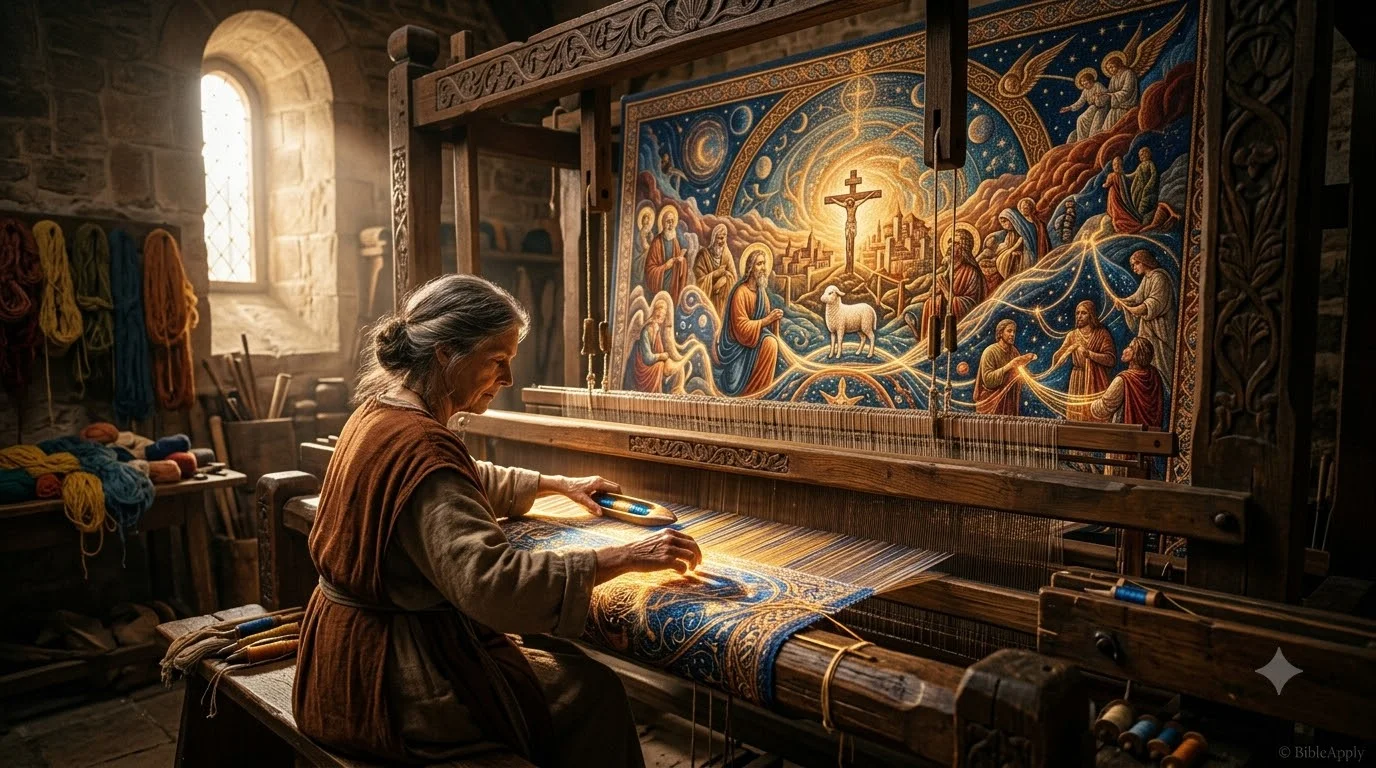
Catholic nuns wear habits as an outward sign of their consecration to God, symbolizing their vows of poverty, chastity, and obedience. The habit serves as a visible witness that the wearer has set aside worldly identity to belong entirely to Christ. Each element — the tunic, scapular, veil, and cincture — carries specific theological meaning rooted in centuries of monastic tradition.
Stand in the middle of any bustling international airport for long enough, and you will eventually see something that disrupts the secular modern landscape. Among the sea of tailored business suits, athleisure wear, and brightly colored vacation attire, a woman walks by wearing a floor-length brown tunic, a stark white wimple framing her face, and a flowing black veil.
The conversation around you pauses for a split second. People stare. Some smile softly; others look bewildered. In a world utterly obsessed with self-expression and individualistic fashion, the Catholic nun’s habit is a jarring, beautiful interruption. It speaks a silent language of contradiction to modern values.
But why do they wear it? Is it just an outdated uniform from a bygone era, or does it carry a deeper theological weight? To understand the habit, we have to look past the fabric and peer into the deeply rooted theology of consecration, tracing a line all the way back to ancient biblical customs, through the desert fathers, and right up to the modern era.
The Biblical Roots of Veiling and Consecration
To grasp the origins of the religious habit—particularly the veil—we must start in the dusty landscapes of the ancient Near East. Let’s examine the story of Isaac and Rebekah. In Genesis 24:65, as Rebekah sees Isaac walking in the field to meet her, she asks the servant who he is. Upon learning he is her future husband, she “took her veil and covered herself.”
The Hebrew word used here for veil is tsa’iyph (Strong’s H6809), indicating a large wrap or shawl. This wasn’t merely a protective measure against the sun; it was an act of solemn consecration and preparation. By covering herself, Rebekah signaled that she was set apart, reserved exclusively for her bridegroom.
This ancient bridal imagery carries over into the New Testament church. When the Apostle Paul wrote his letters to the early Christian communities, he frequently addressed the concept of visible consecration. In 1 Corinthians 11:5-6, Paul instructs women to cover their heads when praying or prophesying. He employs the Greek word katakalupto (Strong’s G2619), meaning “to cover wholly” or “to hide.”
Modern readers often bristle at these verses, reading them through the lens of contemporary gender politics. Yet, in the Roman world of the first century, a veiled woman was signaling something countercultural. Early Christian virgins—women who renounced marriage to dedicate themselves entirely to Christ—began adopting the veil not as a sign of subjugation to earthly men, but to signal their exclusive devotion to a heavenly Bridegroom. They were intentionally dressing like married women to communicate a spiritual reality: they were already spoken for.
We are called to offer our bodies as a “living sacrifice, holy and pleasing to God” (Romans 12:1-2). For these early women, the veil was the literal, physical manifestation of that living sacrifice.
From Desert Ascetics to Medieval Cloisters
The development of the full habit didn’t happen overnight. It evolved slowly over centuries. As the persecution of Christians waned in the fourth century, the “white martyrdom” of monasticism began to flourish. Men and women fled into the deserts of Egypt and Syria to live lives of intense prayer and poverty.
These early monastics adopted the simplest, poorest clothing available—often rough animal skins or undyed wool. Saint Augustine of Hippo, one of the greatest theologians of the early Church, recognized the power of this physical renunciation. In his treatise On Holy Virginity, Augustine warned against the pride that could easily corrupt a consecrated life, noting that true holiness required a genuine humility that extended even to one’s attire. The clothing was meant to hide the individual, drawing attention solely to Christ.
By the time Saint Benedict penned his famous Rule in the 6th century, he provided specific guidelines for monastic clothing. He insisted that the garments should be simple, cheap, and suited to the local climate. Monks and nuns were given a tunic, a cowl (hood), and a scapular for working.
As centuries passed and medieval religious orders blossomed, each community developed its own distinctive habit. What started as the everyday clothing of the poor in the Middle Ages eventually became “frozen in time.” While secular fashion marched forward into the Renaissance and beyond, the religious sisters retained their medieval garments as a permanent sign of their vow of poverty and separation from the world.
Anatomy of Consecration: Naming the Parts of the Habit
If you look closely at a traditional nun’s habit, you will realize that every single piece of fabric is preaching a sermon. It is a masterclass in tactile theology. Let’s break down the anatomy of a traditional habit:
The Tunic
This is the main body of the garment, a long, simple dress that reaches the floor. It symbolizes modesty, poverty, and the covering of the flesh. It represents the foundational calling to strip away the worldly identity.
The Scapular
Perhaps the most symbolically rich piece of the habit, the scapular is a long piece of cloth worn over the shoulders, hanging down the front and back. Originally an apron to protect the tunic during manual labor, it came to symbolize the “yoke of Christ” from Matthew 11:30. When a sister puts on her scapular, she is willingly taking up the gentle yoke of obedience.
The Cincture or Cord
Worn around the waist, the cincture is a belt or a woven rope. In many orders, particularly the Franciscans, this cord features three prominent knots. These knots are not decorative; they represent the three evangelical counsels, or vows: poverty, chastity, and obedience. It binds the sister to her promises.
The Coif, Guimpe, and Wimple
These pieces surround the face, neck, and shoulders. The coif is a close-fitting cap that covers the hair. The wimple is a piece of cloth (usually stiff and white) that covers the neck and cheeks, while the guimpe covers the upper chest and shoulders. By covering the hair (historically a woman’s “crowning glory” and a symbol of physical allure) and framing only the face, the sister is intentionally deflecting attention from physical beauty to the soul and the eyes.
The Veil
Worn over the coif, the veil is the ultimate sign of consecration. There is a distinct progression here: novices (those in training) typically wear a white veil, symbolizing their baptismal purity and their beginning stages of religious life. Once a sister makes her perpetual (final) vows, she receives the black veil, signifying her permanent death to the world and her total belonging to Christ.
The Rosary
Most habits include a large Rosary hanging from the cincture at the sister’s side. Just as a medieval knight wore a sword at his hip, the nun wears her Rosary. It is her spiritual weapon, constantly at hand to do battle against the principalities and powers of darkness.
The Colors of Grace: Specific Orders and Their Meanings
Not all habits look the same. If you know what to look for, the color and style of a habit can tell you exactly what charism (spiritual focus) that specific order embodies.
The Benedictines: Traditionally wearing all black, the Benedictine habit represents death to the world. Black is the color of mourning, but also of utter simplicity. It echoes their vow of stability and their focus on ora et labora (prayer and work).
The Dominicans: Known as the Order of Preachers, Dominicans wear a striking white tunic and scapular covered by a black cape (cappa). The white represents purity of heart and the joyous light of Christ, while the black cape signifies penance and death to the ego. They are called to preach the unadulterated truth.
The Franciscans: Typically clad in coarse brown or grey, Franciscan sisters wear the color of the earth. Saint Francis of Assisi chose this color specifically because it was the cheapest, most undesirable fabric available. It is the ultimate emblem of their strict vow of poverty and solidarity with the destitute.
The Carmelites: These cloistered, contemplative sisters wear a brown tunic and scapular covered by a white mantle (cape) on special occasions. The brown ties them to the ancient hermits of Mount Carmel (calling to mind the fiery zeal of the prophet Elijah), while the white mantle symbolizes the protective purity of the Virgin Mary.
The Missionaries of Charity: Founded by Saint Teresa of Calcutta in the 20th century, these sisters wear a simple white Indian sari with three blue stripes along the edge. The white stands for truth and purity, and the blue stripes represent the Virgin Mary, as well as their vows of poverty, chastity, and obedience (with the widest blue stripe representing their unique fourth vow of wholehearted free service to the poorest of the poor).
The Theological Symbolism: The Bridal Garment
At the heart of the habit is the theology of the Bride of Christ. In Colossians 3:12, Paul commands believers to “clothe yourselves with compassion, kindness, humility, gentleness and patience.” For the religious sister, this spiritual clothing is made literal.
Theologian C.S. Lewis captured the essence of this “putting on” in his classic work, Mere Christianity. Lewis argued that the Christian life is not merely about trying to be a better person, but about putting on Christ Himself. He wrote: “The real problem of the Christian life comes where people do not usually look for it. It comes the very moment you wake up each morning. All your wishes and hopes for the day rush at you like wild animals. And the first job each morning consists simply in shoving them all back; in listening to that other voice, taking that other point of view, letting that other larger, stronger, quieter life come flowing in.”
When a nun wakes up and methodically puts on each layer of her habit, she is physically performing that reality. She is shoving back her own preferences and dressing herself in the identity of Christ.
The habit is deeply eschatological—it points to the end of time. In the Book of Revelation, the Church is described as a Bride beautifully dressed for her Husband. The sister, fully professed and veiled, is a living, breathing foreshadowing of the heavenly banquet. She wears her wedding garment every day.
The Earthquake of Vatican II and the Modern Crisis
If the habit is so richly meaningful, why do so many modern sisters wear secular street clothes?
The shift occurred in the wake of the Second Vatican Council (1962–1965). The Council promulgated a document called Perfectae Caritatis (The Decree on the Adaptation and Renewal of Religious Life). It instructed religious communities to adapt their way of life, including their clothing, to the circumstances of modern times, urging that habits should be “simple and modest, poor and at the same time becoming… suited to the circumstances of time and place and to the needs of the ministry involved.”
The intention was good: some habits had become heavily starched, physically cumbersome, and unsuited for nurses or teachers working in hot climates. The council fathers wanted to free sisters from unnecessary burdens so they could serve more effectively.
However, the implementation was chaotic. In the decades following the council, many orders took the directive to “adapt” as permission to completely discard the habit in favor of secular dress. They argued that blending in with the laity made them more approachable and relational.
Yet, this created a crisis of identity. Without the visible sign of consecration, many orders saw a catastrophic drop in vocations. The visual interruption was gone; the sisters became virtually indistinguishable from dedicated lay social workers.
Recognizing this loss, Pope John Paul II gently but firmly reasserted the value of the traditional garment. In his 1996 apostolic exhortation Vita Consecrata, he wrote: “The Church must always seek to make her presence visible in everyday life, especially in contemporary culture… the habit is a sign of consecration, poverty and membership in a particular Religious family. I therefore join the Fathers of the Synod in strongly recommending to men and women religious that they wear their proper habit.”
Today, we are witnessing a fascinating resurgence. The religious orders that are currently exploding with young, joyful vocations are almost entirely those that have returned to wearing the full, traditional habit. Young women in the 21st century are not looking for a watered-down, comfortable religious life; they are craving the uncompromising, visible, all-consuming consecration that the veil demands.
Practical Application: What We Can Learn from the Habit
You might never take vows of poverty, chastity, and obedience. You will likely never wear a wool scapular or a tightly pinned wimple. But the theology of the Catholic nun’s habit has direct implications for every believer.
1. Let your consecration be visible. You don’t need to wear medieval clothing to stand out. But does your life—the way you speak, the way you spend your money, your biblical modesty, and your refusal to participate in the toxic gossip of your workplace—serve as a visual interruption to the secular world?
2. Put on Christ daily. Before you check your phone or read the news in the morning, take a moment to spiritually “dress” yourself. Just as a sister prays over every piece of her habit, pray as you prepare for the day. Ask God to clothe you in patience, purity, and the yoke of obedience.
3. Remember that you are spoken for. The veil reminds a sister that she is the Bride of Christ. As a member of the universal Church, so are you. Your body, your mind, and your future do not belong to the whims of modern culture. You belong to the Bridegroom. Live like someone who is preparing for a wedding feast.
To explore related topics, see How Does Catholic Confession Work?, Why Do Priests and Nuns Take Vows of Celibacy?, and Does a Christian Marriage Have to Happen in a Church?.