

Quick Answer: Explore the creation mandate, stewardship of the earth, and how Christians should think about environmental care.
Few topics ignite as much passion, anxiety, and political polarization as the environment. Humanity is grappling with climate change, deforestation, pollution, and resource depletion. This collective sense of ecological dread—often termed “eco-anxiety”—has begun to permeate our global consciousness.
People naturally ask where this is all heading. They wonder if the end of the world is near. For many, the environmental crisis is the defining existential threat of our generation. We are desperately searching for a framework to understand our relationship with the natural world.
In this culturally charged landscape, Christians often find themselves caught between two extremes. On one side is a secular environmentalism that sometimes elevates nature to the level of the divine. This view advocates preserving the earth at the expense of human flourishing.
On the other side is a Christian escapism that views the physical world as inherently disposable. It interprets the biblical mandate of “dominion” as a license for unchecked exploitation. This view often assumes that because the earth will eventually be destroyed, our present treatment of it is inconsequential.
A holistic look at Scripture reveals a theology of the environment that rejects both the worship of nature and its exploitation. The Bible offers a paradigm of “creation care.” This is rooted in the understanding that the earth is the Lord’s, and humanity was uniquely commissioned to be His stewards.
The biblical destiny of the cosmos is not annihilation, but redemption and renewal. To ask what the Bible says about the environment is to ask about the nature of God and the purpose of humanity. It also points to the sweeping scope of Christ’s redemptive work.
A Pastoral Note: I’ve sat with farmers who wept over barren fields and young people paralyzed by fear over the planet’s future. It breaks my heart how quickly we retreat into political tribes instead of looking at the dirt beneath our feet as a sacred gift. You don’t have to worship nature to treat it with respect. Tending to the earth is a tangible way to love God and leave a habitable home for our grandchildren.
The Foundation of Creation Care: God’s Ownership and Delight
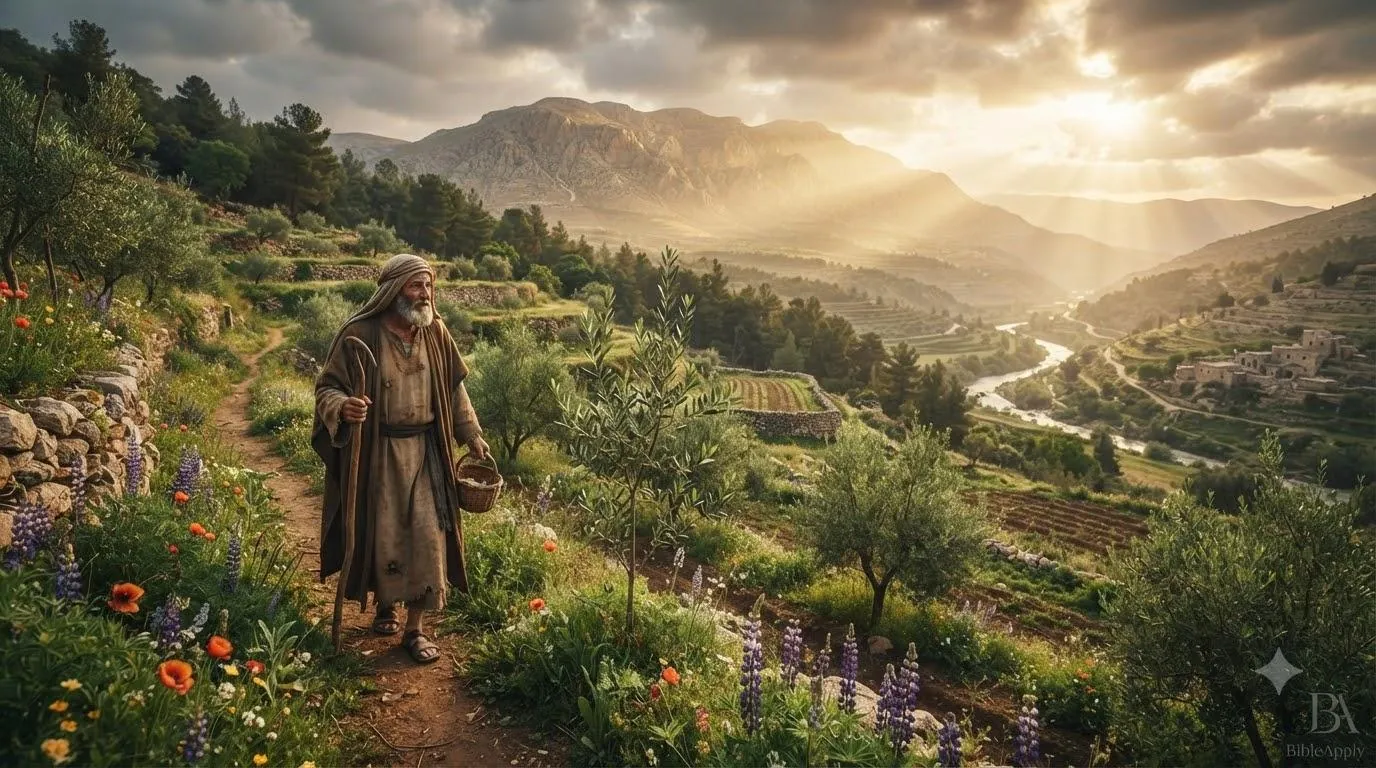
The starting point for a biblical environmental ethic is not humanity, nor the environment itself. The starting point is God. Failing to recognize God’s ownership of creation inevitably leads to ecological abuse.
The Earth Belongs to the Lord
The most foundational environmental statement in Scripture is found in the Psalms:
“The earth is the Lord’s, and everything in it, the world, and all who live in it; for he founded it on the seas and established it on the waters.” (Psalm 24:1-2, NIV)
The earth is not unowned territory waiting to be conquered. It is not humanity’s collective property to divide and consume at will. It is the sovereign property of the Creator. We are not owners; we are tenants.
If you borrow a car from a friend, your respect for that friend dictates how you treat the vehicle. Trashing the car insults the owner. Likewise, our treatment of the earth reflects our reverence for the God who created it.
The Inherent Goodness of Creation
In Genesis 1, as God calls the cosmos into existence, a rhythmic refrain echoes through the narrative: “And God saw that it was good.” Before human beings took their first breath, God declared the material world to be inherently good.
Its value is not derived solely from its usefulness to humanity. It has worth because it originated in the mind of God.
This is vividly illustrated in God’s speech to Job (Job 38-41) and in Psalm 104. God revels in aspects of creation that have absolutely nothing to do with human utility. He waters the desolate wasteland where no man lives (Job 38:26) and rejoices in the wild donkey and the ostrich.
He even created the Leviathan—a fearsome sea creature—simply “to play” in the ocean (Psalm 104:26). The environment has intrinsic value because God created it, it reflects His glory, and He takes immense pleasure in it.
The Mandate: Humanity’s Role as Stewards
If God is the owner, what is our role? In the opening chapters of Genesis, God establishes the unique vocation of humanity regarding the natural world. This vocation is often misunderstood, leading to tragic ecological consequences.
Dominion vs. Domination: Understanding Radah and Kabash
In Genesis 1:26-28, God blesses the first humans and gives them a command:
“God blessed them and said to them, ‘Be fruitful and increase in number; fill the earth and subdue it. Rule over the fish in the sea and the birds in the sky and over every living creature that moves on the ground.’” (Genesis 1:28, NIV)
The Hebrew words translated as “subdue” (kabash) and “rule” (radah) are strong verbs. In ancient contexts, they were used to describe kings ruling over subjects.
Historically, some interpreted these words as a mandate for tyranny. They assumed God gave humanity a blank check to strip-mine the earth and consume resources without restraint.
This interpretation fundamentally misunderstands biblical kingship. In the ancient Near East, a good king was a shepherd, not a tyrant. His role was to govern on behalf of the true Sovereign, ensuring justice and order.
To exercise dominion (radah) in the image of God means ruling the way God rules: with sacrificial love and care. We are called to harness the raw potential of the earth for human flourishing, but in a way that allows the rest of creation to thrive alongside us.
To Work and To Keep: The Vocation of Abad and Shamar
The dominion mandate of Genesis 1 is further refined in Genesis 2, where God places Adam in the Garden of Eden:
“The Lord God took the man and put him in the Garden of Eden to work it and take care of it.” (Genesis 2:15, NIV)
The Hebrew words here are deeply illuminating. The word for “work” or “cultivate” is abad. While it can mean agriculture, its primary meaning throughout the Old Testament is “to serve.” It is the exact word used for serving God in worship.
The word for “take care of” or “keep” is shamar, meaning to protect, guard, and preserve. This is the same word found in the Aaronic blessing: “The Lord bless you and keep (shamar) you” (Numbers 6:24).
Humanity’s fundamental relationship with the environment is one of service and protection. We serve the earth so it yields its fruit, and we protect its ecological integrity. We are called to be servant-kings, tending God’s garden with care and wisdom.

The Fall and Its Ecological Impact
Tragically, human rebellion severed the harmony between God, humanity, and creation. The Fall in Genesis 3 did not merely result in spiritual death; it caused ecological catastrophe. Because humanity was appointed as the head of creation, when humanity fell, it dragged the rest of creation down with it.
“Cursed is the ground because of you; through painful toil you will eat food from it all the days of your life. It will produce thorns and thistles for you…” (Genesis 3:17-18, NIV)
The relationship between humans and the environment became fractured. Instead of cooperative stewardship, there is constant struggle. We experience natural disasters, disease, and scarcity.
The prophets also repeatedly linked human sin with environmental degradation. When societies embrace injustice, idolatry, and bloodshed, the land itself suffers.
“There is no faithfulness, no love, no acknowledgment of God in the land. There is only cursing, lying and murder, stealing and adultery… Because of this the land dries up, and all who live in it waste away; the beasts of the field, the birds in the sky and the fish in the sea are swept away.” (Hosea 4:1-3, NIV)
The Apostle Paul highlights this cosmic brokenness in Romans 8. He explains that creation was “subjected to frustration” and is currently “groaning as in the pains of childbirth” (Romans 8:20-22).
The environmental crises we see today are symptoms of this groaning creation. The earth is waiting for the revelation of the children of God.
Old Testament Environmental Laws
God’s concern for the environment is not limited to poetry. It is hardwired into His legal code. The Old Testament contains detailed environmental laws mandating conservation and ecological respect.
- Sabbath for the Land: Just as humans were commanded to rest every seventh day, the Israelites were commanded to let the agricultural land rest every seventh year (Leviticus 25:1-7). This “Sabbath year” prevented soil depletion and allowed local ecosystems to recover.
- Wildlife Conservation: Deuteronomy 22:6-7 commands that if an Israelite finds a bird’s nest, they may take the eggs or the young, but must let the mother bird go free. This ensured the preservation of the breeding population.
- Wartime Restraint: Deuteronomy 20:19 forbids the destruction of fruit-bearing trees during military sieges. God explicitly asks, “Are the trees people, that you should besiege them?” Scorched-earth policies that destroy long-term ecological viability are condemned.
Redemption and the Eschatological Hope
A major theological factor influencing Christian views on the environment is eschatology—the study of the end times.
A persistent misconception in some Christian circles is that the physical world will be completely destroyed. Many assume it will be replaced by a non-material, spiritual heaven.
This view owes more to Greek Gnosticism—which viewed matter as evil and spirit as good—than to biblical theology. The biblical hope is not an evacuation of the earth. It is the resurrection of the body and the renewal of creation.
“For God was pleased to have all his fullness dwell in him, and through him to reconcile to himself all things, whether things on earth or things in heaven, by making peace through his blood, shed on the cross.” (Colossians 1:19-20, NIV)
Christ’s redemptive work on the cross is cosmic in scope. He died to reconcile all things, including the natural world.
In Revelation 21, the climax of the biblical story is not humanity floating away to heaven. It is the New Jerusalem coming down from heaven to a renewed and glorified Earth. God declares, “I am making everything new!” (Revelation 21:5)—not “I am making new things.”
Addressing Common Misconceptions
Misconception 1: “It’s all going to burn anyway, so why care?”
This objection usually stems from a misreading of 2 Peter 3:10. Older translations render this verse as the earth being “burned up.” Deeper manuscript studies and modern translations correctly render the Greek as “will be exposed” or “laid bare.”
The fire described is a refining fire of purification, not an annihilating fire of destruction. Just as our mortal bodies will be transformed into resurrected bodies, the present earth will be purified and transformed into the New Earth. Because the material world has an eternal destiny, what we do to it today matters.
Misconception 2: “Environmentalism is a secular, New Age agenda.”
Secular environmentalism does sometimes drift into pantheism—worshipping the creation rather than the Creator (Romans 1:25). But the Christian response to bad theology is not no theology; it is good theology.
Ignoring the environment because New Age movements care for it is like ignoring the poor because Marxists care for them. Creation care is an orthodox, biblical mandate. We do not care for the earth because it is our mother. We care for it because it was made by our Father.
3 Practical Applications
Understanding the biblical theology of the environment demands a practical response. If we are called to be servant-kings and stewards of God’s creation, this must reflect in how we live our daily lives.
1. Rethink Consumption and Waste
Our modern economic systems are built on a linear model of extraction, consumption, and disposal. This directly contradicts the sustainable rhythms God built into nature.
Christians should intentionally cultivate a lifestyle of moderation, rejecting the idolatry of consumerism. This looks like minimizing waste, repairing items instead of replacing them, and making thoughtful purchasing decisions. We must ask ourselves if our habits are loving our global neighbors and honoring the Creator.
2. Support Sustainable Practices and Local Initiatives
Stewardship requires action. Believers should be at the forefront of supporting local agriculture, conservation efforts, and policies that protect vulnerable ecosystems.
This can involve starting a community garden at your church, volunteering for local clean-ups, or advocating for clean energy. When the church models creation care, it serves as a powerful apologetic to a world desperate for ecological hope.
3. Incorporate Creation Care into Worship and Prayer
Our liturgy and prayers should reflect the cosmic scope of God’s redemption. When we worship, we should intentionally thank God for the beauty and provision of the natural world.
We can also pray for farmers, policymakers, and those most acutely affected by environmental degradation. Reintegrating creation into our worship reminds us that we join with the mountains, rivers, and trees in praising the Creator (Psalm 98).