

Quick Answer: The Bible describes marriage as a lifelong covenant between one man and one woman, designed by God to provide companionship, establish families, and reflect Christ’s sacrificial love for the church.
Marriage means different things depending on who you ask. Some view it as an outdated constraint. Others see it as a pragmatic arrangement based on emotional fulfillment. With divorce rates high and the cultural definition of marriage constantly shifting, finding a solid foundation for human relationships is difficult.
Scripture paints a very different picture. The Bible doesn’t treat marriage as a temporary social contract. Instead, it frames it as a divine covenant and a living metaphor for God’s love.
We can’t ignore the pain attached to this topic. For every idealized romance, there are countless stories of heartbreak, betrayal, and loneliness. Many approach this subject carrying the fallout of broken vows. Others are single, wondering where they fit into church cultures that idolize the nuclear family. To truly grasp what the Bible says, we need to look past our cultural baggage and start at the beginning.
A Pastoral Note: The couples sitting on my couch usually aren’t arguing about theology; they’re exhausted by the friction of daily life. The most dangerous lie they believe is that marriage is a 50/50 split. If you both only give 50%, the moment someone gets sick, depressed, or overwhelmed, the whole thing caves in. Real marriage requires two people committed to giving 100%, stepping up to carry the weight when the other person simply can’t. That stubborn, covenant-keeping grit is the only thing that survives when the romance fades and real life hits hard.
The Genesis Blueprint: Design and Purpose
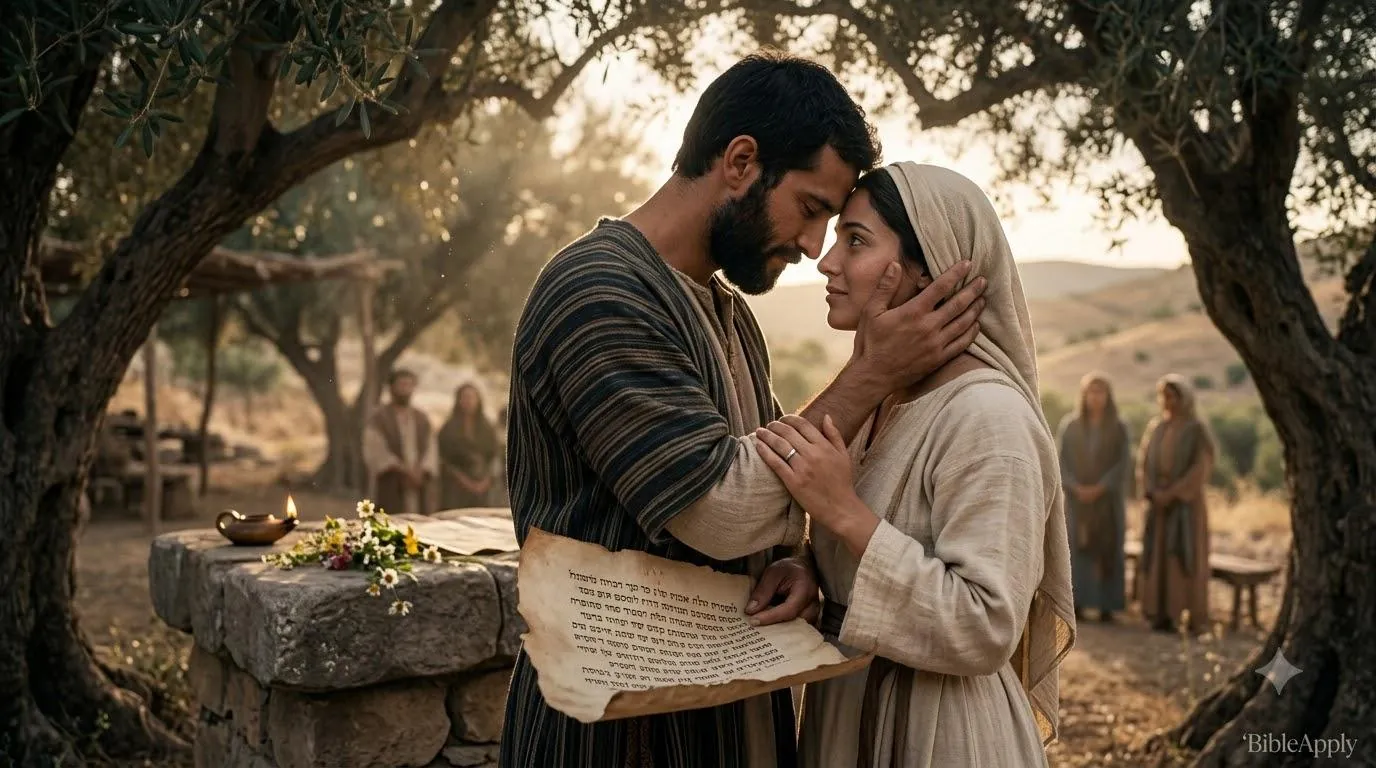
To understand marriage biblically, we have to start in Genesis. The opening chapters establish the baseline for human sexuality and relationships. God creates humanity in His image, distinctly male and female (Genesis 1:27). But in Genesis 2, the camera zooms in on the very first marriage.
The Problem of Isolation
“Then the LORD God said, ‘It is not good that the man should be alone; I will make him a helper fit for him.’” (Genesis 2:18, ESV)
This is the first time in the creation story that God calls something “not good.” Adam’s isolation is a genuine problem. Humanity was built for communion, not solitude.
The Hebrew phrase used for the woman is ‘ezer kenegdo, often translated as “helper fit for him.” In modern English, “helper” sounds like a subordinate assistant. But the Hebrew word ‘ezer is frequently used in the Old Testament to describe God as the rescuer of His people (Psalm 121:1-2). It denotes a strong, rescuing provision. The woman was created as a corresponding strength, an equal partner who stands face-to-face with the man.
The “One Flesh” Covenant
“Therefore a man shall leave his father and his mother and hold fast to his wife, and they shall become one flesh.” (Genesis 2:24, ESV)
This verse serves as the foundation of biblical marriage. It establishes three essential actions: leaving, cleaving (holding fast), and becoming one flesh. “Leaving” implies a shift in primary allegiance away from parents and toward the spouse.
The Hebrew word for “hold fast” is dabaq. It implies a resolute, clinging loyalty, often used when describing covenant keeping (Deuteronomy 10:20). Marriage isn’t a consumer transaction based on mutual convenience. It’s a binding covenant based on steadfast commitment.
Finally, “one flesh” represents a profound unity. It naturally encompasses physical intimacy, which the Bible celebrates within this boundary. But it also points to a holistic merging of lives, resources, and vulnerabilities.
A Picture of the Gospel
If Genesis gives us the blueprint, the New Testament explains the ultimate meaning. The Bible doesn’t view marriage as an end in itself. Instead, it serves as a signpost pointing to a greater reality.
The Great Mystery
In Ephesians 5, Paul gives his most comprehensive teaching on marriage. He outlines specific instructions for husbands and wives, then pulls back the curtain to reveal the core purpose behind it all:
“‘Therefore a man shall leave his father and mother and hold fast to his wife, and the two shall become one flesh.’ This mystery is profound, and I am saying that it refers to Christ and the church.” (Ephesians 5:31-32, ESV)
Paul quotes Genesis 2:24 and calls it a “mystery”—a truth once hidden but now revealed. Human marriage was designed from the beginning to be a living diorama of the gospel. Its ultimate purpose is to reflect the passionate, covenant-keeping love Jesus has for His Church.
Roles and Sacrificial Love
This gospel framework radically reshapes how we view roles within marriage. Paul calls for mutual submission out of reverence for Christ (Ephesians 5:21).
Wives are called to submit to their husbands as to the Lord (Ephesians 5:22). The Greek word hypotasso doesn’t mean subjugation or inferior worth. It’s a voluntary yielding in love, reflecting the Church’s joyful embrace of Christ’s loving leadership.
Husbands are given a staggering command:
“Husbands, love your wives, as Christ loved the church and gave himself up for her…” (Ephesians 5:25, ESV)
The Greek word for love here is agape—unconditional, sacrificial love. A husband’s leadership should never be characterized by domination or authoritarianism. He is called to out-serve and lay down his life for the flourishing of his wife, just as Jesus did for the Church.
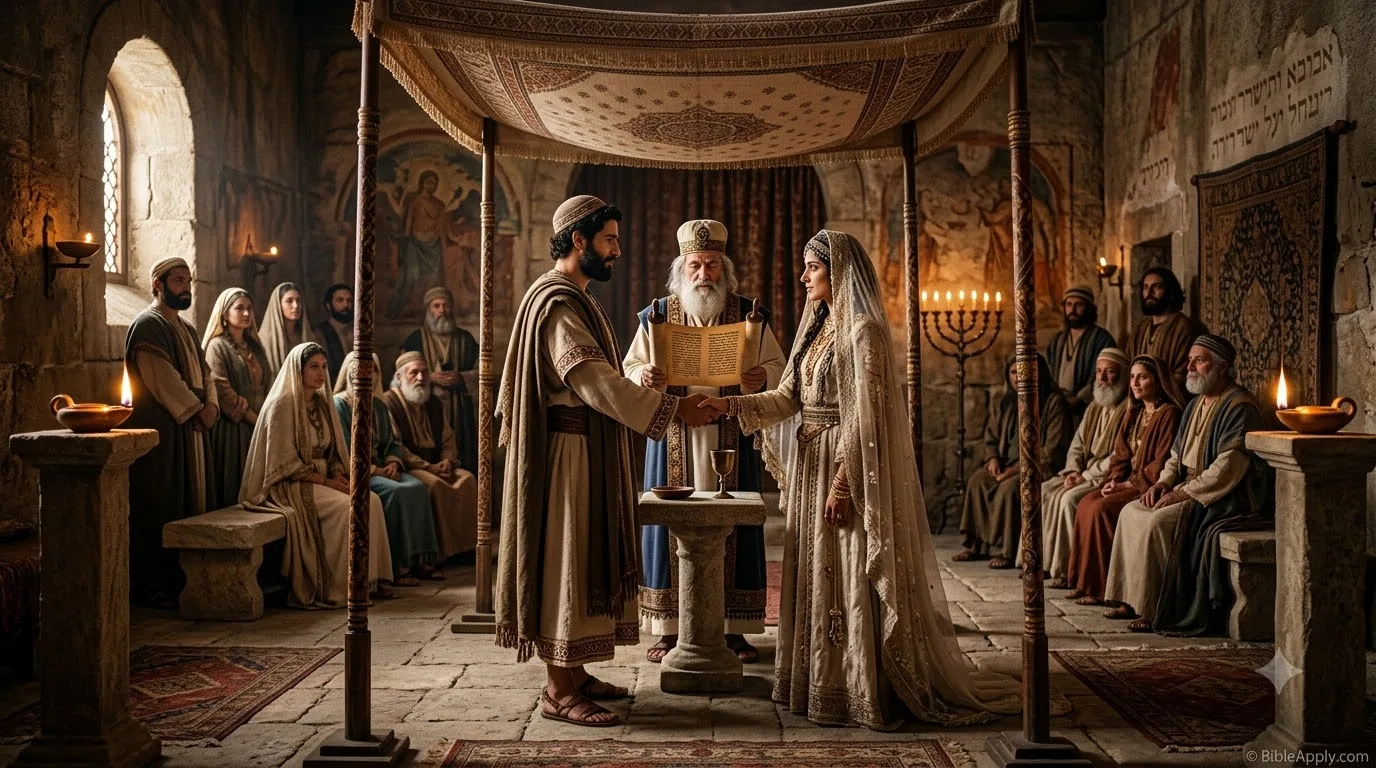
The Reality of Brokenness
While the design is beautiful, reality is often gritty. The entrance of sin in Genesis 3 shattered the perfection of Eden. The Bible is painfully realistic about the hardness of the human heart and the reality of marital breakdown.
Jesus on Divorce
When religious leaders tried to trap Jesus in a legal debate about divorce, He pointed them straight back to Genesis:
“He answered, ‘Have you not read that he who created them from the beginning made them male and female… What therefore God has joined together, let not man put asunder.’” (Matthew 19:4, 6, RSV)
When asked why the Law of Moses permitted divorce, Jesus responded, “For your hardness of heart Moses allowed you to divorce your wives, but from the beginning it was not so” (Matthew 19:8). The Bible acknowledges divorce as a tragic reality resulting from human sin. It permits it in specific cases of covenant-breaking, like sexual immorality or abandonment (Matthew 19:9, 1 Corinthians 7:15).
However, divorce is never presented as God’s ideal. It is a concession to a broken world. God’s heart is always oriented toward reconciliation and preserving the covenant.
Grace for the Broken
Crucially, the biblical narrative is one of redemption. For those who have experienced the pain of divorce, infidelity, or a toxic marriage, God offers immense grace. He identifies as the healer of the brokenhearted (Psalm 147:3).
Jesus constantly extended grace to those whose relational lives were messy. While God upholds a high standard for the marriage covenant, His grace is more than enough for our failures and fractured relationships.
Addressing Common Objections
In our modern context, the biblical view of marriage faces significant pushback. It’s important to engage these concerns honestly.
“Marriage is just a piece of paper.”
Many argue that love is all that matters, and formalizing it with a legal or religious ceremony is unnecessary. But biblically, marriage is a public covenant, not just a private emotional state. The “piece of paper” represents a binding vow made before God and community.
True love seeks to bind itself to the beloved. Vows act as the anchor holding the relationship steady when storms hit. Without a covenant, a relationship is entirely dependent on the shifting sands of feelings.
“Submission means inferiority.”
Critics often view biblical submission through the lens of worldly power dynamics, equating it with oppression. But the Trinity models submission without inferiority. Jesus joyfully submitted to the Father’s will, yet He is fully equal to the Father in essence and glory.
Biblical submission isn’t about silencing a wife’s intellect or voice. It’s an ordered partnership where the husband bears the weight of loving, sacrificial responsibility, and the wife willingly aligns with that Christ-like leadership.
“The Bible’s view is outdated.”
Modern critics often label the biblical definition of marriage as archaic. Yet, in its historical context, the biblical view radically elevated women. In the Greco-Roman world, husbands held absolute power, infidelity by men was expected, and women were largely treated as property.
Paul’s command for husbands to sacrifice for their wives and remain exclusively faithful to them was revolutionary. The biblical framework protects the vulnerable by demanding steadfast commitment, refusing to let relationships be discarded when they stop being emotionally profitable.
3 Practical Applications
Understanding the theology of marriage is essential, but it has to translate into everyday life. Whether you are married, hoping to be, or supporting others, here are three practical takeaways.
1. Choose covenant over consumerism.
We need to shift from a consumer model (“What am I getting out of this?”) to a covenantal model (“What have I promised to give?”). Modern romance is usually sustained only as long as both parties feel perfectly satisfied.
Biblical marriage calls for a commitment that outlasts temporary dissatisfaction. This means choosing to love, serve, and honor your spouse even when the emotional high is completely gone. Vows are a promise of future action, not a description of current feelings.
2. Prioritize spiritual growth together.
Because marriage is designed to reflect Christ and the Church, its ultimate goal is holiness, not just earthly happiness. Husbands and wives are called to partner together in their spiritual journeys.
Paul speaks of the husband seeking to present his wife “in splendor, without spot or wrinkle” (Ephesians 5:27). Practically, this looks like praying together, discussing Scripture, and actively encouraging each other’s gifts. Your spouse should be your primary partner in pursuing God.
3. Embrace daily forgiveness.
Since marriage joins two sinners, it will inevitably involve hurt, misunderstanding, and failure. The only way a marriage survives long-term is through the constant application of forgiveness.
Just as God in Christ has forgiven us, we are commanded to forgive our spouses (Ephesians 4:32). This means keeping short accounts, refusing to harbor bitterness, and being quick to apologize. A healthy marriage isn’t two perfect people; it’s two broken people constantly applying grace.