

Quick Answer: The biblical timeline places the creation of all land animals on Day 6 alongside humans. Based on Genesis, representatives of dinosaur kinds would have been present on the Ark.
For many of us, our earliest introduction to natural history came through dinosaur toys and museum exhibits. These creatures capture the imagination of children and adults alike. Yet, Christians raised in a culture that teaches a secular history—where dinosaurs lived millions of years before humans—often hit a wall. When believers read the book of Genesis account of the Flood, a natural question arises: Were there dinosaurs on the Ark?
It touches on the authority of Scripture and how we interpret biblical narrative alongside scientific evidence. When society insists humans and dinosaurs are separated by 65 million years, the idea of a Triceratops boarding a wooden vessel seems unbelievable. It makes sense why many struggle to reconcile school textbooks with the animals of the biblical flood.
By understanding the biblical timeline, looking at the Hebrew vocabulary of creation, and addressing the logistics of Noah’s mission, we can find a satisfying answer.
A Pastoral Note: A ten-year-old kid in my Sunday school class once stalled the whole lesson by demanding to know where exactly the T-Rex slept on Noah’s Ark. His parents looked mortified, bracing for me to shut him down. I just laughed, and we spent the next hour talking about how messy, loud, and bizarre that boat must have been. If we don’t give people room to ask gritty, uncomfortable questions about the Bible without shaming them, they’ll just walk away. God is definitely big enough to handle our weirdest curiosities.
The Biblical Framework for Creation and the Flood
To answer whether dinosaurs were on the Ark, we first need to look at the timeline. Genesis 1 records that God created the earth and all life within six days. The creation of all land-dwelling animals occurred on the exact same day as the creation of the first humans, Adam and Eve.
“And God said, ‘Let the earth bring forth living creatures according to their kinds—livestock and creeping things and beasts of the earth according to their kinds.’ And it was so.” (Genesis 1:24, ESV)
In the original Hebrew, the text uses specific categories for land animals: behemah (livestock), remes (creeping things), and chayyah (wild beasts). Dinosaurs, by definition, were land-dwelling, air-breathing animals. They fall squarely within these categories created on Day 6. There is no scriptural gap of millions of years between the creation of dinosaurs and humanity.
Fast forward to the days of Noah. The world had become corrupted, prompting God’s judgment through a global flood. God commanded Noah to build an ark to save his family and a remnant of animal life. The parameters for the animals were explicit:
“And of every living thing of all flesh, you shall bring two of every sort into the ark to keep them alive with you. They shall be male and female.” (Genesis 6:19, ESV)
The commandment is universal for land-dwelling, air-breathing life. Since dinosaurs fit this description, the biblical conclusion is that representatives of the dinosaur kinds were present on Noah’s Ark.
Understanding Biblical “Kinds” (Min)
A critical concept for Ark logistics is the biblical word “kind,” translated from the Hebrew min (מִין). Modern taxonomy uses the term “species,” but a biblical “kind” is a broader category. It often aligns more closely with the modern classification of a “family.”
God did not command Noah to bring two coyotes, two wolves, and two domestic dogs. Noah simply needed to bring two of the “dog kind.” The genetic potential for all the diverse dog species we see today was bundled within that original pair.
When applied to dinosaurs, this drastically reduces the numbers. While paleontologists have named over 1,000 different dinosaur “species,” many are simply variations of the same foundational kind. Creation scientists estimate there were likely only 50 to 80 distinct “dinosaur kinds.” Bringing two of each means roughly 120 individual dinosaurs were required to board the Ark.
The Biblical Description of Dinosaurs
A common objection is: If dinosaurs were on the Ark, why doesn’t the Bible mention the word ‘dinosaur’?
The word “dinosaur” simply did not exist when the Bible was translated into English. The term Dinosauria (“terrible lizard”) was coined by Sir Richard Owen in 1841. The King James Version was translated in 1611. We shouldn’t expect a 19th-century scientific term in ancient scripture.
However, the Bible describes creatures that fit the physical characteristics of dinosaurs perfectly. It uses ancient terms like tannin (often translated as dragon or sea monster). The most striking description is found in the book of Job, written after the Flood.
In Job 40, God speaks out of the whirlwind, pointing Job to the greatest of all land animals:
“Behold, Behemoth, which I made as I made you; he eats grass like an ox. Behold, his strength in his loins, and his power in the muscles of his belly. He makes his tail stiff like a cedar…” (Job 40:15-17, ESV)
Some study Bible footnotes have suggested that the “Behemoth” was a hippopotamus or an elephant. But a careful reading of the text shatters this assumption.
God notes that the Behemoth moves its tail like a cedar tree. A hippo has a tiny, fleshy flap. An elephant has a thin, rope-like tail. The description of massive, tubular bones, immense power, and a cedar-like tail perfectly matches the anatomy of a sauropod dinosaur like a Diplodocus.
Since Job lived after the Flood, he likely observed a post-flood descendant of the dinosaurs that disembarked from the Ark. God spoke of the Behemoth as a creature Job was personally familiar with.

Addressing Common Objections
The idea of dinosaurs on the Ark raises practical logistical questions. Let’s look at the most common objections.
Dinosaurs Were Too Big
The image of an 80-foot-long, 40-ton Brachiosaurus trying to squeeze through the Ark door is a stumbling block. But this objection relies on underestimating the Ark’s size and misunderstanding dinosaur biology.
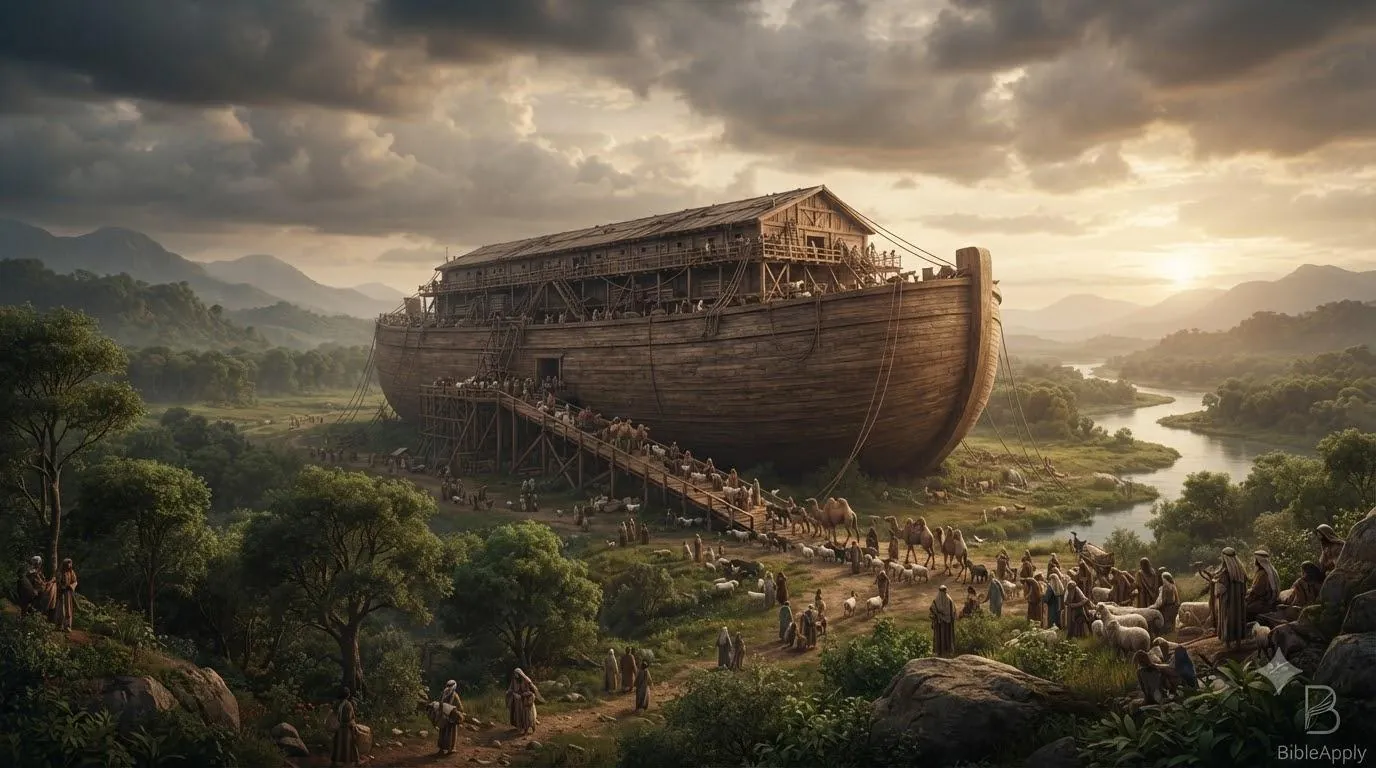
The Ark was massive. According to Genesis 6:15, it was 300 cubits long. That gives it a gross volume of around 1.5 million cubic feet, with the carrying capacity of over 500 standard railroad stock cars. There was ample room for the estimated 16,000 animals needed to preserve the terrestrial kinds.
Additionally, God is wise. He wouldn’t have sent the oldest, largest adult dinosaurs to Noah. The primary purpose was to repopulate the earth, so God would have logically sent juveniles.
Dinosaur eggs are remarkably small—the largest discovered is about the size of a football. Every massive dinosaur started out very small. Studies on dinosaur bone histology show many experienced rapid growth spurts during their “teenage” years. A juvenile sauropod would be roughly the size of a cow or horse, eating less and producing less waste.
Why Did They Go Extinct?
If dinosaurs walked off the Ark, why aren’t they roaming the earth today? Their extinction follows the same pattern as the dodo bird or the woolly mammoth.
The catastrophic global flood drastically altered the climate, creating harsh environmental conditions. The lush vegetation that massive sauropods required was largely gone, replaced by a sparser landscape. Additionally, humans were now authorized by God to eat meat, and animals possessed a new fear of mankind.
As humans spread out after the Tower of Babel, they naturally came into conflict with these large reptiles. Ancient literature, artwork, and oral traditions from cultures globally are saturated with stories of “dragons.” These are likely historical memories of post-flood human encounters with surviving dinosaurs. Like many apex predators, they were eventually hunted to extinction.
Radiometric Dating
The secular timeline hinges heavily on radiometric dating. However, creation scientists point out that these methods are based on unprovable assumptions about the past. They require a constant rate of decay and a closed system without contamination.
Empirical science has recently provided stunning evidence confirming the young age of dinosaur fossils. Since 2005, paleontologists have discovered soft tissue, intact blood vessels, and highly fragile proteins like collagen inside unfossilized dinosaur bones. According to the laws of chemistry, these organic materials cannot survive for millions of years. Their presence suggests these creatures lived recently and were rapidly buried in sedimentary layers.
The Theological Depth of God’s Creation
When God describes the Behemoth in Job 40, He is establishing a hierarchy of power. The Behemoth was terrifying, untamable, and immense. The implication is clear: mankind cannot tame this beast, but the Creator can.
By preserving these colossal creatures through the Flood, God demonstrated His sovereignty over the most fearsome elements of creation. Dinosaurs remind us that God’s creation is wild and majestic, reflecting His infinite power.
If God can command massive, armored dinosaurs to peacefully walk up the ramp of the Ark, He is more than capable of managing the chaotic circumstances of our own lives.
3 Practical Applications
How does this impact our daily lives as believers? Here are three practical takeaways.
1. Trust the Reliability of Scripture
The secular narrative regarding dinosaurs is pervasive, but it contradicts God’s Word. Understanding that the Bible provides a coherent explanation for the history of dinosaurs builds our confidence in Scripture. If we can trust what Genesis says about earth’s history, we can trust what the Gospels say about our salvation in Jesus Christ.
2. Teach the Next Generation
Dinosaurs are often used by secular educators to separate Christian children from the faith of their parents. By embracing the biblical truth about dinosaurs, we can take back this narrative. Teach your children that dinosaurs point to the reality of the Creator, the truth of the Fall, and the catastrophic judgment of the Flood.
3. Stand in Awe of the Creator
When you look at the towering skeleton of a Tyrannosaurus rex in a museum, do not view it as a relic of an evolutionary past. View it as a testament to the boundless creativity and power of God. Let the sheer size of these creatures humble you and lead you to a deeper worship of the God who spoke them into existence.