Jude Chapter Summaries
A complete, chapter-by-chapter guide to the Book of Jude. Read deep dives into the meaning, historical context, and modern application of every chapter.
Jump to Chapter
Welcome to our complete guide to the Book of Jude. Below you will find a chapter-by-chapter summary that flows through the entire narrative, helping you understand the context, meaning, and application of this profound book.
Jude Chapter 1 Summary
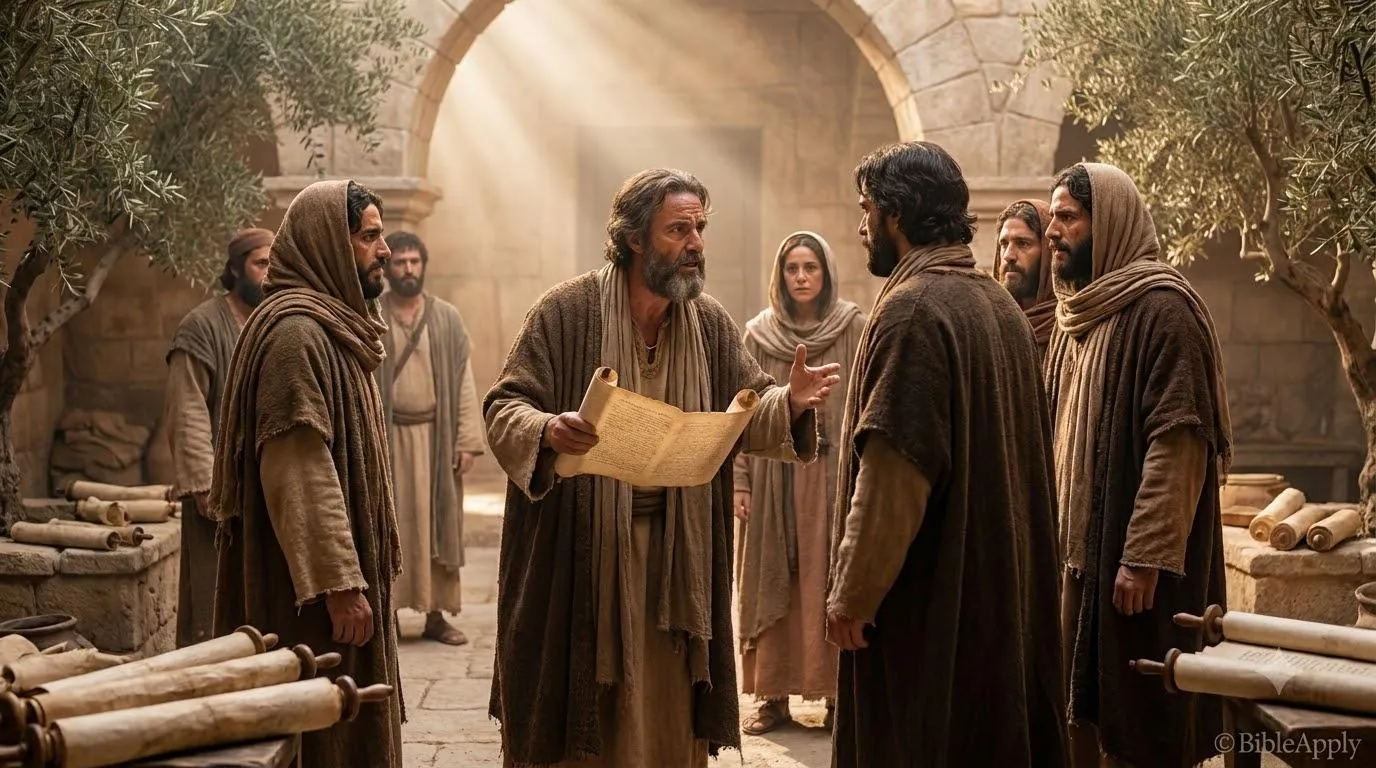
The Epistle of Jude is a short, intense, and urgently needed letter tucked into the New Testament just before the Book of Revelation. Written by Jude (or Judas, distinct from the traitor Judas Iscariot), the author identifies himself simply as “the servant of Jesus Christ, and brother of James.” This is a remarkably humble introduction, considering that Jude and James were the literal half-brothers of Jesus Christ Himself, born to Mary and Joseph. During Christ’s earthly ministry, His brothers did not believe in Him (John 7:5). It was only after the resurrection that their eyes were opened to the reality that their older sibling was, in fact, the incarnate Son of God.
Instead of flexing his earthly family ties or demanding special privilege within the early church, Jude submits completely to the Lordship of Christ. By referring to himself merely as a “servant” (Greek: doulos, meaning bondservant or slave), Jude demonstrates a profound theological truth: spiritual rebirth through the Gospel is far more important and foundational than any physical or genetic lineage.
Jude had originally sat down with the intention of writing a joyful, pastoral letter about the “common salvation” he shared with his readers. However, compelled by the Holy Spirit and the urgency of a rising crisis, he pivoted. He was forced to write a sharp, commanding warning. The early church was under attack. While they were experiencing external persecution from the Roman Empire, Jude recognized that the far more dangerous threat was internal theological corruption. False teachers had secretly infiltrated the local congregations, bringing with them a deadly doctrine that perverted the grace of God.
These infiltrators were likely early proponents of what would later formalize into Gnosticism or antinomianism—the belief that since believers are saved by grace alone, the moral law no longer applies. They taught a dangerous dualism, suggesting that because God only cares about the spirit, the actions of the physical body do not matter. They turned God’s beautiful, liberating grace into a license for unchecked immorality. Jude’s singular chapter is a blazing call to arms, urging the church to wake up, recognize the theological poison in their midst, and fight for the purity of the Gospel. It serves as a necessary vestibule to the Book of Revelation, reminding believers that the battle for truth must be fought continually until the King returns.
The Call to Contend (Verses 1-4)
“Beloved, when I gave all diligence to write unto you of the common salvation, it was needful for me to write unto you, and exhort you that ye should earnestly contend for the faith which was once delivered unto the saints.” (Jude 1:3)
After a brief greeting emphasizing that true believers are “sanctified by God the Father, and preserved in Jesus Christ, and called,” Jude gets straight to the point. He issues a direct apostolic command to “earnestly contend” for the faith. The Greek word used here is epagonizesthai, from which we derive the English word agonize. It is a vigorous compound word drawn from the ancient athletic arenas and military battlefields. It implies an intense, strenuous, agonizing struggle to defend something infinitely precious.
The “faith” Jude refers to is not the subjective feeling of believing, but the objective, unchanging body of truth—the Gospel—that was “once delivered unto the saints.” Because it was delivered directly by Christ and His apostles, it is complete. It does not need to be updated, modified, culturally accommodated, or improved upon by later generations.
Jude explains exactly why this fight is necessary in verse 4: “For there are certain men crept in unawares.” The danger was stealthy. These false teachers did not stand outside the church shouting heresy; they quietly slipped into the pews, participated in the fellowship meals, took leadership roles, and subtly twisted the Scriptures from the inside out. They committed two grave theological errors:
- They turned the grace of God into “lasciviousness” (Greek: aselgeia, meaning unbridled lust, moral rebellion, and a total lack of restraint).
- By doing so, they denied the Lordship of Jesus Christ. Jude makes it clear that you cannot accept Jesus as Savior while rejecting Him as Lord. To reject Christ’s moral authority over your life is to reject Christ Himself.
Related to this, you may want to read Jeremiah 29:11 Meaning: For I Know the Plans I Have for You for additional biblical perspective.
Three Historical Monuments of Judgment (Verses 5-7)
To prove that God will severely judge these infiltrators, Jude reaches back into the Old Testament and pulls three famous, undeniable examples of rebellion and divine judgment. He reminds his readers that God’s character does not change.
If you want to explore this further, our in-depth study on jeremiah 29 11 breaks this down verse by verse.
1. Israel in the Wilderness (v. 5)
God miraculously and graciously saved the Israelites out of slavery in Egypt. Yet, when they reached the border of the Promised Land, they refused to trust Him, shrinking back in fear and rebellion. Because of their unbelief, God destroyed that generation in the wilderness. The theological lesson is stark: past deliverance and religious affiliation do not guarantee future immunity if a person ultimately abandons faith and lives in rebellion.
2. The Fallen Angels (v. 6)
Jude points to a specific group of angels who “kept not their first estate, but left their own habitation.” Whether this refers to the original cosmic rebellion led by Satan or the bizarre, boundary-breaking events of Genesis 6 (where the “sons of God” took human wives), the lesson is identical. These were beings of immense spiritual privilege, power, and glory. Yet, because they rebelled against God’s established boundaries (their oikētērion or proper domain), they are now reserved in “everlasting chains under darkness” awaiting final judgment. If God did not spare mighty angels who rebelled, He will certainly not spare false teachers.
3. Sodom and Gomorrah (v. 7)
These ancient cities gave themselves over to gross sexual immorality and “strange flesh” (unnatural desires). They abandoned God’s design for human sexuality. As a result, God’s devastating judgment of fire fell upon them, completely wiping them from the face of the earth. Jude states that their destruction stands as a permanent, historical warning to anyone who flagrantly rejects God’s moral law.
The theological weight in these three examples is heavy. God is perfectly holy, and He does not overlook rebellion, whether it comes from His covenant people, the angelic host, or pagan nations. Grace is not an exemption from the consequences of persistent, unrepentant sin.
The Character of the Apostates (Verses 8-16)
“Woe unto them! for they have gone in the way of Cain, and ran greedily after the error of Balaam for reward, and perished in the gainsaying of Core.” (Jude 1:11)
Jude launches into a blistering, almost poetic description of the false teachers. He notes that they operate on base animal instinct rather than spiritual wisdom. They reject legitimate authority and even have the audacity to blaspheme spiritual beings.
Also Read:
To highlight their extreme arrogance, Jude contrasts their behavior with that of Michael the archangel (v. 9). When Michael contended with the devil in a dispute over the body of Moses (an event likely drawn from a well-known intertestamental Jewish text, The Assumption of Moses), Michael did not rely on his own angelic authority. He did not hurl abusive insults or pronounce his own judgment. Instead, he simply said, “The Lord rebuke thee.” If the most powerful archangel in heaven shows such deep humility and deference to God’s sovereign authority in the midst of spiritual warfare, how utterly foolish are mere men who proudly mock things they do not understand?
Jude then ties the false teachers to an unholy trinity of Old Testament rebels:
- The Way of Cain: Cain approached God on his own terms rather than through the required blood sacrifice, leading to jealousy, anger, and the murder of his righteous brother Abel. It represents the religion of human effort and pride without saving faith.
- The Error of Balaam: Balaam was a prophet for hire who sold out the truth for financial gain and eventually taught the Moabites how to lead God’s people into sexual compromise and idolatry. This represents the dangerous monetization of ministry and compromising truth for popularity or wealth.
- The Rebellion of Korah (Core): Korah rose up against God’s appointed leadership (Moses and Aaron) out of raw pride and a desire for power. He refused to submit to the structure God had established. This represents a rebellious, anti-authority spirit that seeks self-exaltation.
To ensure his readers grasp the absolute emptiness of these apostates, Jude describes them using brilliant, vivid metaphors of nature gone wrong. They are “clouds without water” (promising life-giving rain to a parched land but delivering nothing but shadows), “trees whose fruit withereth, without fruit, twice dead, plucked up by the roots,” and “wandering stars.” In the ancient world, sailors navigated by the fixed stars. A “wandering star” (a meteor or shooting star) burns bright for a fleeting moment but then vanishes into the blackness of space forever, making it utterly useless for guidance. These false teachers look the part of spiritual guides, but they are spiritually bankrupt and destined for “the blackness of darkness forever.”
The Believer’s Defense and Duty (Verses 17-23)
“But ye, beloved, building up yourselves on your most holy faith, praying in the Holy Ghost, Keep yourselves in the love of God, looking for the mercy of our Lord Jesus Christ unto eternal life.” (Jude 1:20-21)
Many believers wrestle with the question of joshua 1 9 — and Scripture has profound, life-changing answers.
Having relentlessly exposed the danger, the tone of the letter abruptly softens. Jude pivots to instruct true believers on how to survive, thrive, and fight back in a culture of rampant apostasy. His battle plan is practical and highly actionable.
First, Remember (v. 17). He reminds them that the apostles of Jesus Christ had already predicted that mockers and false teachers would come in the last days. The presence of heresy and apostasy shouldn’t shock us or cause us to doubt; rather, it confirms the absolute truth of Scripture. God warned us this would happen.
Many believers also ask Psalm 91 Meaning: He Who Dwells in the Shelter — and the Bible gives us a clear, powerful answer.
Second, Remain (vv. 20-21). How do we “keep ourselves in the love of God”? Not by passively sitting in a pew, but by actively engaging in spiritual disciplines. We must be “building up yourselves on your most holy faith,” which means diligently studying the Word of God and growing deep roots in sound theology. We must also be “praying in the Holy Ghost,” which means praying not with mindless repetition, but in deep alignment with the Spirit’s will and power. We stay safely within the boundaries of God’s love by clinging tightly to His truth.
Third, Rescue (vv. 22-23). Jude does not tell believers to hide in a bunker and wait for the rapture. He commands them to engage the deceived with profound spiritual triage, recognizing that different people require different approaches:
- To those who are sincerely struggling with honest doubts, we are to show mercy, patience, and gentle instruction.
- Others have wandered dangerously close to the flames of divine judgment; we must urgently and aggressively “snatch them out of the fire.”
- For others deeply entrenched in the toxic lifestyle of the false teachers, we are to show mercy but with extreme “fear,” being incredibly careful not to let their corrupt lifestyle stain our own garments. We must passionately love the sinner while maintaining a holy, absolute dread of the sin itself.
The Doxology: Kept by the King (Verses 24-25)
“Now unto him that is able to keep you from falling, and to present you faultless before the presence of his glory with exceeding joy, To the only wise God our Saviour, be glory and majesty, dominion and power, both now and ever. Amen.” (Jude 1:24-25)
After 23 verses of intense spiritual warfare, terrifying warnings of fiery judgment, and exhausting commands to fight for the truth, Jude concludes with one of the most beautiful, soaring, and reassuring doxologies in all of Scripture.
A thoughtful reader might ask: If the false teachers are so deceptive, if the devil is so active, and if apostasy is so prevalent, how can I possibly survive? Won’t I inevitably be swept away by the current too?
Jude’s glorious answer points away from human effort and directly to the power of the Gospel. Yes, we are called to “keep ourselves” (v. 21), but ultimately, our eternal security rests entirely in the sovereign hands of the One who is “able to keep you from falling.” The Greek word for “keep” here (phylassō) means to mount a guard, to protect as in a heavily fortified military garrison. God Himself stands guard over our salvation.
And the promise gets even better: He will not just help us barely limp across the finish line of faith. He promises to present us “faultless” (Greek: amōmos, a word used for perfect, unblemished temple sacrifices) before His glorious presence with “exceeding joy.” The agony, tears, and struggles of the earthly battle will instantaneously give way to the ecstatic joy of eternal victory. Because of the finished work of Jesus Christ, we are kept, we are eternally secure, and we are destined for unblemished glory.
3 Practical Applications from Jude 1
Many believers wrestle with questions like romans 8 28 — and Scripture has profound answers.
- Contend for Truth, Don’t Just Argue: Contending for the faith does not mean being combative, arrogant, or mean-spirited on social media. It means deeply knowing what the Bible actually teaches and having the moral courage to stand firm when the culture—or even well-known leaders within the church—try to compromise it. Truth is worth fighting for, but it must be defended with the grace, humility, and absolute dependence on God that Michael the archangel demonstrated.
- Recognize the Danger of Distorting Grace: The ultimate test of false teaching is what it does with the grace of God. If a sermon, book, or theology makes you perfectly comfortable in your sin, or suggests that God’s infinite love means He doesn’t care about your moral obedience, it is echoing the exact same lie Jude fought in the first century. True biblical grace doesn’t just forgive our sins; it provides the transformational power to conquer them.
- Rest Safely in God’s Keeping Power: In a modern world where high-profile moral failures and spiritual deconstruction seem rampant, fear can easily creep into a believer’s heart. But your salvation does not depend merely on the strength of your grip on God; it depends entirely on His almighty, unbreakable grip on you. Do the daily, necessary work of building your faith and praying in the Spirit, but sleep peacefully at night knowing that God is the One guarding your soul. He is utterly faithful, and He will bring you safely home, completely faultless, with exceeding joy.
Also Read
- Joshua 1 Summary & Meaning: Stepping into God’s Promises
- Malachi 1 Summary & Meaning: Apathy, Blemished Sacrifices, and the Greatness of God
- Colossians 1 Summary & Meaning: The Supremacy and Sufficiency of Christ
Read Jude 1
Dive into the full scripture text for deeper study.
Conclusion
We hope this chapter-by-chapter summary of Jude has helped you better understand God's Word. To continue your study, explore our other Bible Chapter Summaries or read our detailed Verse Meanings.