Esther Chapter Summaries
A complete, chapter-by-chapter guide to the Book of Esther. Read deep dives into the meaning, historical context, and modern application of every chapter.
Welcome to our complete guide to the Book of Esther. Below you will find a chapter-by-chapter summary that flows through the entire narrative, helping you understand the context, meaning, and application of this profound book.
Chapter 1: The King's Grand Banquet and Queen Vashti's Defiance
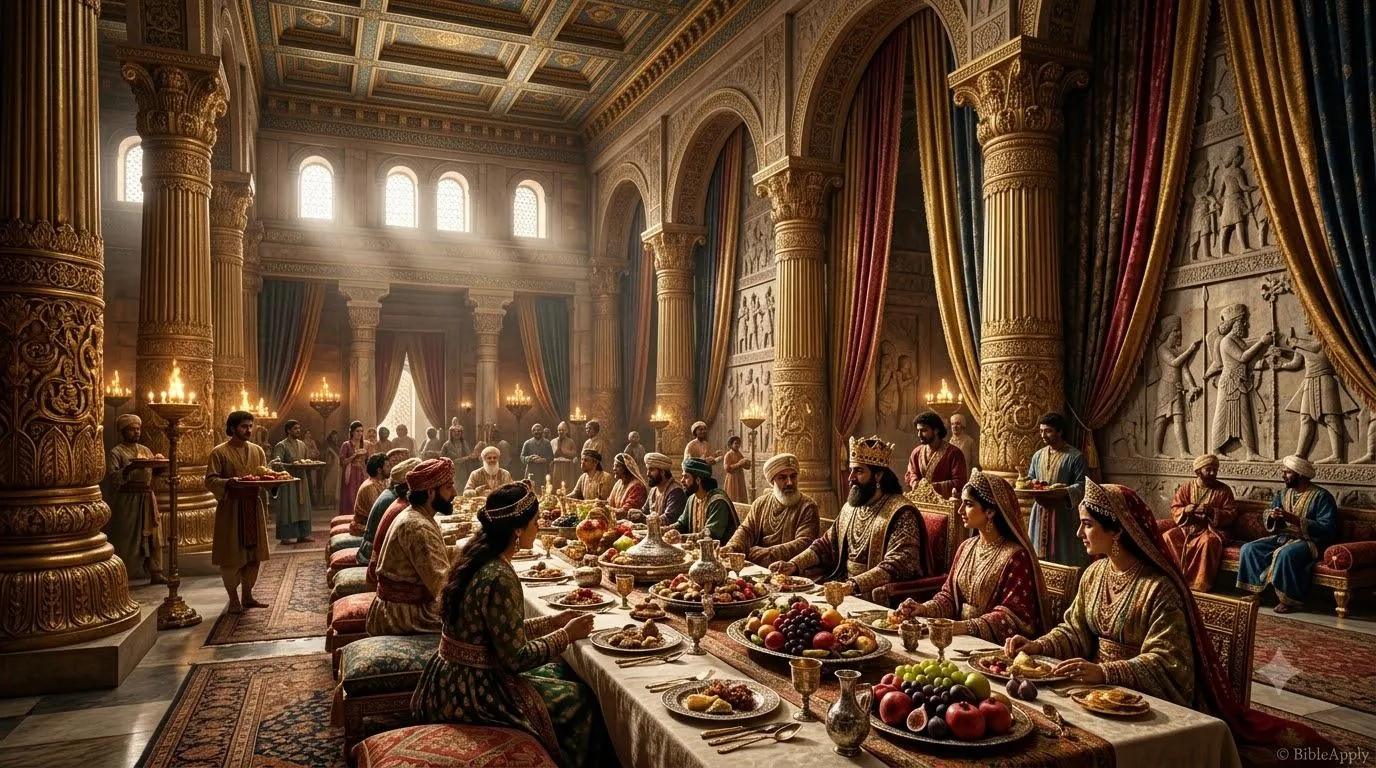
The Book of Esther stands unique among the books of the Bible, most notably because it is the only biblical book that does not explicitly mention the name of God. Yet, the fingerprints of divine providence are visible on every page. Set against the backdrop of the vast Persian Empire during the reign of King Ahasuerus (commonly identified as Xerxes I, who ruled from 486–465 BC), the narrative unfolds in the capital city of Susa. Historically, this places the events of Esther after the first wave of Jewish exiles had returned to Jerusalem under Zerubbabel, but before the leadership of Ezra and Nehemiah. The Jews living in Persia were those who had chosen to remain in the diaspora rather than brave the difficult return to their homeland.
Esther Chapter 1 serves as the prologue to a sweeping drama of conspiracy, courage, and deliverance. It establishes the immense power, wealth, and caprice of the Persian court, setting a stark contrast between the illusion of absolute human sovereignty and the reality of God’s unseen control. The chapter doesn’t feature any of the main Jewish characters—Esther and Mordecai are entirely absent—but it meticulously orchestrates the political and social vacuum that Esther will eventually fill.
Through a display of excessive opulence that culminates in domestic conflict and impulsive legislation, Chapter 1 highlights the fragility of human empires. King Ahasuerus commands an empire stretching from India to Ethiopia, yet he cannot command his own wife or control his own temper. This opening chapter invites the reader to look beyond the glitter of the royal court and recognize the fragile, often absurd nature of earthly power, preparing us for the quiet, strategic, and faithful acts of those through whom the silent God will work His salvation.
The Grandeur and Excess of King Ahasuerus (Esther 1:1-9)
The chapter opens by establishing the sheer scale of Ahasuerus’s dominion and the extravagant measures he took to display it.
A Display of Worldly Power
“Now in the days of Ahasuerus, the Ahasuerus who reigned from India to Ethiopia over 127 provinces, in those days when King Ahasuerus sat on his royal throne in Susa, the citadel, in the third year of his reign he gave a feast for all his officials and servants.” (Esther 1:1-3)
The author goes to great lengths to describe the majesty of the Persian Empire. The King hosts a massive, six-month-long (180 days) banquet for his military and political leaders, followed by a seven-day feast for all the people in the citadel of Susa. The description of the palace courtyard—with its white cotton and blue hangings, silver rings, marble pillars, and couches of gold and silver—paints a picture of unparalleled luxury. Wine flowed in abundance from golden vessels, each of unique design.
If this resonates with you, our deep dive into Jeremiah 29:11 Meaning: For I Know the Plans I Have for You explores the scriptural foundation further.
Theologically, this passage presents a vivid portrait of humanity’s attempt to build its own kingdom and glory in its own achievements. Ahasuerus is the quintessential worldly king, relying on material wealth, military might, and political alliances to secure his legacy. The 180-day feast was likely a strategic military planning session for his impending, historically disastrous campaign against Greece. The extravagance is designed to impress and intimidate, a clear demonstration of the pride of life. Yet, as the text will soon reveal, all this glory is superficial. It masks a deep vulnerability and a lack of true authority. The biblical author implicitly contrasts this fleeting, earthly glory with the eternal, unshakeable Kingdom of God.
Queen Vashti’s Separate Banquet
“Queen Vashti also gave a feast for the women in the palace that belonged to King Ahasuerus.” (Esther 1:9)
While the king entertains the men, Queen Vashti hosts a separate banquet for the women. This separation highlights the cultural norms of the Persian court but also sets the stage for the impending conflict. Vashti is established as a woman of position and influence within her own sphere. Her subsequent actions must be understood not merely as the rebellion of a subordinate, but as the decision of a queen acting within the complex dynamics of ancient near-eastern royalty.
The Queen’s Refusal and the King’s Wrath (Esther 1:10-12)
The turning point of the chapter occurs when the king’s pride clashes with his queen’s dignity.
Many believers wrestle with questions like jeremiah 29 11 — and Scripture has profound answers.
Also Read:
A Drunken Command
“On the seventh day, when the heart of the king was merry with wine, he commanded… to bring Queen Vashti before the king with her royal crown, in order to show the peoples and the princes her beauty, for she was lovely to look at.” (Esther 1:10-11)
As the seven-day feast reaches its climax, Ahasuerus, inebriated and emboldened, commands his seven eunuchs to bring Queen Vashti before the assembly. The text is clear about his motivation: to display her beauty to his officials. Vashti is treated not as a partner, but as another piece of royal property—another golden vessel or marble pillar—to be paraded for the king’s self-aggrandizement. Her presence wearing the “royal crown” was meant to be the crowning jewel of his grand exhibition of wealth and possessions.
Vashti’s Courageous Defiance
“But Queen Vashti refused to come at the king’s command delivered by the eunuchs. At this the king became enraged, and his anger burned within him.” (Esther 1:12)
Vashti refuses. The text does not explicitly state her reasons. Perhaps it was a refusal to be objectified before a crowd of drunken men, or perhaps it violated Persian customs regarding the modesty of noble women. Regardless of her motivation, her refusal is a stunning act of defiance against an absolute monarch whose word was law.
In a single moment, the facade of Ahasuerus’s omnipotence is shattered. The man who rules 127 provinces cannot command the obedience of his own wife. His reaction—burning anger—reveals his lack of self-control. The Book of Proverbs reminds us, “Whoever is slow to anger is better than the mighty, and he who rules his spirit than he who takes a city” (Proverbs 16:32). Ahasuerus may rule an empire, but he cannot rule his own spirit. This dramatic irony serves a profound theological purpose: it exposes the impotence of worldly authority when faced with human free will and dignity, and subtly prepares the reader for the superior, though hidden, sovereignty of God.
The Absurdity of the Imperial Response (Esther 1:13-22)
The King’s inability to handle a domestic dispute privately leads to an absurd, empire-wide crisis.
For a deeper study, see our guide on Psalm 91 Meaning: He Who Dwells in the Shelter which many readers have found helpful.
The Council of the Wise Men
“Then the king said to the wise men who knew the times… ‘According to the law, what is to be done to Queen Vashti, because she has not performed the command of King Ahasuerus delivered by the eunuchs?’” (Esther 1:13, 15)
In his anger, Ahasuerus turns to his inner circle of seven wise men, experts in law and custom. The fact that the most powerful man in the world needs a committee of legal experts to tell him how to handle his disobedient wife highlights his incompetence. The king’s authority is entirely propped up by the machinery of his empire.
Memucan’s Ridiculous Overreaction
“Then Memucan said in the presence of the king and the officials, ‘Not only against the king has Queen Vashti done wrong, but also against all the officials and all the peoples who are in all the provinces of King Ahasuerus. For the queen’s behavior will be made known to all women, causing them to look at their husbands with contempt…’” (Esther 1:16-17)
Memucan, one of the wise men, elevates a personal marital dispute into a national emergency. He argues that Vashti’s defiance will spark a feminist revolution across the Persian Empire, leading to widespread disrespect and marital discord. His proposed solution is swift and absolute: Vashti must be deposed and her royal position given to another who is “better than she.” Furthermore, an empire-wide decree must be issued demanding that all women give honor to their husbands.
The irony here is palpable. In their attempt to mandate respect, the king and his advisors only broadcast their insecurity. True respect and authority cannot be legislated by imperial decree; they are earned through character and integrity, qualities entirely lacking in Ahasuerus and his court.
The Decree of the King
“So the king sent letters to all the royal provinces, to every province in its own script and to every people in its own language, that every man be master in his own household and speak according to the language of his people.” (Esther 1:22)
The chapter concludes with the dispatch of this decree throughout the vast empire. The decree is inherently unenforceable and somewhat comical in its desperation. Yet, behind the absurdity of the Persian court, God’s silent providence is at work. The deposal of Vashti creates the necessary vacancy for Esther. The foolishness of human rulers is being actively repurposed to set the stage for the salvation of God’s people. As Psalm 2:4 declares, “He who sits in the heavens laughs; the Lord holds them in derision.” God does not need to intervene miraculously; He simply allows the arrogance and folly of powerful men to run their course, weaving their missteps into His perfect plan of redemption.
3 Practical Applications from Esther 1
Many believers wrestle with the question of isaiah 41 10 — and Scripture has profound, life-changing answers.
- Recognize the Emptiness of Worldly Glory: King Ahasuerus possessed unimaginable wealth, power, and status, yet he lacked self-control, security, and true peace. His 180-day feast was an attempt to validate his own worth through external validation. As believers, we are reminded that true significance is not found in what we possess or how others perceive us, but in our identity as children of God. We must guard against the temptation to build our own kingdoms and instead seek first the Kingdom of God.
- Stand Firm in Your Dignity: Queen Vashti, though not a worshipper of Yahweh, models a commendable sense of dignity and self-respect. She refused to compromise her integrity or allow herself to be objectified simply to satisfy the pride of a powerful man, even at great personal cost. Her example encourages us to set healthy boundaries and to resist pressures—whether from culture, authorities, or peers—that ask us to compromise our God-given dignity or moral convictions.
- Trust in God’s Unseen Providence: The name of God is absent in this chapter, yet His hand is firmly on the wheel of history. The impulsive anger of a pagan king and the foolish advice of his counselors were the very instruments God used to place Esther in the palace for “such a time as this.” When we look at the chaotic, often unjust systems of our world, we can take comfort in knowing that God is Sovereign. He is working behind the scenes, using even the flawed actions of human leaders to accomplish His redemptive purposes.
Also Read
- Philippians 1 Summary & Meaning: Joy, Chains, and the Unstoppable Gospel
- Matthew 1 Summary & Meaning: The Royal Genealogy and the Incarnation
- Acts 1 Summary & Meaning: The Ascension and the Waiting Church
Read Esther 1
Dive into the full scripture text for deeper study.
Chapter 2: Esther's Ascent to the Throne
Esther finds tremendous favor with Hegai, the eunuch in charge of the harem, and undergoes twelve months of beauty treatments. When her turn comes to go before King Ahasuerus, he is captivated by her above all the other women. He sets the royal crown on her head, making her queen in place of Vashti. Meanwhile, Mordecai, while sitting at the king's gate, overhears a plot by two eunuchs to assassinate the king. He informs Queen Esther, who reports it to the king in Mordecai's name, saving the king's life.
Chapter 3: Haman's Malicious Plot Against the Jews
Learning of Mordecai's Jewish heritage, Haman decides that punishing Mordecai alone is not enough; he resolves to annihilate the entire Jewish population within the Persian Empire. Haman casts lots (called "pur") to determine the most favorable day for this genocide. He then manipulates the king, offering a massive sum of silver and portraying the Jews as a rebellious, lawless people. The king gives Haman his signet ring, authorizing a decree that orders the destruction, slaughter, and annihilation of all Jews on a single day.
Chapter 4: For Such a Time as This
Esther hesitates, reminding Mordecai that approaching the king uninvited is punishable by death, unless the king extends his golden scepter. Mordecai issues a chilling warning: she will not escape the massacre just because she lives in the palace, suggesting she may have been brought to royal position "for such a time as this." Bolstered by his words, Esther requests that all Jews in Susa fast for her for three days, boldly declaring, "If I perish, I perish."
Chapter 5: Esther's First Banquet and Haman's Arrogance
Haman leaves the palace in high spirits, but his joy sours when he sees Mordecai at the king's gate, still refusing to show him any respect. Filled with rage, Haman goes home and boasts of his wealth, honors, and exclusive invitations to his wife Zeresh and his friends. They advise him to build a massive gallows, seventy-five feet high, and to ask the king in the morning to have Mordecai hanged on it. Delighted by the wicked idea, Haman orders the gallows built.
Chapter 6: The King Honors Mordecai
Before Haman can speak, the king asks him, "What should be done for the man the king delights to honor?" Assuming the king means him, Haman suggests a lavish public parade wearing royal robes and riding the king's own horse, led by a noble prince. To Haman's utter horror, the king commands him to immediately bestow these exact honors on Mordecai the Jew. Humiliated, Haman leads Mordecai through the city square, proclaiming his honor, before rushing home in grief, where his wife warns him that this is the beginning of his downfall.
Chapter 7: Esther's Plea and Haman's Demise
Outraged, the king demands to know who would dare scheme such a vile thing. Esther points directly at her enemy, declaring, "An adversary and enemy! This wicked Haman!" Terrified, Haman cowers as the king storms out into the palace garden in a blazing fury. Desperate, Haman throws himself onto Esther's couch to beg for his life. The king returns just in time to see this and, believing Haman is assaulting the queen, condemns him. Harbona, one of the eunuchs, points out the towering gallows Haman had built for Mordecai. The king orders Haman hanged on his own gallows, and finally, the king's wrath is appeased.
Chapter 8: The Counter-Decree of Deliverance
The king authorizes Esther and Mordecai to write a new decree in the king's name and seal it with his signet ring. Mordecai quickly dictates a counter-edict that grants the Jews the right to assemble, defend themselves, and destroy any armed force that might attack them. Fast riders on royal horses carry this new decree to every province. The city of Susa rejoices, and for the Jews, it is a time of happiness, joy, gladness, and honor. Many people of other nationalities even become Jews out of fear of them.
Chapter 9: Victory and the Inception of Purim
Esther requests one more day for the Jews in Susa to defend themselves and for Haman's sons to be publicly hanged, further securing their safety. In the provinces, the Jews eliminate seventy-five thousand of their enemies. Following their survival, the Jews rest and celebrate with feasting and joy. Mordecai and Esther write official letters establishing the fourteenth and fifteenth days of Adar as the annual festival of Purim—named after the "pur" or lots Haman had cast. It becomes a lasting celebration of God's deliverance, marked by feasting, joy, and giving gifts to the poor.
Chapter 10: The Greatness of Xerxes and Mordecai
Equally important is the legacy of Mordecai the Jew. He is elevated to second in rank to King Ahasuerus, wielding immense authority. Mordecai uses his high position not for personal gain, but to seek the good of his people. He becomes preeminent among the Jews, held in high esteem by his many fellow Jews, as he consistently works for their welfare and speaks peace to all their descendants, ensuring their ongoing security and prosperity.
Conclusion
We hope this chapter-by-chapter summary of Esther has helped you better understand God's Word. To continue your study, explore our other Bible Chapter Summaries or read our detailed Verse Meanings.