

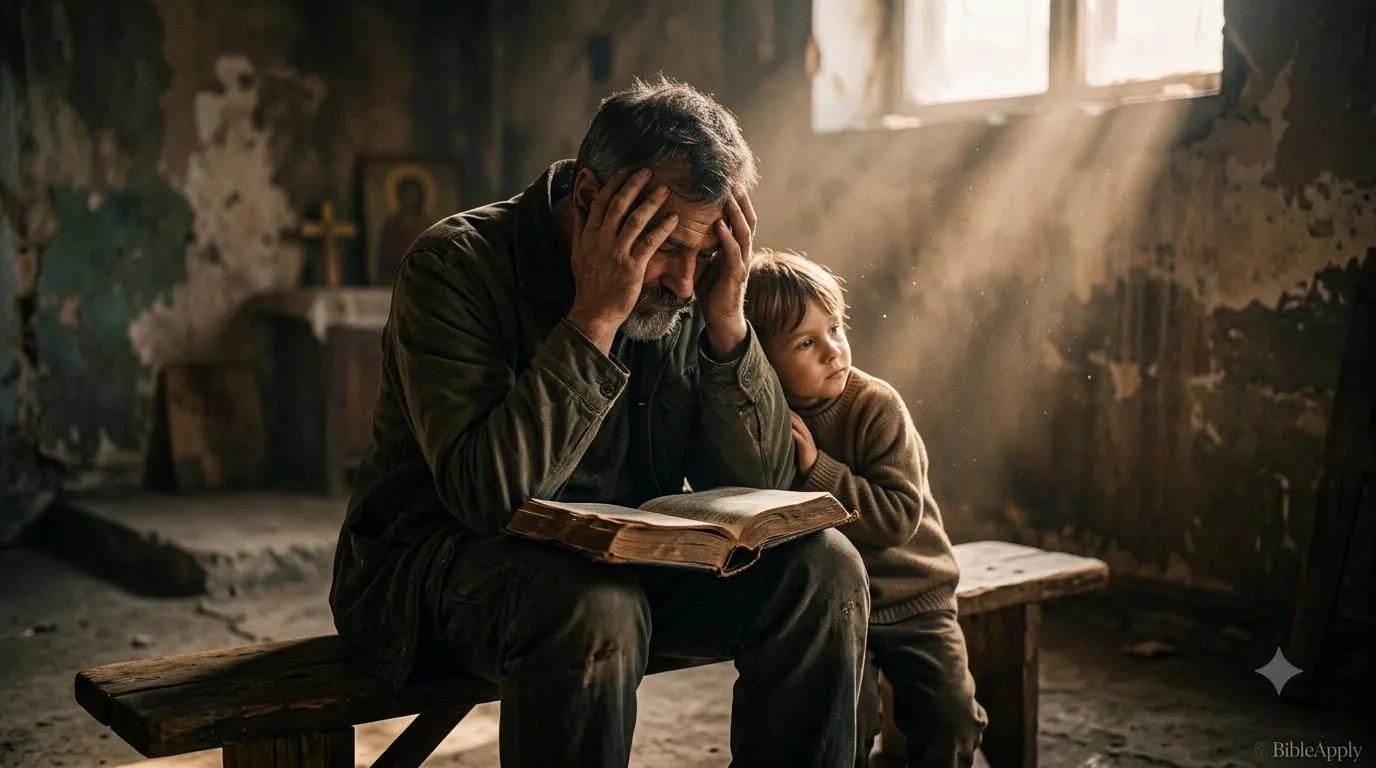
The question of why a loving God permits human suffering remains the most formidable theological challenge to the Christian faith. The biblical framework does not provide a singular, simplistic rationale, but instead reveals a complex reality: suffering is the tragic byproduct of human free will in a fractured world, a severe instrument utilized for spiritual formation, and an enduring mystery that ultimately finds its resolution not in philosophical arguments, but in the incarnation of Jesus Christ—a God who willingly enters human agony to dismantle it from the inside out.
Theology is rarely more tested than in the corridors of a pediatric oncology ward or the silent ruins of a city devastated by an earthquake. When we open our Bibles and attempt to reconcile the character of God with the lived reality of human trauma, we are entering holy, often uncomfortable ground. The problem of evil—known formally in theology as theodicy (from the Greek theos for God and dikē for justice)—is not merely an academic puzzle to be solved. It is an open wound crying out for treatment.
The Logical Problem of Evil: The Epicurean Trilemma
Before we look at the specific biblical narratives, we have to deal with the raw philosophical tension that has bothered thinkers for millennia. The Greek philosopher Epicurus (341–270 BC) is often credited with first articulating the logical problem of evil in a format that later theologians called the “Epicurean Trilemma.” It goes like this:
- If God is willing to prevent evil, but not able, then He is not omnipotent.
- If He is able, but not willing, then He is malevolent.
- If He is both able and willing, whence cometh evil?
If God is all-powerful, He possesses the capacity to stop a hurricane, prevent a genocide, or cure a disease. If God is entirely good, He would inherently desire to do so. Yet the hurricane strikes, the genocide occurs, and the disease takes hold. For the skeptic, this serves as definitive proof that the God of the Bible either lacks power, lacks goodness, or simply does not exist.
Christian theology, stretching back to Augustine of Hippo, has vehemently rejected the idea that we must sacrifice either God’s power or His goodness. Augustine argued that evil is not a created substance; it is a privatio boni, a privation or corruption of the good. Blindness is not a “thing” in itself—it is the absence of sight. Evil, then, is what happens when goodness is corrupted or absent. But acknowledging what evil is does not entirely soothe the ache of why it is allowed to persist. For that, we must dive into the different categories of suffering we experience.
Categorizing the Darkness: Moral, Natural, and Disciplinary
We do ourselves a disservice when we lump all suffering into one massive category. The biblical text makes careful distinctions regarding the nature and origin of our trials. The Hebrew word often translated as “evil” or “calamity” is ra’ (Strong’s H7451). Depending on the context, it can denote moral wickedness or simply physical distress and disaster. In the New Testament, the Greek word thlipsis (Strong’s G2347) is used for tribulation or affliction, carrying the literal meaning of being subjected to immense pressure, like grapes in a winepress.
To interpret these texts accurately, we must differentiate between three distinct types of suffering.
Moral Evil
The vast majority of human suffering is the direct result of human choices. Murder, warfare, exploitation, abuse, and theft are all forms of moral evil. When a drunk driver strikes a pedestrian, it is intellectually dishonest to immediately ask, “Why did God do this?” God did not do it; a human being made a reckless, sinful choice. Moral evil is the tragic fallout of our rebellion against the Creator.
Natural Evil
This category encompasses earthquakes, tsunamis, famines, and diseases—calamities that are not directly caused by human action. The biblical explanation for natural evil is rooted in the cosmic disruption caused by the Fall. According to Genesis 3, human rebellion didn’t just break our relationship with God; it fractured the very fabric of creation. The Apostle Paul writes in Romans 8:20-22 (ESV):
“For the creation was subjected to futility, not willingly, but because of him who subjected it, in hope that the creation itself will be set free from its bondage to corruption and obtain the freedom of the glory of the children of God. For we know that the whole creation has been groaning together in the pains of childbirth until now.”
Nature itself is sick. It is groaning, waiting for its ultimate redemption.
Suffering as Divine Discipline
There is a third, often unpopular category in modern Christianity: suffering that serves as God’s loving, corrective discipline. Hebrews 12:5-11 reminds believers not to regard the Lord’s discipline lightly. Verse 6 states clearly: “For the Lord disciplines the one he loves, and chastises every son whom he receives.” (Hebrews 12:6, ESV). This is not God lashing out in unhinged anger. It is the careful, sometimes painful work of a loving Father pruning His children so they might bear more fruit. If we never faced consequences for our destructive behaviors, we would run headlong into eternal ruin.
The Risk of Genuine Love: The Free Will Defense
Why didn’t God simply create a world where suffering was impossible?
Theologians have long posited that for God to create a world where moral evil is entirely impossible, He would have to create a world populated by automatons. The “Free Will Defense” argues that genuine love requires genuine choice, and genuine choice intrinsically carries the risk of genuine rejection.
C.S. Lewis masterfully articulates this in his seminal work, The Problem of Pain. He argues that if humans are to truly love God and love one another, they must possess the actual capacity to choose not to love.
“If you choose to say, ‘God can give a creature free will and at the same time withhold from it the power of doing wrong,’ you are not saying anything about God: you are only talking nonsense. … Try to exclude the possibility of suffering which the order of nature and the existence of free-wills involve, and you find that you have excluded life itself.” (C.S. Lewis, The Problem of Pain)
God deemed that a universe containing free creatures who could voluntarily choose love and relationship was far superior to a sterile universe of robotic obedience, even knowing the catastrophic pain that human rebellion would unleash. The gamble of free will was, in the mind of the Creator, worth the agonizing cost.
The Crucible of Character: The Soul-Making Theodicy
But what about the suffering that doesn’t immediately result from someone’s specific sin? The second-century Church Father Irenaeus of Lyons offered what is now known as the “Soul-Making Theodicy.” Irenaeus proposed that humanity was not created entirely mature, but rather in a state of spiritual infancy, meant to grow into the likeness of God through moral struggle and the overcoming of adversity.
In this framework, the world is not meant to be a hedonistic paradise of endless comfort; it is a proving ground—a crucible designed for the forging of character.
The New Testament authors repeatedly lean into this theology. James, writing to severely persecuted early Christians, says, “Count it all joy, my brothers, when you meet trials of various kinds, for you know that the testing of your faith produces steadfastness. And let steadfastness have its full effect, that you may be perfect and complete, lacking in nothing” (James 1:2-4, ESV).
Similarly, Paul writes in Romans 5:3-5 that “suffering produces endurance, and endurance produces character, and character produces hope.” You cannot develop courage in a world without danger. You cannot learn profound compassion in a world without sorrow. God can and does leverage the brokenness of this world to carve His image more deeply into our souls.
The Whirlwind and the Mystery
Despite the philosophical merit of the free will defense and the soul-making theodicy, there are moments when tragedy is so profound, so senseless, that all explanations fall violently short. At this juncture, the Bible introduces the theodicy of mystery, most vividly displayed in the book of Job.
Job was blameless, yet he lost his wealth, his ten children, and his health in rapid succession. For dozens of chapters, Job’s friends try to apply neat theological formulas to his pain—insisting that Job must have sinned to deserve this. Job vehemently maintains his innocence and demands an audience with the Almighty.
When God finally speaks from the whirlwind in Job 38-42, He does not answer Job’s “why.” He does not tell Job about the cosmic wager with Satan. He does not offer a dissertation on free will. Instead, God takes Job on a tour of the cosmos. He asks, “Where were you when I laid the foundation of the earth? Tell me, if you have understanding” (Job 38:4, ESV).
God’s answer to Job was not an explanation, but a revelation of His character. He effectively tells Job, “The universe is infinitely more complex than you can comprehend. If you cannot understand how I feed the lions or lay the snow, how can you presume to understand the moral governance of the cosmos?” Job is humbled, and he rests in the sovereignty of God, even without a categorized list of reasons for his grief. There are times when faith requires us to bow before the mystery, acknowledging that an infinite God will always possess motives that our finite minds cannot decode.
The Protest of the Soul: Lament and Emotional Agony
Yet, submitting to the mystery does not mean we are required to suffer in pious silence. The Bible is startlingly comfortable with our anger, our frustration, and our desperate questioning of God’s ways.
Consider the literary giant Fyodor Dostoevsky. In The Brothers Karamazov, the character Ivan rebels fiercely against the idea that future harmony can justify the present suffering of innocent children. Ivan declares that he “returns his ticket” to heaven if it requires the tears of a tortured child. Or consider Elie Wiesel’s haunting memoir Night. Watching a young boy slowly hang on the gallows in a concentration camp, a man asks, “Where is God?” Wiesel hears a voice within him answer: “Where is He? This is where—hanging here from this gallows.”
The biblical writers did not shy away from this raw emotional terrain. Over a third of the Psalms are laments. They are gritty, tear-stained protests directed at heaven. Psalm 22:1 begins with the agonizing cry, “My God, my God, why have you forsaken me? Why are you so far from saving me, from the words of my groaning?” (ESV).
The theology of the Bible gives us a robust vocabulary for our pain. It invites us to beat our fists against God’s chest. God is not fragile; He is not threatened by our “Why?”
Biblical Characters in the Crucible
Scripture does not merely teach about suffering in abstract principles; it shows us people wading through it.
Look at Joseph. Sold into slavery by his own brothers, falsely accused of rape, and left to rot in an Egyptian dungeon. It was a staggering sequence of moral evils committed against an innocent man. Yet, decades later, having been elevated to a position of power and standing face-to-face with his betrayers, Joseph reframes his trauma through the lens of God’s sovereignty: “As for you, you meant evil against me, but God meant it for good, to bring it about that many people should be kept alive, as they are today” (Genesis 50:20, ESV). Notice the dual reality: the brothers intended genuine evil, yet God concurrently intended the exact same event for a redemptive good.
Consider the Apostle Paul. In 2 Corinthians 12:7-10, Paul speaks of a “thorn in the flesh, a messenger of Satan to harass me.” Scholars debate what this was—a physical ailment, encroaching blindness, or fierce opposition—but whatever it was, it brought Paul to his knees. Three times he pleaded with God to remove it. God’s response was not deliverance, but sustaining grace: “My grace is sufficient for you, for my power is made perfect in weakness” (2 Corinthians 12:9, ESV).
And then we look to Jesus in the Garden of Gethsemane. The Son of God, sweating drops of blood, entirely overwhelmed by the impending horror of the cross. “My Father, if it be possible, let this cup pass from me” (Matthew 26:39, ESV). Jesus Himself experienced the visceral dread of suffering and begged for another way, yet willingly submitted to the Father’s will.
The God Who Bleeds
This brings us to the most uniquely Christian answer to the problem of evil.
Tim Keller, in his profound book Walking with God Through Pain and Suffering, writes:
“Christianity alone among the world religions claims that God became uniquely and fully human in Jesus of Nazareth and therefore knows firsthand despair, rejection, loneliness, poverty, bereavement, torture, and imprisonment. On the cross he went beyond even the worst human suffering and experienced cosmic rejection and pain that exceeds ours as infinitely as his knowledge and power exceeds ours.”
Islam presents a God who is strictly transcendent. Buddhism calls for the detachment from desire to escape suffering. Secularism says suffering is just the blind, unguided result of a meaningless universe.
Christianity says something utterly different. It says that the Author of the story wrote Himself into the narrative. He did not stay in the safety of heaven, shouting down advice. He became flesh. He allowed Himself to be betrayed, stripped, beaten, and nailed to Roman wood.
When you ask, “Where was God when my heart was breaking?” the Christian can look at the cross and say, “He was right there, suffering with you.” We may not know exactly why God allows specific instances of suffering, but looking at the cross, we know what the reason cannot be. It cannot be that He does not love us.
Practical Application: Walking Through the Valley
How then should we live when the darkness encroaches? How do we apply this theology practically?
- Embrace the Discipline of Lament: Stop pretending you are fine when you are not. Use the Psalms of lament as a template. Write out your anger, your sorrow, and your confusion, and hand it directly to God. He desires your honesty over your superficial piety.
- Resist the Urge to Fix Others: When you are ministering to a friend in the immediate aftermath of a tragedy, do not offer them theological platitudes like “God has a reason.” Do what Job’s friends did for the first seven days: sit in the ashes with them, weep with them, and keep your mouth shut. Presence is far more healing than philosophy in the immediate wake of trauma.
- Look for the Severe Mercy: Without rushing the grieving process, begin asking the Holy Spirit to reveal how He might be using the current affliction to forge endurance and character within you (James 1).
- Anchor in the Eschatological Hope: Christianity does not merely offer a coping mechanism for the present; it guarantees a resurrected future. Revelation 21:4 (ESV) promises, “He will wipe away every tear from their eyes, and death shall be no more, neither shall there be mourning, nor crying, nor pain anymore, for the former things have passed away.”
The Christian hope is not that God will explain everything in this life, but that He has promised to eventually end the suffering and make all things new. Until that day, we walk with a God who knows the way through the valley of the shadow of death, because He has walked it Himself.
Related Topics
- What Is Faith?
- Do All Religions Lead to God?
- Genesis Chapter 1 Summary