

Quick Answer: The Bible describes several types of angels, primarily archangels, cherubim, seraphim, and ministering spirits.
People have always been fascinated by the unseen realm. From Renaissance paintings to modern movies, angels occupy a huge space in our collective imagination. Many folks wonder if an angel intervened when a car inexplicably swerves to avoid a crash, or when a comforting presence is felt in a hospital room.
Our cultural obsession has blurred the lines between biblical truth and artistic license. Folklore and art have heavily shaped our understanding of what angels are and what they do. People want to separate fact from fiction. They wonder if the chubby babies playing harps in classical art reflect reality, or if the terrifying, multi-eyed beings described by ancient prophets are more accurate.
Studying the different types of angels helps us understand how God has organized His spiritual creation. We are reminded that we live in a universe where God’s ministering spirits are actively working behind the scenes.
A Pastoral Note: People usually walk into my office picturing angels as chubby babies or glowing women with wings. When we actually crack open Isaiah and read about the terrifying seraphim, the mood always shifts. Realizing the beings closest to God have to cover their faces in reverence tends to strip away our casual assumptions about worship. It reminds us that the spiritual realm is vastly more powerful than our pop culture caricatures.
Messengers of the Most High
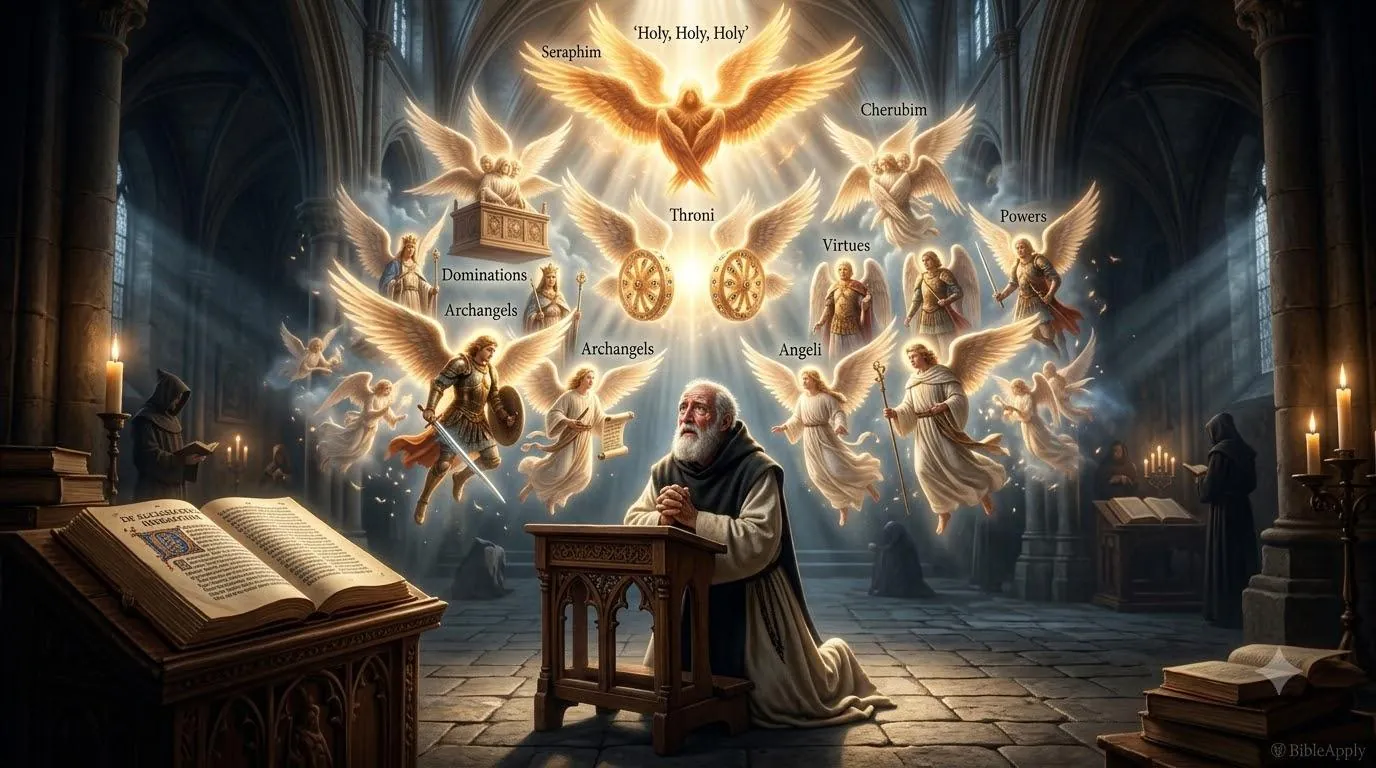
In both the Old and New Testaments, the words translated as “angel”—the Hebrew mal’akh and the Greek angelos—literally mean “messenger.” While the term describes their primary function, it has come to represent a specific class of beings.
Angels are created, spiritual beings (Colossians 1:16). They are not eternal. They were spoken into existence by God, likely before the physical universe was formed. Job 38:7 describes them “shouting for joy” when the earth’s foundations were laid.
They are immensely powerful and deeply intelligent. Angels are devoted to the will of God, though they possess distinct wills. This is evidenced by the rebellion of Satan and a third of the angelic host (Revelation 12:4).
Crucially, humans do not become angels when they die. Angels and humans are entirely different orders of creation.
Types of Angels
The Bible does not provide an exhaustive encyclopedia of heavenly beings. Through the visions of prophets and apostles, Scripture reveals several distinct types or orders of angels. Each has specific roles, appearances, and proximities to the throne of God.
Archangels
The prefix arch- means “chief” or “ruler.” An archangel is a high-ranking or chief angel. The Bible only explicitly identifies one angel by this title: Michael.
In the book of Daniel, Michael is described as “one of the chief princes” (Daniel 10:13) and the great prince who protects Israel (Daniel 12:1). In the New Testament, he is seen leading the heavenly armies in cosmic warfare against Satan.
“But even the archangel Michael, when he was disputing with the devil about the body of Moses, did not himself dare to condemn him for slander but said, ‘The Lord rebuke you!’” (Jude 1:9)
While extra-biblical literature names several archangels such as Raphael and Uriel, canonical Scripture only names Michael. Gabriel is another prominent angel, known for delivering monumental news to Daniel, Zechariah, and Mary. The Bible never specifically applies the title “archangel” to him. He is simply referred to as one who “stands in the presence of God” (Luke 1:19).
Cherubim
When most people hear the word “cherub,” they picture a chubby, winged infant. The biblical Cherubim (plural of Cherub), however, are terrifyingly majestic beings. Their primary role in Scripture is to guard God’s holy presence and vindicate His righteousness.
The Hebrew root karuv is of uncertain origin, but their function is clear. They first appear in Genesis 3:24, stationed with a flaming sword to guard the tree of life after Adam and Eve’s expulsion from Eden. Later, God commands that golden figures of Cherubim be placed on the cover of the Ark of the Covenant (Exodus 25:18-22).
The prophet Ezekiel provides the most detailed description of Cherubim.
“Their faces looked like this: Each of the four had the face of a human being, and on the right side each had the face of a lion, and on the left the face of an ox; each also had the face of an eagle… Each had four faces and four wings, and under their wings was what looked like human hands.” (Ezekiel 1:10, 10:21)
Cherubim are intimately connected with the throne of God. They are often depicted as bearing His chariot-throne. They emphasize God’s unapproachable holiness and sovereign majesty.
Seraphim
The Seraphim appear only once by name in the entire Bible, in the breathtaking throne room vision of the prophet Isaiah. The word seraphim is derived from the Hebrew verb saraph, which means “to burn.” They are literally the “burning ones,” radiating with brilliant light.
“Above him were seraphim, each with six wings: With two wings they covered their faces, with two they covered their feet, and with two they were flying. And they were calling to one another: ‘Holy, holy, holy is the Lord Almighty; the whole earth is full of his glory.’” (Isaiah 6:2-3)
Their role is distinct from the Cherubim. While Cherubim guard the presence of God, Seraphim are relentlessly focused on worship. In Isaiah’s vision, it is a Seraph who takes a burning coal from the altar and touches Isaiah’s lips, purifying him. Seraphim represent the absolute purity of God and the consuming fire of His holiness.
The “Living Creatures”
In the Book of Revelation, the Apostle John describes “four living creatures” surrounding the throne of God (Revelation 4:6-8). These beings seem to combine characteristics of both Ezekiel’s Cherubim and Isaiah’s Seraphim. They have six wings, are covered with eyes, and have faces resembling a lion, an ox, a man, and an eagle.
Like the Seraphim, they never stop saying: “Holy, holy, holy is the Lord God Almighty, who was, and is, and is to come” (Revelation 4:8). It is these very beings who later summon the four horsemen of the apocalypse. This suggests that the categories of angels might not be rigid biological classifications. They could simply be descriptions of the multifaceted beings that dwell in God’s throne room.
Ministering Spirits
The vast majority of the angelic host belongs to the broader category of ministering spirits. These are the unnamed thousands upon thousands (Daniel 7:10) who carry out God’s will throughout the cosmos. When they interact with humanity, they almost always appear as ordinary human men (Hebrews 13:2).
Their duties are vast. They deliver messages, protect God’s people (Psalm 91:11), execute God’s judgments (2 Samuel 24:16), guide believers (Acts 8:26), and minister to the saints.
“Are not all angels ministering spirits sent to serve those who will inherit salvation?” (Hebrews 1:14)
Angelic Ranks and Hierarchies
The New Testament frequently refers to spiritual hierarchies. The Apostle Paul uses a specific vocabulary to describe the organizational structure of both holy and fallen angels.
“For in him all things were created: things in heaven and on earth, visible and invisible, whether thrones or powers or rulers or authorities; all things have been created through him and for him.” (Colossians 1:16)
This hierarchy—Thrones, Dominions, Rulers, and Authorities—points to a highly organized spiritual realm. God is a God of order. The spiritual universe is structured with delegated authority.
Old Testament poetry and prophecy often refer to the “Divine Council” or the “Assembly of the Holy Ones” (Psalm 82:1; Psalm 89:5-7). This portrays God holding court with lesser spiritual beings, incorporating them into His governance of the cosmos. God delights in using an ordered administration of spiritual powers to execute His sovereign will.
Common Misconceptions
Several cultural myths about angels persist today.
Humans become angels when they die This is a deeply ingrained cultural comfort, often expressed at funerals. However, biblically, angels and humans are entirely different species. Humans are created in the image of God; angels are not. In the resurrection, believers will actually be elevated to judge or rule over them (1 Corinthians 6:3).
Everyone has a specific “Guardian Angel” The concept of individual guardian angels stems primarily from Jesus’ words in Matthew 18:10. While this proves that angels are intimately involved in protecting believers, it does not demand a strict one-to-one ratio where a single angel is permanently assigned to a person. Believers have the entire heavenly host at God’s disposal, dispatched as God sees fit (2 Kings 6:16-17).
Angels are cute, chubby babies The artistic depiction of angels as chubby infants with small wings has zero biblical basis. When angels appear in Scripture, they are fearsome warriors radiating divine glory. Their first words to humans are almost always, “Do not be afraid,” precisely because their appearance is utterly terrifying.
Why does God need angels? God does not need angels. He could speak judgment, deliverance, or messages directly. Yet, God chooses to use intermediate means. Just as God uses human beings to accomplish His will on earth, He uses angelic beings in the spiritual realm.
Practical Applications
Cultivate Awe
When we study the Cherubim and Seraphim, we realize that the beings closest to God are the most terrified of His holiness. The burning Seraphim must cover their faces in His presence. The bizarre, overwhelming descriptions of angels should cure us of casual, flippant attitudes toward God. Our worship should reflect the gravity of the God who is surrounded by a fiery, unceasing chorus.
Find Comfort in Hidden Protection
You are not walking through this world alone. Hebrews 1:14 promises that God sends His ministering spirits to serve those inheriting salvation. We can rest confidently in the unseen reality that God has deployed mighty warriors to protect, guide, and minister to us. When you face overwhelming odds, remember Elisha’s servant, whose eyes were opened to see the hills full of horses and chariots of fire (2 Kings 6:17).
Keep Worship Directed Toward God
A common pitfall is becoming overly enamored with the angels themselves. When John fell down to worship an angelic messenger, the angel swiftly rebuked him (Revelation 22:9). Angels are magnificent, but they are fellow servants. Our fascination with the messenger must never eclipse our adoration for the King.