

Featured Snippet: Prayer is the act of communicating with God through honest, relational dialogue rather than polished performance. Rooted in the model of the Lord’s Prayer (Matthew 6:9-13), biblical prayer involves aligning our will with God’s character, asking for our daily needs, confessing our sins, and seeking spiritual protection. Through methods like the ACTS model, ancient practices like lectio divina, and the unfiltered lament seen in the Psalms, believers are invited to approach the throne of grace boldly, trusting that the Holy Spirit intercedes for us.
When the disciples approached Jesus with the request, “Lord, teach us to pray” (Luke 11:1), they were not rookies in religion. These were Jewish men, raised on a steady diet of the Torah, synagogue liturgy, and the rhythmic chanting of the Psalms. They knew the vocabulary of the divine. Yet, as they watched Jesus slip away into the wilderness to speak with the Father, they recognized a glaring deficit in their own spiritual lives. Jesus possessed an intimacy, a quiet authority, and a sustained communion that their rote recitations lacked.
Prayer is arguably the most fundamental discipline of the Christian life, yet it is notoriously the most difficult to sustain. We often view it as a transaction—inserting our requests into a cosmic vending machine—or as a heavy obligation. The early church father Augustine once observed, “True prayer is nothing but love.” If that is the case, learning how to pray is less about mastering a spiritual technique and more about entering into the ongoing, loving dialogue within the Trinity itself.
Let us dismantle the mechanical views of prayer and excavate the rich, dynamic, and sometimes grueling reality of talking to God, beginning with the blueprint Christ Himself provided.
The Blueprint: Exegeting the Lord’s Prayer
Jesus did not leave His followers to guess what God wants to hear. In the Sermon on the Mount, He offers a masterclass in communion, commonly known as the Lord’s Prayer (Matthew 6:9-13). It is not meant to be a magical incantation repeated mindlessly, but rather a scaffold upon which we build our own communion with the Divine.
“Our Father in heaven” (Matthew 6:9a)
Jesus revolutionized prayer by addressing God as Father. The Aramaic term Abba (Mark 14:36) denotes a deep, familial intimacy. It is the cry of a child to a trusted parent. In the ancient world, deities were typically capricious and terrifying, requiring appeasement. By starting with “Our Father,” Jesus insists that our primary standing before the Creator of the cosmos is one of adopted children (Romans 8:15). We are not praying to a distant manager, but to a deeply invested parent.
“Hallowed be your name” (Matthew 6:9b)
To “hallow” (from the Greek hagiazo, Strong’s G37) means to sanctify, to set apart as holy, or to revere. Notice that the very first petition of the Lord’s Prayer has nothing to do with our needs. Before we ask for bread, pardon, or protection, we are instructed to pray for the vindication of God’s character in the world. John Calvin wrote extensively on this, noting that our prayers are often disordered because we prioritize our comfort over God’s glory. Hallowing His name realigns our perspective; it reminds us that the universe does not revolve around our anxieties.
“Your kingdom come, your will be done, on earth as it is in heaven” (Matthew 6:10)
This phrase carries both an eschatological hope and a present-day mandate. Eschatologically, it is a cry for the final consummation of all things—when Christ returns to wipe away every tear (Revelation 21:4) and establish justice permanently. Yet, it is also a disruptive, present-tense request. To pray “Thy kingdom come” is to invite the subversive rule of Jesus into our immediate context: our homes, our workplaces, and our deeply flawed hearts. It is a dangerous prayer. As C.S. Lewis remarked, there are ultimately only two kinds of people: those who say to God, “Thy will be done,” and those to whom God says, “Thy will be done.”
“Give us this day our daily bread” (Matthew 6:11)
The Hebrew concept behind this request is lechem (Strong’s H3899), recalling the manna provided to the Israelites in the wilderness (Exodus 16:4). The manna could not be hoarded; it was given fresh every morning and rotted if stored for the next day. This petition forces us into a posture of daily dependence. We are not asking for a lifetime supply of security; we are asking for precisely what we need to faithfully endure today.
“And forgive us our debts, as we also have forgiven our debtors” (Matthew 6:12)
Here lies the most terrifying hinge in the entire prayer. Jesus explicitly ties our reception of divine forgiveness to our willingness to extend it to others. Why? Because a heart that refuses to forgive is a heart that has not truly understood the magnitude of its own pardon. If I hoard bitterness toward a coworker or a spouse, I am revealing that I view grace as something I earned rather than something I received as a beggar. Jesus is not saying our forgiveness of others earns God’s forgiveness, but rather that a truly forgiven person is fundamentally transformed into a forgiving person.
“And lead us not into temptation, but deliver us from evil” (Matthew 6:13)
This phrase often creates theological whiplash because James 1:13 explicitly states, “Let no one say when he is tempted, ‘I am being tempted by God,’ for God cannot be tempted with evil, and he himself tempts no one.” How do we reconcile this tension? The Greek word peirasmos (Strong’s G3986) can be translated as either “temptation” or “testing.” While God never entices us to sin, He certainly allows our faith to be tested in the crucible of affliction (1 Peter 1:7). This petition is a humble acknowledgment of our own frailty. It is a plea for God to act as a shepherd, steering us clear of trials that might overwhelm our weak faith, and rescuing us from the clutches of the Evil One.
Models of Prayer: Moving Beyond Rote Recitation
While the Lord’s Prayer provides the scaffolding, history and scripture offer various models to help us flesh out our conversations with God. If you find your mind wandering or your words drying up, incorporating a structural framework can provide much-needed guardrails.
The ACTS Model
This acronym is a staple in pastoral counseling because it covers the full spectrum of biblical communication with God.
- Adoration: Begin by praising God for His attributes. Focus on His sovereignty, His mercy, and His holiness (Psalm 95:1-6).
- Confession: Bring your sins into the light. Specificity is key here. Vague apologies produce vague repentance (1 John 1:9).
- Thanksgiving: Express gratitude for specific blessings. Gratitude is the antidote to bitterness (1 Thessalonians 5:18).
- Supplication: Bring your requests, both for yourself and for others. Intersession is the heavy lifting of the Christian life (Philippians 4:6).
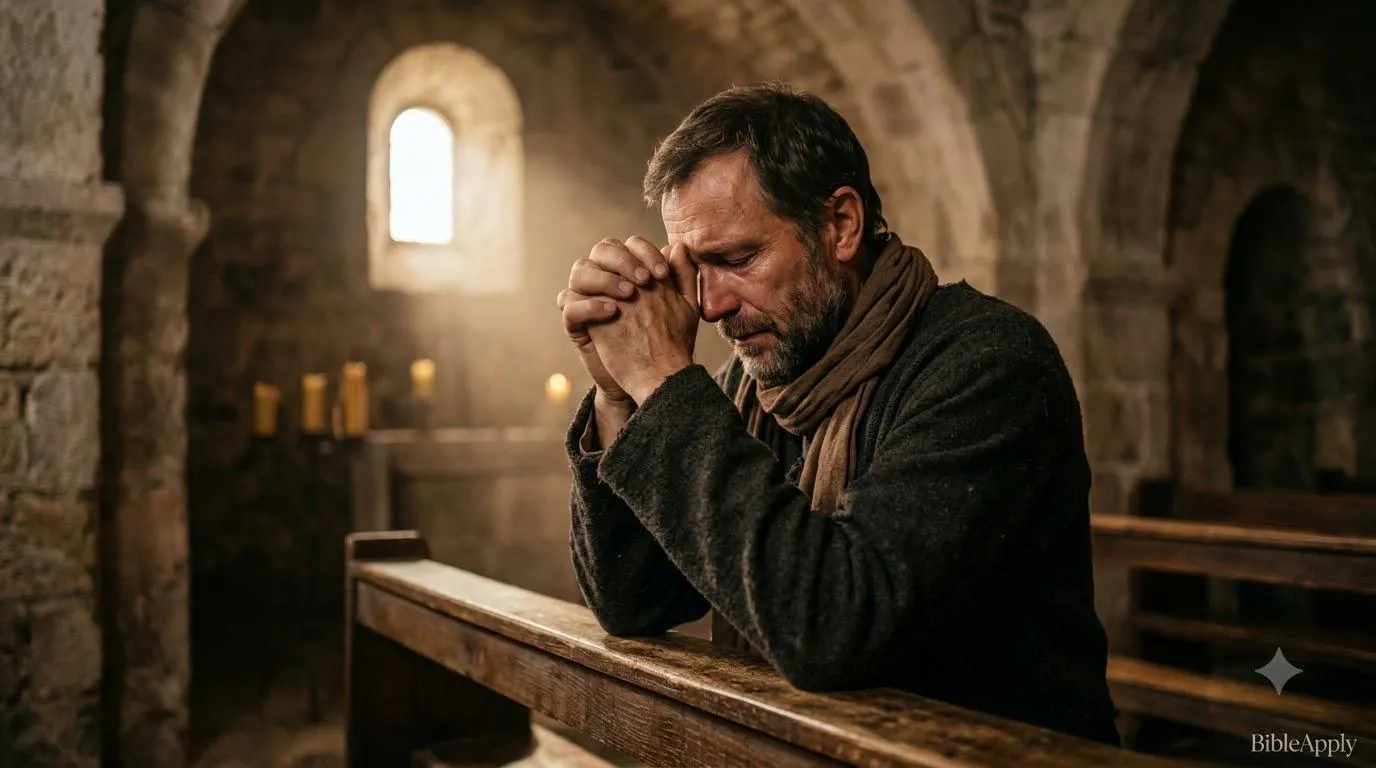
Lectio Divina (Divine Reading)
This ancient monastic practice involves a slow, contemplative praying of the Scriptures. It consists of four movements: reading a passage slowly, meditating on a specific word or phrase that stands out, praying that concept back to God, and resting quietly in God’s presence. If you struggle to know what to say, let the Scriptures themselves supply the vocabulary. Praying through a chapter like Psalm 23 line by line is often more fruitful than trying to generate original thoughts.
Breath Prayer
Originating from the early centuries of the Church, breath prayer is a way to “pray without ceasing” (1 Thessalonians 5:17). It involves a short, biblical phrase tied to the rhythm of your breathing. The most famous is the Jesus Prayer: (Inhale) “Lord Jesus Christ, Son of God,” (Exhale) “have mercy on me, a sinner.” It is a vital tool for tethering your anxious mind to the reality of God’s presence during a chaotic workday or a sleepless night.
The Raw Prayers of Scripture: Permission to Bleed
There is a sanitized, Sunday-morning version of prayer that sounds polite, theological, and utterly detached from the grit of human suffering. But when we open the Bible, we find something entirely different. The prayers of Scripture are bloody, desperate, and often shockingly confrontational.
Consider Hannah in 1 Samuel 1:10-16. Barren, humiliated by her rival, and deeply depressed, she goes to the temple and weeps so violently, praying with such erratic fervor, that Eli the priest assumes she is drunk. She does not offer a polite, three-point prayer; she pours out her soul in the bitterness of her anguish. And God hears her.
Look at David, a man after God’s own heart. In Psalm 88, arguably the darkest chapter in the Bible, David accuses God of abandoning him in the pit. The psalm ends with the haunting phrase, “Darkness is my closest friend” (Psalm 88:18). In Psalm 22, he screams, “My God, my God, why have you forsaken me?” (Psalm 22:1). These lament psalms prove that God can handle our anger, our confusion, and our accusations. He prefers our furious honesty over our fabricated piety.
Even Jesus, in the Garden of Gethsemane, models the agony of raw prayer. Sweating drops of blood, crushed by the impending wrath of the cross, He begs, “Father, if you are willing, remove this cup from me” (Luke 22:42). He wrestles openly with the terror of His calling, submitting to the Father’s will only after intense, agonizing struggle. If the Son of God had to wrestle in prayer, we should expect our own prayer lives to resemble a battlefield more often than a spa day.
Questions from the Trenches
Does God hear the prayers of sinners?
A common fear is that our sin forms an impenetrable ceiling, bouncing our prayers back to us. Isaiah 59:2 does warn that “your iniquities have made a separation between you and your God.” If we are actively harboring unrepentant sin and mocking God’s commands, we cannot expect Him to rubber-stamp our requests. However, the prayer of repentance from a broken sinner is the very sound that causes angels to rejoice (Luke 15:10). The tax collector who beat his chest and cried, “God, be merciful to me, a sinner!” went home justified, while the self-righteous Pharisee was ignored (Luke 18:13-14). God does not require you to clean yourself up before you speak to Him; speaking to Him is how the cleaning begins.
Can I pray when I’m angry at God?
Absolutely. The biblical category for this is lament. As we saw in the Psalms, God invites our unfiltered grief and anger. Storing up resentment toward God because you are trying to be “respectful” is a form of spiritual slow-death. Tell Him that you are furious about the cancer diagnosis. Tell Him you feel abandoned in your divorce. The reformer Martin Luther was known for his fierce, wrestling prayers, arguing with God based on His promises. Anger directed at God, when brought to God in prayer, is actually an profound act of faith. It proves you still believe He is there and that He holds the power to change things.
What if I feel absolutely nothing when I pray?
Spiritual dryness is a universal experience among serious Christians. St. John of the Cross called this the “Dark Night of the Soul.” When the emotional consolations of prayer vanish, we are presented with a unique opportunity: we get to prove that we love God for who He is, not just for the good feelings He provides. Praying when you feel nothing is a massive exercise in spiritual muscle-building. You are walking by faith, not by sight (2 Corinthians 5:7). Keep showing up, trusting that the Holy Spirit intercedes for us with groanings too deep for words (Romans 8:26).
Wisdom from the Saints
Throughout history, men and women who have forged deep paths of prayer leave behind breadcrumbs for us to follow.
Brother Lawrence, a 17th-century monk assigned to kitchen duty, wrote a short compilation called The Practice of the Presence of God. He learned to commune with God not just in the chapel, but while washing dishes and repairing sandals. He noted, “The time of business does not with me differ from the time of prayer; and in the noise and clatter of my kitchen… I possess God in as great tranquility as if I were upon my knees at the blessed sacrament.” Prayer, for him, was an unbroken, running dialogue throughout the mundane tasks of life.
George Müller, a 19th-century evangelist who cared for thousands of orphans in Bristol, England, never once asked for financial donations. He simply prayed and asked God to provide. But Müller recognized the priority of the heart in prayer. He wrote, “The first great and primary business to which I ought to attend every day is, to have my soul happy in the Lord. The first thing to be concerned about was not, how much I might serve the Lord, how I might glorify the Lord; but how I might get my soul into a happy state, and how my inner man might be nourished.”
The Unfinished Conversation
There is no predictable bow to tie around the mystery of prayer. We will always wrestle with why some prayers are answered with miraculous speed while others are met with years of agonizing silence. We will always struggle to keep our minds from drifting to our grocery lists while we intercede for the nations.
But the call remains. The veil of the temple has been torn in two (Matthew 27:51), granting us direct access to the Holy of Holies. The God who spoke the universe into existence bends His ear to hear the whispered anxieties of a mother rocking a sick child at three in the morning.
You do not need better vocabulary; you simply need to begin. Open your Bible, read a Psalm out loud, and let the dialogue commence. Your Father is waiting.