

Quick Answer: When Joshua commanded the sun to stand still, God intervened in human history. Whether through celestial mechanics, atmospheric refraction, or poetic language, the text shows Yahweh’s ultimate supremacy over rival gods.
Joshua 10 often creates a wall of intellectual and scientific friction for modern readers. The narrative describes Joshua commanding the celestial bodies to halt, making the sun stand still over the valley of Aijalon so the Israelite army could complete their victory. For many, this account feels like a bridge too far.
We know the sun doesn’t move across the sky; the Earth rotates on its axis. If the Earth suddenly halted its rotation, catastrophic inertia would theoretically tear the planet apart. This reality forces us to ask what exactly happened on that battlefield.
The question of whether the sun actually stood still strikes at the heart of how we read scripture. Skeptics view the story as prime evidence that the Bible is a collection of pre-scientific myths. Believers, on the other hand, can find it to be a source of quiet anxiety. It often becomes a passage we prefer to gloss over rather than defend.
Yet grappling with this event forces us to dive into the ancient Hebrew text and the cultural context of the ancient Near East. When we examine the linguistic nuances, literary genres, and theological messages, we discover a much richer text.
A Pastoral Note: We’ve all hit moments where the math just doesn’t work out and we need a literal miracle. I’ve sat in enough ICU waiting rooms to know that when you’re desperate, you don’t care about celestial mechanics or atmospheric refraction. You just need to know if the God who made the world can actually step into it and stop the bleeding. Joshua 10 isn’t just an ancient science puzzle. It’s a reminder that God isn’t trapped by His own physical laws when His people are crying out for help.
The Biblical Context of the Miracle
To understand the miracle, we must first look at the setting. Joshua and the Israelites had recently entered the Promised Land. They had forged a controversial treaty with the Gibeonites, leading five Amorite kings to form a coalition and attack Gibeon. Joshua honors the treaty, marching his army all night from Gilgal to launch a surprise attack.
As the Amorites flee, God intervenes. He hurls massive hailstones from the sky, killing more enemy soldiers than the Israelites did with the sword. In the midst of this chaotic rout, Joshua steps forward and speaks:
“At that time Joshua spoke to the LORD in the day when the LORD gave the Amorites over to the sons of Israel, and he said in the sight of Israel, ‘Sun, stand still at Gibeon, and moon, in the Valley of Aijalon.’ And the sun stood still, and the moon stopped, until the nation took vengeance on their enemies. Is this not written in the Book of Jashar? The sun stopped in the midst of heaven and did not hurry to set for about a whole day. There has been no day like it before or since, when the LORD heeded the voice of a man, for the LORD fought for Israel.” (Joshua 10:12-14, ESV)
This bold prayer and its astonishing result represent one of the most unique miraculous events in Scripture. But what exactly happened in the sky that day?
Examining the Original Hebrew: Dom and Amad
A careful study of the original Hebrew language opens up several possibilities. The primary verb Joshua uses when commanding the sun is dom (דּוֹם), an imperative form of the root damam.
In most English Bibles, dom is translated as “stand still.” However, the primary meaning of damam in the Hebrew Bible is “to be silent,” “to cease,” or “to wait.” For example, in Psalm 4:4, it is translated as “be silent.”
The second verb used in verse 13 to describe what the sun and moon actually did is amad (עָמַד). This generally means “to stand,” “to remain,” or “to stop.” The phrase “did not hurry to set” comes from the Hebrew lo atz labo, which literally means “did not hasten to come [down].”
Because of the semantic range of these Hebrew words, biblical scholars have proposed several different models for understanding what historically occurred.
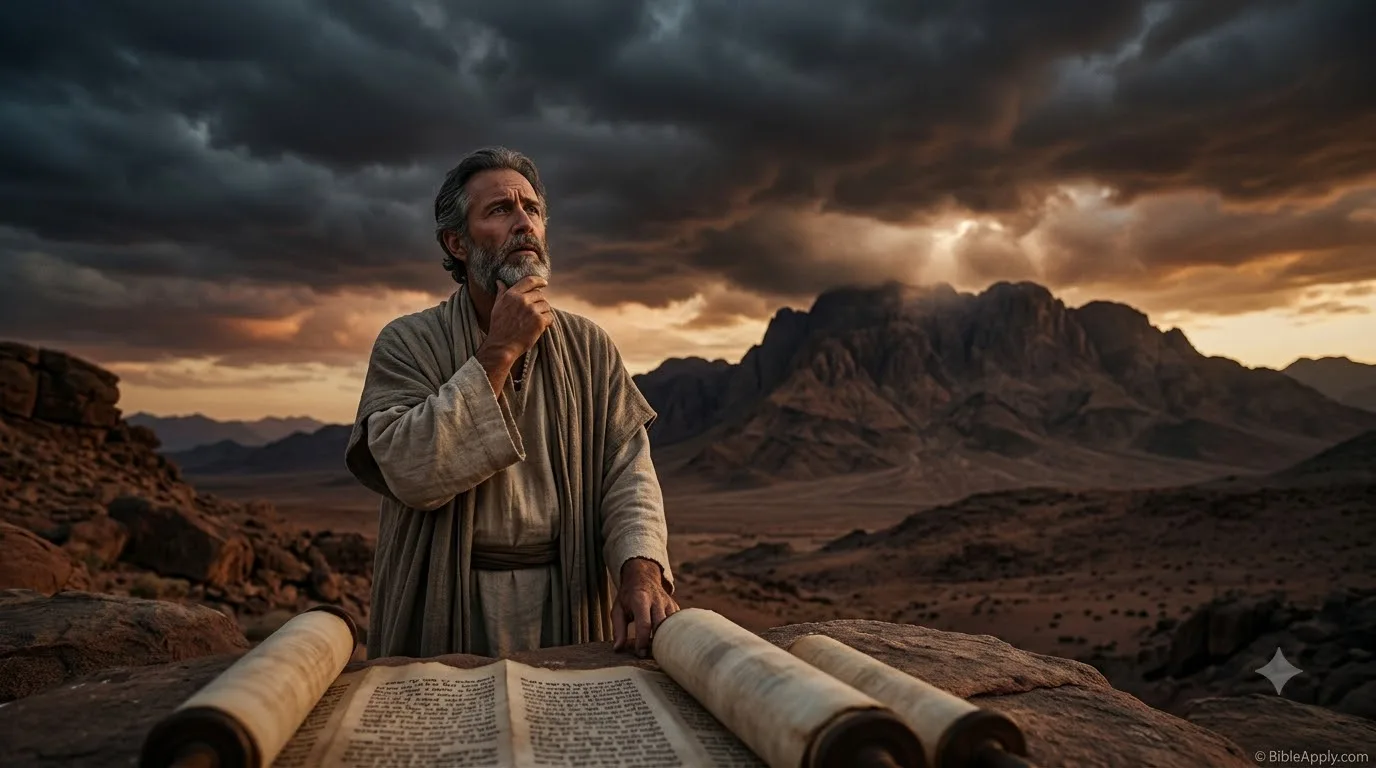
Four Major Views on the Long Day of Joshua
1. The Phenomenological / Literal View (Cessation of Rotation)
Historically, the most common interpretation is that God miraculously halted or slowed the rotation of the Earth. This caused the sun and moon to appear stationary in the sky for nearly twenty-four hours.
Proponents argue that the Creator of the universe can easily suspend the laws of physics. Just as a programmer can pause a simulation, God can halt the Earth’s rotation while dampening the cataclysmic effects of inertia. This view takes the text at its most straightforward face value.
2. The Optical Refraction View
Some scholars suggest God employed a localized, atmospheric miracle rather than stopping the Earth entirely. Through miraculous manipulation of the atmosphere, God could have refracted the light of the sun and moon.
This would cause them to remain visible over the battlefield long after they technically set below the horizon. It created the appearance of the sun standing still, providing the extra daylight Joshua needed without freezing the cosmos.
3. The Solar Eclipse View (Cessation of Shining)
A fascinating view leans heavily on translating damam as “to cease” or “be silent.” Ancient Near Eastern astronomical texts sometimes use similar terminology to describe an eclipse.
In this view, Joshua wasn’t asking for prolonged daylight, but for relief from the blistering midday heat. He prayed for the sun to “cease” its fierce shining.
An annular solar eclipse would cause the sun’s light to dim significantly and the temperature to drop. This would allow the Israelite soldiers to continue their intense physical exertion. A total or near-total eclipse would also explain the appearance of both the sun and the moon in the same sky.
4. The Poetic / Figurative View
Joshua 10:12b-13a is formatted as poetry in the Hebrew text and explicitly quotes from the “Book of Jashar.” This was an ancient collection of Hebrew poetry and heroic songs, now lost to history.
In poetry, cosmic imagery frequently describes historical events. In Judges 5:20, Deborah sings that “from heaven the stars fought against Sisera.” No one believes literal stars descended to the battlefield; it is poetic imagery for divine intervention.
Advocates of this view argue Joshua 10 uses poetic hyperbole to say God accomplished two days’ worth of work in a single day. The “sun standing still” is a poetic triumph, not a scientific treatise.
Addressing Common Objections
“Science proves this couldn’t happen.”
The most frequent objection to the literal view is the problem of inertia. If the Earth, rotating at roughly 1,000 mph at the equator, suddenly stopped, oceans would wash over continents.
However, this objection assumes a God who is bound by the universe He created. If a deity possesses the power to speak a universe into existence, suspending planetary rotation is logically consistent.
A miracle is an exception to the natural order. Dismissing the text because it violates natural laws rules out a miracle-working God from the start.
“It’s just an ancient myth stolen from other cultures.”
Critics point to other ancient cultures with myths about elongated days or nights, suggesting the biblical author copied a popular trope. However, this could actually serve as corroborating evidence.
If a globally observable astronomical anomaly occurred, multiple ancient cultures would likely record the phenomenon in their mythologies. The biblical account simply provides the theological reasoning behind the historical event.
The Theological Significance: Why Does It Matter?
Regardless of which mechanical interpretation you hold, the theological message of the text is unambiguous. It was devastating to the surrounding Canaanite culture.
In the ancient Near East, the sun and the moon were chief deities. The Amorites and Canaanites worshipped Shamash, the sun god, and Yarih, the moon god.
When Joshua commands the sun and the moon to stand still, the theological statement is thunderous. Yahweh, the God of Israel, is the supreme sovereign over the cosmos.
The gods of the Canaanites were completely subjugated to Yahweh’s will. Shamash and Yarih were forced to light the way for the destruction of their own worshippers.
The ultimate point of the narrative isn’t celestial mechanics. It is the shocking covenant faithfulness of God. The Creator of the universe listened to a human leader and intervened in history to keep His promises.
3 Practical Applications
1. Bring your most audacious prayers to God
Joshua’s prayer is astonishing in its audacity. He didn’t merely pray for strength to fight; he prayed for the cosmos to halt.
Often, our prayers are small and safe because our view of God’s power is small and safe. The long day of Joshua reminds us that we serve a God of infinite power. Ask boldly, and trust His sovereign answer.
2. Remember that God fights for you
The text tells us the sun stood still because “the Lord fought for Israel.” The Israelites still had to swing their swords, but the victory depended entirely on divine intervention.
In our own spiritual battles, we are not fighting alone. God is actively engaged in the defense of His people. Even when you feel exhausted, rest in the reality that God is on the battlefield with you.
3. Let the mystery of scripture drive you to worship
We may never know the exact physics of Joshua 10 on that fateful day. But we don’t need to know the physics to know the character of the God who performed it.
When we encounter passages that challenge modern sensibilities, we should dig deep and explore the context. Ultimately, we must allow the sheer majesty of an incomprehensible God to lead us to worship.