2 Kings Chapter Summaries
A complete, chapter-by-chapter guide to the Book of 2 Kings. Read deep dives into the meaning, historical context, and modern application of every chapter.
Welcome to our complete guide to the Book of 2 Kings. Below you will find a chapter-by-chapter summary that flows through the entire narrative, helping you understand the context, meaning, and application of this profound book.
Chapter 1: Elijah Calls Down Fire
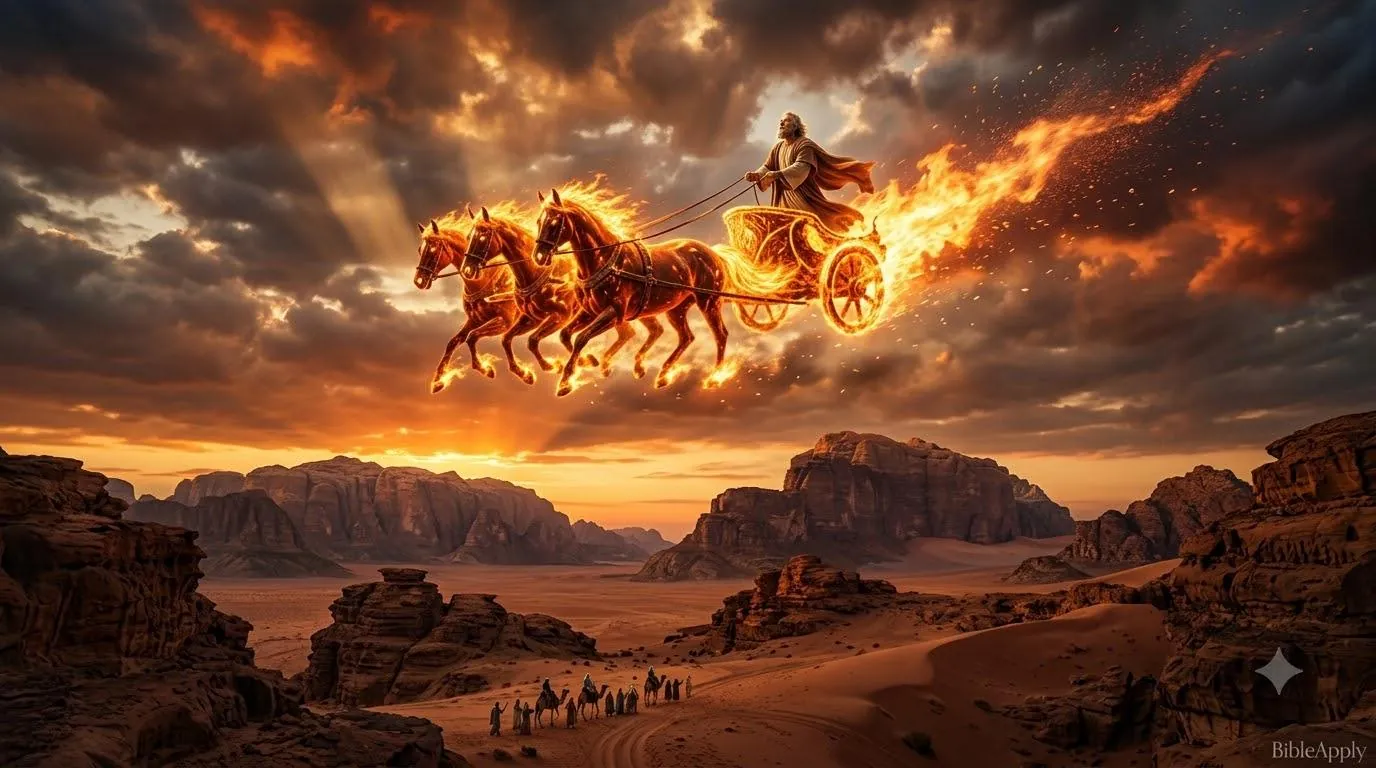
The Books of 1 and 2 Kings were originally a single scroll in the Hebrew Bible, recounting the dramatic history of the Israelite monarchy from the glorious reign of Solomon to the tragic exile of the nation. As 2 Kings opens, the unified kingdom has long since fractured into two distinct nations: Israel in the north and Judah in the south. The narrative immediately plunges us into the chaotic aftermath of King Ahab’s death, a ruler infamous for institutionalizing Baal worship in the Northern Kingdom alongside his wicked queen, Jezebel.
Against this backdrop of systemic apostasy, Chapter 1 sets the stage for the rest of the book. It is a transitional period, not only marking the shift from Ahab’s dynasty to his son Ahaziah, but also serving as the twilight of Elijah’s prophetic ministry before he passes the mantle to Elisha. The book is fundamentally a theological history, demonstrating that Israel’s fortunes rise and fall not based on military might or political alliances, but entirely upon their covenant faithfulness to Yahweh.
In this dramatic opening act, 2 Kings 1 draws a sharp line in the sand regarding true authority. When Ahaziah seeks supernatural guidance from a Philistine deity, God sends Elijah to intervene with a message of judgment. The ensuing confrontation between the sickly king’s military detachments and the solitary prophet of Yahweh starkly illustrates the futility of human power when arrayed against the Sovereign Lord. It is a chapter that vividly reminds us that Yahweh alone is God in Israel, and He will not share His glory with another.
Rebellion and the Fall of Ahaziah
The chapter begins with two critical pieces of information that establish the crisis: national rebellion and personal tragedy.
“After the death of Ahab, Moab rebelled against Israel. Now Ahaziah fell through the lattice in his upper chamber in Samaria, and lay sick; so he sent messengers, telling them, ‘Go, inquire of Baal-zebub, the god of Ekron, whether I shall recover from this sickness.’” (2 Kings 1:1-2, ESV)
The Loss of National Security
The opening verse briefly notes that Moab, a vassal state, rebelled against Israel following Ahab’s death. This is not merely a historical footnote; it is a theological statement. In the ancient Near East, the strength of a nation was directly tied to the blessing of its gods. For Israel, military dominance over its neighbors was a promised covenant blessing for obedience (Deuteronomy 28:1, 7). Conversely, oppression by foreign nations was a covenant curse for disobedience (Deuteronomy 28:25). Moab’s successful rebellion is a symptom of Israel’s spiritual sickness under the house of Omri. The protective hand of Yahweh is withdrawing.
The Foolishness of Idolatry
Ahaziah’s physical fall through the lattice is symbolic of the spiritual fall of his administration. Gravely injured, the king faces his mortality. Yet, in his desperation, he does not turn to the God of his ancestors, the God who delivered Israel from Egypt. Instead, he sends messengers to “Baal-zebub, the god of Ekron.”
The name Baal-zebub is likely a mockery of the deity’s actual title, “Baal-zebul” (Lord of the High Place or Prince Baal), corrupted by Hebrew scribes into “Lord of the Flies.” Ekron was a prominent Philistine city, and seeking out a foreign god was an act of profound spiritual treason. Ahaziah is treating Yahweh as irrelevant or non-existent, preferring the supposed oracle of an idol. This reveals the deep entrenchment of idolatry in the Northern Kingdom; even in the face of death, the king’s reflex is to seek pagan counsel rather than divine mercy.
For a deeper study, see our guide on Jeremiah 29:11 Meaning: For I Know the Plans I Have for You which many readers have found helpful.
The Inevitable Confrontation: Elijah vs. The King
God does not remain silent while His covenant king consults demons. He intercepts the king’s messengers through His chosen instrument, Elijah the Tishbite.
If you want to explore this further, our in-depth guide on romans 8 28 breaks this down verse by verse.
The Word of the Lord Intervenes
“But the angel of the LORD said to Elijah the Tishbite, ‘Arise, go up to meet the messengers of the king of Samaria, and say to them, ‘Is it because there is no God in Israel that you are going to inquire of Baal-zebub, the god of Ekron? Now therefore thus says the LORD, You shall not come down from the bed to which you have gone up, but you shall surely die.’’ So Elijah went.” (2 Kings 1:3-4, ESV)
The rhetorical question God poses through Elijah is piercing: “Is it because there is no God in Israel?” This is the central theological issue of the chapter and the entire book of Kings. Ahaziah’s actions are a functional atheism regarding Yahweh. God’s response is swift and decisive. He answers the king’s inquiry before the messengers even reach Ekron, demonstrating His omniscience and supremacy. The verdict is a death sentence. Yahweh, not Baal-zebub, determines the king’s fate.
The Prophet Recognized
When the messengers return prematurely to the king and relay the message, Ahaziah asks for a description of the man who spoke to them.
“They answered him, ‘He wore a garment of hair, with a belt of leather about his waist.’ And he said, ‘It is Elijah the Tishbite.’” (2 Kings 1:8, ESV)
Elijah’s distinctive attire—a rough, hairy garment and a leather belt—marked him as an ascetic outsider, a man untamed by the luxuries of the royal court. This stark appearance was a visual rebuke to the soft, compromising culture of the monarchy. It also became the archetypal look for a prophet, famously adopted centuries later by John the Baptist (Matthew 3:4). Ahaziah instantly recognizes the description. The king knows exactly who he is dealing with: the man who had confronted his father Ahab, called down fire on Mount Carmel, and pronounced doom upon his mother Jezebel.
The Clash of Authorities: Fire from Heaven
Faced with a prophetic death sentence, Ahaziah responds not with repentance, but with arrogance. He attempts to arrest the prophet, seeking to assert royal authority over divine authority. What follows is a dramatic demonstration of God’s power protecting His messenger.
Also Read:
- Deuteronomy 1 Summary & Meaning: The Tragedy of Unbelief
- Colossians 1 Summary & Meaning: The Supremacy and Sufficiency of Christ
- Zephaniah 1 Summary & Meaning: The Approaching Day of the Lord
The Arrogance of the First Captain
“Then the king sent to him a captain of fifty men with his fifty. He went up to Elijah, who was sitting on the top of a hill, and said to him, ‘O man of God, the king says, “Come down.”’” (2 Kings 1:9, ESV)
The king sends a military detachment of fifty men. This is a show of force, an attempt to intimidate Elijah. The captain addresses Elijah as a “man of God,” but the title is spoken with contempt rather than reverence, overshadowed by the command, “the king says.” The captain demands that Elijah submit to the king’s authority.
Elijah’s response is a terrifying manifestation of God’s defense of His prophet:
“But Elijah answered the captain of fifty, ‘If I am a man of God, let fire come down from heaven and consume you and your fifty.’ Then fire came down from heaven and consumed him and his fifty.” (2 Kings 1:10, ESV)
The fire from heaven is not a display of petty vindictiveness by Elijah, but a divine judgment. It echoes the fire that fell on Mount Carmel (1 Kings 18). It proves conclusively that Elijah is indeed a true “man of God” and that the word he speaks carries the weight of Almighty God. The king’s military power is utterly obliterated by the spoken word of the prophet.
The Stubbornness of the Second Captain
Incredibly, Ahaziah does not yield. His heart, much like Pharaoh’s in Exodus, is hardened. He sends a second captain of fifty, who exhibits even greater insolence.
“Again the king sent to him another captain of fifty men with his fifty. And he answered and said to him, ‘O man of God, this is the king’s order, “Come down quickly!”’” (2 Kings 1:11, ESV)
The second captain not only repeats the command but adds urgency: “quickly!” He has learned nothing from the fiery demise of his predecessor. He continues to assert the primacy of the king’s decree over the prophet’s position. The result is identical: Elijah calls down fire, and the second detachment is consumed. This repetition underscores the absolute folly of opposing God and the devastating consequences of refusing to learn from divine judgment.
The Humility of the Third Captain
The climax of this confrontation comes with the third captain. This man approaches the situation with a fundamentally different posture.
“Again the king sent the captain of a third fifty with his fifty. And the third captain of fifty went up and came and fell on his knees before Elijah and entreated him, ‘O man of God, please let my life, and the life of these fifty servants of yours, be precious in your sight.’” (2 Kings 1:13, ESV)
This captain recognizes the true hierarchy of power. He does not come demanding obedience to the king; he comes pleading for mercy from God’s representative. He falls on his knees, an act of submission, and acknowledges his men as Elijah’s “servants.” He values his life and fears the God who answers by fire.
If this resonates with you, our deep dive into Psalm 91 Meaning: He Who Dwells in the Shelter explores the scriptural foundation further.
Because of his humility and reverence, the angel of the Lord instructs Elijah to go down with him. God spares those who fear Him. The contrast between the first two captains and the third is a timeless lesson in how humans must approach the Holy God—not with demands and reliance on earthly authority, but with humble submission and a plea for grace.
The Fulfillment of the Prophetic Word
Elijah fearlessly accompanies the captain into the presence of King Ahaziah. Despite the hostile environment of the royal court, Elijah does not alter his message.
“He said to him, ‘Thus says the LORD, “Because you have sent messengers to inquire of Baal-zebub, the god of Ekron—is it because there is no God in Israel to inquire of his word?—therefore you shall not come down from the bed to which you have gone up, but you shall surely die.”’” (2 Kings 1:16, ESV)
Elijah speaks truth to power, reaffirming the sentence of judgment directly to the king’s face. The narrative then swiftly concludes the episode with cold, historical finality.
“So he died according to the word of the LORD that Elijah had spoken. Jehoram became king in his place in the second year of Jehoram the son of Jehoshaphat, king of Judah, because Ahaziah had no son.” (2 Kings 1:17, ESV)
The text emphasizes that Ahaziah died exactly “according to the word of the LORD.” God’s word is sovereign and unfailing. Kings rise and fall, armies are consumed by fire, but the word of God stands forever. Ahaziah’s reign ends in disgrace, cut short by his own idolatrous folly, passing the troubled kingdom to his brother Jehoram.
3 Practical Applications from 2 Kings 1
While we do not live in the era of ancient theocracies and prophets calling down literal fire from heaven, the theological principles of 2 Kings 1 are deeply relevant to modern believers.
1. Identify and Destroy Your “Ekrons”
When Ahaziah was in crisis, he turned to Baal-zebub of Ekron instead of the living God. We must examine our own hearts: where do we turn first when we are afraid, sick, or in need of guidance? Our “Ekrons” might not be pagan statues; they are more likely to be modern idols. Do we place our ultimate trust in medical science, financial security, political power, or the advice of secular experts before seeking the Lord in prayer and searching His Word? While God uses doctors and counselors, our primary dependence must always be on Him. Seeking ultimate answers or salvation outside of God is a functional denial of His presence and power in our lives.
2. Respect the Authority of God’s Word
The conflict between Ahaziah and Elijah was a clash between human authority and divine authority. Ahaziah believed his royal commands could override the prophet of God. The fire from heaven proved otherwise. Today, we must maintain a high view of Scripture. When cultural norms, political pressures, or even our own desires conflict with the clear teaching of God’s Word, we must submit to God. We must not be like the arrogant captains who demanded that God conform to their agenda. Instead, we must be like the third captain, approaching God’s revelation with humility, reverence, and a readiness to obey, even when it challenges our preconceived notions.
3. Cultivate Humility in the Face of Judgment
The fate of the first two captains is a sobering warning about the dangers of spiritual pride and stubbornness. They witnessed (or at least knew of) God’s judgment, yet persisted in their rebellion. The third captain modeled the correct response: he fell on his knees and pleaded for mercy. When we are confronted with our sin or face the disciplinary hand of God, our response must not be defensiveness or arrogance. We must embrace true repentance, humbling ourselves before the Lord. God resists the proud, but gives grace to the humble (James 4:6). The third captain survived because he recognized his utter helplessness and cast himself upon the mercy of God’s representative—a beautiful foreshadowing of how we find salvation by casting ourselves upon the mercy of Christ.
Also Read
- Genesis 1 Summary & Meaning: In the Beginning
- 2 Corinthians 1 Summary & Meaning: The God of All Comfort and the ‘Yes’ in Christ
- Revelation 1 Summary & Meaning: The Unveiling of the Glorified Christ
Read 2 Kings 1
Dive into the full scripture text for deeper study.
Chapter 2: Elijah's Ascent and Elisha's Succession
Elisha requests a double portion of Elijah’s spirit, a request granted only if he sees Elijah taken away. Suddenly, a chariot of fire and horses of fire appear, separating them, and Elijah is taken up to heaven in a whirlwind. Elisha tears his clothes in mourning, picks up Elijah's fallen cloak, and strikes the Jordan, which parts for him, confirming his succession. Elisha then performs his first miracles: purifying the poisonous waters of Jericho and cursing youths who mock him, resulting in two bears mauling them.
Chapter 3: The Campaign Against Moab
Marching through the desert of Edom, the coalition armies run out of water and face disaster. Jehoshaphat seeks a prophet of the Lord, leading them to Elisha. Though Elisha rebukes Joram for his idolatry, out of respect for Jehoshaphat, he prophesies that the dry valley will fill with water without rain or wind, and that God will deliver Moab into their hands. The next morning, water miraculously floods the trenches. To the Moabites, the water appears red as blood, tricking them into a reckless attack, resulting in their crushing defeat.
Chapter 4: Elisha’s Miracles of Provision and Life
Next, a wealthy Shunammite woman provides hospitality to Elisha. In return, Elisha prophesies she will bear a son, despite her husband's old age. Years later, the boy dies suddenly. The desperate mother rushes to Elisha, who goes to her home, prays, and restores the boy to life. Later, during a famine in Gilgal, Elisha purifies a poisonous stew prepared by the prophets. Finally, he feeds a hundred men with only twenty loaves of barley bread, miraculously multiplying the food with leftovers to spare.
Chapter 5: The Healing of Naaman
Initially furious at the lack of ceremony and the muddy Jordan, Naaman is persuaded by his servants to obey. After dipping seven times, his skin is completely restored. Overjoyed, Naaman pledges worship to Yahweh alone. However, Elisha's greedy servant, Gehazi, secretly follows Naaman to request a talent of silver and garments under false pretenses. When Elisha confronts Gehazi about his deception, Naaman's leprosy is transferred to Gehazi and his descendants forever.
Chapter 6: The Floating Axhead and the Blinded Arameans
The Aramean king sends a massive army to surround Dothan and capture Elisha. Elisha's servant is terrified, but Elisha prays for his eyes to be opened, revealing hills filled with angelic chariots of fire. Elisha prays for the Arameans to be struck with blindness, leading them directly into Samaria. Instead of executing them, Elisha instructs the Israelite king to feed them and send them home, ending the Aramean raids.
Chapter 7: The Siege of Samaria Broken
That evening, four desperate lepers outside the city gates decide to surrender to the Arameans, reasoning they will die either way. They discover the camp completely abandoned; the Lord had caused the Arameans to hear the sound of a massive army, prompting them to flee in terror, leaving all their supplies behind. The lepers feast and loot before finally alerting the city. The prophecy is fulfilled, and the skeptical officer is trampled to death in the stampede for food.
Chapter 8: The Shunammite's Return and Hazael's Usurpation
Elisha then travels to Damascus, where King Ben-Hadad of Aram is gravely ill. The king sends Hazael to inquire if he will recover. Elisha prophesies that Ben-Hadad will die and weeps, foreseeing the terrible atrocities Hazael will commit against Israel when he becomes king. Hazael returns, suffocates Ben-Hadad with a thick, wet cloth, and seizes the throne. Meanwhile, in Judah, Jehoram and then Ahaziah take the throne, both acting wickedly by following the sinful practices of Ahab's house.
Chapter 9: Jehu Anointed King and Ahab's Downfall
King Joram of Israel and King Ahaziah of Judah ride out to meet Jehu. When Joram realizes it is treason, he attempts to flee, but Jehu shoots him with an arrow, throwing his body onto the property of Naboth, fulfilling Elijah's prophecy. Ahaziah is also pursued and mortally wounded. Jehu then arrives at Jezreel, where Jezebel adorns herself and looks out a window. Jehu commands her eunuchs to throw her down. She is trampled by horses, and dogs devour her flesh, exactly as Elijah had foretold, leaving nothing but her skull, feet, and hands.
Chapter 10: Jehu Eradicates Baal Worship
Feigning zeal for Baal, Jehu summons all of Baal's prophets and worshippers for a massive sacrifice in the temple of Baal. Once they are gathered and trapped inside, Jehu orders his guards to slaughter every single one of them. He demolishes the sacred stone and turns the temple into a latrine, completely eradicating Baal worship from Israel. However, despite his zeal in destroying Ahab's line and Baal worship, Jehu fails to turn away from the golden calves at Bethel and Dan, losing God's full favor.
Chapter 11: Athaliah's Reign of Terror and Joash's Rise
In the seventh year, Jehoiada the priest orchestrates a brilliant coup. He gathers the commanders and guards, arming them with King David's spears and shields. They bring young Joash out, crown him, and anoint him king, shouting, 'Long live the king!' Hearing the commotion, Athaliah rushes to the temple, crying 'Treason!' Jehoiada orders her execution outside the temple precincts. The priest then leads the people in a renewed covenant with God, destroying the temple of Baal and its altars.
Chapter 12: Joash Repairs the Temple
Initially, Joash commands the priests to use incoming funds to repair the temple, but by his twenty-third year, no progress has been made. He confronts Jehoiada and establishes a new system: a chest is placed near the altar to directly collect silver from worshippers. This money is given to honest supervisors who pay carpenters, builders, and masons to restore the temple structure. Later, under threat from King Hazael of Aram, Joash strips the temple and palace of their sacred treasures to pay a ransom. Ultimately, Joash's own officials conspire against him and assassinate him.
Chapter 13: Jehoahaz, Jehoash, and the Death of Elisha
Meanwhile, the prophet Elisha falls terminally ill. King Jehoash visits him, weeping over the impending loss of Israel's spiritual defender. Elisha instructs the king to shoot an arrow out the window, declaring it the Lord's arrow of victory over Aram. He then tells Jehoash to strike the ground with the remaining arrows. The king strikes only three times, angering Elisha, who states that because of his lack of zeal, Israel will only defeat Aram three times instead of destroying them completely. Elisha dies, but his miraculous power persists—a dead man tossed into Elisha's tomb is revived upon touching his bones.
Chapter 14: Amaziah of Judah and Jeroboam II of Israel
The two armies clash at Beth Shemesh, and Judah is utterly routed. Jehoash captures Amaziah, marches to Jerusalem, tears down a large section of its wall, and plunders the temple and palace treasures before returning to Samaria. Years later, Amaziah is assassinated by conspirators. In Israel, Jeroboam II ascends to the throne. Despite his wickedness, Jeroboam restores Israel's borders from Lebo Hamath to the Dead Sea, fulfilling the prophecy of Jonah. God shows mercy to Israel during his reign, temporarily sparing them from destruction.
Chapter 15: A Succession of Kings and Assyrian Threat
Menahem ruthlessly solidifies his power and faces a new existential threat: Tiglath-Pileser, king of Assyria. Menahem forces Israel's wealthy to pay a massive tribute to secure Assyrian backing. Following Menahem's death, his son Pekahiah rules briefly before his officer, Pekah, murders him. During Pekah's reign, the Assyrian empire begins dismantling Israel, capturing key cities in the north and deporting citizens. Finally, Hoshea assassinates Pekah, marking the final violent transition before Israel's ultimate downfall.
Chapter 16: Ahaz's Idolatry and Desecration
Ahaz strips the silver and gold from the Lord's temple to bribe Assyria, who then attacks Damascus and kills Rezin. While visiting Tiglath-Pileser in Damascus, Ahaz is enamored by a pagan altar. He sends detailed plans back to Uriah the priest in Jerusalem, demanding a replica be built. Upon his return, Ahaz boldly offers sacrifices on this new altar, displaces the bronze altar of Yahweh, and makes sweeping, profane alterations to the temple furnishings to appease the Assyrian king.
Chapter 17: The Fall of Samaria and Exile of Israel
The author provides a sweeping theological indictment: Israel fell because they blatantly rebelled against Yahweh. They built high places, worshipped idols, sacrificed their children, and ignored the relentless warnings of the prophets. To repopulate the land, the Assyrian king resettles foreigners in Samaria. When these settlers are attacked by lions, they request an Israelite priest to teach them the 'requirements of the god of the land.' The result is a syncretic religion where the new Samaritans worship the Lord but also serve their own pagan idols.
Chapter 18: Hezekiah's Faith and Sennacherib's Threat
However, King Sennacherib of Assyria sweeps through Judah, capturing fortified cities. Hezekiah attempts to buy him off with temple gold, but the Assyrian army marches on Jerusalem regardless. Sennacherib's field commander, the Rabshakeh, stands before the walls of Jerusalem and delivers a terrifying, mocking speech in Hebrew. He belittles Hezekiah's military strength, claims Yahweh sent Assyria to destroy them, and demands immediate surrender, sowing deep fear and despair among the people on the wall.
Chapter 19: Deliverance from Assyria
Hezekiah takes the letter into the temple, spreading it before the Lord in a beautiful, desperate prayer acknowledging God's supremacy over all kingdoms. Isaiah returns with a prophecy of utter defeat for Assyria, declaring that God will defend His city. That very night, the angel of the Lord sweeps through the Assyrian camp, striking down 185,000 soldiers. A devastated Sennacherib retreats to Nineveh, where he is eventually assassinated by his own sons while worshipping in the temple of his god, exactly as Isaiah prophesied.
Chapter 20: Hezekiah's Illness and Pride
Following his recovery, envoys from Babylon arrive with gifts. In a moment of foolish pride, Hezekiah gives them a comprehensive tour of his treasuries, armories, and everything in his kingdom. Isaiah confronts him, delivering a chilling prophecy: all the wealth he has shown, and even some of his own descendants, will eventually be carried off into Babylonian captivity. Hezekiah selfishly accepts the word, relieved that there will at least be peace during his own lifetime.
Chapter 21: The Wickedness of Manasseh and Amon
Because of Manasseh's extreme abominations, which surpassed even the pagan nations driven out before Israel, God pronounces severe judgment through His prophets. The Lord declares He will wipe Jerusalem clean like a dish, handing the remnant of Judah over to their enemies for plunder. Manasseh fills Jerusalem from end to end with innocent blood. Upon his death, his son Amon continues the legacy of idolatry and evil. After just two years, Amon’s officials assassinate him in the palace, paving the way for eight-year-old Josiah to take the throne.
Chapter 22: Josiah and the Book of the Law
Shaphan the secretary reads the scroll before the king. Upon hearing the severe covenant curses for disobedience, Josiah tears his clothes in deep distress, realizing the immense wrath God harbors toward Judah for their ancestors' failures. Josiah immediately sends a delegation to inquire of the Lord. They consult the prophetess Huldah, who confirms that utter disaster is indeed coming upon Judah because of their idolatry. However, because Josiah's heart was responsive and he humbled himself before God, the destruction will be delayed until after he goes to his grave in peace.
Chapter 23: Josiah's Reforms and Tragic Death
Josiah commands the nation to celebrate the Passover, resulting in the most faithful observance since the days of the Judges. However, despite his unparalleled zeal, God’s burning anger against Judah remains due to Manasseh's immense sins. Tragically, Josiah is killed in battle by Pharaoh Necho of Egypt at Megiddo. His son Jehoahaz rules briefly before Pharaoh deposes him, placing another son, Jehoiakim, on the throne as an Egyptian vassal.
Chapter 24: Babylonian Invasions and Captivity
Jehoiachin's reign lasts only three months. Nebuchadnezzar returns to lay siege to Jerusalem, and Jehoiachin surrenders. The Babylonian king strips the temple of its treasures and carries away ten thousand captives, including the royal family, the elite commanders, the skilled artisans, and the strongest warriors, leaving only the poorest people in the land. Nebuchadnezzar installs Mattaniah, Jehoiachin's uncle, as a puppet king and renames him Zedekiah. Like his predecessors, Zedekiah does evil and eventually rebels against Babylon, triggering the final, catastrophic destruction of Jerusalem.
Chapter 25: The Fall of Jerusalem
Nebuzaradan, commander of the Babylonian imperial guard, enters Jerusalem and systematically burns it to the ground, destroying the temple of the Lord, the royal palace, and every significant house. He tears down the city walls and exiles the remaining population. The magnificent bronze pillars, sea, and furnishings of the temple are broken up and carried off. A small remnant is left under a governor named Gedaliah, but he is soon assassinated, prompting the terrified survivors to flee to Egypt. The book closes with a glimmer of hope: decades later, the Babylonian king Awil-Marduk releases Jehoiachin from prison, giving him a seat of honor at the royal table.
Conclusion
We hope this chapter-by-chapter summary of 2 Kings has helped you better understand God's Word. To continue your study, explore our other Bible Chapter Summaries or read our detailed Verse Meanings.