2 Chronicles Chapter Summaries
A complete, chapter-by-chapter guide to the Book of 2 Chronicles. Read deep dives into the meaning, historical context, and modern application of every chapter.
Jump to Chapter
Welcome to our complete guide to the Book of 2 Chronicles. Below you will find a chapter-by-chapter summary that flows through the entire narrative, helping you understand the context, meaning, and application of this profound book.
Chapter 1: Solomon's Humble Request for Wisdom
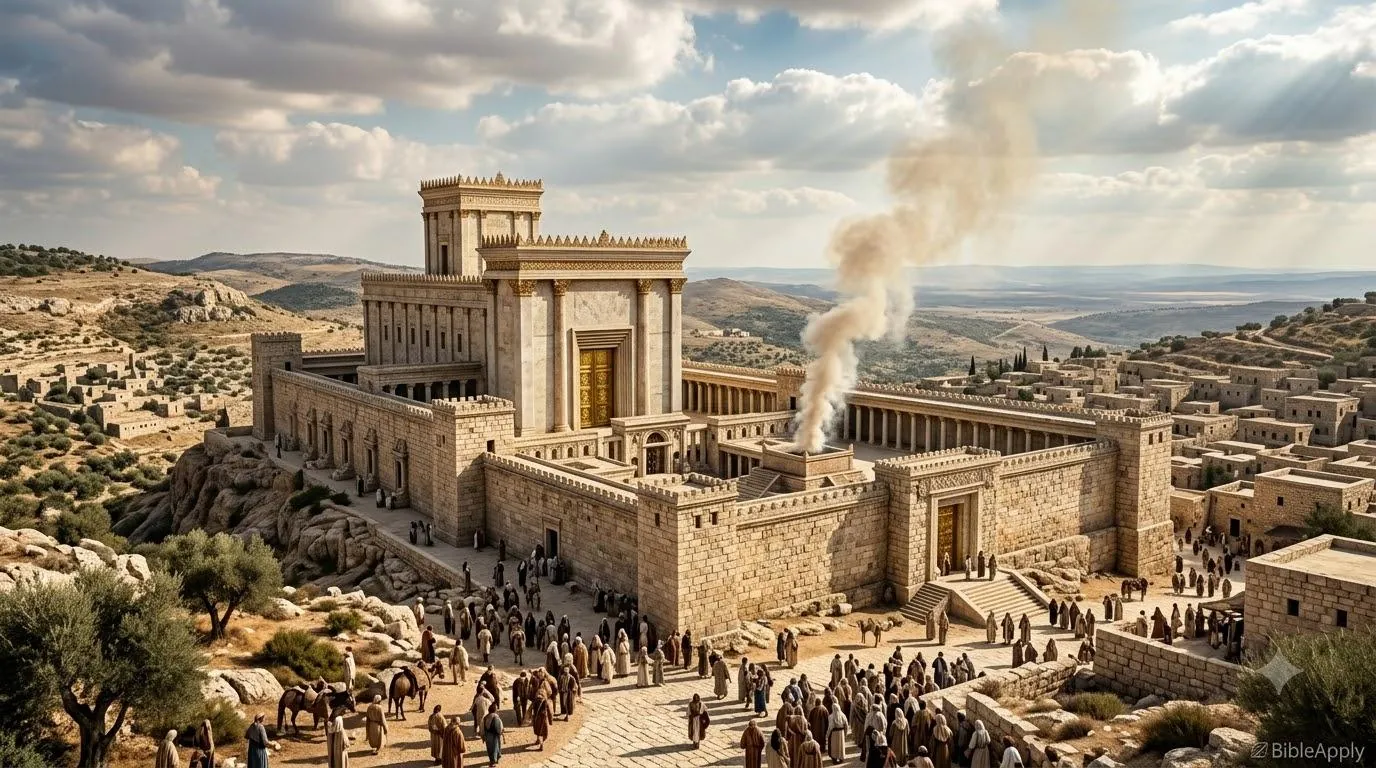
Introduction: The Dawn of a Golden Era
To fully grasp the theological weight of 2 Chronicles, we must first understand its original audience. Unlike the books of Samuel and Kings, which were likely compiled during the Babylonian exile to answer the question, “Why are we in exile—, the Chronicles were written to a post-exilic community. These returning Israelites, struggling to rebuild their lives, the walls of Jerusalem, and the temple under the Persian empire, were asking a different question: “Are we still God’s chosen people? Does the covenant still stand— The Chronicler answers with a resounding “Yes,” focusing heavily on the Davidic covenant, the temple, and proper worship as the foundations of Israel’s identity and hope.
Second Chronicles picks up immediately where 1 Chronicles left off, transitioning from the foundational reign of King David to the magnificent era of his son, King Solomon. David has unified the kingdom, secured its borders, and made extensive preparations for the building of the temple in Jerusalem. Now, the mantle of leadership falls to Solomon. Chapter 1 serves as the prologue to Solomon’s reign, immediately establishing that his authority and success are not merely the result of political maneuvering, but of divine endorsement. The chapter sets the trajectory for the entire kingdom, linking Solomon’s unprecedented prosperity directly to his pursuit of God and his request for divine wisdom.
In this pivotal chapter, we see a masterful theological narrative unfold. The Chronicler emphasizes Solomon’s immediate move to unite the leaders of Israel in worship at Gibeon, his profound humility before God, and God’s overwhelmingly gracious response. By prioritizing the spiritual foundation of Solomon’s reign over political or military achievements, 2 Chronicles 1 sets a timeless precedent: true leadership and lasting legacy are birthed in the presence of God and sustained by His wisdom.
The Assembly at Gibeon and the Pursuit of God (2 Chronicles 1:1-6)
A Kingdom Established by Divine Power
Many believers wrestle with the question of isaiah 41 10 — and Scripture has profound, life-changing answers.
“And Solomon the son of David was strengthened in his kingdom, and the LORD his God was with him, and magnified him exceedingly.” (2 Chronicles 1:1, KJV)
The opening verse of 2 Chronicles sets the thematic tone for the entire book. The phrase “strengthened in his kingdom” (using the Hebrew root chazaq, meaning to fasten upon, to seize, or to be strong) suggests that Solomon’s grip on the throne was firm and secure. However, the text immediately attributes this strength not to Solomon’s military might or political cunning, but to the presence of Yahweh: “the LORD his God was with him.” This echoes the promise made to David and reinforces a central biblical truth: true authority and stability are derived solely from God’s enduring presence. The word “magnified” (gadal) indicates that God made him exceedingly great. This is a direct fulfillment of the Davidic covenant (2 Samuel 7), assuring the returning exiles that God keeps His promises across generations.
The Corporate Act of Worship
Solomon does not begin his reign with a military campaign or a political summit; he begins it with a massive corporate worship service. He summons the captains, judges, governors, and chief of the fathers of all Israel. Together, they journey to the “high place” at Gibeon.
“So Solomon, and all the congregation with him, went to the high place that was at Gibeon; for there was the tabernacle of the congregation of God, which Moses the servant of the LORD had made in the wilderness.” (2 Chronicles 1:3, KJV)
Why Gibeon? While the Ark of the Covenant had been brought to Jerusalem by David and placed in a tent (1 Chronicles 16:1), the original Bronze Altar and the Tabernacle constructed by Moses and Bezalel in the wilderness remained at Gibeon. By going to Gibeon, Solomon is deliberately connecting his new administration to the historic, foundational worship structures of Israel’s past. He is honoring the continuity of God’s redemptive history.
This topic connects with Jeremiah 29:11 Meaning: For I Know the Plans I Have for You, one of the most-searched biblical questions today.
Verse 5 notes that Solomon and the congregation “sought unto it” (the altar). The Hebrew word for “sought” is darash, a rich theological term meaning to seek with care, to inquire of, or to frequent a place for a specific purpose. Solomon is not merely performing a religious ritual; he is intentionally seeking the face of God, demonstrating that the future of his kingdom depends entirely on the God of his ancestors. He offers a staggering one thousand burnt offerings on the bronze altar, an act of extravagant devotion and complete consecration.
The Divine Encounter and the Request for Wisdom (2 Chronicles 1:7-10)
The Blank Check from Heaven
The extravagant worship at Gibeon prepares the spiritual atmosphere for one of the most remarkable encounters in Scripture.
“In that night did God appear unto Solomon, and said unto him, Ask what I shall give thee.” (2 Chronicles 1:7, KJV)
God’s appearance to Solomon at night is a profound moment of divine initiation. The offer, “Ask what I shall give thee,” is staggering. It is the biblical equivalent of a blank check. How a person responds to such an offer reveals the true condition of their heart. In this moment of testing, Solomon’s priorities are laid bare. He could have asked for long life to enjoy his reign, the destruction of his remaining political enemies, or unparalleled wealth. Instead, his response is rooted in deep humility and an acute awareness of his own inadequacy.
Recognizing Inadequacy and Covenant Loyalty
Before making his request, Solomon anchors himself in God’s past faithfulness.
“And Solomon said unto God, Thou hast shewed great mercy unto David my father, and hast made me to reign in his stead. Now, O LORD God, let thy promise unto David my father be established: for thou hast made me king over a people like the dust of the earth in multitude.” (2 Chronicles 1:8-9, KJV)
Solomon uses the word “mercy” (Hebrew: hesed), which denotes God’s loyal, steadfast, covenantal love. Solomon acknowledges that his position on the throne is not a right he earned, but a manifestation of God’s hesed toward David. By asking God to “let thy promise… be established,” Solomon aligns his personal desires with God’s overarching redemptive plan. He recognizes the sheer weight of his responsibility—governing a people as numerous as the dust of the earth, an explicit reference to the Abrahamic covenant (Genesis 13:16).
The Request for Wisdom
“Give me now wisdom and knowledge, that I may go out and come in before this people: for who can judge this thy people, that is so great— (2 Chronicles 1:10, KJV)
Solomon’s ultimate request is for “wisdom” (chokmah) and “knowledge” (madda). In biblical Hebrew, chokmah is not merely intellectual accumulation or philosophical abstraction; it is applied knowledge, the skill of living righteously and making discerning decisions in the fear of the Lord. The phrase “go out and come in” is an idiom for leadership and the daily administration of duties. Solomon realizes that without divine empowerment, he is completely incapable of leading God’s chosen people.
Also Read:
Theology & Gospel Connection: Solomon’s request for wisdom points us directly to Jesus Christ. While Solomon was the wisest mortal king, Jesus is the very embodiment of the wisdom of God. As the Apostle Paul writes, in Christ “are hid all the treasures of wisdom and knowledge” (Colossians 2:3). Jesus is the “greater than Solomon” (Matthew 12:42) who perfectly judged the people and flawlessly governed His kingdom, not merely with earthly insight, but with divine perfection.
God’s Abundant Response (2 Chronicles 1:11-13)
The Principle of the Prioritized Heart
If you want to explore this further, our in-depth guide on joshua 1 9 breaks this down verse by verse.
God is immensely pleased not just by what Solomon asked, but by what he did not ask.
“And God said to Solomon, Because this was in thine heart, and thou hast not asked riches, wealth, or honour, nor the life of thine enemies, neither yet hast asked long life; but hast asked wisdom and knowledge for thyself, that thou mayest judge my people, over whom I have made thee king: Wisdom and knowledge is granted unto thee; and I will give thee riches, and wealth, and honour, such as none of the kings have had that have been before thee, neither shall there any after thee have the like.” (2 Chronicles 1:11-12, KJV)
God’s response highlights a vital kingdom principle that Jesus would later articulate in the Sermon on the Mount: “But seek ye first the kingdom of God, and his righteousness; and all these things shall be added unto you” (Matthew 6:33). Because Solomon prioritized God’s purposes—the just governance of God’s people—over his own personal gain, God graciously bestowed upon him both the wisdom he requested and the wealth and honor he forsook.
This moment reveals the heart of God as an abundantly generous Father who delights in answering prayers that align with His will. The unprecedented wealth and honor granted to Solomon were meant to be a testimony to surrounding nations of the greatness of Israel’s God. When we seek God’s face rather than merely His hand, we position ourselves to receive blessings that far exceed our natural capacities.
The Fruits of Blessing: Wealth, Chariots, and Horses (2 Chronicles 1:14-17)
A Foretaste of Glory and a Seed of Caution
The chapter concludes with a staggering description of the material wealth that immediately began to flow into Solomon’s kingdom as a result of God’s blessing.
Many believers also ask Psalm 91 Meaning: He Who Dwells in the Shelter — and the Bible gives us a clear, powerful answer.
“And Solomon gathered chariots and horsemen: and he had a thousand and four hundred chariots, and twelve thousand horsemen, which he placed in the chariot cities, and with the king at Jerusalem. And the king made silver and gold at Jerusalem as plenteous as stones, and cedar trees made he as the sycomore trees that are in the vale for abundance.” (2 Chronicles 1:14-15, KJV)
The Chronicler describes a utopian era where precious metals were as common as rocks in the street. Solomon establishes an impressive military force and a thriving international trade network, importing horses and linen yarn from Egypt. To the post-exilic readers, this description served as a reminder of the glorious heights their nation could reach when living in obedience and under divine favor.
However, for the careful student of Scripture, these verses also introduce a subtle, underlying tension. In Deuteronomy 17:16-17, Moses had explicitly warned future kings against three things: multiplying horses (especially from Egypt), multiplying wives, and greatly multiplying silver and gold. While the Chronicler is primarily focused on presenting the idealized reign of Solomon to encourage the returning exiles, the original readers well-versed in the Torah would recognize the seeds of Solomon’s eventual downfall.
The very blessings God provided became the tools of Solomon’s compromise later in life. This serves as a profound theological warning: the gifts of God must never eclipse the Giver. When earthly prosperity—even that which is divinely bestowed—becomes our primary focus, it inevitably leads to spiritual decline.
3 Practical Applications from 2 Chronicles 1
The narrative of Solomon’s ascendance and his encounter with God provides immense practical wisdom for the modern believer.
Many believers wrestle with questions like romans 8 28 — and Scripture has profound answers.
1. Seek God’s Wisdom Over Earthly Success
Solomon’s request challenges us to examine our own prayer lives. When given the opportunity to ask God for anything, what do we naturally default to? Are our prayers dominated by requests for comfort, financial breakthrough, or the removal of obstacles? Or do we, like Solomon, ask for the wisdom, discernment, and character necessary to fulfill the calling God has placed on our lives? James 1:5 promises, “If any of you lack wisdom, let him ask of God, that giveth to all men liberally, and upbraideth not; and it shall be given him.” We must prioritize spiritual insight over material increase, trusting that God knows how to provide for our earthly needs when our hearts are aligned with His kingdom.
2. Approach God in Corporate and Personal Worship
Before making major decisions or launching his administration, Solomon prioritized extravagant worship. He understood that recognizing God’s sovereignty was the prerequisite for effective human leadership. In our own lives, whether we are starting a new job, entering a new relationship, or facing a major life transition, our first step should always be to go to the “altar”—to seek God’s presence in prayer and worship. Furthermore, Solomon didn’t do this alone; he gathered the leaders of Israel. There is immense power in corporate worship and seeking God together with the community of believers.
3. Recognize that God’s Blessings Come with Responsibility
God granted Solomon unprecedented wealth, peace, and power, but these blessings were not meant for selfish indulgence. They were given so that Solomon could effectively lead God’s people and build a temple that would bear witness to the nations. Similarly, whatever resources, talents, or influence God has entrusted to you are not strictly for your own benefit. You are a steward of God’s grace. Furthermore, as the end of the chapter subtly hints, we must guard our hearts against allowing God’s blessings to become idols. Prosperity requires as much, if not more, spiritual discipline as poverty. We must remain dependent on the Lord even when the “silver and gold are as plenteous as stones.”
Also Read
- Acts 1 Summary & Meaning: The Ascension and the Waiting Church
- Romans 8 Summary & Meaning: Life in the Spirit
- James 1 Summary & Meaning: Trials, Temptation, and True Religion
Read 2 Chronicles 1
Dive into the full scripture text for deeper study.
Chapter 2: Preparations for the Great Temple
Solomon requests skilled artisans who can work with gold, silver, bronze, and fine fabrics, as well as a steady supply of cedar, pine, and algum logs from Lebanon. Hiram gladly agrees, blessing the Lord for giving David a wise son to rule Israel. The alliance is sealed with an exchange of resources, setting the stage for the greatest construction project in Israel's history.
Chapter 3: Laying the Foundations of the Temple
The temple's interior is a breathtaking display of opulence and devotion, entirely overlaid with pure gold and adorned with precious stones. In the Most Holy Place, Solomon commissions two massive, gold-covered cherubim whose wings stretch across the width of the room, symbolizing God's sheltering presence. Before the grand entrance, he erects two towering bronze pillars, named Jakin and Boaz, signifying security and strength.
Chapter 4: Furnishing the House of the Lord
Additionally, ten smaller basins are created for washing the sacrificial offerings, along with ten golden lampstands and ten tables placed within the main hall. Huram-Abi, the master craftsman from Tyre, completes all the intricate bronze work, from pots and shovels to the magnificent capitals on the pillars. The sheer volume of bronze is so immense that its weight cannot even be determined.
Chapter 5: The Ark Enters the Most Holy Place
As the priests withdraw from the Holy Place, a massive choir and orchestra of Levites lift their voices in unison, singing praises and giving thanks to the Lord, declaring His eternal goodness and enduring love. At that moment, a thick, radiant cloud fills the temple, overwhelming the priests with the sheer glory of God's presence.
Chapter 6: Solomon's Prayer of Dedication
Solomon acknowledges that no earthly temple can truly contain the infinite God, yet he implores the Lord to hear the cries of His people when they pray toward this sanctuary. He petitions for God's forgiveness and intervention in times of famine, plague, defeat, or exile, asking that whenever Israel repents and seeks His face, God would hear from heaven and forgive their sin.
Chapter 7: Fire from Heaven and God's Promise
Following a joyous, fourteen-day festival of dedication, the Lord appears to Solomon by night with a solemn promise. He assures the king that He has heard the prayer and chosen this temple. God makes a famous, enduring covenant: 'If my people, who are called by my name, will humble themselves and pray and seek my face and turn from their wicked ways, then I will hear from heaven, and I will forgive their sin and will heal their land.'
Chapter 8: Solomon's Expansion and Prosperity
Solomon meticulously establishes the religious protocols prescribed by David, organizing the priests and Levites into their appointed divisions for daily service and worship. Furthermore, he expands Israel's economic reach by constructing a fleet of ships at Ezion Geber on the shore of the Red Sea. With the help of Hiram's experienced sailors, this fleet embarks on lucrative trading voyages, bringing back massive quantities of gold from Ophir.
Chapter 9: The Queen of Sheba and Solomon's Death
Solomon's reign becomes defined by unparalleled prosperity; gold is so common that silver is considered nearly worthless. Kings from all over the earth seek audiences with him, bringing annual tributes of immense value. After ruling over a vast, unified Israel for forty years in Jerusalem, Solomon dies and rests with his ancestors, leaving his son Rehoboam to succeed him.
Chapter 10: The Foolish Choice of Rehoboam
Tragically, Rehoboam rejects the wise counsel of the elders who served his father, choosing instead to follow the arrogant advice of his young peers. He harshly threatens the people with an even heavier yoke and cruel punishment. Outraged, ten of the northern tribes revolt, rejecting the house of David and returning to their homes. The united kingdom of Israel is fractured, fulfilling the prophecy previously spoken by Ahijah.
Chapter 11: The Fortification of Judah
Accepting his reduced kingdom, Rehoboam focuses on fortifying cities throughout Judah and Benjamin, equipping them with commanders, food supplies, and weaponry. Meanwhile, Jeroboam establishes idolatrous worship in the northern kingdom, driving the faithful priests, Levites, and God-fearing Israelites to migrate south to Jerusalem. For three years, this influx of faithful worshippers strengthens the kingdom of Judah, as they follow the righteous path of David and Solomon.
Chapter 12: Shishak's Invasion and Rehoboam's Fall
The prophet Shemaiah confronts Rehoboam and the leaders, explaining that God has abandoned them because they abandoned Him. The king and leaders humble themselves, declaring the Lord is just. Consequently, God spares them from complete destruction but allows Shishak to subjugate them and loot the temple treasures, including Solomon's gold shields. Rehoboam replaces them with bronze shields, finishing his reign as a king who 'did evil because he had not set his heart on seeking the Lord.'
Chapter 13: Abijah's Victory of Faith
Ignoring the speech, Jeroboam sets a cunning ambush, surrounding the Judean army front and rear. Finding themselves trapped, the men of Judah cry out to the Lord, and the priests blow their trumpets. God dramatically intervenes, routing Jeroboam's massive army before Abijah. Half a million Israelite soldiers fall that day, and Judah emerges victorious purely because they relied on the Lord, the God of their ancestors.
Chapter 14: Asa's Reforms and the Cushite Defeat
This peace is shattered when Zerah the Cushite invades with an overwhelming army of one million men and three hundred chariots. Facing impossible odds, Asa offers a powerful prayer, acknowledging that God can help the powerless as easily as the mighty. He cries out, 'Help us, Lord our God, for we rely on you.' In response, the Lord strikes down the Cushites, and Asa's army pursues them, winning a decisive victory and collecting immense plunder.
Chapter 15: A Nation Renews Its Covenant
Deeply encouraged, Asa intensifies his efforts, removing despicable idols from the entire land and repairing the altar of the Lord. He gathers the people of Judah, Benjamin, and many defectors from the northern tribes in Jerusalem to offer massive sacrifices from their recent plunder. Together, they enter into a joyful, solemn covenant to seek the Lord with all their heart and soul, and God blesses them with continued rest and peace.
Chapter 16: Asa's Tragic Failure of Faith
The tactic works politically, forcing Baasha to retreat, but it is a catastrophic spiritual failure. The seer Hanani confronts Asa, rebuking him for relying on a foreign king rather than the Lord, whose 'eyes range throughout the earth to strengthen those whose hearts are fully committed to him.' Enraged by the conviction, Asa imprisons the prophet and begins to ruthlessly oppress some of the people. In his final years, Asa is afflicted with a severe foot disease, yet he stubbornly refuses to seek the Lord's healing, dying in physical and spiritual bitterness.
Chapter 17: Jehoshaphat's Dedication to the Word
Recognizing that spiritual reform requires education, Jehoshaphat initiates an unprecedented nationwide teaching campaign. In his third year, he sends a delegation of officials, Levites, and priests throughout all the towns of Judah, carrying the Book of the Law of the Lord to instruct the people. This commitment to God's Word brings a profound fear of the Lord upon all the surrounding kingdoms, preventing them from making war against Jehoshaphat and resulting in a period of great prosperity and military strength.
Chapter 18: A Foolish Alliance with Ahab
Ahab brings out four hundred false prophets who unanimously promise victory, but Jehoshaphat asks for a true prophet of the Lord. Ahab reluctantly summons Micaiah, whom he hates for always prophesying doom. Micaiah reveals a vision of a deceiving spirit luring Ahab to his death. Ignoring the warning, the two kings go into battle. Ahab disguises himself, hoping to cheat death, while Jehoshaphat nearly dies when targeted in his royal robes. Providentially, a random Aramean arrow strikes Ahab between his armor joints, fulfilling the prophecy and ending his wicked life.
Chapter 19: Jehu's Rebuke and Jehoshaphat's Justice
Chastened, Jehoshaphat turns his focus back to the spiritual and civil well-being of his nation. He travels among the people, leading them back to the Lord. He completely overhauls the judicial system, appointing righteous judges in all the fortified cities of Judah. He firmly charges them to judge not for man, but for the Lord, warning them against bribery and injustice, and demanding they serve faithfully with a whole heart in the fear of God.
Chapter 20: The Battle Won Through Praise
The Spirit of the Lord comes upon Jahaziel, a Levite, who prophesies: 'Do not be afraid or discouraged... the battle is not yours, but God’s.' The next morning, the army of Judah marches out, but rather than leading with warriors, Jehoshaphat places a choir at the front to sing praises to the Lord. As they begin to sing, God sets ambushes against the invading armies, causing them to completely slaughter one another. Judah arrives to find only dead bodies and spends three days collecting the immense plunder, returning to Jerusalem with immense joy.
Chapter 21: Jehoram's Bloody and Cursed Reign
Because of this grave evil, the prophet Elijah sends Jehoram a terrifying letter, predicting a great plague upon his people and a painful, incurable bowel disease for the king. True to the prophecy, God stirs up the Philistines and Arabs, who invade Judah, carrying off all the king's wealth, wives, and sons, leaving only the youngest, Ahaziah. Finally, Jehoram is struck by the agonzing disease and dies in excruciating pain. He passes away to no one's regret and is buried without royal honors.
Chapter 22: Ahaziah's Fall and Athaliah's Usurpation
Ahaziah travels to Jezreel to visit Joram, stepping right into God's appointed judgment. During his visit, Jehu, whom God anointed to destroy the house of Ahab, arrives and slaughters Joram, the princes of Judah, and eventually Ahaziah himself. When Athaliah hears of her son's death, she commits a shocking atrocity: she murders the entire remaining royal family of Judah to seize the throne for herself. However, Ahaziah's sister secretly rescues his infant son, Joash, hiding him in the temple for six years while Athaliah rules the land.
Chapter 23: Jehoiada's Courageous Revolt
With the protective detail in place, Jehoiada brings Joash out, crowns him, hands him the copy of the covenant, and anoints him king. The crowd erupts in joyous shouts of 'Long live the king!' Hearing the commotion, Athaliah rushes to the temple, only to find the young king standing by the pillar. She screams 'Treason!', but Jehoiada orders her immediate execution outside the temple grounds. Jehoiada then leads the king and the people in a renewed covenant to be the Lord's people, tearing down the altars of Baal in a sweeping spiritual restoration.
Chapter 24: Joash's Rise and Tragic Apostasy
However, when Jehoiada dies at the age of 130, the spiritual foundation of Joash's life crumbles. He listens to corrupt officials and abandons the temple, returning to idol worship. When God sends prophets to warn them, including Jehoiada's own son, Zechariah, Joash callously orders Zechariah to be stoned to death in the temple courtyard. Judgment falls swiftly: a small Aramean army defeats Judah's massive force, leaving Joash severely wounded. His own officials then assassinate him in his bed, a tragic end for a king who forgot his spiritual roots.
Chapter 25: Amaziah's Half-Hearted Reign
Amaziah successfully defeats the Edomites, but shockingly brings back their gods and sets them up to worship them, burning incense to the very idols that couldn't save Edom. God sends a prophet to rebuke this immense foolishness, but Amaziah arrogantly threatens him. Filled with pride, Amaziah then foolishly challenges King Jehoash of Israel to war. Judah is heavily defeated, the wall of Jerusalem is broken down, and the temple is plundered. Amaziah is eventually assassinated, having turned away from the Lord.
Chapter 26: Uzziah's Pride and Leprosy
Tragically, this immense strength and success lead to his downfall. Uzziah's heart becomes proud, and he presumptuously enters the temple of the Lord to burn incense on the altar—a sacred duty reserved strictly for the consecrated priests. When the high priest Azariah and eighty courageous priests confront him, Uzziah rages against them. Instantly, the Lord strikes Uzziah with leprosy on his forehead. Horrified, he is forced to live the rest of his life isolated in a separate house, barred from entering the temple forever.
Chapter 27: Jotham's Steady Faithfulness
Jotham focuses on strengthening the infrastructure and defense of his kingdom. He rebuilds the Upper Gate of the temple, does extensive work on the wall at the hill of Ophel, and builds towns, forts, and towers throughout the Judean hills. He also successfully wages war against the Ammonites, forcing them to pay a massive annual tribute of silver, wheat, and barley. The text summarizes his success simply: Jotham grew powerful because he walked steadfastly before the Lord his God.
Chapter 28: Ahaz's Descent into Darkness
Even in the midst of crushing defeat by Edomites and Philistines, Ahaz refuses to repent. Instead of crying out to God, he desperately strips the temple of its treasures to bribe the king of Assyria for help, which ultimately backfires. In his final acts of rebellion, Ahaz sacrifices to the gods of Damascus, cuts the temple furnishings into pieces, utterly shuts the doors of the Lord's temple, and establishes pagan altars on every street corner in Jerusalem.
Chapter 29: Hezekiah Cleanses the Temple
Hezekiah commands the Levites to consecrate themselves and begin the massive task of cleansing the temple of all defilement, removing the accumulated debris of idolatry. Once the physical cleaning is complete, Hezekiah leads the officials in offering extensive sacrifices to atone for the nation's sins. As the burnt offerings begin, the Levitical choir erupts into glorious, joyful praise with cymbals, harps, and trumpets. The chapter ends with immense rejoicing, as a nation unexpectedly and swiftly returns to worshiping the true God.
Chapter 30: The Great Passover Celebration
The crowd that gathers in Jerusalem is immense. Even though many from the northern tribes are not ceremonially clean, Hezekiah prays a beautiful prayer of grace: 'May the Lord, who is good, pardon everyone who sets their heart on seeking God.' The Lord hears him and heals the people. The celebration is marked by overwhelming joy, passionate worship, and such lavish generosity that the feast is extended for an additional seven days. There had been no joy like this in Jerusalem since the days of Solomon.
Chapter 31: Generosity and Continued Reform
Hezekiah then turns his attention to organizing the temple worship and providing for the priests and Levites. He commands the people to bring the mandated portion of their wealth to support the religious leaders. The people respond with overwhelming generosity, bringing in massive heaps of grain, new wine, olive oil, and tithes of all their produce. The abundance is so staggering that Hezekiah has to construct special storerooms within the temple just to hold the surplus. The chapter concludes by noting that Hezekiah sought his God wholeheartedly, and as a result, he prospered greatly.
Chapter 32: Deliverance from Assyria and Hezekiah's Pride
In desperation, Hezekiah and the prophet Isaiah cry out to heaven in prayer. The Lord responds by sending a single angel who annihilates the entire fighting force of the Assyrian camp. Sennacherib returns home in disgrace and is assassinated by his own sons. Later, Hezekiah falls deathly ill but is miraculously healed after praying. However, his heart becomes proud, bringing temporary wrath upon Judah before he repents. Hezekiah dies in immense wealth and honor, leaving a legacy of faith.
Chapter 33: The Extremes of Manasseh
God speaks to Manasseh, but he ignores the warnings. Consequently, the Assyrian army captures him, puts a hook in his nose, binds him in bronze shackles, and takes him to Babylon. In his deep distress, Manasseh profoundly humbles himself and cries out to God. In an incredible display of grace, God hears his plea and restores him to the throne. A changed man, Manasseh tears down the idols and commands Judah to serve the Lord. His son Amon, however, returns to wickedness and is quickly assassinated.
Chapter 34: Josiah's Great Restoration
When the words of the Law are read to Josiah, he tears his robes in deep grief, realizing the intense wrath God must have against them for their generations of disobedience. He sends a delegation to the prophetess Huldah, who confirms that disaster will come upon the land, but promises Josiah that because of his tender and responsive heart, he will die in peace before the judgment falls. Josiah gathers the entire nation and leads them in a passionate renewal of their covenant with God.
Chapter 35: Josiah's Passover and Tragic Death
However, Josiah's stellar reign ends in sudden tragedy. Years later, King Necho of Egypt marches up to fight the Babylonians at Carchemish. Despite Necho warning Josiah that God had commanded him to hurry and that he had no quarrel with Judah, Josiah stubbornly refuses to listen. He disguises himself and goes into battle at Megiddo. Archers shoot the king, mortally wounding him. His death plunges the entire nation into deep mourning, with the prophet Jeremiah composing laments for the fallen righteous king.
Chapter 36: The Fall of Jerusalem and the Promise of Return
God's judgment finally arrives in the form of King Nebuchadnezzar of Babylon. The Babylonian army ruthlessly slaughters the young men in the sanctuary, shows no pity to the elderly, and loots every remaining treasure from the temple and palaces. They set fire to the house of God, tear down the walls of Jerusalem, and carry the survivors into exile in Babylon. The land lies desolate for seventy years to enjoy its Sabbath rests, fulfilling the word of Jeremiah. Yet, the book ends on a note of hope: King Cyrus of Persia decrees that the exiles may return to Jerusalem to rebuild the temple.
Conclusion
We hope this chapter-by-chapter summary of 2 Chronicles has helped you better understand God's Word. To continue your study, explore our other Bible Chapter Summaries or read our detailed Verse Meanings.